nfkb

54.8K posts

nfkb banner
nfkb

nfkb

@nfkb

Médecin. Dealer assimilé fonctionnaire. Je suis le dernier rempart contre la mort (après 18h) /// Doctor talking to aslept people. Triathlon enthusiast.


Rijsel Katılım Aralık 2008
876 Takip Edilen4K Takipçiler
nfkb
nfkb@nfkb·
@docdu16 merci pour le partage, n'hésite pas à me faire un SMS, je ne viens quasiment plus ici. Ils ont été assez juqu'au boutiste ces investigateurs !
Français
0
0
0
12
nfkb
nfkb@nfkb·
Bonjour @Mattintouch bravo pour la façon dont vous avez interviewé Mme Knafo. Faites tourner quelques LLM sur le vote électronique vous aurez des début de réponses à votre interrogation. Le papier est plus robuste que l'électronique pour ce cas précis.
Français
1
0
0
382
Alex Hutchinson
Alex Hutchinson@sweatscience·
I'm super hesitant to write about supplements, but a broccoli shot called Nomio has been getting lots of buzz. The main claim is that it reduces lactate levels, but the underlying science (preliminary though it is) is more nuanced... and interesting. outsideonline.com/health/nutriti…
English
15
14
108
16K
nfkb
nfkb@nfkb·
<< is AFK.
Indonesia
0
0
0
268
nfkb
nfkb@nfkb·
@docdu16 @Fraslin pour le moment c'est plutôt les US qui viennent d'accorder 40 milliards à l'Argentine !!
Français
1
0
0
43
Grange JC
Grange JC@docdu16·
@Fraslin Il va demander un prêt au tronçonneur argentin. Milei.
Français
1
0
0
123
nfkb
nfkb@nfkb·
@omarkandah @DavidLBrownMD on protein intake he is NOT evidence based at all, he dismisses the epidemiology and fundamental science like it hase dog sh*it to sell his David bars
English
0
0
1
24
Omar
Omar@omarkandah·
@DavidLBrownMD I agree with that point as well. He often generalizes his findings and interpretations broadly which is likely a flaw, however, i still think compared to the Means siblings it’s a night/day difference.
English
1
0
1
87
Marie Bernard
Marie Bernard@MarieBnard·
- J’espère que votre concept onirique à tendance kafkaïenne coexiste avec votre vision intrinsèque du monde. JP le didjé est sur France Cul maintenant. Alain Chabat Voix off de Bruno Carette
Français
9
85
383
23.6K
nfkb
nfkb@nfkb·
@nntaleb Bonjour M Taleb, j'imagine que vous avez lu Herman Pontzer ? c'est très sympa et intéressant à lire.
Français
0
0
0
299
nfkb
nfkb@nfkb·
@RogerSeheult It's of high interest for me, I'm not trolling as se see too foten on X (it's becoming unreadable for me between CAC score zealots, carnivores and seed oils)
English
0
0
0
74
Roger Seheult, MD
Roger Seheult, MD@RogerSeheult·
Iron is important. But there is a difference between heme-iron (meat) and non-heme iron (plants). Cross et al., 2003 (Cancer Research) — randomized crossover in 21 healthy men. Adding 8 mg/day of heme iron (or a high-red-meat diet) significantly increased fecal N-nitroso compounds, known carcinogens, whereas an equivalent dose of inorganic (non-heme) iron did not. This isolates heme iron as the driver of carcinogenic NOC formation in the human gut. Note, this was not an observational study or one using a questionnaire. pubmed.ncbi.nlm.nih.gov/12750250/
English
22
15
127
13.1K
Peter Attia
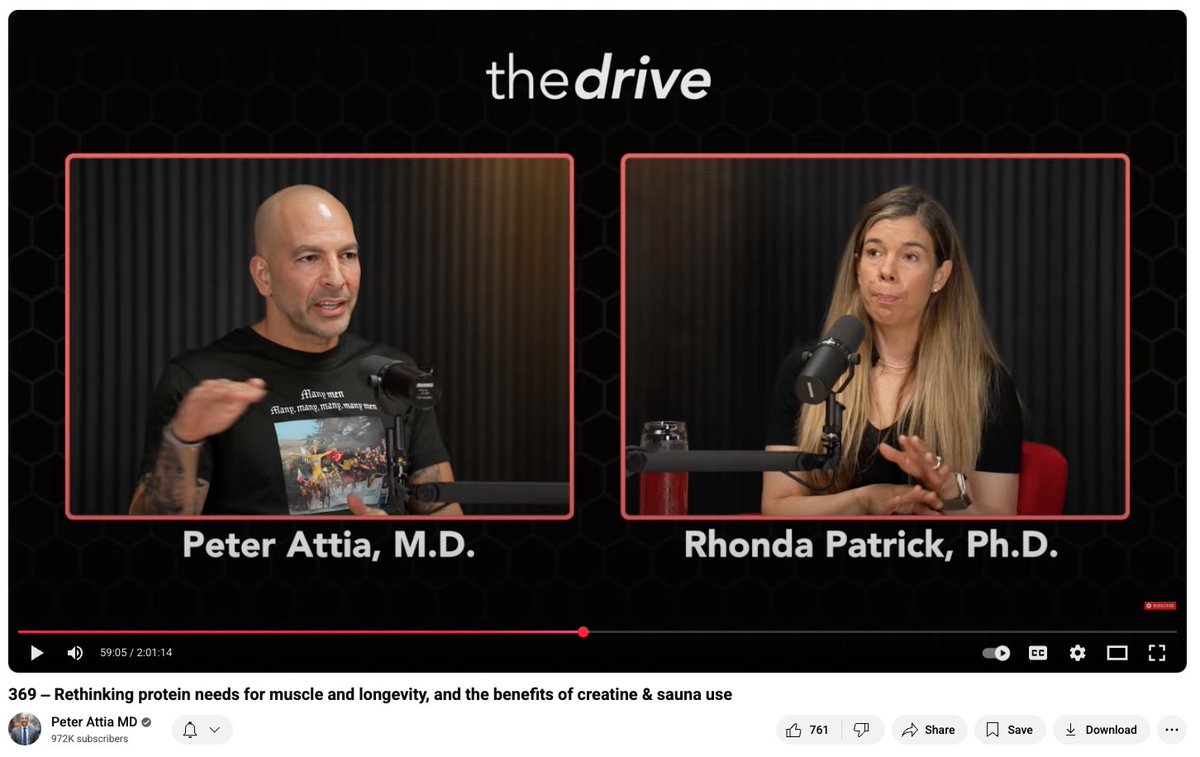
Peter Attia@PeterAttiaMD·
How Older Adults Can Stop Muscle Loss | Rhonda Patrick, Ph.D. (@foundmyfitness) This clip is from episode # 369 of The Drive which was released today (10/20/25). In the full episode, we cover: -How protein requirements evolve with age, activity, and goals, and why building muscle early is critical for long-term health -The connection between protein intake, mTOR, and longevity, and why fears around activation are largely misplaced -Why creatine’s cognitive effects may be as important as its role in physical performance -How regular heat exposure supports recovery, enhances mood, and may help protect against neurodegenerative disease -More Watch or listen (Ep. # 369) to the full episode on my website or your favorite podcast player.
English
30
172
1.2K
105.9K
nfkb
nfkb@nfkb·
@RogerSeheult It's a shame people now believe more in an unknown guy on the internet than from their doctors :/ same with statins, vaccines, etc.
English
1
0
2
302
Roger Seheult, MD
Roger Seheult, MD@RogerSeheult·
The only time I've seen Methylene Blue used in my life is when a patient undergoing a bronchoscopy had been given lidocaine and had a rare reaction to it that caused methemoglobinemia (where the Fe2+ in your hemoglobin becomes oxidized to Fe3+). The MB reduces it back to the ferrous from the ferric form. The patient's sats dropped into the 80s and recovered after giving the MB.
Juliette@zenovaire

I stopped taking Methylene Blue because it did much more damage than good. I took the bait, and it left me significantly worse off in every aspect of my life. Since I previously posted my (initially) positive experience with it, and people were reaching out asking if it's something they should take, I feel obligated to publicly share what happened and why I stopped Some background: In 2023, after a decade of dealing with chronic disease, I undertook a holistic lifestyle overhaul and was able to experience a full level of health again. I believe I was cured, was feeling consistently healthy, and decided to go back to working at a job that allowed me to maintain my healthy routines in March of 2024. I began taking methylene blue at this time, after seeing positive reviews and seemingly great science from sellers. I started with a few drops per day, cycling every few weeks. Overtime, I gradually migrated to taking 5-10 drops daily, with cycling. Sometimes I felt a bit weird taking it (things like headaches, heart palpitations, anxiety, hyperactivity etc), but brushed it off, especially if I paired it with something like coffee that can have similar effects. It wasn’t anything major initially. These symptoms gradually grew to be more prominent overtime. I believe the methylene blue was accumulating and causing damage to my system, regardless of cycling. What I experienced later was much worse Summer of 2025, after taking methylene blue for over 1 year with cycling, these symptoms grew significantly, and my overall functioning started to decline. I did not think it was the methylene blue, so I didn’t stop taking it. I began experiencing moderate insomnia, stomach issues, hyperactivity, and muscle weakness. I thought I was having a Lyme/Co-infection flare up, which I haven’t had in 2+ years. I was confused, because I truly believed I had healed myself, my immune system, and was maximizing natural detoxification methods. I started fishing around for what I could do for this "flare up," and methylene blue came up as a treatment for Lyme infections. The advertised science seemed fine - so, I started taking MUCH higher doses of it - amounts corresponding to what doctors claim they were giving their patients who saw positive results. I did this for 2 months. Throughout this time, I thought I was experiencing some cycle of herxxing effects, chopped it up to “proof” it’s fighting bacteria, so I kept taking higher doses and feeling more energy as a result. I felt great at first, like a honeymoon period, but ultimately it acted like a positive feedback loop -> feel bad, take more, feel better temporarily. All the while methylene blue was diminishing my body's ability to heal itself, because things became much worse. After these 2 months, my issues suddenly began compounding very quickly, and within a few weeks my life turned into what I could only describe as a literal “hell on earth". My body felt like it was going hay-wire, completely off the rails. My physical symptoms included fever/chills, neuropathy, shakiness, light sensitivity, nausea/vomiting, floaters, general joint stiffness, muscle twitches and soreness, general weakness, tinnitus, migraines, weight gain. The mental symptoms included erratic behavior, irritability, my brain feeling “numb”, extreme paranoia, extreme anxiety, seeing shadows and stars in my vision, and I would go as far as saying I was experiencing a state of psychosis. Things got so bad, I stopped working. I stopped going to the gym. I stopped cooking my own meals. I was rambling about irrelevant things. My family started voicing concerns about my state of health. I became withdrawn and not myself. My decision-making capability was VERY impaired - I made uncharacteristically poor, longterm financial and relationship decisions during this time that have significantly altered the trajectory of my life for the foreseeable future. I moved out of my house. I thought my friends and neighbors were conspiring against me. I would say odd or irrelevant things during conversations. I legitimately felt like I was losing my mind, my entire self. I could not even imagine what I would do if I was a mother who had to take care of her children during this time. Knowing there are kids taking this stuff whose brains aren’t fully developed is heartbreaking. When I realized this drug was not actually healing me, I began the process of easing off of it. I found that tapering down from methylene blue, especially from higher doses, was incredibly difficult - like a chemical-dependancy level of difficulty. The impulsive, irritable, and excitable behaviors I was exhibiting by using MB was a very similar experience to that of taking highly dosed prescription amphetamines. After my experience, I do not believe that methylene blue should be taken as a means of healing the body, or really in any capacity The best way I can describe methylene blue is that it acts as a bandaid that makes the body FEEL better, while simultaneously decreasing the body's ability to heal itself To learn more about the science, @NutriDetect @hubermanlab @paulsaladinomd all have good YouTube videos on it and @yungkingmito has a lot of info on his page. Thank you to @yoursimmo and others for encouraging me to share my story - lots of love to you all

English
12
1
78
15.3K
Josh Schlottman
Josh Schlottman@JoshSchlottman·
@brady_h Good thread & summary. I stick with 1.8 g/kg/day to cover my bases as a trained lifter to make sure I'm maximizing muscle growth. Most of the excessive protein gets oxidized & doesn't get directly stored as weight gain
Josh Schlottman tweet media
English
1
0
1
240
Brady Holmer
Brady Holmer@Brady_H·
Dr. Rhonda Patrick and Dr. Peter Attia just set the record straight on protein recommendations. It's the best synopsis of "why you should hedge against more protein versus less" that I've heard. My recap 🧵👇
Brady Holmer tweet media
English
13
41
507
81.1K
nfkb
nfkb@nfkb·
@brady_h ok, but please also think about the protein sources... they are many advantages to plant proteins againt animal proteins
English
0
0
0
24
Brady Holmer
Brady Holmer@Brady_H·
7. Practical takeaway: aim for 2.0, land around 1.6 You don’t need to hit your protein target perfectly every day. But if you aim for about 2.0 g/kg/day, your “off” days will still end up in that 1.6 range, which is where all the benefits kick in. A few easy heuristics: - Use goal or lean body weight to calculate needs if you’re overweight. - Spread protein across 3–4 meals to maximize MPS peaks. - Prioritize resistance training (protein + lifting is where the magic happens). (/end)
English
8
5
60
8K
nfkb
nfkb@nfkb·
@brady_h but what about people with a tiny bit of insulino-resistance gulping proteins bits all day long since there are protein snacks everywhere now ? then, it becomes the "chronic activation" problem
English
0
0
0
27
Brady Holmer
Brady Holmer@Brady_H·
6). The mTOR and cancer worries are way overblown Yes, leucine and mechanical tension from training activate mTOR, but that’s the point—mTOR in muscle is what drives repair and growth. The “mTOR equals cancer” fear came mostly from mouse studies where mTOR was cranked up everywhere, in the absence of exercise. In active humans, the story flips: muscle becomes a sink for amino acids, not a systemic driver of overgrowth. Turning on mTOR in muscle post-training isn’t a problem.
English
2
0
16
8.5K
nfkb
nfkb@nfkb·
@brady_h and what about longevity, wasn't it the goal of the drive podcast to talk about longevity ? there is plenty of evidence AGAINST going this high in proteins for longevity, healthy aging is not a muscle centric question, it's a parameter but not the paramount
English
0
0
0
25
Brady Holmer
Brady Holmer@Brady_H·
4. The sweet spot? Around 1.6 g/kg/day Meta-analyses looking at people who lift show clear gains in lean mass and strength when total protein intake climbs up to about 1.6 g/kg/day. Beyond that, you still get small benefits, but the curve flattens out—though going higher (2.0–2.2 g/kg) can help if you’re training hard, cutting calories, or trying to preserve muscle during fat loss.
English
2
2
32
8.7K
nfkb
nfkb@nfkb·
@brady_h I agree, but what proportion of the listeners of this podcasts are frail ? the slippage of ideas from the geriatric population to a 30 yo athlete is strange to me
English
0
0
0
11
Brady Holmer
Brady Holmer@Brady_H·
3. Aging and inactivity cause “anabolic resistance," but protein fixes that As we age, or when we’re inactive for long periods (think sitting, bed rest, travel), the body becomes less responsive to amino acids. You need a higher dose to get the same muscle-building signal (muscle protein synthesis, or MPS). Research shows older adults often need ~40g of protein per meal to trigger MPS, compared to maybe 20–25g for younger folks. Consistently hitting ≥1.2 g/kg/day helps offset that decline—and studies show it can reduce frailty risk in women by ~30%. Add resistance training, and you basically restore that youthful sensitivity.
English
2
0
24
8.9K