Nigel

127 posts

Nigel banner
Nigel

Nigel

@nigwil

Life as a computing-nerd. SpaceX dummy payload.

Australia Katılım Nisan 2008
416 Takip Edilen87 Takipçiler
Sabitlenmiş Tweet
Nigel
Nigel@nigwil·
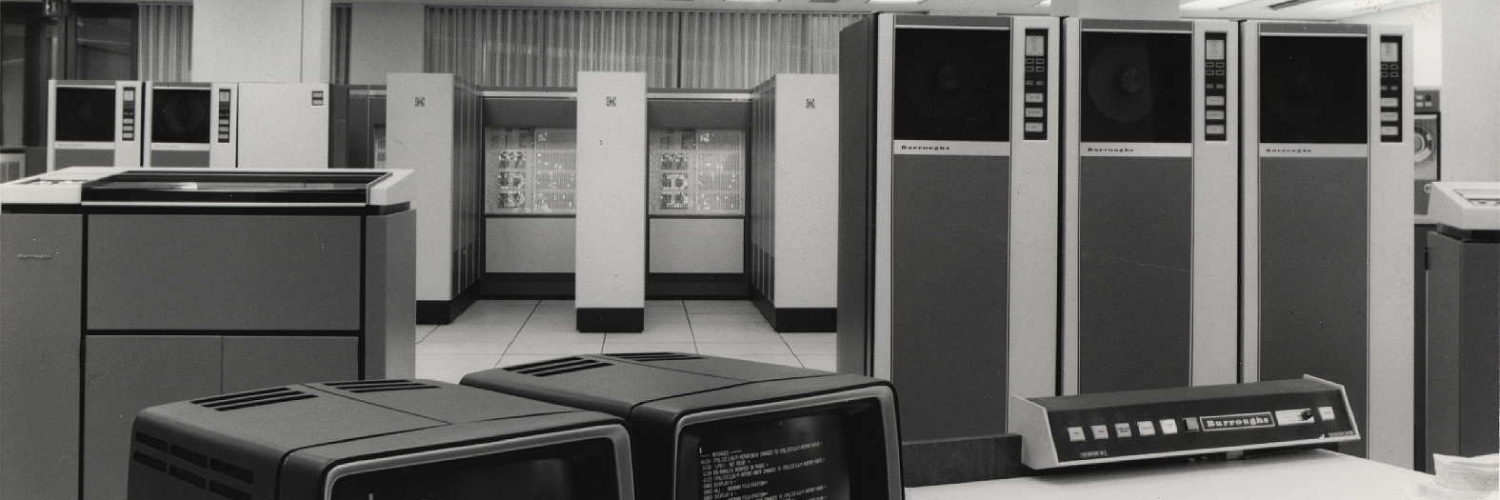
Seeking Software for the Burroughs B6700 System A group of us are working on developing a modern emulator for the Burroughs B6000/7000 series systems, specifically targeting the MCP II.x releases from the early 1970s. We currently have partial MCP releases from that era, but we are missing some essential components—particularly the ESPOL compiler, which was used to compile MCP, and the INTRINSICS. If anyone has printer listings or magnetic media containing software from that time for any of the following Burroughs machines, we would be eager to connect and discuss options for digitizing them: B6500, B6700, B6800, B6900, B5900, B7700, B7800, and B7900. These systems were released in the 1970s, and most MCP releases were largely compatible across them until MCP version 3.3, when support for the B6700 series was completely removed.
English
2
1
2
235
Nigel
Nigel@nigwil·
@pmarca IBM System R / UCB's Ingres - both are existence proofs for RDBMS.
English
0
0
0
90
Marc Andreessen 🇺🇸
Dozen most important post-punch-card software? AT&T/BSD/Linux Unix kernel GNU suite/GCC VisiCalc WordPerfect MacOS/iOS GL/Doom/Quake JavaScript PageRank/Backrub/Google GPT 1/2/3/4/5 GPT O1/Deepseek R1 OpenClaw/Pi Anything missing?
English
640
58
1.3K
244.8K
Andrew McCalip
Andrew McCalip@andrewmccalip·
Such a wild thought. I had never considered data in flight in this manner. The fiber is like an absurd, physically real ring buffer. Echo tube memory, but it’s glass and lasers. You’re not “storing” bits in the normal sense, you’re just letting them exist for a millisecond because the fiber is long enough. So at 256 Tb/s over 200 km you get ~32 GB literally hanging out in the fiber at any instant. It’s basically a giant shift register where the only address you get is time. No random access, just tap the stream at the right moment and skim what you need into a small cache.
John Carmack@ID_AA_Carmack

256 Tb/s data rates over 200 km distance have been demonstrated on single mode fiber optic, which works out to 32 GB of data in flight, “stored” in the fiber, with 32 TB/s bandwidth. Neural network inference and training can have deterministic weight reference patterns, so it is amusing to consider a system with no DRAM, and weights continuously streamed into an L2 cache by a recycling fiber loop. The modern equivalent of the ancient mercury echo tube memories. You would need to pipeline a bunch of them to implement modern trillion parameter models, but fiber transmission may have a better growth trajectory than DRAM does today, so it might someday become viable. Much more practically, you should be able to gang cheap flash memory together to provide almost any read bandwidth you require, as long as it is done a page at a time and pipelined well ahead. That should be viable for inference serving today if flash and accelerator vendors could agree on a high speed interface.

English
46
35
861
84.1K
Nigel
Nigel@nigwil·
@aramh Typed Assembly Language (TAL) came out in the 1990s (Cornell/CMU), was one or two levels above the ISA. Dependently TAL in 1999 later from UoC/CMU.
English
0
0
1
171
Aram Hăvărneanu
Aram Hăvărneanu@aramh·
The CPU instruction set is but a giant sum type. It uses particularly unusual encodings (for software people, anyway), but instruction decoding is just pattern matching on the type. Even if you can't let go of the fact that particular representations don't matter, the output from the instruction decoder is a *typed* instruction (the payload). Even the most low-level systems require types and are designed in terms of types. I am surprised that dependent types weren't invented by low-level people. Dependent types arise naturally when you want to internalize an encoding into your reasoning framework and abstract over it.
English
19
11
232
17.1K
Nikita Bier
Nikita Bier@nikitabier·
Over the last few months, we scoured the world for the top posters in every niche & country We've compiled them into a new tool called Starterpacks: to help new users find the best accounts—big or small—for their interests ⬇️ Reply below with a topic you're most interested in We'll be rolling out to everyone in the coming weeks.
English
8.5K
592
10K
3.2M
Nigel
Nigel@nigwil·
Regarding NASA history, as researchers dedicated to preserving computer history, could I humbly request that you task someone to thoroughly search NASA Ames' archives, storage facilities, and perhaps even reach out to retired staff for anything related to the Illiac IV supercomputer hosted there in the 1970s. While the nearby Computer History Museum holds a piece of the hardware, the software, NASA documents, and related materials for this pioneering machine seem to be missing entirely. The Illiac IV, the world's first massively parallel supercomputer, delivered crucial early results in computational fluid dynamics (CFD) that supported Space Shuttle designs and other NASA engineering advancements, cementing Ames' role as a leader in supercomputing. To complete its software history, we also seek materials for its service machines: the DEC PDP-10 and Burroughs B6700. All three systems were key participants in the early ARPAnet, the forerunner to today's internet. We have a somewhat complete set of software for the PDP-10 but almost nothing for the Burroughs B6700 or Illiac IV. The people who operated and used these machines are fading away fast—if we find anything, we must act quickly to consult them before their knowledge is lost forever. We would be eager to collaborate on preservation efforts, such as digitization or oral histories. Thank you for helping preserve this irreplaceable chapter of NASA's legacy.
English
0
1
4
246
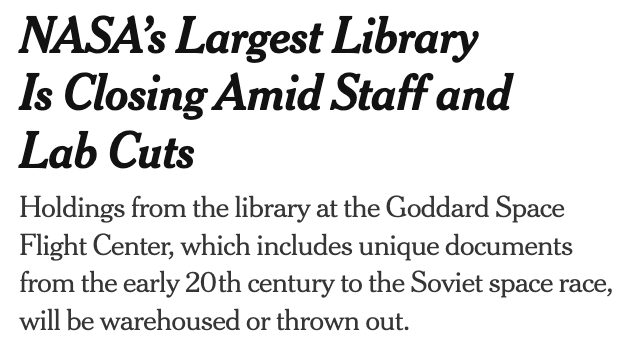
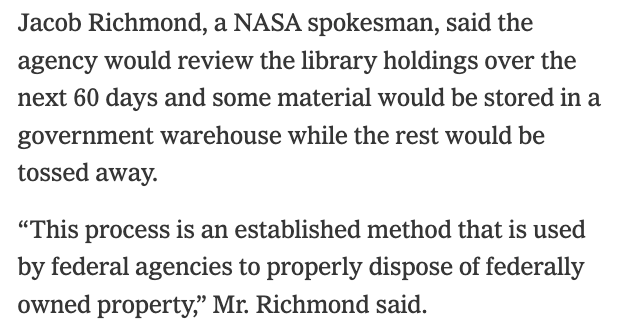
NASA Administrator Jared Isaacman
The @NYTimes story does not fully reflect the context NASA shared. At no point is NASA “tossing out” important scientific or historical materials, and that framing has led to several other misleading headlines. This is unfortunate at a time when the world should be energized by a plan to send NASA astronauts farther into space than ever before, return us to the lunar environment with a commitment to stay, alongside historic investments in an orbital economy and a renewed pursuit of science and discovery. The facts: - The physical library space at Goddard is closing as part of a long-planned facilities consolidation approved in 2022 under the previous administration. - NASA researchers will continue to have access to the scientific information and resources they need to do their work. - NASA follows a deliberate process to evaluate materials, ensuring they are digitized, transferred to other libraries, or otherwise preserved for historical purposes.
NASA Administrator Jared Isaacman tweet mediaNASA Administrator Jared Isaacman tweet media
English
213
766
5.9K
279.4K
Eric S. Raymond
Eric S. Raymond@esrtweet·
gitlab.com/esr/yerd A huge percentage of business software is what's called CRUD applications - collections of forms in a web browser or local GUI that allow users to query and update a database. (CRUD stands for Create, Read, Update, Delete.) But it's deeply silly that these are ever written by hand. A better idea: describe your data model in a simple markup language, then compile it to produce a database schema and a CRUD application that talks to it. Less handwork, fewer errors. This is what YERD aims to do. Thing is, while I know a lot about how to design markup languages and code generators, I don't have a lot of practical experience with CRUD applications. I'm therefore taking the unusual-for-me step of announcing this project before I have it to a working beta. Because I'm not sure I understand the problem domain well enough yet; I don't want to generate theoretically elegant CRUD interface code that is so alien to users' expectations that nobody will ever want to deploy it. I have a little language for describing data models. I can make ERD graphs from it, and I can make SQL database schemas from it. What I can't yet do is generate the CRUD interface code. I'm looking for collaborators. Not to do the heavy coding, I'm going to steer LLMs to do that. I need people to tell me what a CRUD interface should actually look like - starting by critiquing the general description that I researched with an LLM. If you have practical experience with CRUD interface programming by hand, and agree that it would be a good idea to nuke this problem flat with better tools, reply to this post or DM me about how we can set up collaboration on this.
English
80
46
424
43.6K
Nigel
Nigel@nigwil·
@xai soon? or please? "I'm afraid I don't have direct access to your personal X (formerly Twitter) bookmarks, as they are private and only visible to you on the platform. X doesn't provide a built-in way to sort or filter bookmarks strictly by date (like the last month, from late November to December 28, 2025), and there's no official export feature for dated summaries." - Grok
English
0
0
0
19
Nigel
Nigel@nigwil·
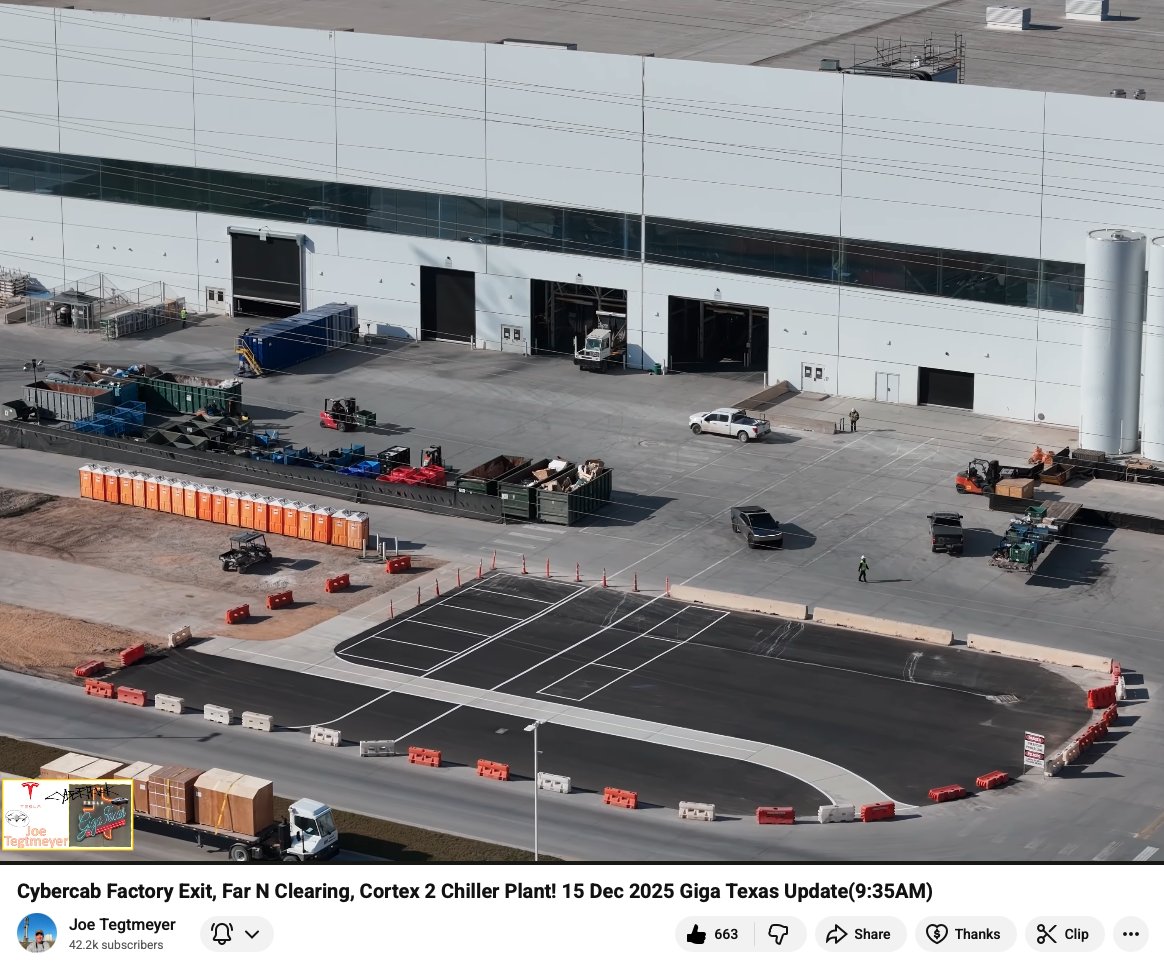
Cybercab distribution Watching Joe’s latest tour of GigaTexas, Tesla is painting the embarkation point for Cybercab as they exit the factory. Given Tesla is permitted to operate Cybercab throughout Texas, that suggests that as a Cybercab exits the factory it is free to join the Robotaxi fleet anywhere in the state. Does Cybercab simply set off driving to its earmarked territory, stopping at wireless chargers along the way? Does it hitch a ride on a car-carrier to get there? Or drive itself to nearby rail-head? Austin city is going to be initially the best-serviced Robotaxi area in the state as it is close to the factory, but subsequently the service area coverage spreads steadily out from this location as Cybercabs could leave the factory 24x7 to expand the fleet throughout the state. Autonomy really does break the traditional distribution model in remarkable ways. @JoeTegtmeyer @jamesdouma
Nigel tweet media
English
0
0
0
59
Dan Go
Dan Go@CoachDanGo·
The most successful people I've met: - Workout daily - Never complain - Insanely curious - Growth oriented - Strong work ethic - Focused on solutions - Have a reason for waking up - Understand 2nd order consequences - Network and hang with other successful people Anything you'd add?
English
148
346
4.3K
154.6K
Nigel
Nigel@nigwil·
@Tesla_NL_TR Multiple payment options in Tesla account for supercharging; and the ability to add backup credit just in case the credit card payment process is broken.
English
0
0
0
181
Tesla Inside
Tesla Inside@TSLA_inside_·
🔥 TESLA OWNERS: WHAT’S YOUR #1 SOFTWARE OR FEATURE YOU WANT CHANGED / ADDED RIGHT NOW? 🔥 (I’m collecting all your ideas and sending them straight to Tesla as feedback!) My personal #1 request: Matrix headlights currently activate at very low speeds inside city limits (built-up areas). That’s exactly when they should NOT be on! Please make Matrix headlights only turn on from ~80 km/h and higher — keep them off in 30/50 zones so they don’t blind people in the city. Your turn! What’s the one thing (software or hardware) you’d change or add to your Tesla if Elon gave you one wish today? Drop your idea below (the crazier the better) ⬇️ I’ll collect the best ones and send them straight to Tesla! 🚀 #Tesla #ModelY #Model3 #Cybertruck #TeslaFeedback $TSLA @elonmusk
Tesla Inside tweet media
English
783
28
514
91.7K
Nigel
Nigel@nigwil·
checkout FUNLIB, which targets S/34 and S/36. The usual suspects from the Midrange enthusiasts community (AEK, DMcG, MWS, CM and others) were on the hunt for it over several years and it has been found and recovered. This mail thread highlights the past-thinking, discoveries and concerns about going near this material. It would be an opportune time for IBM to make a statement about their position on these artefacts, especially while individuals from that era are still available to provide their firsthand accounts of these systems. wiki.midrange.com/index.php/FUNL… rescue.sunhelp.narkive.com/WO6AC5wy/looki…
English
2
0
2
946
John Carmack
John Carmack@ID_AA_Carmack·
I helped fund the restoration of an old IBM S/34, and now I find myself occasionally thinking about what realtime games you could make run on a 5251 DisplayStation. Tetris would probably be the most engaging. Not sure if you could do it in RPG or COBOL; might require S/34 Assembly. gofundme.com/f/ibm-system-3… @crusty.computer" target="_blank" rel="nofollow noopener">youtube.com/@crusty.comput… en.wikipedia.org/wiki/IBM_Syste…
English
46
17
526
74.3K
Nigel
Nigel@nigwil·
@sdf_pubnix On your vid, there is a comment by redmartian "I'm looking to run a GCOS system and provide remote access to it."
English
0
0
1
18
Nigel
Nigel@nigwil·
@sdf_pubnix he has a channel too: youtu.be/5RBumMR57GI?si… Somewhere he showed a Bull DPS7000 system running GCOS7 but I am not finding it in his video series or posts.
YouTube video
YouTube
English
0
0
0
34
Nigel
Nigel@nigwil·
@Dr_Singularity 2010s due to AlexNet result in ImageNet, later AlphaGo, manufacturing revolution due to Tesla and others, mRNA, reusable rockets, drones, sub-micron silicon, smartphones, and so on. This was the decade of rampant synergy.
English
0
0
1
116
Dr Singularity
Dr Singularity@Dr_Singularity·
Which decade would you consider the first in which our technology became 'advanced'? The 1990s, 2000s, 2010s, 2020s, earlier? Or do you think our current tech is still a joke, and we can only start calling ourselves advanced once we reach a Type I / Type II civilization level?
English
45
7
84
8.8K