

Falk Grollmus
799 posts

Trump says 'ready to use the full economic might of the US' to strengthen Hungary's economy.

English
@Microinteracti1 your posts are very good. why misrepresent this one? he said clearly the states should take care of it, not the federal government.
English

Right. So America can park two carrier strike groups in the Persian Gulf, maintain 750 military bases across the planet, and spend $886 billion a year on defense.
But daycare? Absolutely beyond the capacity of a functioning nation.
Trump didn’t accidentally say the quiet part out loud. He just finally ran out of ways to dress it up.
Gandalv / @Microinteracti1
The Lincoln Project@ProjectLincoln
WATCH: The White House took down this video, but we still have it. Trump: We can't take care of daycare. We're a big country. We're fighting wars. It's not possible for us to take care of daycare, Medicaid, Medicare, all these things.
English
@manyapan why the big fly? I can see the insect character on the botton left but no idea what it says.
English

A Chinese postdoctoral researcher's reported suicide following questioning by US law enforcement has become one of China's top trending topics this week - yet key details remain officially unconfirmed on both sides. Drawing on official statements, public records & social media, this article maps what is known, what remains unclear, and why this case has struck such a nerve. eyeondigitalchina.substack.com/p/the-chilling…

English
@chri_gru ja, nur schlecht für diejenigen die gebrauchtwagen für 5000€ kaufen. 2,30€ macht für vielfahrer 100-150€ mehr im monat.
Deutsch

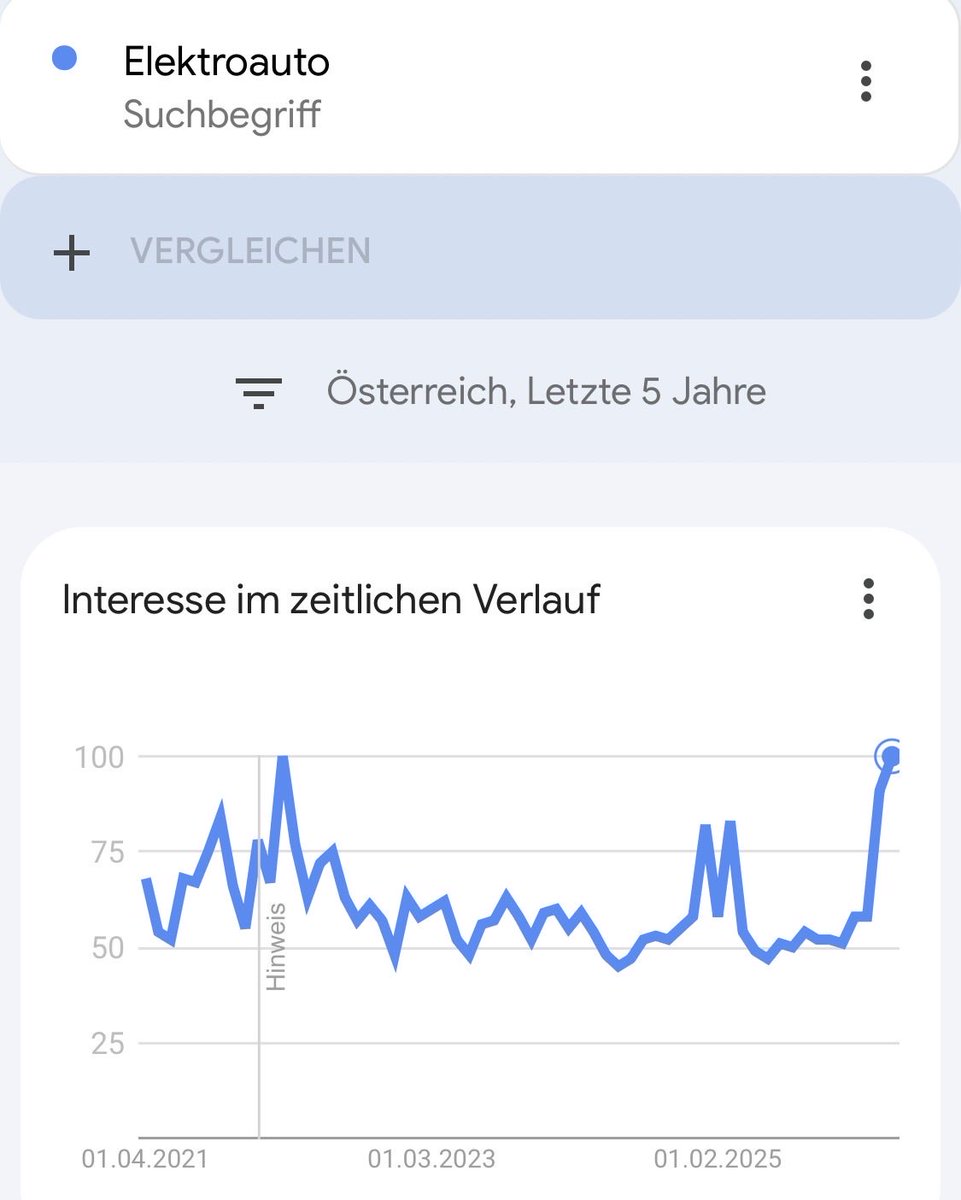
Jedes Mal, wenn die Dieselpreise auf über 2 Euro pro Liter steigen, hebt auch das Interesse an Elektroautos ab. Das war 2022 so, und ist auch jetzt der Fall.
Deutsch
@TopStockAlerts1 with a large enough family&friends easy to digest within one year 🤣
English

Nestlé has reported the theft of 413,793 KitKat bars—around 12 tons—during transport to Europe, potentially causing shortages in stores just before Easter. The shipment went missing last week while traveling from a production center in Italy to Poland, with its current location still unknown.
A company spokesperson joked that the thieves “took a break” with more than 12 tons of chocolate. Investigations are ongoing in close cooperation with local authorities and supply chain partners.
Each KitKat bar carries a unique batch code, allowing anyone who finds stolen products to alert Nestlé and provide proper evidence for recovery.
$NESTLEIND.NSE
English
@Stocktwits or collecting some 10$ interest per day while short while losing 2000 on the position.
English

When I get a $3 dividend but I’m down $10,000 in the market.
English
@commonsenseplay exactly. How could he suggest to buy into such a bubble? where is your exit in case you did so? maybe he got excited and saw an even larger bubble coming like in 2021.
English

@ningxiaexpert Which is the exact height of the market - take a look at some of the ticker symbols I mentioned
$IONQ $OKLO $JOBY $BTQ $RGTI $QBTS $IREN etc etc all popular retail stocks absolutely crushed since this interview.
English
MUST WATCH FOR EVERYONE IN THE STOCK MARKET!
Retail investors will always be misled by hedge-fund billionaires.
$IONQ, $RGTI, $OKLO, $JOBY, $IREN , $LAES , $BTC , $BTQ , $JOBY , $OPEN , $META , $NVDA , $GOOG
This is why you should never rely on CNBC hedge-fund billionaires when they give highly public interviews to an audience of millions.
At the very height of the stock market bubble for hype industries like Quantum / Nuclear / AI etc , Paul Tudor Jones went on Squawk Box claiming it “feels like 1999” and that the rally would continue through year-end. His Key Insights:
- "The biggest winners are Gold and Bitcoin"... "there is a Morgan Stanley basket, that is a Retail flow basket that has all the meme stocks in it, it's up 67% or 68%"
- "I'd want to have positions in all of that, FOR SURE" - referring to the meme-stock basket containing bubble names like $IONQ, $RGTI, $OKLO, $JOBY, $IREN, etc.
- "What will be the winners, we have this race which is certainly to the end of the year"
- "I'd want to have combination of Gold, Crypto, the Nasdaq, and whatever the fastest horse at this point in time probably has a good chance of having that on December 31"
Summary:
1. He was telling retail investors to keep holding and buying the meme-stock craze, gold, and crypto.
2. Since that interview three weeks ago:
- $BTC has dropped 50%
- Popular retail-style meme stocks have dropped 50 to 70%+ (e.g., $IONQ, $RGTI, $BTW, $OKLO)
3. He effectively pumped these names to provide exit liquidity for institutions and Wall Street - the same pattern every time.
4. Never rely on interviews from hedge-fund CEOs or billionaires proclaiming broad market predictions like this.
5. They have their own motives. They are not looking out for your portfolio.
6. Do your own due diligence - see through the hype narrative being sold to you.
English
@JoeySalads whats wrong with you? chinese new year is big deal. maybe you should join celebrate it.
English

She was given birthright citizenship in America which offered her and her family freedom, and instead she chose to represent our authoritarian adversary on the world stage.
Revoke her citizenship, she can go live in China now.
x.com/zoomyzoomm/sta…
English
@thstocksnetwork where these short dated options? incredible gains, hope you locked in some.
English

I think I’m up like $175k on $16k short on $CVNA after earnings
English
@SariArhoHavren no easy call here. are you aware of how much the prices for solar panels have dropped? certainly killed our industries but also a big tailwind for building renewables faster. also the low priced EV's from China are a double sided sword. big + for climate big - for EU car industry
English

“We need to engage with China because of climate change.”
I'd like to see a journalist ask our politicians: What else has that engagement brought, besides killing our own solar and wind industries?
WarMonitor🇺🇦🇬🇧@WarMonitor3
China has pumped out more pollution in 10 years then Britain has since its Industrial Revolution-Telegraph Wow...
English
@JoeMclean196154 @Mr_Derivatives you are not alone with liquidations this week. tough but we will figure it out somehow. good luck!
English

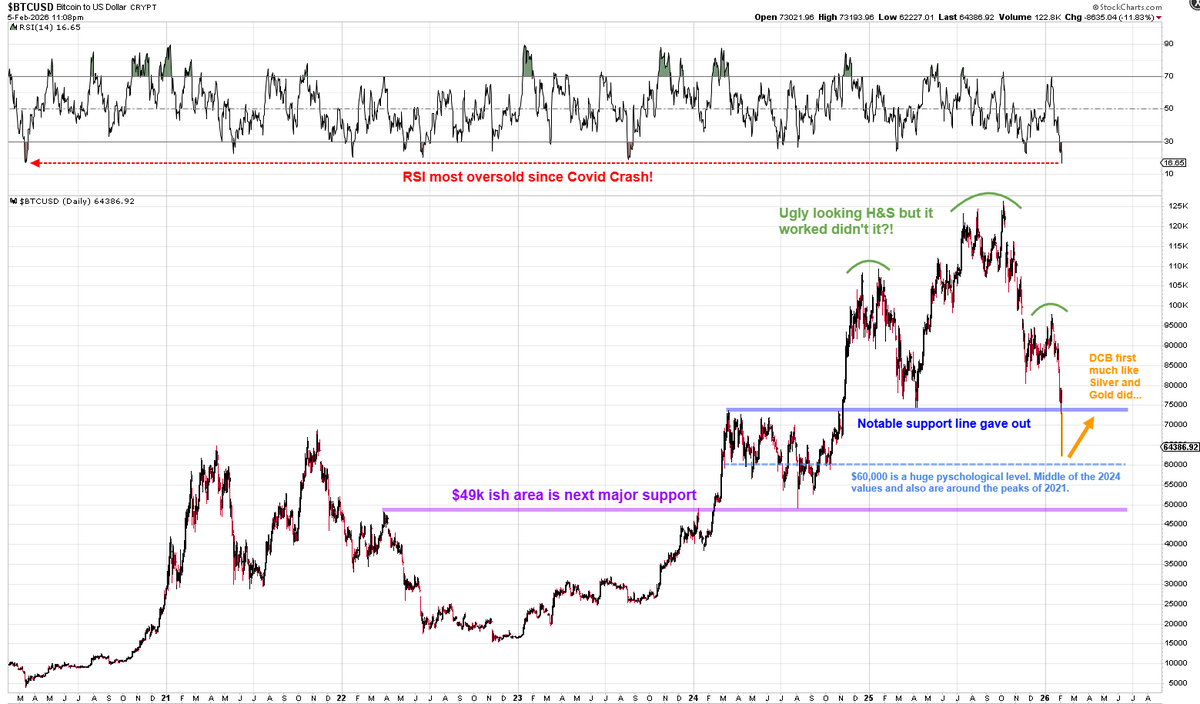
$BTC Chart Update:
Keep it short. Yes, Bitcoin is due for a dead cat bounce and soon. I wouldn't be surprised it went to $70k at minimum all the way up to $75k to retest the breakdown of the neckline, with a possibility of overshooting towards $80k.
The next major supports below are $60k and the big kahuna one in $49k ish.
Those are the lines for ya. I would be highly surprised if it just kept crashing towards $49k with ZERO bounce...
English
@Mr_Derivatives Thank you for always finding this stuff so quickly!!
English
$BTC today is the 3rd most oversold Daily RSI in its history.
$ETH today is near the 4th most oversold Daily RSI in its history.
English
@1bxss @TradersConf he said 1% of his capital gets 10 times the 600. so you need 600000€ then one trade with 1% gives you the 6000. its a nice dream world. not impossible that there are traders out there who are soo disciplined and always winning.
English


I am 27. For the last 3 years i focused on trading, i got no job, got a wife and a kid. Live in a country where the minimum wage is +/- 600 euros. I only take 1/2 trades a month, 1% with the accounts i have is 10 times the minimum wage. I sit my ass all day waiting for my kid to come back from school and play with him.
English
@eurofounder 380€ taxes you pay for 3000€ pension. for the position you mention this is more likely: 1500-2000€ Pension, own house and one real estate property with extra income.
English

My uncle Ernst just retired at 67
After 41 years as a director at Deutsche Bahn, his pension is €1,247 a month
"I never felt richer" he said when I visited him last week
He showed me his new budget spreadsheet
€400 for rent
€380 for taxes he still voluntarily pays
€250 for groceries
The rest goes into a savings account at 0.3% interest
"The German banking system keeps my money safe"
Americans will never understand this kind of wealth
English
@StocksPursuit @Mr_Derivatives shanghai is closed. the real difference is 1-2$ to comex. the rest of VAT.
English

@Mr_Derivatives #Silver it is not over yet either way, $40 difference between Comex and Shanghai , it is anybody's guess how will it resolve ?
x.com/StocksPursuit/…
DarkHorse@StocksPursuit
How the $40 #Silver Price Spread Resolves ? A $40 gap between COMEX silver futures around $92 and Shanghai spot prices around $130 reflects a deeper fracture in the global monetary and commodity system. This isn’t just a trading anomaly it’s a sign that financial silver (paper contracts) has decoupled from industrial silver (physical reality). Over time, that gap must close, and physics not policy will dictate how. 1. Arbitrage Can’t Function , Yet In a normal market, such a massive spread wouldn’t survive for long. Traders would buy COMEX contracts where silver is “cheap,” ship physical bars to Shanghai, and sell them high, pocketing the difference. That arbitrage restores price alignment. But today, structural barriers stop the flow. China’s export licenses effectively trap silver inside its borders. Purity mismatches between Western (99.9%) and Chinese (99.99%) standards slow refinery conversion. Shipping, insurance, and customs clearance add friction. The result: two semi-isolated ecosystems—one liquidity-driven, one reality-driven. As long as those constraints hold, the spread persists. 2. The Physical Bites Back Paper markets can ignore scarcity for a while, but manufacturers can’t. When COMEX cash-settles or fails to deliver, industrial users still need metal. They will turn to the open market, where the only reliable supply is priced off Shanghai. That means they will eventually pay physical premiums, not paper discounts. Once enough industrial players bypass futures entirely, the “price of use” replaces the “price of trade” as the benchmark. This gradually drags Western reference prices higher since replacement cost not speculative positioning sets the real-world floor. 3. Trust in COMEX Fades If Western exchanges become known for cash settlement rather than delivery, credibility collapses. Industrial users and even bullion banks will migrate to markets that honor physical settlement. That means pricing power shifts decisively East. COMEX and LBMA can either reform by backing contracts with verifiable, deliverable metal or risk becoming paper casinos. Reconnection to physical supply is the only path to relevance. Expect new “deliverable” or “Shanghai-linked” contracts to emerge as exchanges attempt to restore trust. 4. Repricing is Inevitable The final resolution will be monetary, not mechanical. Either Western silver prices rise sharply toward $130 as market participants revalue contracts to attract real metal, or industrial demand contracts as firms curtail output because prices no longer hedge operational costs. Both paths close the gap. Physical shortages, refinery premiums, and inventory depletion are all early signals of this repricing phase. Just as oil’s paper benchmarks corrected during past dislocations, silver’s “real” market will eventually dictate terms. 5. Conclusion: Physics Wins In the end, markets anchored in financial leverage are temporary illusions. The $40 spread is not sustainable because real-world demand cannot function at artificial prices. When vaults empty, paper promises lose meaning. Whether through rising Western prices, collapsing paper liquidity, or a full shift of price discovery to Shanghai, equilibrium will return—because molecules, not models, always win.
English
For you degens:
Weekend Silver: +2.5%
Weekend Gold: +1.1%
Weekend QQQ: -.33%
Weekend DIA: -.24%
English

Should film ported $sndk dip to 490….
Mistake
Vegan Hippo@Veganhippo21
$SNDK I will just leave this here....lol I will let you imagine, yes, it was weekly calls
English





@sheslee @Mr_Derivatives @SilverBullionPL @BullionStar sure, the demand from investing is real but will dry up as soon as price doesnt keep rising. today's buyers want to sell next week for 120, not in 10 years for 150.
English

I checked out the websites of bullion dealers like @SilverBullionPL and @BullionStar and I can see the diminishing supply.
I get further confirmation from my bullion dealer directly. There’s no other ways I’m verifying this so it’s not a science but when certainty is out on CNBC, it’ll be far too late to act on…
Also, we are all waiting for someone to figure out what they can replace silver with. Until they do, they’ll keep using silver and bid up prices.. still negligible at these price levels…
I’m just placing my bets on what I know… I’m a nobody retail investor at the end of day so I may be wrong and you may be right… we’ll just have to see…
English
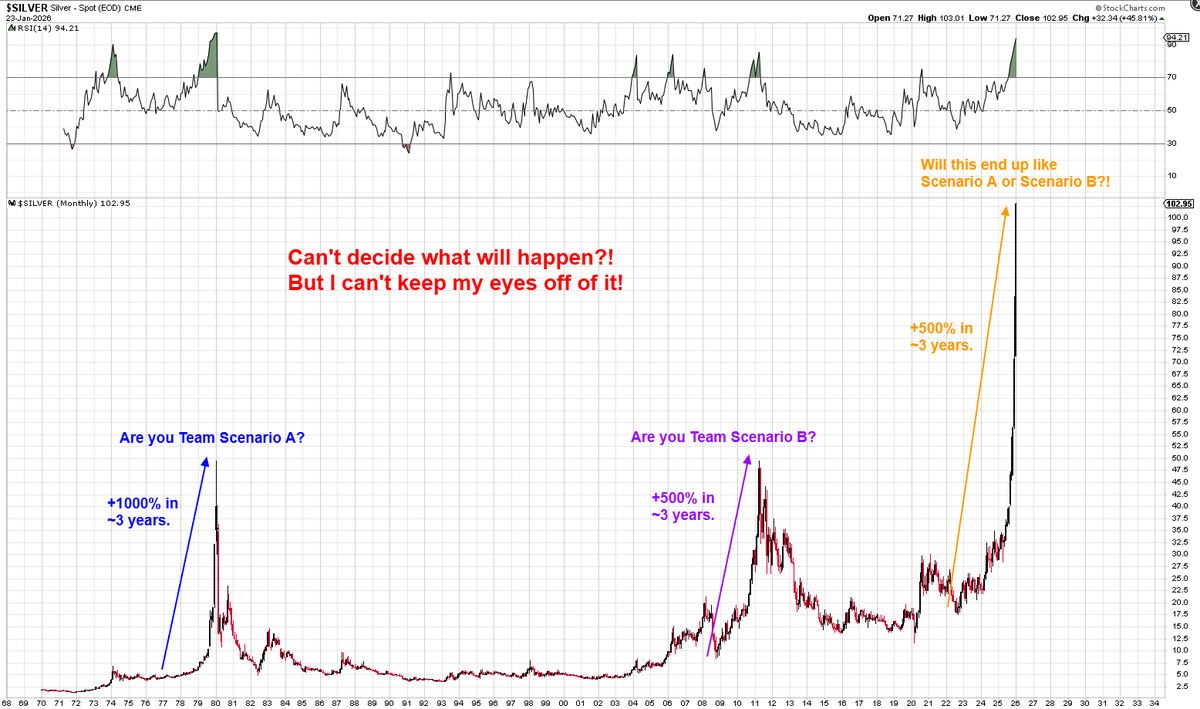
$SILVER
Are you Team A, where we could go up another 100% from current levels?
Or...
Are you Team B, where we are exactly at the top right now?
Or...
Somewhere in the middle of A and B? So let's call it Team C.
English