Top Kek
3.7K posts

Top Kek
@nokeksgiven
Ⓜ️eme ♿️aser & Gud Tek Enthusiast 👾


While we are incredibly excited for mainnet, we've been thoroughly auditing the code internally prior to the devnet -> mainnet transition, namely the payout logic on a settled market to ensure payout match matches the Gaussian design that is intended. We have completely reworked payout claiming after combing through it all day: • function rewritten with correct args • heavy bug fixes with tx simulation failing • Portfolio button fixed as conditional Close/Claim based on market status • Claim button now existent in Portfolio for all users • Claiming now burns the positional NFT If you participated in the ASTEROID market that closed last week, you can now go into Portfolio and click the claim button to claim your Gaussian payout based on your ranged estimate. Image 1: Position now burns on close (as intended). Image 2: Proper gaussian payout via the Claim button post-settlement; vault -> payout to wallet (solscan.io/tx/5aBxKhP8bAu…) Users are encouraged to visit their Portfolio page and claim their Gaussian payout for the settled ASTEROID market (if participated in) to validate these fixes. We needed to do this deep audit for a few reasons to ensure the payout math is proper on-chain once more as the payouts are the crux of this ecosystem, and they computed properly end-to-end. We're going to walk through this thoroughly as we feel this needs to be explained. This position on the ASTEROID market— we bought a position on this market predicting the ASTEROID market cap would land within $129M - $276M by April 23, 2026. We paid ~$8 USDC for this with LMSR rounding. Market settled at $139M at expiration (end-of-day for April 23rd, 2026). As most prediction markets are binary (yes/no, you get either 100% correctness or 0%)— Isometric uses a smoothed payout (how much of a Gaussian distribution centered on the settlement price falls within our traded range; this fraction times our cost = our payout). The bell curve for settlement was centered at $139M (settlement price) with a spread of about $24.5M— most of its mass was roughly between $90M and $190M. Our range was $129M to $276M. To find the frauction of the Gaussian inside [$129, $276] we measure the sigmas-from-center (z-score). z_low = (129 - 139) / 24.5 = -0.408 z_high = (276 - 139) / 24.5 = +5.59 The lower edge of our range is 0.4 sigmas < settlement, upper edge is 5.6 sigmas > settlement. The system then decides which fraction of a unit Gaussian lies below z: Φ(-0.408) ≈ 0.342 (34.2% of the bell curve is below our lower edge) Φ(+5.59) ≈ 1.000 (essentially 100% — way out in the tail) With the fraction inside our range equating to 0.658 so 65.8% of the Gaussian centered at $139M falls within our $129-$276M range. So therefore our payout would be: payout = cost × fraction = $7.999994 × 0.658 = $5.267 Which matches the exact on-chain amount with proper rounding and it just properly worked via claim for the first time in history. Settlement at $139M, our range started at $129M and goes to $276M, so: • Settlement within our range (good) • Only $10M above our lower edge • Upper edge is far away from settlement If we'd have been more narrow in our predicted and traded range and centered (around like 130-150m), our payout would've been higher as the Gaussian would've mostly fit within the range. Missing it entirely, we would've had a near-zero payout, this is the "you were just blatantly wrong" case. This is the core differentiator versus binary markets: baking in partial credit. All-in-all, math matches design. Protocol paid fairly based on design. Being roughly right gets you roughly paid rather than losing everything for being slightly wrong. This was a critical test we needed to do to ensure everything worked on that side properly. We've concluded internal audits from end-to-end and are now patching up a few frontend bugs— mainnet is coming soon! We apologize for the delay(s); however, with a protocol as dense, novel and complex as Isometric, there must be meticulous care at each level prior to involving real money.



The Isometric LPing demonstration video is now available! Efficient and optimal liquidity providing does not have to be difficult— inexperienced users should be able to jump right into profitable on-chain mechanisms such as providing liquidity without needing a wide array of technical knowledge; experienced users should also be able to capitalize on their knowledge and skills to receive a more profitable outcome. In conventional products utilizing archaic models, those two entities can rarely coexistent simultaneously. Through Isometric's novel concept of utilizing AMM-based components to fuel a prediction market and through the usage of our market-pricing, range-pricing and payout models, those two entities can exist simultaneously. Providing liquidity has never been easier yet more profitable than it is with Isometric. Simply find a market you like, dictate your range and provide your single-side liquidity (in USDC) and you're done! - No more perpetual monitoring of positions— Isometric caps that through the insurance fund (informational post coming regarding this— we built the insurance fund in a very specific way and there have been quite a few questions regarding how it'll work). - No more obstacles barring late entries that cause asymmetric risk-return ratios— our sigmoid bonding curves fix this. Early conviction is rewarded but late entries aren't penalized asymmetrically. - No more constant fear of dual-token liquidity providing causing volatile impermanent loss— the LMSR model used for liquidity provisioning on Isometric allows for a single-side deposit (denominated in a stablecoin, USDC) with a counterparty synthetically created through the inherent nature of the model; this mirrors Meteora's DLMM single-sided deposits into price bins but adjusted to our outcome ranges. - No more lackluster fees— unlike conventional products where compression often kills gains, prediction markets naturally have a wider spread due to information asymmetry; this is further amplified by the usage of our range outcomes rather than binary outcomes employed by traditional products. Gains are maximized, downside is capped. Simplicity that rewards knowledge and niche skillsets but does not penalize inexperience. Isometric is building within the obvious-in-hindsight overlap of prediction markets and AMMs and we're very excited to be at the forefront of this developing and novel industry! Similar to the heavy focus on informational articles regarding the liquidity providing side of Isometric, we will now be shifting focus to providing informational posts regarding the trading side of Isometric.


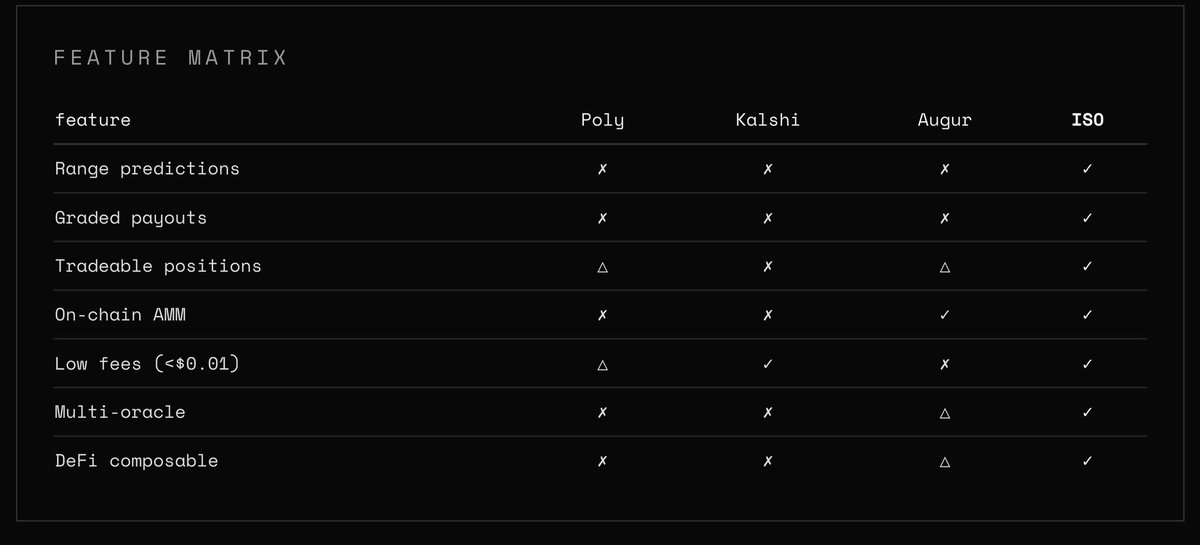
From this article Prediction markets are broken in a way that's now mathematically proven 👇. · 87% of wallets lose money · Takers lose -1.12% per trade on average · Longshots (1¢ contracts) return $0.43 on the dollar — worse than a slot machine · The Nash equilibrium shifted: optimal strategy is now 65-70% maker (passive liquidity), not taker The winning strategy today: · Sell longshots (they're overpriced) · Buy near-certainties (they're underpriced) · Provide liquidity (capture spread) · Use Kelly for position sizing · Update with Bayes when evidence changes How This Applies to @isometricmkts 1. $Iso eliminates the longshot bias problem. On @Polymarket, 1¢ contracts are a trap. On @isometricmkts, you don't bet on a single point. You bet a range. A 1¢ range near the tail still has longshot odds, but the Gaussian payout means being close still pays. The "all or nothing" cliff is gone. 2. $Iso is built for the Nash equilibrium shift. The data shows the optimal strategy is now 65-70% maker (passive LP). Isometric's entire LP model is designed for this. Single-sided USDC deposits. Capped downside. Risk-weighted fees. It's literally built for the strategy that 72M trades proved wins. 3. The insurance fund solves the maker risk problem. The reason most people aren't makers on Polymarket? Uncapped risk. Isometric caps downside at 5%. That's the unlock that lets retail participate in the winning strategy. 4. Gaussian payouts align with Bayesian updating. Bayes is about updating probabilities as evidence arrives. On Polymarket, your position is binary—you're either in or out. On Isometric, your position's value evolves continuously with new information. That's Bayesian-native. The Thesis: The data proves the winning strategy is: provide liquidity, sell overpriced longshots, buy underpriced near-certainties. @isometricmkts is the first protocol built to let anyone execute that strategy. · Single-sided LP → capture maker edge without dual-asset IL · Capped downside → remove the risk that keeps retail out · Range-based outcomes → sell longshot tails without binary wipeout · Gaussian payouts → get paid for being close, not just exact Polymarket's model is proven broken by 72M trades. Isometric is the structural fix. The Real Alpha here is: The Becker data isn't just interesting. It's the empirical proof that Polymarket's model is fundamentally flawed for retail. $Iso isn't competing on features. It's competing on structural efficiency. The data says the winning strategy is passive LP with capped risk. Isometric is the only protocol that offers that. The market hasn't connected these dots yet. When they do, the shift from @Polymarket to @isometricmkts won't be about UI or marketing. It'll be about math. Great read by @0xMovez 🤝


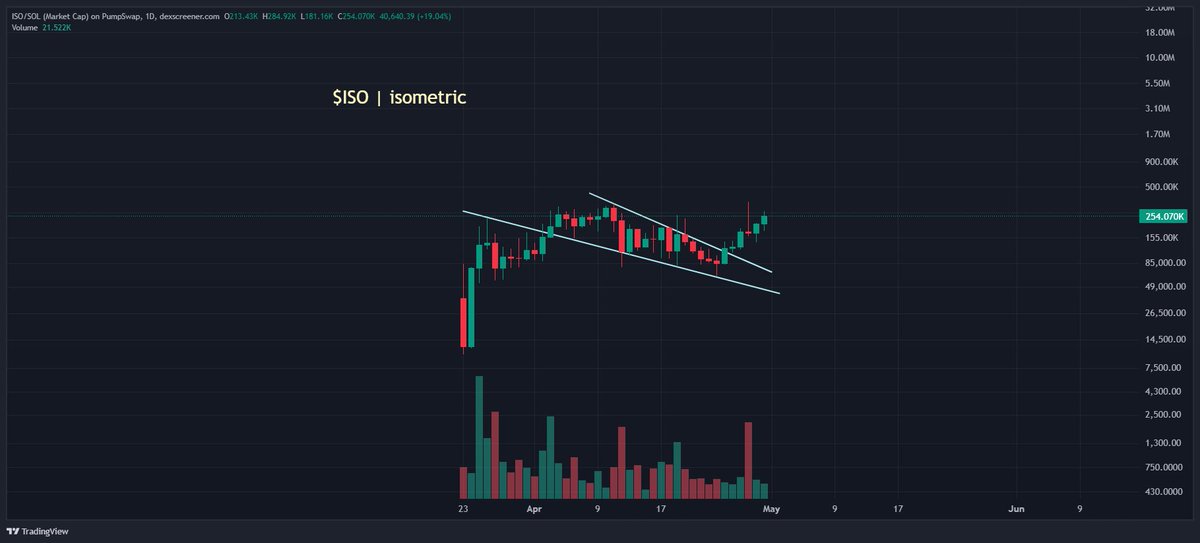
BOOM $iso | @isometricmkts the defi prediction primitive is cooking mainnet launch this sunday (5/3) i don't say this lightly, but you're very early.


Is it just me? Or am I getting bull market vibes in printr eco