Navdeep

272 posts

Navdeep banner
Navdeep

Navdeep

@nsrCodes

Crafting Code @RequestlyIO

India Katılım Mart 2020
137 Takip Edilen81 Takipçiler
Navdeep
Navdeep@nsrCodes·
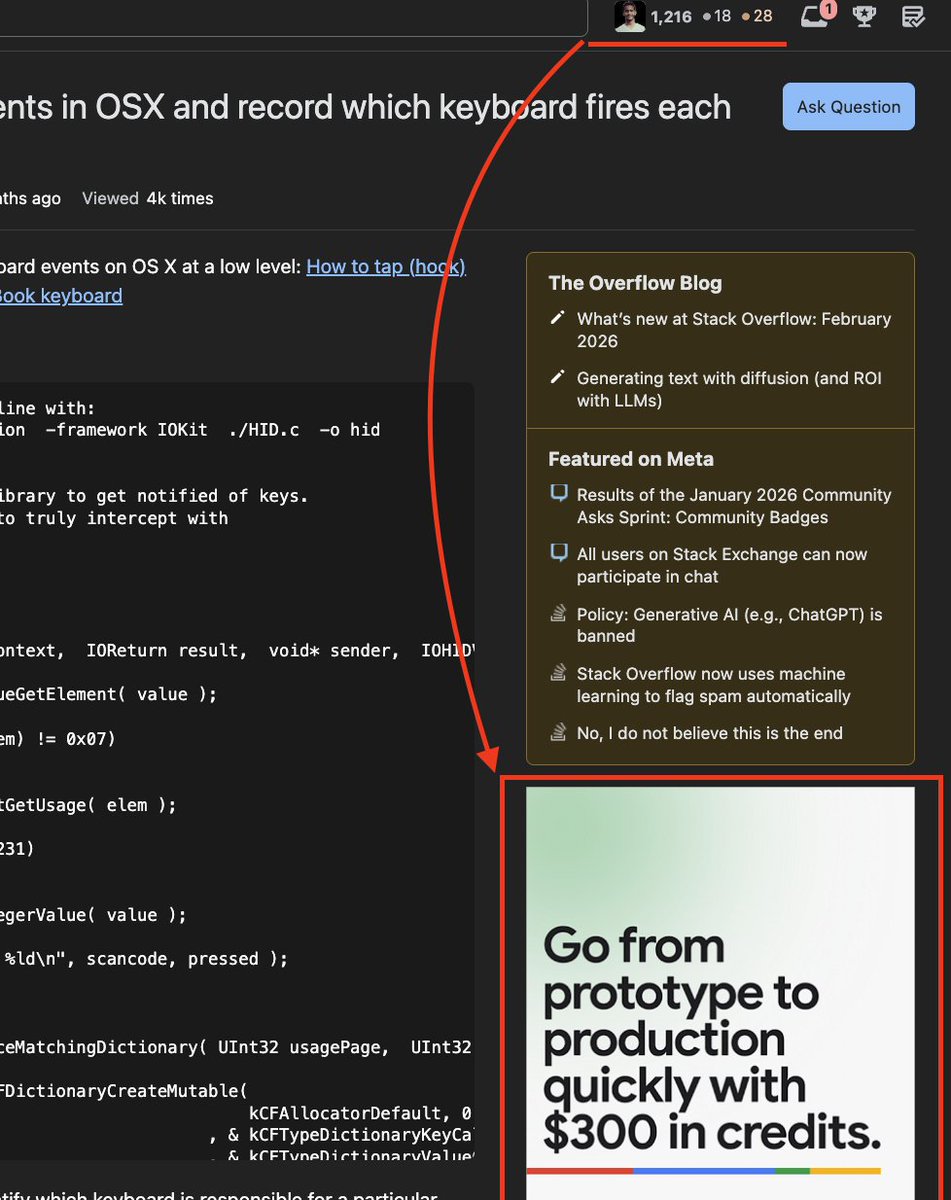
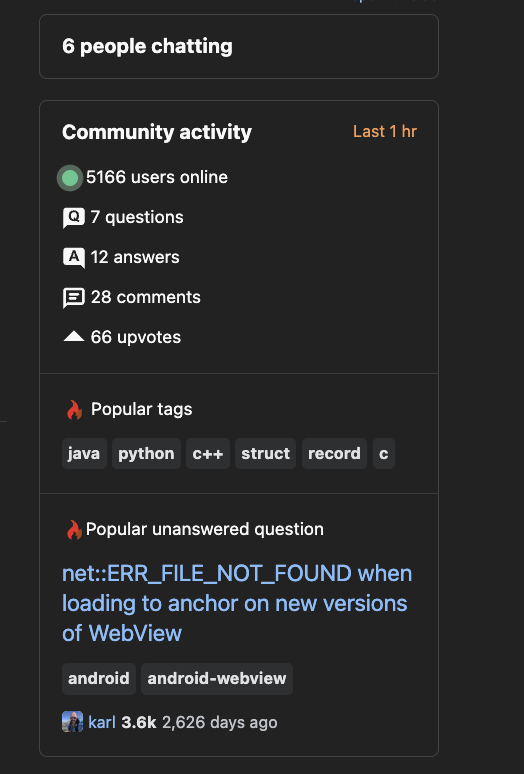
I don't want to keep hating on stackoverflow (mostly because I am forever grateful for all that it helped with before AI came along), but it really seems like they are out of ideas at this point. Doesn't this look painfully familiar and fundamentally wrong for this website?
English
0
0
0
8
Navdeep
Navdeep@nsrCodes·
Went on StackOverflow after a long time today and feels like their team is only trying play catchup - showing ads even though my reputation tier used to help me stay away them - a section about their traffic info (often seen on small blogs) to probably signal its still relevant
Navdeep tweet mediaNavdeep tweet media
English
1
0
0
34
Navdeep
Navdeep@nsrCodes·
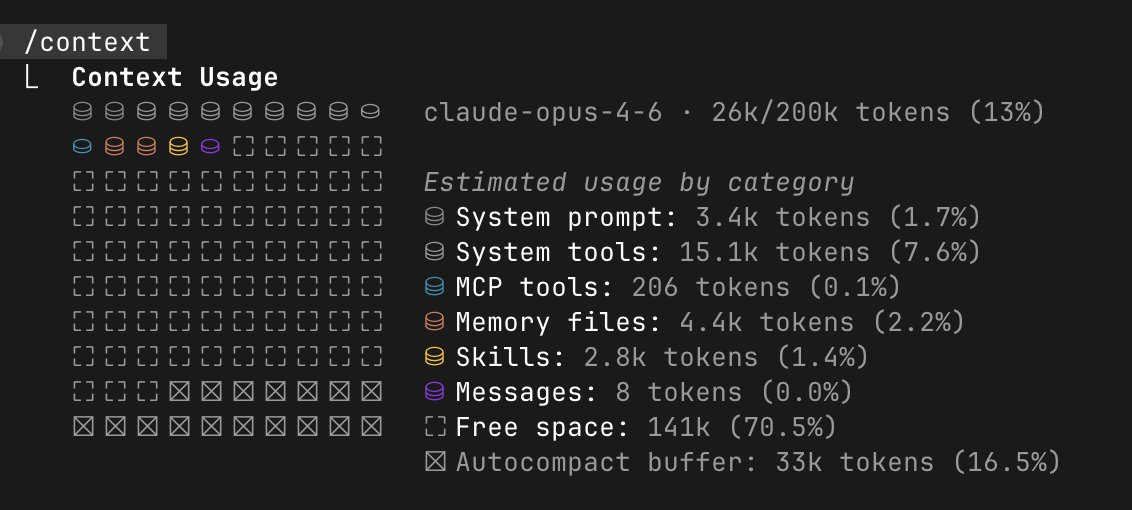
@amritwt @grok What view is this and how can I see it for my claude code?
English
1
0
0
377
amrit
amrit@amritwt·
13% of my context is finished even before I begin
amrit tweet media
English
50
1
495
28.5K
Navdeep
Navdeep@nsrCodes·
Seems a bit more obvious now, but I have shot myself in the foot several times as I become lazy and try to YOLO stuff and let the coding agent have more control than it should
English
0
0
0
8
Navdeep
Navdeep@nsrCodes·
While agentic coding these days I feel its less about whether the agent is hallucinating or if it has the relevant context. The quality of the results I get greatly varys on if I have the mental capacity and knowledge to actually steer the agent correctly.
English
2
0
1
13
Navdeep retweetledi
JNS
JNS@_devJNS·
every time I learn something new in tech, the industry drops 3 more things to learn.
JNS tweet media
English
81
580
4.1K
62K
Navdeep retweetledi
magnus
magnus@magnushambleton·
I chose the green door ninety-three days ago. At the time, it seemed obviously correct. Not even a close call. The red door offered two billion dollars immediately—a sum so large it would solve every material problem I'd ever face, fund any project I could imagine, and still leave enough to give away amounts that would meaningfully change thousands of lives. But two billion is a number. It has a fixed relationship to the economy, to the things money can buy, to the world. The green door offered one dollar that doubles every day. I remember standing there, doing the mental math. Day 30: about a billion dollars. Day 40: over a trillion. Day 50: a quadrillion. The red door would be surpassed before the first month ended, and after that, the gap would grow incomprehensibly fast. Choosing the red door would be like choosing a ham sandwich over a genie's lamp because you were hungry right now. So I walked through the green door. The first few weeks were unremarkable. I had a dollar, then two, then four. By day ten I had $512, which felt like finding money in an old jacket. By day twenty I had over a million, and I started getting calls from financial advisors I'd never contacted. By day thirty-one I had crossed the two-billion threshold—officially richer than I would have been behind the red door. I didn't understand what was happening until around day sixty. The money, you see, had to exist somewhere. Not philosophically—I mean physically. Digitally. When I checked my bank balance, a computer somewhere had to store that number. And storing the number 2^n requires n bits. One bit per day. That's it. That's the rate at which my fortune's representation grows. A linear function. Almost comically modest. But here's what I'd failed to understand about exponential growth: the value doesn't care about the representation. The bits grow linearly. The dollars they encode grow exponentially. And dollars make claims on the physical world. Day sixty. My balance: 2^60 dollars. About 1.15 quintillion. Roughly 1,000 times the entire global GDP. The number itself required only 60 bits to store—less than a tweet, less than this sentence, trivially small from an information-theoretic perspective. But money is not information. Money is a claim. The calls started coming from the Treasury Department. Polite, confused, increasingly frantic. They explained that the M2 money supply of the United States was approximately 21 trillion dollars. I now held about 15,000 times that amount. When I tried to spend any of it—even a tiny fraction—the transaction represented a claim on more goods and services than the entire human economy had ever produced in its history. "The number in your account," a Treasury official said, "is not meaningful." "It's in your computer," I replied. "The computer," she said carefully, "does not understand what the number represents." Day seventy-five. 2^75 dollars. I could purchase—in principle—roughly 350 million copies of the entire Earth's annual economic output. The representation remained elegant: 75 bits. Nine and a half bytes. I could write my net worth on a Post-it note in binary. But representations aren't wealth. Wealth is factories, farmland, human labor, time, attention, atoms arranged into useful configurations. And I had laid claim to more atoms than existed. This is where it gets strange. The global financial system is, at its core, a system of ledgers. Distributed, reconciled, audited. When the Federal Reserve's systems recorded my balance, and Chase's systems recorded my balance, and the IRS's systems recorded my balance, those numbers had to match. And they did match—trivially, easily, using a handful of bytes each. But then the systems tried to do things with the number. Calculate taxes owed. Assess systemic risk. Determine what fraction of GDP was held by a single individual. Run inflation models. Price assets in a market that now included a participant with claims exceeding the value of all other claims combined. Day eighty-two. The S&P 500 became undefined. Not zero, not infinity—undefined. My proportional ownership of the market, if I chose to exercise it, exceeded 100%. The shares I could theoretically purchase outnumbered the shares that existed. Financial models divide by market cap; market cap now included a term that broke the arithmetic. Day eighty-five. The International Monetary Fund published a paper titled "On the Representability of Post-Scarcity Claims." It concluded that exchange rates could no longer be calculated because the dollar itself had become paradoxical—simultaneously the world's reserve currency and a unit of measurement that had lost all meaning. My balance on day eighty-five: 2^85 dollars. Still just 85 bits. About ten and a half bytes. The representation remained trivial. The reality it pointed to had become impossible. Day ninety. I tried to buy a coffee. The transaction failed. Not because of insufficient funds, not because of a technical error, but because the payment system could not determine a meaningful exchange rate. My card represented a claim on approximately 10^27 dollars. The coffee cost $4.50. The ratio between these numbers—the percentage of my wealth the coffee would cost—was so small that it rounded to zero in every floating-point system on Earth. I could not pay because the act of payment required representing a number smaller than any computer could distinguish from nothing. I offered to pay in cash. I had a twenty. The barista looked at me like I'd offered to pay with a seashell. "Where did you get physical currency?" she asked. That's when I realized: I had broken cash too. The Treasury had stopped printing bills three weeks earlier. Why maintain physical currency when one account holder could—at any moment—claim more dollars than had ever been printed in human history? The symbolic relationship between paper and value had always been a polite fiction, but my existence had made the fiction impossible to maintain. Day ninety-three. Today. My balance is 2^93 dollars: approximately 10^28. About 10 billion times the estimated value of all assets on Earth. The representation requires 93 bits. Twelve bytes. Smaller than my name. The economy hasn't collapsed, exactly. People still trade, still work, still produce. But they've stopped using dollars. They've had to. A currency in which one person holds virtually infinite units is not a currency at all—it's a monopoly ticket that everyone has silently agreed to stop playing with. I keep thinking about what money actually is. It's not the bits. The bits are trivial; they always were. It's not even the paper or the gold or the entries in a ledger. Money is a shared agreement about who has claims on what. A story we tell together about value and exchange and debt. I broke the story. Not through violence, not through fraud, not through any action more dramatic than walking through a door and watching a number tick upward. Just by existing. Just by holding a claim that grew faster than the world's ability to honor it. The red door offered two billion dollars. A large but finite claim. A claim that fit within the story, that could be exchanged and spent and taxed and inherited. A claim the world could accommodate. The green door offered something else entirely: a claim that would grow until it consumed all other claims, until the very concept of claiming became incoherent. I still have the 93 bits. They're sitting on a server somewhere, humming along, doubling quietly at midnight. By next week they'll represent more dollars than there are atoms in the observable universe. And I still can't buy a coffee.
English
552
2.2K
22K
7.2M
Navdeep retweetledi
trash
trash@trashh_dev·
me watching the llm do the job i used to love
trash tweet media
English
180
1.6K
17K
1.6M
Navdeep retweetledi
JNS
JNS@_devJNS·
hot takes: a developer who admits they don't know something is more trustworthy than one who pretends.
JNS tweet media
English
190
242
5.4K
92.2K
Navdeep
Navdeep@nsrCodes·
just found this channel @musicwithmae" target="_blank" rel="nofollow noopener">youtube.com/@musicwithmae part of me loves it the other part is thinking - there is a chance this could be completely AI generated
English
1
0
2
71
Navdeep retweetledi
Raza Habib
Raza Habib@RazRazcle·
Occasionally I think Google will win the AI race because of their compute dominance. Then I try to get an API key to use any of their products and I remember
English
195
217
5.9K
358.6K
Navdeep
Navdeep@nsrCodes·
And I am no longer afraid to do such drastic rewrites ever since the feature for rolling back code changes was introduced.
English
0
0
1
31
Navdeep
Navdeep@nsrCodes·
I was looking forward to use zustand in my next project - after getting a taste for its good DX elsewhere setup everything manually (no ai help) to make sure I understand each detail after a while ran into infinite re-renders in react, something related to not using rehydration and persist properly. Before AI, at this point in a project I would usually abandon it and learn from my naive mistake of choosing new(to me)-and-shiny tool for a serious project. But this time just one prompt and 5 minutes later the whole thing was migrated to redux - something I am comfortable with (and I was pretty sure it doesn't have the same issue) at the end of it, everything just worked and no more errors another quick pragmatic win with cc!
Navdeep tweet media
English
1
0
1
33
joel ⛈️
joel ⛈️@joelhooks·
okay, @claude_code is the best coding agent in the world for people who already know how to code i have used all of them i have no financial relationship to claude its simply the best in its class
English
88
26
572
41.4K
Aiden Bai
Aiden Bai@aidenybai·
guess the AI coding tool
Aiden Bai tweet media
English
180
11
379
105.9K
Navdeep
Navdeep@nsrCodes·
I have a feeling a lot of the recent hype around codex is sponsored Because I tried codex after the updated claude code opus limits And I don't think codex comes anywhere close to how good claude code works (even without opus) CC Fetches the correct files, thinks the right way Then again, I could be biased.
I Am Devloper@iamdevloper

cursor vs codex no I won't explain

English
0
1
2
1.9K
Navdeep
Navdeep@nsrCodes·
I have a feeling a lot of the recent hype around codex is sponsored Because I tried codex after the updated claude code opus limits And I don't think codex comes anywhere close to how good claude code works (even without opus) CC Fetches the correct files, thinks the right way Then again, I could be biased.
I Am Devloper@iamdevloper

cursor vs codex no I won't explain

English
0
0
1
88
Navdeep
Navdeep@nsrCodes·
Today's equivalent of while it compiles is While the agent plans and thinks
English
0
1
2
59
Navdeep
Navdeep@nsrCodes·
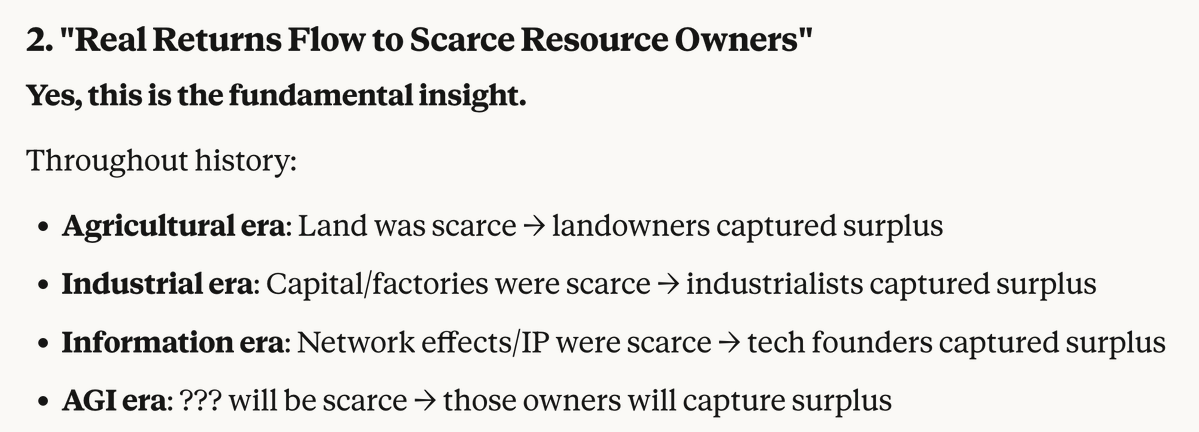
@paraschopra Relevant context Or data, as most people call it
English
0
0
0
90
Paras Chopra
Paras Chopra@paraschopra·
What will be scarce in the AGI era? that's what will make real returns 💸
Paras Chopra tweet media
English
73
12
329
40.1K