nick chen retweetledi

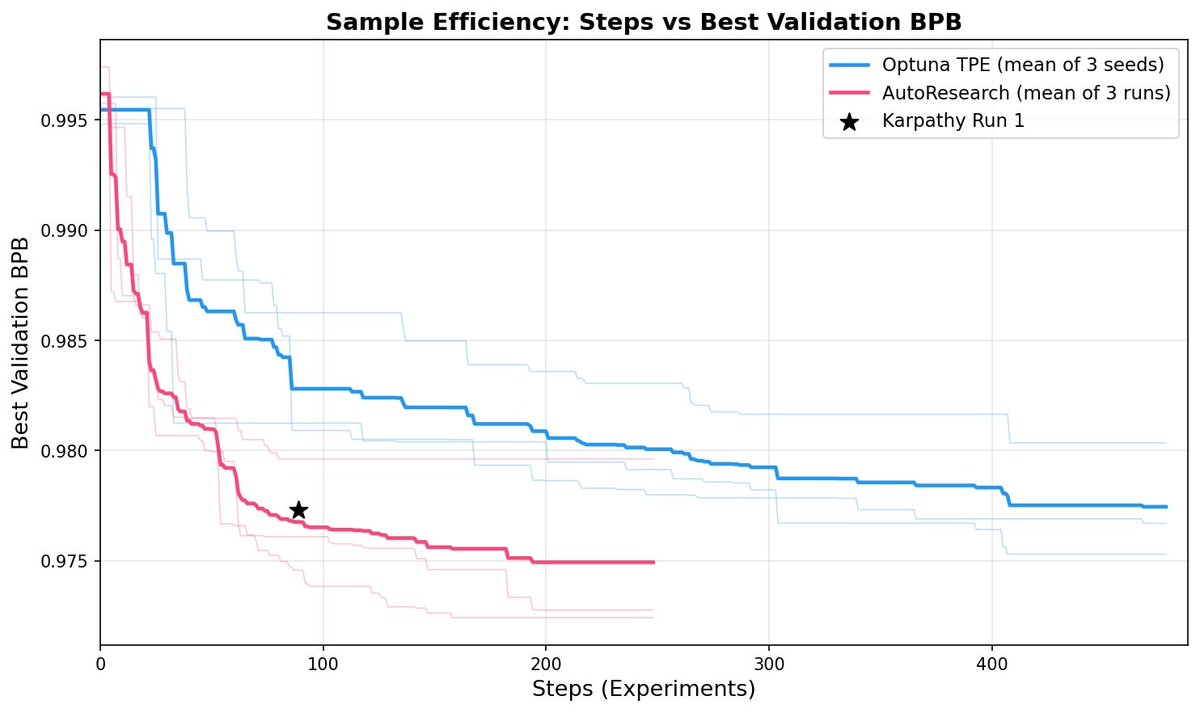
Is autoresearch really better than classic hyperparameter tuning?
We did experiments comparing Optuna & autoresearch.
Autoresearch converges faster, is more cost-efficient, and even generalizes better: 🧵(1/6)
English
nick chen
303 posts


@nykoras
leading frontier seed investments @goldenventures. prev: head of ventures @IEX, @Georgian_io, founder @ syzygy records. affinity for esoterica 🪡
Love this project: nanoGPT -> recursive self-improvement benchmark. Good old nanoGPT keeps on giving and surprising :) - First I wrote it as a small little repo to teach people the basics of training GPTs. - Then it became a target and baseline for my port to direct C/CUDA re-implementation in llm.c. - Then that was modded (by @kellerjordan0 et al.) into a (small-scale) LLM research harness. People iteratively optimized the training so that e.g. reproducing GPT-2 (124M) performance takes not 45 min (original) but now only 3 min! - Now the idea is to use this process of optimizing the code as a benchmark for LLM coding agents. If humans can speed up LLM training from 45 to 3 minutes, how well do LLM Agents do, under different kinds of settings (e.g. with or without hints etc.)? (spoiler: in this paper, as a baseline and right now not that well, even with strong hints). The idea of recursive self-improvement has of course been around for a long time. My usual rant on it is that it's not going to be this thing that didn't exist and then suddenly exists. Recursive self-improvement has already begun a long time ago and is under-way today in a smooth, incremental way. First, even basic software tools (e.g. coding IDEs) fall into the category because they speed up programmers in building the N+1 version. Any of our existing software infrastructure that speeds up development (google search, git, ...) qualifies. And then if you insist on AI as a special and distinct, most programmers now already routinely use LLM code completion or code diffs in their own programming workflows, collaborating in increasingly larger chunks of functionality and experimentation. This amount of collaboration will continue to grow. It's worth also pointing out that nanoGPT is a super simple, tiny educational codebase (~750 lines of code) and for only the pretraining stage of building LLMs. Production-grade code bases are *significantly* (100-1000X?) bigger and more complex. But for the current level of AI capability, it is imo an excellent, interesting, tractable benchmark that I look forward to following.


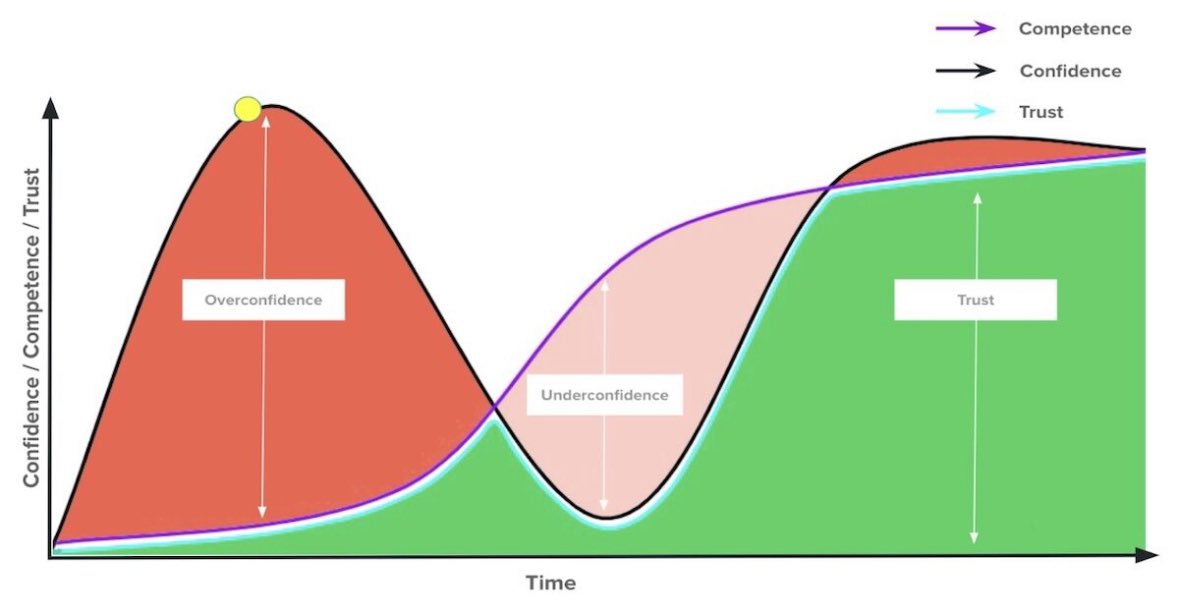
We ran a randomized controlled trial to see how much AI coding tools speed up experienced open-source developers. The results surprised us: Developers thought they were 20% faster with AI tools, but they were actually 19% slower when they had access to AI than when they didn't.








I'm excited to share @GoldenVentures' newest investment thesis focused on #genai, #web3 and frontier technologies at large, “Trust is all you need.”