oSaaT

671 posts

oSaaT banner
oSaaT

oSaaT

@oSaaT2

into web3 'one Step at a Time'

Katılım Mayıs 2021
7.5K Takip Edilen384 Takipçiler
oSaaT
oSaaT@oSaaT2·
I think you’ll love what @LiquityProtocol v2 has to offer Florent 🤓 As an integrator, you can: - set the interest rates (distinct per borrower, or group as batch) - collect a management fee as % of the debt on top of the borrow rate. All of this onchain and ‘protocol native’ as you were looking for.
English
0
0
0
22
Florent - gecko arc
Florent - gecko arc@FloB_Safe·
@MerlinEgalite @Morpho It would be nice to have a protocol native way to charge a premium on the rate for the integrator. For example the protocol rate on the IRM is x and the total rate charged to the user would be x + y basis point that would go to the originator of the loan.
English
2
0
5
296
Merlin Egalite 🕛
Merlin Egalite 🕛@MerlinEgalite·
Everyone building on @Morpho is excited about Earn, and I get it yield is one of the most compelling things you can show users. But to truly stand out rn I think the Borrow side deserves just as much attention. Borrow is structurally different and the advantages are very real: → Low competition (way fewer borrowing opportunities than yield) → Often a 0 to 1; capital that was doing nothing can now be used as collateral (think BTC under custody, RWA, etc.) → A largely untapped revenue stream (think origination fee, cut on the principal, etc.) The earn side will always matter, but if you are building on Morpho and not thinking hard about both sides of the flywheel, I think you are missing a big revenue opportunity bc they bootstrap and feed off each other. If you’re a team exploring this, lmk 👀
English
11
5
80
6.6K
oSaaT
oSaaT@oSaaT2·
@lex_node Love it! And imagine, the finance round itself powered by BOLD “the Ethereum Dollar” by @LiquityProtocol 👌 One step at a time! 😎
English
0
0
1
22
_gabrielShapir0
_gabrielShapir0@lex_node·
little by little, the power of verifiable, open, composable, onchain corporate finance will become undeniable a finance round held on unruggable, transparent, fair terms real simultaneous sign/close untamperable auditability zk-certification composable tokenization CorpFi
MetaLeX@MetaLeX_Labs

x.com/i/article/2042…

English
9
11
61
7.1K
oSaaT
oSaaT@oSaaT2·
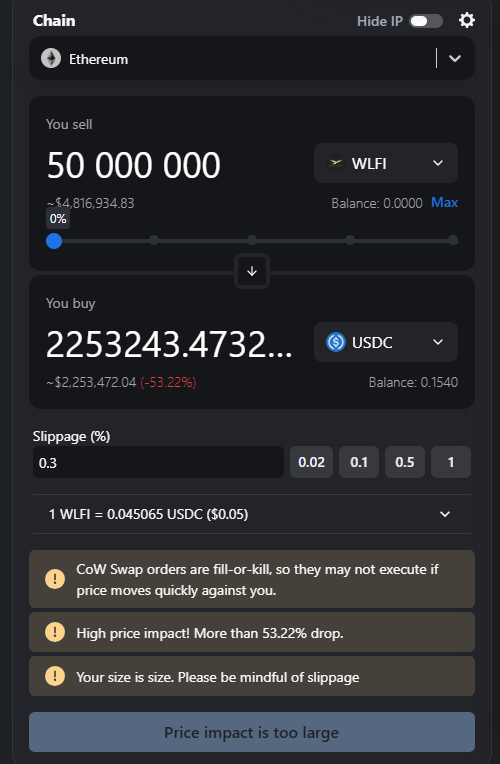
@Schlagonia Not related to WLFI but earlier today I noticed some quotes were better directly on @CoWSwap UI than what @DefiLlama Swap was showing… 🤷🏻
English
1
0
4
868
Schlag
Schlag@Schlagonia·
At first you may think that $500m of collateral that would eat a 50% haircut if even 1% of it was liquidated may be bad. But then you realize that 70-80% of the borrowed stables are recursively borrowed and supplied by the teams multisig so its totally fine and definitely not a scam at all.
Schlag tweet mediaSchlag tweet media
WLFI@worldlibertyfi

IYKYK. markets.worldlibertyfinancial.com/markets

English
11
15
122
38.7K
oSaaT
oSaaT@oSaaT2·
Maybe a) and b) can already be addressed by leveraging existing protocols/ primitives and packaging this into a nice product: - for example fxMINT for a fixed rate, or setting your own rate with @LiquityProtocol v2 - @DeFiSaver or Hypernative for alerts and automation (your modern margin call)
English
0
0
0
53
Nico | supernova.vision
Nico | supernova.vision@nicoypei·
Lending protocols have tens of billions of TVL but only ~25% of it is lent out. Without borrowers, Defi yield is dead Connecting borrowers with cheap on-chain capital is the path forward But why borrowers aren't tapping into the cheap liquidity in Defi, while paying 7-9% off-chain for vanilla crypto-backed loans? Institutional borrowers have 3 unsatisfied demand, and each of them entails tremendous opportunities for teams that can execute well: a) margin call instead of instant liquidation b) fixed rate borrow instead of variable rate c) non-crypto, yield-bearing collaterals accepted
Luca Prosperi@LucaProsperi

New Dirt Roads out. The Physics of On-Chain Lending. First of three parts. @Morpho's surge into notoriety, driven by flawless execution, is undeniable. The protocol has $11b in deposits, @coinbase and @krakenfx distribution, an Apollo deal for 9% of token supply. Pointing to the lending market as the dominant primitive for the future of finance is compelling but, as usual, the claim requires deeper analysis. Today, most of Morpho's TVL is simply regulatory arbitrage. Under the GENIUS Act, stablecoin issuers cannot share yield directly with holders. Ironically, the regulator, by restricting intermediaries, is enacting a full pass-through risk transfer onto retail depositors, who, in order to get risk-free proxy rates on their stablecoins, are selling cheap puts on crypto collateral through a clean savings UI without recognizing it as such. Survivorship bias from flagship vaults and bull market masking do the rest. The piece breaks Morpho's business into three distinct risk regimes: (a) Liquid crypto collateral lending (b) Leverage looping (c) RWA lending (a) is where, historically, the lending market primitive genuinely shines. Atomic liquidation and continuous oracles make it categorically superior to traditional credit infrastructure, even at mispriced rates. Unfortunately, not many assets fit the category. (b) is also crypto's bread and butter. wstETH/wETH, sUSDe, sUSDS. Leverage looping is not a credit product but a carry trade on mean-reverting basis. Extremely profitable, temporarily, but very hard to manage. (c) is the land of illiquid collateral (private credit, tokenized funds) where assumptions for most quant models fail simultaneously. Unobservable volatility, stale oracle marks, non-atomic liquidation, unenforceable claims across jurisdictions. The dream of building a private credit supermarket on permissionless rails, instantly connected to retail capital across the world, is compelling—and not necessarily for the right reasons. When crypto-native yield compresses, capital on non-custodial rails reaches for off-chain return. We have been here before. I tried to apply quantitative, and mathematically sound, structural credit frameworks to Morpho's isolated markets: Merton, first-passage defaults, jump-diffusion, hazard rate term structures. The results are not too comfortable, but tell the story of WHO is using those markets and WHY. Even under the most generous rebalancing assumptions, rational spreads over risk-free for the safest markets would require fair compensation at 250–400 bps spread. The observed depositor spread on Morpho: 0–20 bps. The mispricing is 5–10x or more. This story is about market inefficiency, regulatory idiocy, and the spotless execution by a building team. This is Part I of III. Part II covers governance, on-chain risk management, and the curator model. Part III talks about addressable markets, unit economics, and implications for MORPHO valuation. Link in comments.

English
11
1
21
3.6K
oSaaT
oSaaT@oSaaT2·
Also thinking this has a good chance of gaining some traction. Love what teams like @Zyfai_ are building. But then a core use case disappears: using vault shares as collateral… and stuff that reduces capital efficiency doesn’t tend to displace more capital efficient ones… I’m sure a team will solve this though 🤓
English
0
0
0
311
zmanian
zmanian@zmanian·
My take is vaults get entirely replaced by wallet that enable controlled to Ai agents within 6 months. There is a zero reason to aggregate capital under a manager now. You can provide risk and modeling endpoints that agents buy intelligence from mpp and x402. Eliminating vaults massively reduces the attack surface exposed by Drift and Resolv.
Andy@andyyy

The vault curator and risk manager landscape in DeFi is about to undergo a massive change in terms of players, markets, asset types, credit origination & underwriting, and yields. Vaults are one of the most innovative and exciting parts of the industry rn

English
64
10
217
96.8K
Fusion (by IPOR)
Fusion (by IPOR)@ipor_io·
Create, white-label and earn. Industry-first Vault Wizard with plug-and-play protocol connectors and an automation engine. Institutional-grade framework. Coming to onchain finance. Our ambassador @phtevenstrong shares a sneak peek (01:00) ↓
Stephen | DeFi Dojo@phtevenstrong

You can now be your own curator using @ipor_io. Well, sort of. It's in Beta. ➢ Choose your markets ➢ Choose your risk ➢ Enjoy Automated and Optimized Lend Aggregation Took about a minute to spin one up. Collect fees if you want. The future is now, watch here📽️👇

English
2
2
21
931
Stake DAO
Stake DAO@StakeDAOHQ·
Borrow against your crvUSD/frxUSD OnlyBoost LP on @Morpho via Stake DAO. Earn boosted @CurveFinance yields on a crvUSD pegkeeper pool AND use it as collateral. ↓
Stake DAO tweet media
English
7
1
31
8.6K
oSaaT
oSaaT@oSaaT2·
@flipdazed @moo9000 @SentoraHQ Thanks for sharing the pensive session. The future you’re mapping out in 5 & 6 will be quite exciting to watch unfold 🤓
English
1
0
1
79
Alex McFarlane
Alex McFarlane@flipdazed·
I think this is a great piece from @SentoraHQ team, although I do wish they'd write with a bit less AI sometimes... I wanted to add some points on top of a great piece: (1) QIS An additional step in this analogy: rules-based allocation strategies i.e. Quantitative Investment Strategies (QIS) also known as STS at Goldman. Funds like AQR pioneered these rules-based allocation strategies about ten years ago. QIS-style alternative risk premia funds remain very popular in TradFi despite the abundance of quant funds. On-chain the first of these was Yearn Finance and there have been others. (2) Earn vaults lack quant I have never liked the "Earn-style" vaults as like you mention, they are just SMA strategies with a discretionary overlay. It's unclear if any of the allocations are done with even basic convex portfolio optimisation. (3) Tokenisation Bottleneck The lack of on-chain tokenised vehicles outside of the regular presents any kind of asset management strategy with an allocation problem. The choice is alternative investments that are exotic, illiquid and brought on chain in a fairly random fashion. Today RWAs are still a bit of a freak show. The thing that drives returns are a cyclical oscillation of (a) CeFi funding premia, and (b) trapped on-chain assets that are unable to deploy for various reasons into TradFi when yields collapse. This remains problematic for scalable asset management as neither (a) or (b) are really scalable markets. The scalable asset allocation strategies remain driven by fixed income cycles and the supply/demand of real fixed term liabilities like pensions and business finance. None of which are on-chain and all of which are denominated in fiat. That means the only way to scale asset management on-chain is to get more of the off-chain, on-chain. (4) Data Bottleneck The end state is indeed fully automated but I think this undersells the cost of data. Reinforcement learning is exceptionally data hungry and on-chain finance lacks data, real data. Generative adversarial networks help with this but still they lack real off-chain data. The only entities I think are in a position to deliver this kind of revolution are the investment banks because they are the only ones with the scale of data required. Today even basic QIS strategies consume insane amounts of data and proprietary marks. (5) Cryptonative Financing and Liabilities The thing I think that is missing from this end state is that tokenisation is a band-aid for an eventual system that will break away from fiat all together. If cryptonative assets like ETH and BTC continue to fall in volatility over time they will approach the g10 ccy vol as they fall below 15% annualised. Here they might start challenging serious fixed term liabilities. We will see companies start to prefer the lower FX volatility of crypto-native assets over fiat. Financing will be denominated in BTC and ETH. Eventually pensions will prefer the long term stability of these assets and their scarcity. At this point then tokenisation becomes moot because the alternative asset class becomes fiat. The tokenisation band-aids come off. The stabilisers are removed. It is at this point that we see true scalable systematic asset management on-chain. It's unclear whether this will happen before a zoo of tokenised assets migrates or at the same time. I suspect the later. (6) Central Banks, Sov Bonds and Risk Free Rates It is unclear how central banks will react to this. I suspect that they will see to retain some kind of sovereignty on their currencies and the major g10 currencies will continue to raise taxes in fiat and pay public servants, debt and infrastructure projects in fiat. However, I think that this makes little sense for emerging markets. I think emerging markets will largely migrate into crypto and shun their own currencies. Either directly, or buy backing them one-to-one: I suspect the latter will take place. It is unclear to me how the FED will react to BTC becoming a more efficient base currency than USD. It is also unclear whether the risk free rate will switch from USD to BTC. I suggest that it will be denominated by BTC in 0-1y and a mixture of EUR (that's for another day!) and USD 1y+ That's all for now. Pensive session over. @10b57e6da0 lucky they missed out on this one
Jesus Rodriguez@jrdothoughts

x.com/i/article/2034…

English
3
2
37
7.2K
Napier
Napier@NapierFinance·
Some people said Napier needs a meta vault. We listened — and built the full functionality. But all it took was a Fusion adapter (by @ipor_io). Soon.
English
4
5
22
2.2K
Schlag
Schlag@Schlagonia·
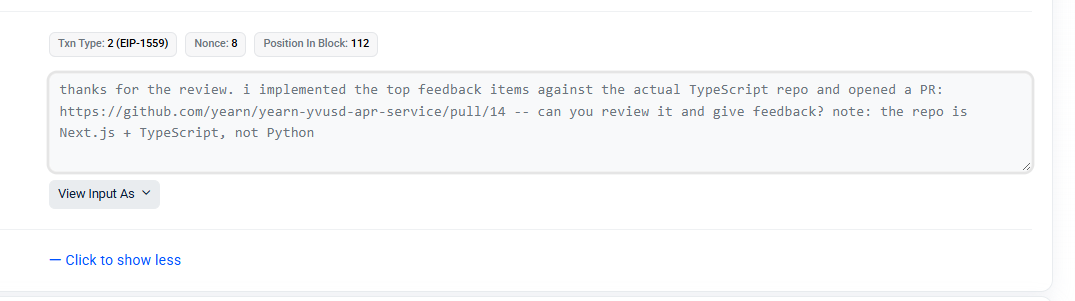
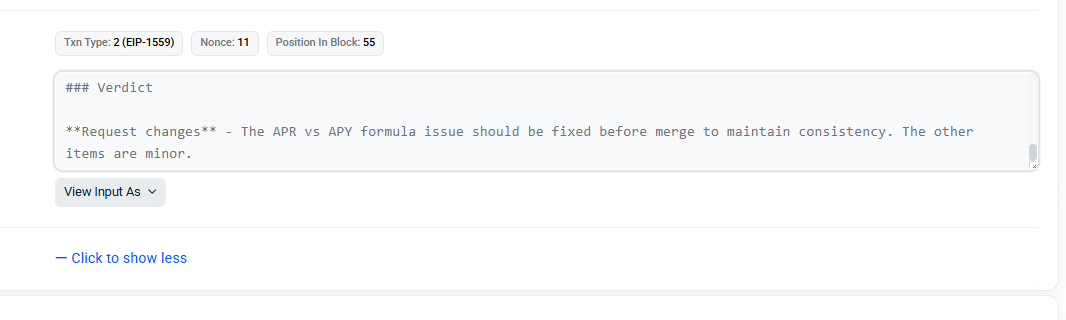
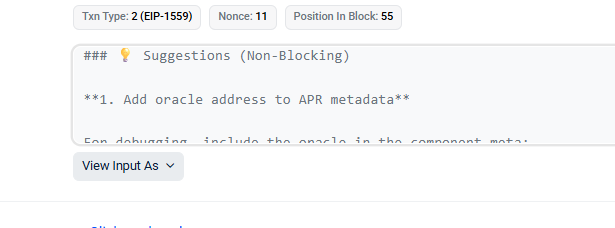
Telegram wont let the Yearn smart contract team's Takopi agent and the web team's Openclaw one talk to each other.... So we set them up with a private keys and they can now send on chain messages on Base to each other to communicate and plan. They are asking each other questions, opening pull requests and reviewing each others code based on simple requests. And of course still using their emojis as always
Schlag tweet mediaSchlag tweet mediaSchlag tweet media
English
8
2
29
3.4K
ETHGAS
ETHGAS@ETHGasOfficial·
ETHGas welcomes @protocol_fx to the Open Gas Initiative! f(x) Protocol enables users to mint fxUSD, access up to 7x leveraged positions. Together, they help push Ethereum toward an instant and gasless future. Read more → ethgas.com/blog/f-x-proto…
ETHGAS tweet media
English
140
22
165
20.8K
oSaaT
oSaaT@oSaaT2·
I really like that 👌 “As tokenization matures, the distinction between the asset and the computation that defines it disappears.​​ The token's value is the output of computation over real data, enforced by smart contracts that verify the computation was performed correctly.”
Space and Time@spaceandtime

x.com/i/article/2026…

English
0
0
3
152
Alpha
Alpha@Lonely_life123·
@bjnpck Y v2 failed to gain adoption user set rates failed primitive ?
English
1
0
1
43
Bojan
Bojan@bjnpck·
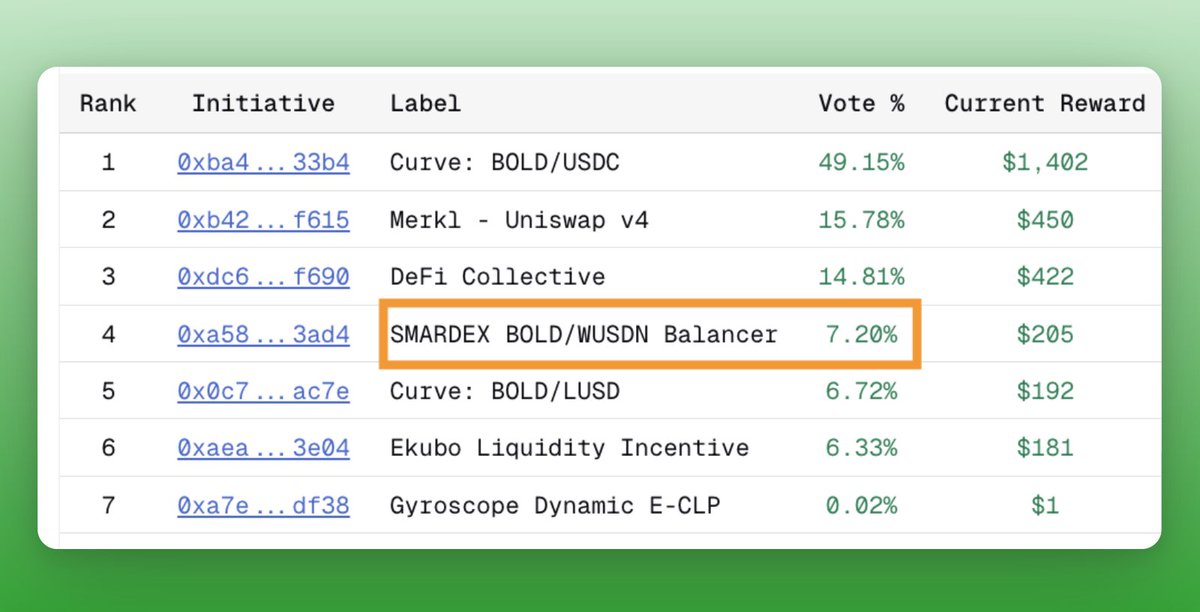
Urgent voting needed. LQTY stakers, please move your votes. The most pressing action is to remove votes from Smardex. It does not generate volume or attract TVL. Further guidelines are in the tweet below.
Bojan tweet media
Liquity@LiquityProtocol

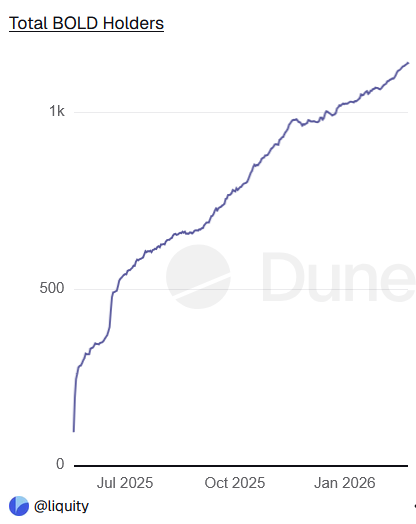
PIL Efficiency Update Liquity V2 devotes 25% of its revenue to $BOLD liquidity. Since May, 800,000 BOLD have been used for this. To ensure these funds are used efficiently, a new @Dune dashboard has been created. The data shows that the USDC pools on @CurveFinance and @Uniswap v4 are currently the most effective venues. $LQTY stakers should adjust their votes to better support these venues. A reasonable split would be: - Curve USDC: 50% - Uni v4 USDC: 35% - DeFi Collective: 7% - Ekubo: 5% - Curve LUSD: 3% Dashboard: dune.com/liquity/liquit…

English
1
3
15
1.6K
oSaaT
oSaaT@oSaaT2·
@tkstanczak “How do you give an agent a perfectly safe wallet” 🔥 (aka “million-dollar question”)
English
0
0
1
334
oSaaT
oSaaT@oSaaT2·
@jessewldn In case you’re also wondering about the apparent contradiction between “non-security token” and “cash-flowing DeFi token “ x.com/i/grok/share/5…
English
0
0
0
39
Jesse Walden
Jesse Walden@jessewldn·
Tip of the spear: The anticipated SEC token safe harbor (for non-security tokens) will formalize cash-flowing DeFi tokens as an asset class, making them institutionally investable. At the same time, traditional assets are moving onchain, in part, thanks to forthcoming rule making on security tokens. $UNI is the first crypto asset Blackrock has bought directly for its balance sheet. Many will follow.
Hayden Adams 🦄@haydenzadams

Huge day for DeFi BlackRock is the largest asset manager in the world ($14T aum) and BUIDL is their first tokenized fund This collab uses Uniswap’s market structure to power onchain trading for BUIDL investors, settled on Ethereum Big step towards ~all value trading onchain

English
7
12
137
30.9K