Herminator

137 posts

Herminator

Herminator

@o_herminator

researcher, mathematican, coder and start-up lover

Katılım Temmuz 2016
885 Takip Edilen409 Takipçiler
Sabitlenmiş Tweet
Herminator
Herminator@o_herminator·
The next AMM generation will likely be about MEV: Ideas as described here ethresear.ch/t/mev-capturin… allow AMMs to capture MOST OF THE MEV they are causing. This would generate new revenue for LPs and remove toxic mem-pool fights. 🧵
Dan Robinson@danrobinson

I don't think there's much alpha left in designing new AMM invariants The next generation of DEX features are going to be about fair execution and tx cost minimization, not new shapes for reserves curves

English
3
13
46
0
Herminator
Herminator@o_herminator·
@koeppelmann With the gains in proving efficiency, the eth-community has two options: Spent more time one L1-proving (scale L1) or spent more time one L1-L2-proving (scale L1-L2 atomicity). Why is the second option the better one?
English
1
0
0
205
koeppelmann
koeppelmann@koeppelmann·
Not sure I have ever been as productive in my life as in the last ~10 weeks: An extremely challenging yet worthwhile goal. The crazy progress of AI coding and heavy use of it. A very small team, world-class skills, and now the ability to multiply output thanks to AI. The result is @etheconomiczone — with a live devnet already: eez.dev. What is this? It will be: a) A new rollup that is fully composable with Ethereum. This means you can do either cheap transactions on this chain that only interact with contracts on this rollup, or more expensive transactions (similar to L1 costs) that can interact in a fully composable way between L1 and L2. So, for example, if you trade on this rollup, the routing can dynamically decide to use only L2 liquidity for a small trade, or for a larger trade — where the extra gas costs are worth it — to use both L2 and L1 liquidity. b) A whole framework that will allow new rollups, as well as existing L2s and sidechains (yes @gnosischain!!) to integrate into this “(Ethereum) economic zone.” Imagine: one could make a trade today simultaneously using Ethereum liquidity, but also Arbitrum, Base, or all the other L2s. This is what EEZ will allow. Now, let’s talk about the tech: Essentially, there are two core concepts that make all of this possible: 1) Proxy contracts 2) Real-time proving 1) Proxy contracts are basically a way to overcome the challenge that ~99% of all contracts are written in a way that only deals with addresses from a single chain. For example, a token or an NFT can be sent to an address, but not to an address on a specific other chain. Proxy contracts fix this. An address “A” on chain “n” will get a deterministic proxy representation, “A*”, on all other chains. So now, if, for example, A is a DAO on Ethereum and it should control, say, a fee switch in contract D (a DEX) on another chain, this can easily be done by setting A* as the owner of D. A (the DAO), on the other hand, can now call D* (the proxy representation of the DEX contract D) on Ethereum. All the cross-chain message passing in between is abstracted away — the contracts just call another contract and do not realize it is actually on another chain. 2) Real-time proving The proxy design already addresses the problem that there is no widely supported cross-chain message-passing standard in EVM land. So it alone would already be helpful for asynchronous calls, or better, calls that do not expect or require a return value. However, this would still not quite bring us to “synchronous composability.” Imagine a DEX trade: you do the first part of the trade on L1 and the second part on L2. You want to know the result of the second part — and if it did not get you the expected amount, you want to be able to revert the first part. This requires the call that triggers the DEX trade on L2 to have a return value. This was long assumed to be impossible - but with real-time proving, it no longer is. Basically, because Ethereum blocks are only produced every 12 seconds (and this would still work with, say, 6 seconds), that is now long enough to build and prove the L2 block that contains, for example, this L1→L2 DEX trade. If you want to learn more, don’t miss the talk by @tw_tter and @jbaylina on Tuesday at @EthCC! Let’s make Ethereum ONE again!
English
49
70
621
41.9K
Herminator
Herminator@o_herminator·
@robinson Why is it okay to "remove the kyc" via this wrapping step for morpho? Seems like an legal loophole?
English
0
0
0
21
Robinson Burkey
Robinson Burkey@robinson·
6/ Convert to wrapped token In order to use $ACRED within DeFi it needs to be wrapped into securitize's permissionless wrapper contract so you can utilize the asset. For this you need to sign a separate loan agreement. Updates coming soon to this to make it easier from what I understand.
English
2
0
10
671
Robinson Burkey
Robinson Burkey@robinson·
What does institutional adoption actually look like today? Not institutions buying and holding crypto but issuing offchain assets -> onchain (RWA's) and utilizing them in DeFi End-to-End Private Credit Example 🧵 ..
English
15
14
151
64.6K
Herminator retweetledi
Protocol Berg v2
Protocol Berg v2@protocol_berg·
Alexander Herrmann is in Cinema 6 presenting a new approach to auctions: Synchronized Priority Auctions. It’s all about MEV capture, trade execution, and syncing across AMMs. Built on “Priority is All You Need.”
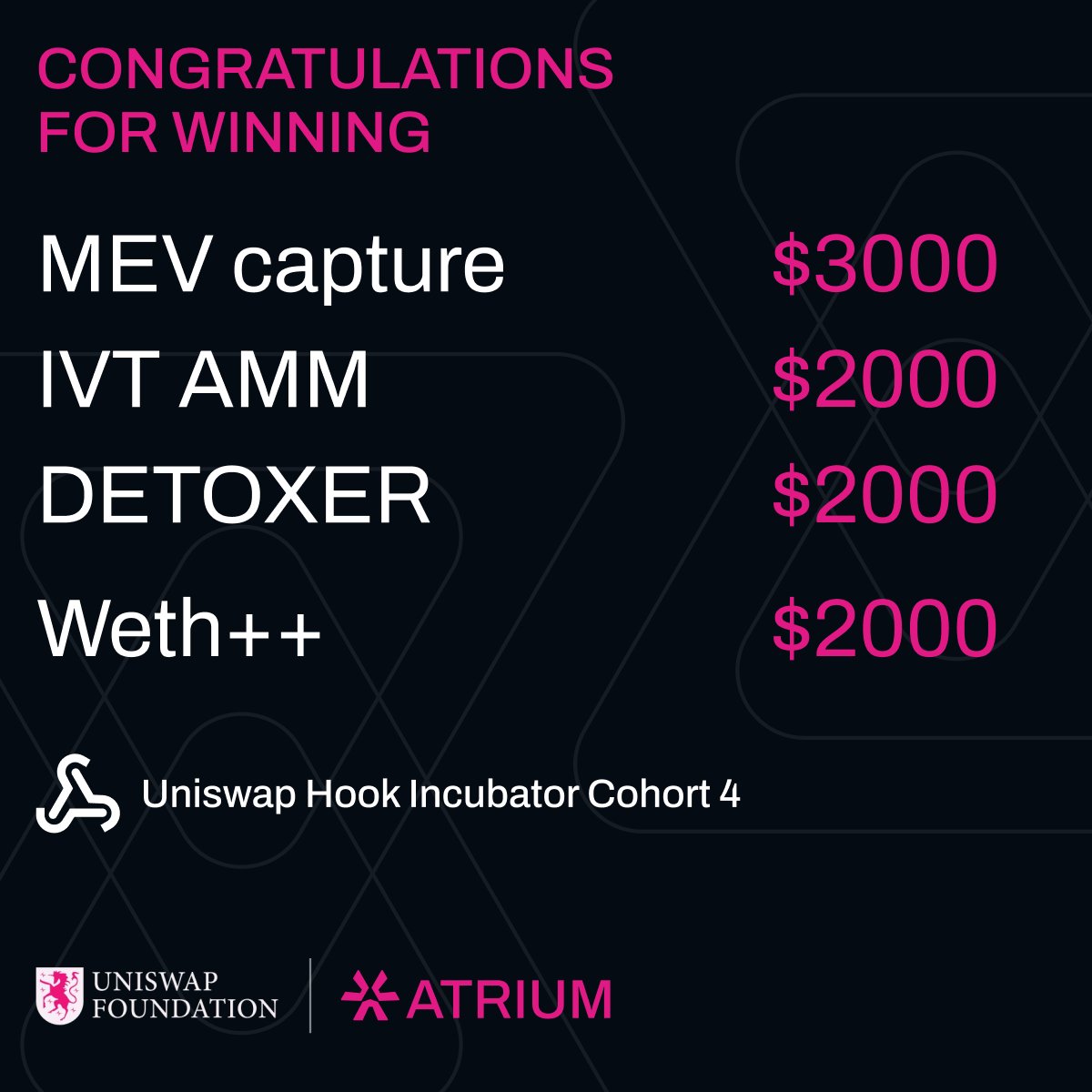
Protocol Berg v2 tweet media
English
0
1
6
275
Herminator
Herminator@o_herminator·
@maxresnick @hasufl @Togbe0x @EdFelten Sooo, priority ordering(with 200ms blocks) is better for jump volatility and FCFS is better for diffusive volatility. How do we decide for each token, which one is better?
English
1
0
0
121
Max Resnick
Max Resnick@MaxResnick·
Volatility can be decomposed into diffusive and jump volatility. For diffusive volatility its best if the arb happens as soon as possible which is why FCFS race is nice for diffusive volatility (on centralized venues for spot an increase in diffusive volatility actually decreases the spread!).
English
1
0
3
482
Herminator
Herminator@o_herminator·
@RadkoAlbrecht @Securitize @OndoFinance >Many tokenized assets require issuer KYC/AML, often due to securities regulations. This hurdle should be easy to take with uni hook + coinbase id nft, right? Why isn't anybody building this?
English
1
0
2
39
Radko
Radko@RadkoAlbrecht·
The big RWA <> DeFi disconnect? 🤔 Many tokenized assets require issuer KYC/AML, often due to securities regulations. This blocks them from truly permissionless DEX liquidity pools & forces investors onto gated platforms (like @Securitize or @OndoFinance), hindering wider adoption 🔒
English
2
0
3
46
Radko
Radko@RadkoAlbrecht·
#RWA tokenization holds immense promise – bringing stocks, bonds, real estate etc. on-chain for efficiency & access. BUT, the reality of easily investing in these via permissionless DEXs faces significant hurdles. Let's look at the friction points... 🧵
English
1
0
7
167
Herminator
Herminator@o_herminator·
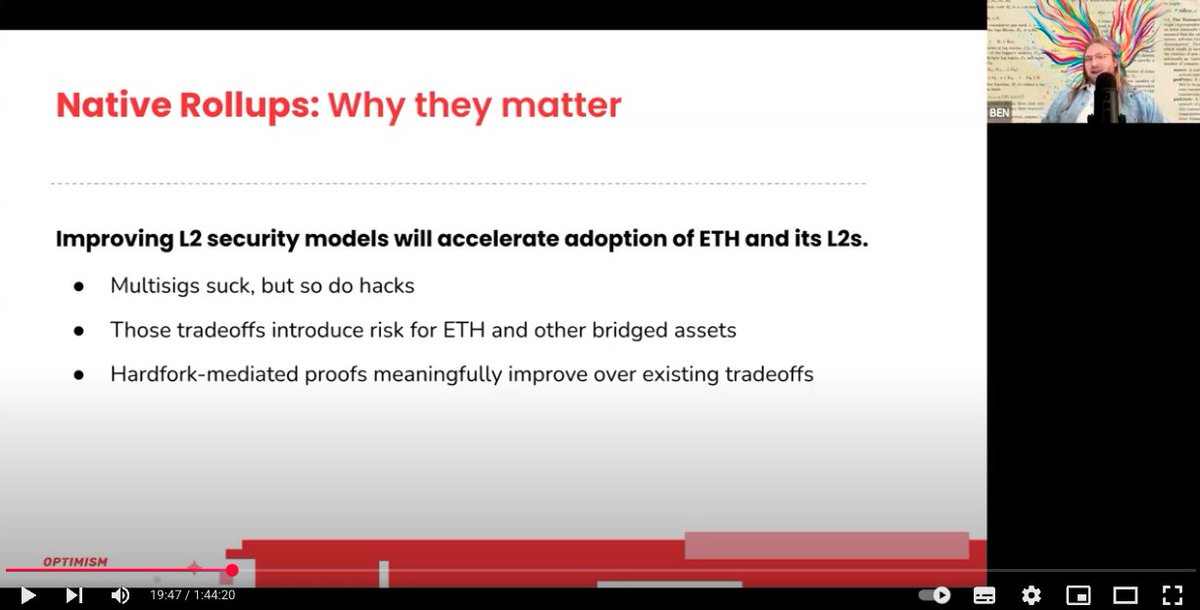
@dankrad @zengjiajun_eth Also, L2 leaders recognise the value of it! I am getting more and more convinced that this is a viable path!
Herminator tweet media
English
0
0
0
77
Dankrad Feist
Dankrad Feist@dankrad·
@o_herminator @zengjiajun_eth I have always been for this but I don't believe it will fundamentally change market incentives. Would more people use Base if it had this? I don't think so.
English
2
0
1
112
曾嘉俊 Zeng Jiajun
曾嘉俊 Zeng Jiajun@zengjiajun_eth·
Blob should only be allowed to be used by Based rollups. The rest, if they wanna use Ethereum, use it like any other apps.
English
6
0
13
1.9K
Herminator
Herminator@o_herminator·
@dankrad @zengjiajun_eth If I know that all my funds could got stuck, due to "execute"-bug, I would not use base. Even if it is unlikely. Right now I am only using base, because they will rescue me via their roll-up proxy pattern. But for rollups "stage 3", we need this security!
English
0
0
0
69
Herminator
Herminator@o_herminator·
@dankrad @zengjiajun_eth Your own "execute"-implementation, 1) could contain errors and is not protected by "forking" Ethereum 2) can not be updated without introducing attack-vectors. EXECUTE-precompile can be updated via Ethereum forking. (important for long lasting contracts on the L2 )
English
1
0
0
125
Herminator
Herminator@o_herminator·
@barnabemonnot Great to have u working on it! What do you think about the idea of using the EXECUTE-precompile to charge L2 reasonable fees (more than computation costs) to improve ETH security budget?
English
1
0
1
44
barnabe.eth
barnabe.eth@barnabemonnot·
Thought this was a good prompt to give an update on my own journey with rollup economics and validator incentives. These are top-of-mind topics for many in EF Research and out, framing it more from my own context here (thanks @francescoswiss for the shoutout!)
Francesco Andreoli ᵍᵐ@francescoswiss

3/ @barnabemonnot — the rollup economics + validator incentive expert. Your voice is key in understanding the sustainable security budget for Ethereum as it scales.

English
3
7
58
6.9K
Herminator
Herminator@o_herminator·
@zack_bitcoin @dankrad yeah, its limiting! But the huge advantage is that the forkable tokens can be traded on ethereum(via the canonical bridge) and a trustless price between the forkable tokens can be created, creating a clear signal for the forkchoice.
English
0
0
1
29
zack
zack@zack_bitcoin·
@o_herminator @dankrad A layer 2 that you cannot put eth into sounds very limited. Using a derivative of eth inside the sidechain would be too costly.
English
1
0
0
38
Dankrad Feist
Dankrad Feist@dankrad·
You need to choose oracles very wisely: For many applications they have as much power as a custodial provider, so the risk is high. I would never trust an oracle that has clearly been abused. Reputation has to be earned.
English
32
21
224
32.8K
Herminator
Herminator@o_herminator·
@dankrad @zack_bitcoin I think the best strategy is to build a forkable L2 anchored in ethereum and deploy projects that need a secure oracle into that forkable L2: x.com/edmundedgar/st… but yes, it requires a community to build a whole new forkable ecosystem.
English
1
0
1
94
koeppelmann
koeppelmann@koeppelmann·
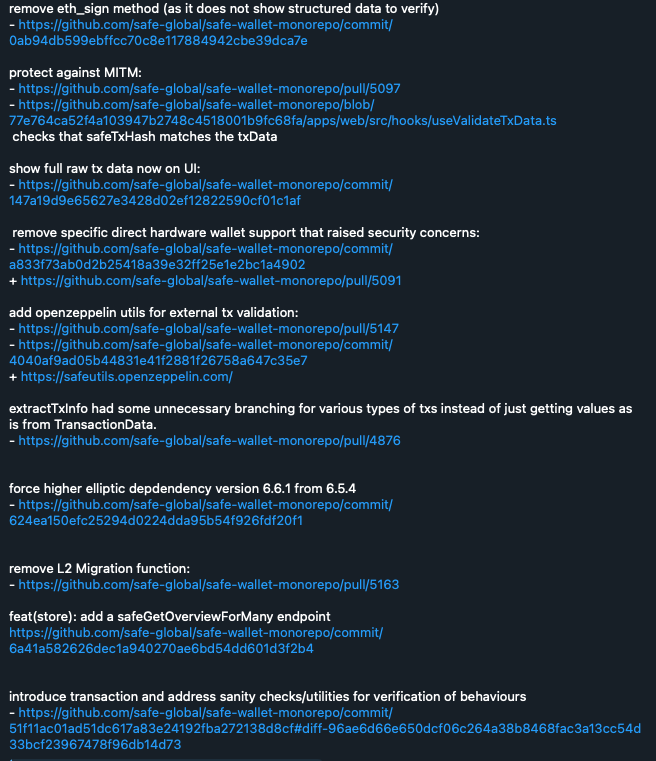
These are the immediate security improvements the @safe team implemented when bringing back the UI. We're doing this transparently and believe there are many lessons to learn industry-wide. Links below 👇
koeppelmann tweet media
English
18
50
439
42.5K
Herminator
Herminator@o_herminator·
Such an UI for re-verification and re-simulation is simple and could be hosted by different providers or via ENS. "verification diversity" seems easier to build than "client diversity".
English
1
0
1
89
Herminator
Herminator@o_herminator·
I agree! One extra feature that would help a lot is to allow for easy verification and re-simulation of the tx-payload that was signed by previous signers on an external website. Even a fully compromised backend/UI can not fake what has been signed to the external site!
koeppelmann@koeppelmann

People see an incident and say: “Oh, that would have been easy to fix. Just do XYZ.” And they are right about that one. But actually, to fix the next incident you need to fix ALL POSSIBLE INCIDENTS SIMULTANEOUSLY which is like 1000x harder.

English
1
0
2
179