Ankur Mehta

170 posts

Ankur Mehta banner
Ankur Mehta

Ankur Mehta

@oncomd

Boston, MA Katılım Nisan 2009
118 Takip Edilen91 Takipçiler
Ankur Mehta
Ankur Mehta@oncomd·
@AbiSivaMD @PathologyPat @muschollings Might help select I/o sensitive disease in this otherwise cold histology. Especially seeing mPIK3Ca enriched! Tissue based TMB still ideal. Nice correlative study!
English
0
0
0
29
Ankur Mehta retweetledi
Dr Sarah Sammons
Dr Sarah Sammons@drsarahsam·
Today is my last day at Dana-Farber Cancer Institute. 💙🎗️ DFCI is a place unlike any other. The standard of care, culture of intellectual curiosity, the relentless focus on patients. A special thank you to Dr. Sara Tolaney and Dr. Nancy Lin for your gracious mentorship. There is no better place. Our hearts are full. We’re heading home to family. 💙 Soon I’m joining the @UMGCCC University of Maryland Marlene and Stewart Greenebaum Comprehensive Cancer Center as Co-Leader of Breast Oncology, with a deep commitment to growing the breast program for the people of Baltimore and the DMV. We plan to initiate a new multidisciplinary CNS Metastases Clinic, home to Maryland’s only Proton Center. 🧠⚡ @UMGCCC is one of 56 NCI-designated comprehensive cancer centers in the country, moving into a brand new state-of-the-art building, and on the rise under the visionary leadership of Dr. Taofeek Owonikoko. To every patient who trusted me: thank you and you are in the best hands. 🎗️ #BreastCancer #Baltimore #BrainMetastases #ProtonTherapy #Oncology #NewChapter #UMGCCC
English
39
11
195
29.7K
Ankur Mehta retweetledi
Dana-Farber’s Breast Oncology Center
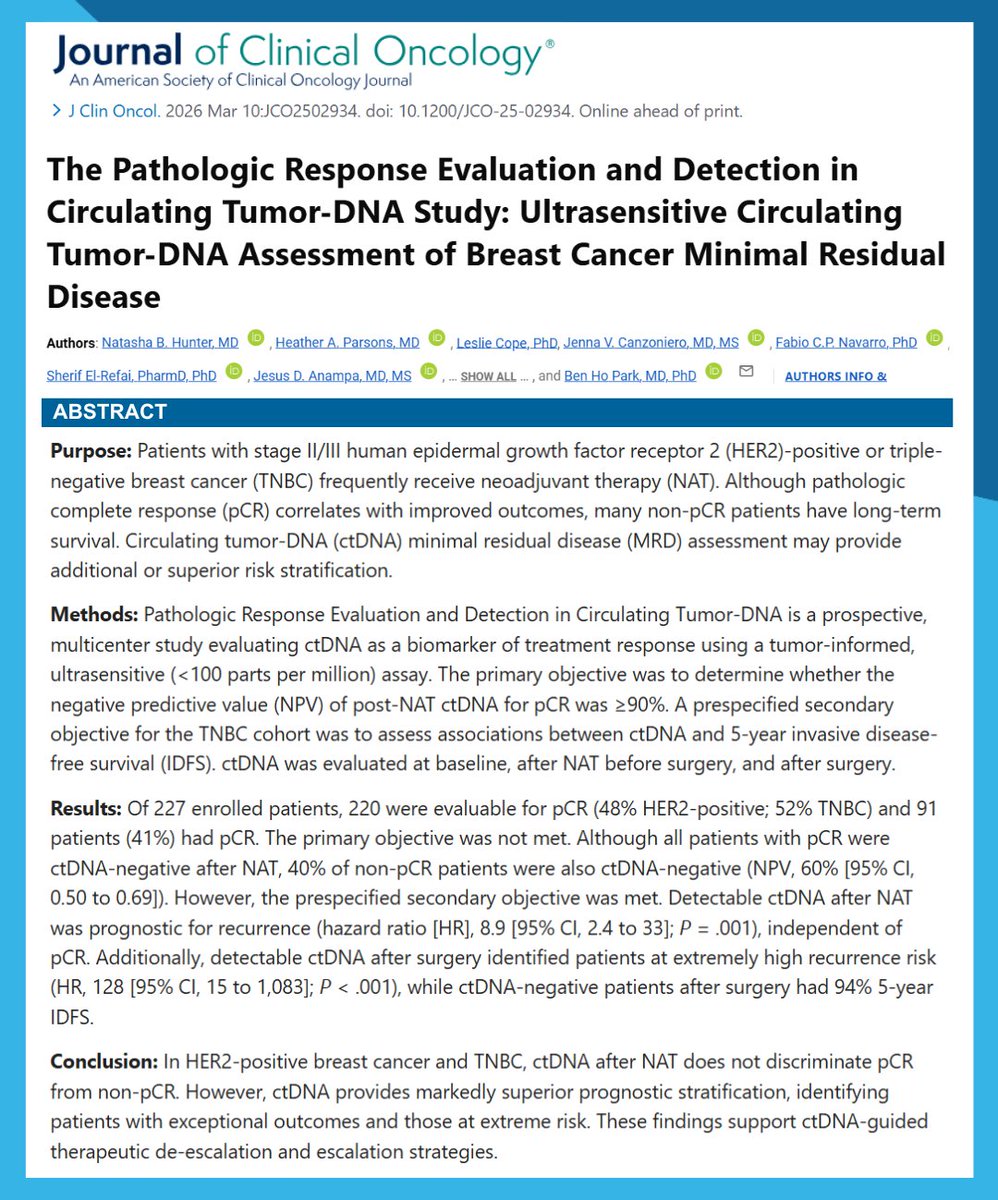
Now out in @JCO_ASCO: The Pathologic Response Evaluation and Detection in Circulating Tumor-DNA Study: Ultrasensitive Circulating Tumor-DNA Assessment of Breast Cancer Minimal Residual Disease pubmed.ncbi.nlm.nih.gov/41805422/ @hthrparsons @FNavarroBioInfo @smelrefai @jesusanampa @jsparano @mfrimawi @RitaNandaMD @AngieDemichele @guptalabunc @FilipaLynce @ErinCobain @DrShelleyHwang @awolff @benhopark #ctDNA #BreastCancer #MRD
Dana-Farber’s Breast Oncology Center tweet media
English
0
15
29
2.8K
Ankur Mehta
Ankur Mehta@oncomd·
Potential breakthrough for metastatic pancreatic cancer - DARAXONRASIB (Revolution Medicines): Ph3 RASolute‑302 in previously treated PDAC showed median OS 13.2 vs 6.7 months with chemo (HR 0.40, p<0.0001); met all PFS/OS endpoints and was well tolerated. Oral RAS(ON) inhibitor targets active mutant KRAS (mutated in ~90% PDAC) , driving tumor initiation, growth, metastasis and therapy resistance by hyperactivating MAPK/PI3K signaling. Targeting oncogenic RAS could finally turn a central tumor driver into a therapeutic vulnerability @DanaFarber_Hale @ASCO @PanCanResearch
English
0
0
0
97
Ankur Mehta
Ankur Mehta@oncomd·
Thanks Sarah, very helpful & imp to include these in guidelines for therapy change. Esp critical in bone only Mets & assessing ADC or I/o responses. Integrating radiology +tumor markers+clinical+ctDNA with rising TF helps(when scans equivocal)
Dr Sarah Sammons@drsarahsam

In mBC, not all imaging changes mean your therapy has stopped working and switching too early is a real risk. 1/ RECIST 1.1 sets a clear bar for progression: ≥20% increase in the sum of target lesion diameters (with ≥5mm absolute increase), unequivocal progression of non-target lesions, or new lesions. Not every change on imaging meets this threshold. 2/ Three scenarios commonly and incorrectly flagged as progression: new asymptomatic sclerotic bone lesions, small mm asymptomatic changes in known lesions, and increased SUV on PET without corresponding size change. None of these, in isolation, trigger a therapy switch for me. 3/ Sclerotic bone lesions deserve particular attention. When effective therapy kills tumor cells in bone, the body lays down new bone matrix appearing dense and white on CT. This is a healing response, not new disease. 4/ The consequences of switching too early are real: loss of disease control from a working regimen, premature exhaustion of sequencing options. 5/ My approach: I integrate clinical symptoms, tumor markers, and serial scans together before making any decision to change therapy. 6/ Bottom line: confirm true progression before changing course. When in doubt, a short interval rescan is almost always preferable to an unnecessary switch. #BreastCancer #MedOnc
English
0
0
0
191
Ankur Mehta
Ankur Mehta@oncomd·
Thnx for pointing out Mark! This should include trial mandated frequency of scans and testing, ex: on Herceptin, echo monitoring q3 mths in the absence of symptoms, makes no sense, especially if LVEF impact is reversible in all! We all have pts getting these ‘surveillance’ echocardiograms for years!
English
0
0
1
152
Ankur Mehta
Ankur Mehta@oncomd·
@dr_yakupergun @PTarantinoMD Agree with Paulo, it’s the best PFS of 44 mth in her2 positive disease so far! Destiny 09 was 40.7 mth in front line. Palbo is so well tolerated & low likelihood of neutropenia leading to infections, again manageable with dose mods if needed.
English
0
0
2
37
Paolo Tarantino
Paolo Tarantino@PTarantinoMD·
I’m all for being critical in interpreting trial results. In this case, though, the PATINA results speak by themselves. The addition of a well-tolerated drug (palbo) improved PFS from 29 to 44 months, with a slight increase in mostly hematologic toxicities (usually asymptomatic). This means 44 months without progression from a deathly metastatic disease, 44 months without the need for chemo, 44 months with a favorable QoL. And hopefully we will eventually see improved OS (requires a long time to read out). It’s hard not to consider this beneficial for our patients.
Timothée Olivier, MD@Timothee_MD

PATINA trial: maintenance palbociclib after first line anti-HER2+chemo in HER2/HR+ metastatic BC: - PFS benefit, no OS (not mature) - significantly more toxic (including financial) - significant early censoring imbalance (estimated 6% versus 12% over first 6 months in both arms, see Breaking-ICE App) -> makes PFS results less reliable, particularly in open-label trial - nonetheless the biological rationale, it is possible that ultimately no OS benefit will be seen "Adding toxicity without an improvement in clinical endpoints should generally be avoided." -> read our essay on PFS and other surrogates here : bmjoncology.bmj.com/content/3/1/e0… @vkprasadlab @VPrasadMDMPH
English
6
17
95
20K
Ankur Mehta
Ankur Mehta@oncomd·
PATINA@nejm. Since 2015 approval of palbociclib, we now finally confirm benefit in HR+Her2 pos mBC after a decade of use in HR+Her2neg mBC! unprecedented 44.3 mths PFS now possible in ~10% of all mBC Real world implications of PATINA, HER2C05 & DB09: 🔆 post induction THP -> HP + palbo /AI now SOC. 🔆 Her2C05 likely SOC in HRneg. But in select pts as tolerability - GI tox concerns if frail, low volume disease, where HP alone is easier. 🔆 Even in “exceptional” responders to THP, we should add Palbo early as better systemic control likely improves CNS PFS as already a signal in this subgroup. Significant absolute diff in CNS PFS of 6% at ~36 mths( ~13% vs 19%). 🔆 Brain Mets- if asymptomatic brain Mets at baseline ( ~12% in HER2CLIMB05, vs ~4% in PATINA) even in HR+, prefer Tucatinib as well established CNS efficacy even though it’s a shorter follow up of ~23 mths 🔆 Next ? Can we combine Tucatinib/Palbo/AI/HP for maintenance esp in Brain Mets? Barring payer coverage issues, there is at least some safety data in Ph 1b/2 trial that Palbo/Tucatinib combo is tolerable, although Palbo dose needed reduction to 75 mg for neutropenia. 🔆 TDxd induction might be ideal in brain Mets, followed by Tucatinib/HP/AI +/-Palbo in maintenance in HR+@NEJM @SABCSSanAntonio @DFCI_BreastOnc @breastcancer
English
0
0
0
113
Ankur Mehta retweetledi
Eric Topol
Eric Topol@EricTopol·
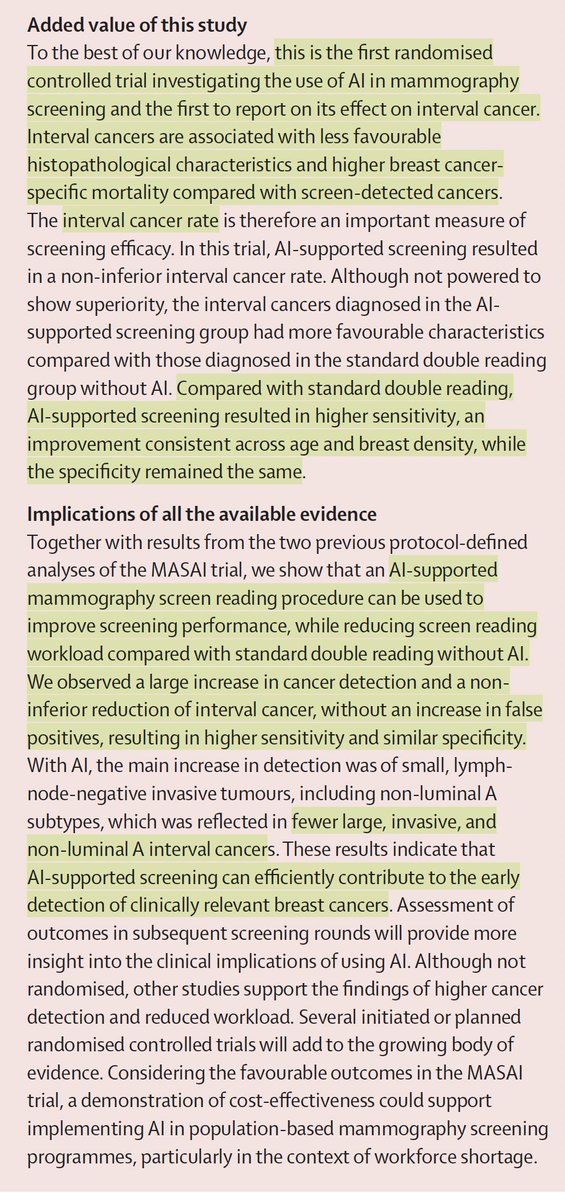
The largest randomized trial of medical A.I. —Over 100,000 women in Sweden —radiologist + AI vs 2 radiologists, in follow-up —AI added led to 29% more cancer detected, 44% reduced workload, and —Less cancer dx in subsequent 2 years, and, when found, less aggressive thelancet.com/journals/lance…
Eric Topol tweet media
English
113
1.3K
6K
1.5M
Ankur Mehta retweetledi
Paolo Tarantino
Paolo Tarantino@PTarantinoMD·
PATINA is now out in @nejm. Among pts with HR+/HER2+ MBC progression-free after chemo induction, adding palbociclib to 1L ET+HER2-blockade maintenance prolonged PFS from 29 mo to an astonishing 44 months (HR 0.75, p=0.02). Congrats @Otto_DFCI & coauthors! nejm.org/doi/full/10.10…
Paolo Tarantino tweet media
English
3
83
261
27.8K
Ankur Mehta retweetledi
Toni Choueiri, MD
Toni Choueiri, MD@DrChoueiri·
Congrats @DrIacovelli + all Italian🇮🇹 team in executing a near impossible trial and paving the way —@NatureMedicine #TACITO @Unicatt @gianluca1aniro
Roberto Iacovelli@DrIacovelli

Thrilled to share results from the TACITO trial, just out in @NatureMedicine! FMT vs pbo in mRCC pts receiving pembrolizumab + axitinib. Look at the posts for more👇 @gianluca1aniro @ciccarese_c @DrChoueiri @montypal @tompowles1 @OncoAlert @KidneyCancer @urotoday @Unicatt

English
1
14
50
9.8K
Ankur Mehta
Ankur Mehta@oncomd·
Intrinsic subtyping in HR + Her2 neg, especially Luminal B which may be more endocrine resistant might help clarify risk. We need better agents for Lum B & not sure if adjuvant cdk4/6 alone is sufficient
Aya Mohamed | MSc, MD 🎗@Dr_Oncologista

• Early TNBC: 74.3% •Non–high-risk HR+/HER2−: 91.2% ⚠️~60% of monarchE-eligible patients did not receive adjuvant abemaciclib Underuse most evident in N1 disease and older patients 📌 N1 ≠ Low risk N1 + Grade 3 or tumor ≥5 cm = true high-risk biology ET alone is insufficient

English
0
2
6
595
Ankur Mehta retweetledi
Aya Mohamed | MSc, MD 🎗
Aya Mohamed | MSc, MD 🎗@Dr_Oncologista·
• Early TNBC: 74.3% •Non–high-risk HR+/HER2−: 91.2% ⚠️~60% of monarchE-eligible patients did not receive adjuvant abemaciclib Underuse most evident in N1 disease and older patients 📌 N1 ≠ Low risk N1 + Grade 3 or tumor ≥5 cm = true high-risk biology ET alone is insufficient
English
2
3
6
943
Ankur Mehta
Ankur Mehta@oncomd·
Micrometastatic axillary disease after neoadjuvant treatment - The Lancet Oncology thelancet.com/journals/lanon… Post NACT, ypN1mi. Study asks if ALND reduces axillary recurrence at 3 yrs. Current SOC- SLND, targeted axillary dissection (TAD) + Regional Nodal Irradiation (RNI) if ypN1mic Key takeaways ✅ 3 y Axillary Recurrence (Primary endpoint) 2.0% (low) ✅ 1.7% with ALND vs 2.3% w/o ALND (P=0.92) ✅ overall safe to omit completion ALND in most, NOT ALL! ❌ in TNBC. 8.7% risk of recurrence at 3 yr (without ALND) vs 2.4% (with ALND), P=0.018. HR 3.83 ❌ omission of Nodal XRT in all HR 2.62. 🔆Practice affirming - in Non TNBC, safe to omit ALND but favor RNI. In TNBC clearly need RNI, and caution in omitting completion ALND. 🔆 Large sample size(1585 pts), multicenter, diverse groups of histology, stages included. 🔆limitations -retrospective ? possible bias if low risk pts selected for omission of ALND. Short f/u especially HR+ve pts with potential late recurrences. @breastcancer, @TheLancetOncol @ASCOPost @MontagnaGiacomo @SABCSSanAntonio
English
1
15
27
2.8K
Ankur Mehta
Ankur Mehta@oncomd·
A must read! Key take aways 1) Stage III Her2+ still needs intensive regimens as underrepresented in THP trials 2) 6 vs 4 cyc of Taxanes ⬆️ pCR but tox⬆️ 3) agree with Paolo-combine genomic/ctDNA/radiographic response to adapt escalation in neoadj 4) wkly Nab-pac/Pac seems better alternative to Docetaxel
Paolo Tarantino@PTarantinoMD

For a decade, the SoC for HER2+ eBC has been neoadjuvant TCHP. Yet, multiple signs suggest we may be moving towards a new SoC. A more tailored one. In this JCO editorial to NeoCARHP, I review the seismic shocks that are reshaping algorithms for HER2+ eBC. ascopubs.org/doi/10.1200/JC…
English
1
8
33
5.5K
Ankur Mehta
Ankur Mehta@oncomd·
Which premenopausal, node -ve HR+, Her2 -ve pts can omit OFS vs Tam mono therapy. Per SOFT/TEXT trials absolute benefit was low ~3- 5 % in distant relapse free survival even in higher risk (G3,>T2,chemo treated) & only 2-3 % OS benefit! QOL is quite poor on chronic OFS -menopausal symptoms, bone loss, poor sexual health, arguably worse for some even compared to 4 cyc of adjuvant TC! Need trials to selectively de-escalate OFS.
English
0
0
0
87
Ankur Mehta
Ankur Mehta@oncomd·
Thanks for highlighting this issue. while it’s nice to have multiple drugs with same MOA- PARPi, BTKi,CDK4/6i, SERDs etc. resources are better spent on novel drug MOA to allow multiple lines & combinations that can allow CRs/ extend cumulative survival. It’s disheartening to see most money spent in each pharma promoting their version of the same drug with some nuance.
Yakup Ergün@dr_yakupergun

Trends in target novelty in oncology research and development Most late-stage oncology drugs are not truly targeting novel biology. Although more than half of targets are novel at the preclinical stage, this proportion drops to roughly one third by phase III. What ultimately reaches clinical practice represents only a small fraction of the initial biological innovation. First-in-class drugs are fewer in number but disproportionately influential. In 2024, 41% of global oncology revenue came from first-in-class agents, despite these drugs accounting for only 31% of marketed products. The therapies that meaningfully shift clinical practice tend to come from this group. The balance between modality and target reflects deliberate risk management. Novel targets are more often pursued using established drug platforms, whereas new technologies are preferentially tested against validated targets. This approach aims to contain clinical development risk. The ADC strategy is clear: innovation lies in architecture, not the target. Most ADCs do not introduce new biological targets; instead, they exploit proven targets such as HER2 and improve efficacy through payload and linker optimization. Clinical benefit is largely driven by this structural refinement. The ‘me-too’ race starts well before approval. Targets such as CD137, CD47, and CDK2 attract dozens of parallel clinical programs. High density in a target space does not necessarily equate to strong or differentiated clinical benefit. The TIGIT experience is instructive. The collective failure of multiple phase III TIGIT programs underscores that being a novel target alone does not guarantee clinical value. 💬True clinical breakthroughs often arise from genuinely new targets, but this path carries substantial risk. Much of the progress seen in daily practice instead comes from smarter and more effective ways of exploiting established targets. nature.com/articles/d4157…

English
1
1
2
289