Oliver Pardo

6.2K posts

Oliver Pardo banner
Oliver Pardo

Oliver Pardo

@opardor

Director del Centro Javeriano de Competitividad @CJC_PUJ. Profesor Asociado, Pontificia Universidad Javeriana. PhD @LSEecon.

Bogotá, D.C., Colombia Katılım Eylül 2010
4.8K Takip Edilen2.4K Takipçiler
Sabitlenmiş Tweet
Oliver Pardo
Oliver Pardo@opardor·
Hace unas semanas lanzamos El Laberinto Fiscal de Colombia en la Javeriana. Para quienes no pudieron venir —o quieren revivir la conversación— el video completo está disponible. ▶️ youtube.com/live/S_34M4pyS…

YouTube video
YouTube
Español
0
1
3
137
Oliver Pardo retweetledi
Banco República 🇨🇴
Banco República 🇨🇴@BancoRepublica·
📉 ¿Por qué las tasas de los créditos hipotecarios van al alza incluso cuando la tasa del Banco de la República había venido bajando? En este nuevo episodio de Cuentas y Cuentos, Mauricio Reina (@ReinaMauricio) conversa con Daniel Osorio (@danielesosorio), investigador del Banco de la República, sobre los factores que hoy están influyendo en las tasas de interés del sector inmobiliario en Colombia. Más en el reciente capítulo del #PódcastBanRep 👉 ow.ly/lG2450Z2irP A partir de un análisis reciente, el episodio explora por qué la relación entre la tasa de política monetaria y las tasas del crédito hipotecario se ha debilitado, qué papel está jugando la deuda pública y por qué esto hace más desafiante el ejercicio de la política monetaria. Consulte el Blog de #BanRepExplica "La relación entre la tasa de interés de intervención y la tasa de interés hipotecaria en la coyuntura reciente" 👉 doi.org/q6q2
Banco República 🇨🇴 tweet media
Español
5
21
37
4.5K
Oliver Pardo retweetledi
Henry Amorocho Moreno
Henry Amorocho Moreno@henry_amorocho·
Con todo respeto me parece casi que extemporánea la advertencia de la #ContraloriageneraldelaRepublica al manejo de la Deuda pública externa e interna en C/bia 2025 - 2026. Cuanto desborde de las finanzas públicas se habría evitado si hubiese habido un control fiscal oportuno.
Español
0
2
2
174
Oliver Pardo retweetledi
Andrea Otero
Andrea Otero@acocotero·
Nuevo Blog Banrep: "Este resultado muestra que el deterioro de la situación fiscal no solo encarece la deuda pública, sino que también eleva el costo de los créditos hipotecarios y el financiamiento de proyectos de inversión a largo plazo de la economía." banrep.gov.co/es/blog/relaci…
Español
0
13
29
1.1K
Oliver Pardo retweetledi
Jack Prandelli
Jack Prandelli@jackprandelli·
Norway and the UK drilled the same North Sea. 🇳🇴Norway got $2 trillion. 🇬🇧The UK got tax cuts. Same basin,Same era.... Completely different outcomes. Norway captured $30 per barrel in government revenue. The UK captured $11. That gap, compounded over 50 years of production, is the entire difference. Norway's model was simple: tax heavily (78% marginal rate), take direct equity stakes in fields via the SDFI, own part of Equinor, and put everything surplus into a fund invested abroad. The Government Pension Fund Global now holds over $2 trillion in assets. That's $390,000 per Norwegian citizen about 1.5% of all listed equities on earth. The fiscal rule: only spend the 3% annual real return. Never touch the principal. The UK started producing earlier, at lower prices, with a lower tax rate (40%) and no saving mechanism. North Sea revenues flowed straight into the general budget. Economists estimate the UK missed out on roughly £400 billion compared to a Norwegian style regime. The windfall largely financed tax cuts in the 1980s rather than a fund. Where things stand in 2026? Norway's petroleum sector will generate $63 bn in net cash flow this year alone feeding a fund already large enough to cover 10-15% of the national budget from returns alone. The UK is a net energy importer. Since 2021 it has paid countries like Norway more than £100 billion for gas. One country treated oil as a finite resource to convert into permanent financial wealth. The other treated it as income. image source:eia
Jack Prandelli tweet media
English
417
3.3K
10.4K
1M
Oliver Pardo retweetledi
Natalia Gurushina
Natalia Gurushina@NGurushina·
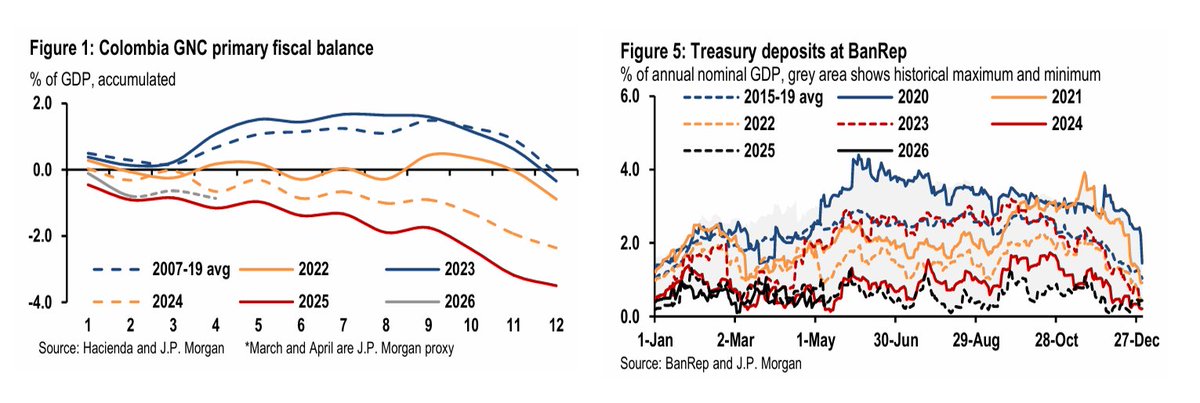
Colombia - Fiscal charts from JPM’s Juan Goldin and Diego Pereira tell a troubling story - a widening primary gap and an evaporating Treasury cash buffer. Elections matter.
Natalia Gurushina tweet media
English
5
48
142
21.8K
Oliver Pardo retweetledi
César A. Hidalgo
César A. Hidalgo@cesifoti·
Europe is one of the best places in the world to live, but one of the hardest places to build and scale a company. After 5+ years in France, following 16+ in the US, I have a conflicted admiration for Europe. On the one hand, Europe has great potential. When I lived in the US, I was skeptical of the European quality-of-life argument. But after getting used to Sunday morning markets, walkable cities, and 4.5 meter ceilings, I get it. There are things that you simply cannot import or experience as a tourist. These things can make Europe very attractive for creative and intellectual work. I honestly believe some parts of Europe are the “best neighborhood” in the planet. But that’s not the full story. I am not only a husband and a dad. I am also an entrepreneur. I founded a company in the US 12+ years ago that has offices in the US and Chile and clients throughout the world. I live in France, yet I have not opened a subsidiary here. That is telling. We once hired someone in France through one of those remote employment platforms. The person received about 5,000 euros net per month, which is considered a very good salary here. But the total cost to the company was closer to 13,000 per month. That makes hiring feel less like a relationship between a company and a worker, and more like renting someone from the state. At the same time, you take an enormous amount of legal and administrative responsibility. The presumption is that all companies should operate like a 1960s car manufacturer. The response is simple. Don’t set up operations in Europe. But this is not a remote-work story. I know many small entrepreneurs in France who do not want to cross the threshold from being a one-person activity to becoming an employer. They sometimes refuse a new customer to stay small and avoid the obligations that come with hiring one person. That should worry us. Many social protections here are described as being provided by the state, but in practice, a lot of the cost and complexity of the implementation falls on the administrative shoulders of entrepreneurs. That is reasonable for a large energy company or bank. But for a small business, it is the difference between an entrepreneur waking up on a Monday to think about product or paperwork. Growth is not the enemy of the European social model. It is what enabled it. Much of the quality of life we enjoy here today dates back to growth incubated in the past. Growth that is increasingly hard to find. France once led frontier industries, like bicycles in the 1860s, cinema in the 1890s, and aviation and automobiles soon after. Since then, Europe built a more humane social model. But that model was built on the assumption that Europe and the US were the only two rich and industrialized places in the world. That is no longer true. Global competition in the 21st century is not what it used to be 50 years ago, and the padding built to protect us, may have grown into the handbrake that constrains the growth of the small and flexible firms we need to compete in new frontier sectors. We should be able to be critical about Europe in our own terms, without comparing ourselves to the US or China. Innovative parts of Europe, like Sweden or Switzerland, operate differently and provide clues. Sweden has embraced a dynamic of capitalization in its pension system for a long time in a continent where fewer people buy stocks. Switzerland, a place that shares an enormous amount of geography and culture with its neighbors, is built in part on strong internal competition among its cantons. But neither can light a candle to a French open-air market on a Sunday morning. A market where cash is king, and for a reason. Europe may be the best place in the world to live. But it is also one of the most challenging places to build and scale an innovative activity. The goal is not to weaken the European model. But to get to a place where we can lead again by example. The world will follow us, but only if we are ahead.
César A. Hidalgo tweet media
English
79
165
1K
137.2K
Oliver Pardo retweetledi
All day Astronomy
All day Astronomy@forallcurious·
🚨: A super El Niño is forming in the Pacific - the biggest since the recorded history Get ready for extreme winters since 1877!
All day Astronomy tweet media
English
1.7K
10.2K
71K
12M
Oliver Pardo retweetledi
Felipe Jiménez Ángel
Felipe Jiménez Ángel@felipeangell·
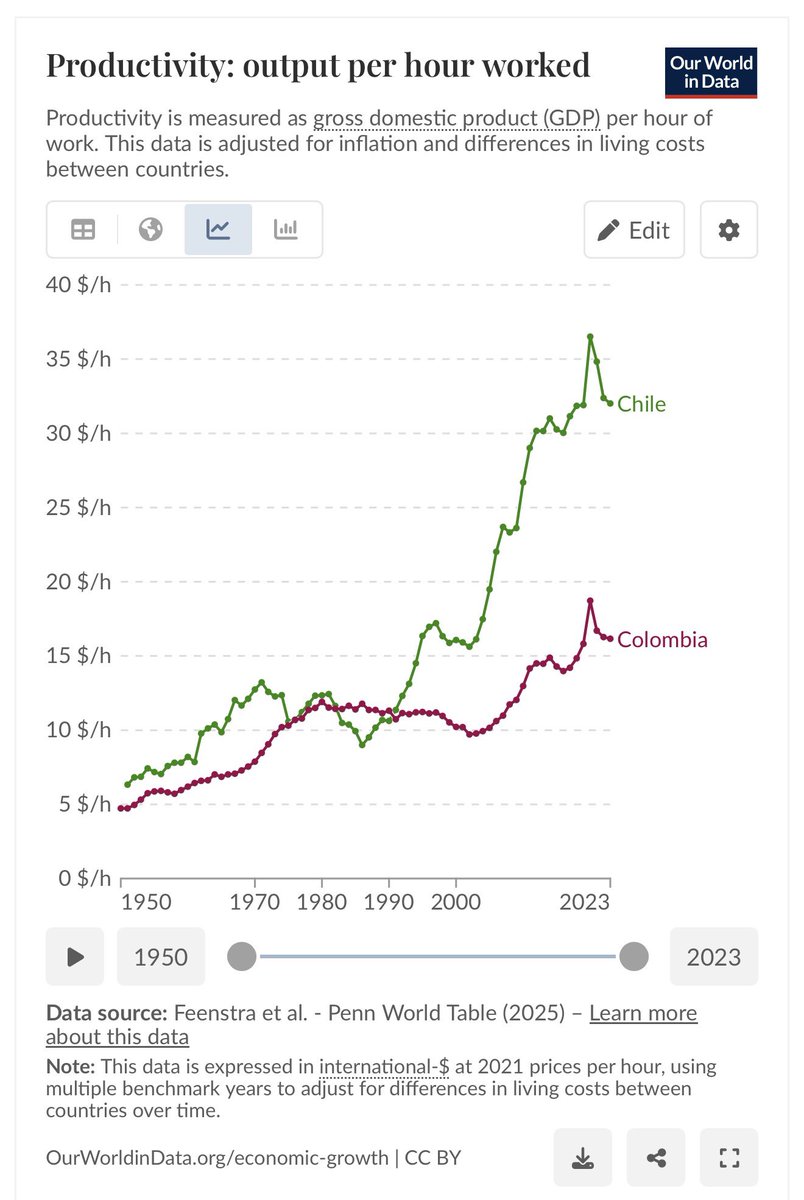
En 1990, la productividad de un trabajador colombiano y uno chileno era la misma. Hoy, la de un chileno es el doble que la del colombiano.
Felipe Jiménez Ángel tweet media
Español
17
157
494
107.5K
Oliver Pardo retweetledi
Paul
Paul@WomanDefiner·
Today I learned the people who make pure silicon are basically the Samurai sword makers and master blacksmiths of our era and that even if China gets Taiwan they wont be able to make chips anywhere near as good as the US can because we have the purest quartz in the world.
English
348
1.5K
18.3K
862.4K
Oliver Pardo retweetledi
Luis Garicano 🇪🇺🇺🇦
Albanian PM credits @ricardo_hausman with fixing the most unfixable country in Europe. All of us economists can learn from the approach. With all my admiration, PMs quotes in laudatio: "There are many economists who explain the world after it changes, and then there are very few economists who change the world before the world itself notices. Professor Ricardo Hausmann belongs to the second category." **[00:01:22]** "My relationship with Ricardo started as a total failure. I tried unsuccessfully to reach him when I was in opposition... eventually I understood something very important: first, you have to win the elections, which in retrospect may be the most sophisticated vetting process of all. So, as soon as I won, Ricardo came." **[00:03:45]** "He came with boots on the ground... countries like ours have seen many experts who know everything, explain it to the country after spending six hours in a hotel, and prepare reports so thick that nobody reads them. Ricardo was completely different. He listened, asked questions, and observed." **[00:07:15]** "Ricardo’s concept of 'black belt teams' allowed us to overcome bureaucracy and deliver strategic projects. He did not come with presentations, but with a hands-on approach." **[00:08:40]** "He taught us that a country’s wealth is not what it has under the ground, but what its people know how to do together." **[00:13:50]** "Ricardo changed the mindset of the government from explaining failures to identifying opportunities." **[00:15:20]** "I remain grateful not only for your advice, but for your trust in Albania – that this country can aspire to more." **[00:18:10]**
Ricardo Hausmann@ricardo_hausman

It was a real honor to receive a Doctorate Honoris Causa from the University of Tirana in Albania. It was an even greater honor to have Prime Minister Edi Rama deliver the Laudatio speech. His words left me speechless. youtu.be/5aIahPFHPzs?si…

English
2
53
270
57.2K
Oliver Pardo retweetledi
Jesús Fernández-Villaverde
Jesús Fernández-Villaverde@JesusFerna7026·
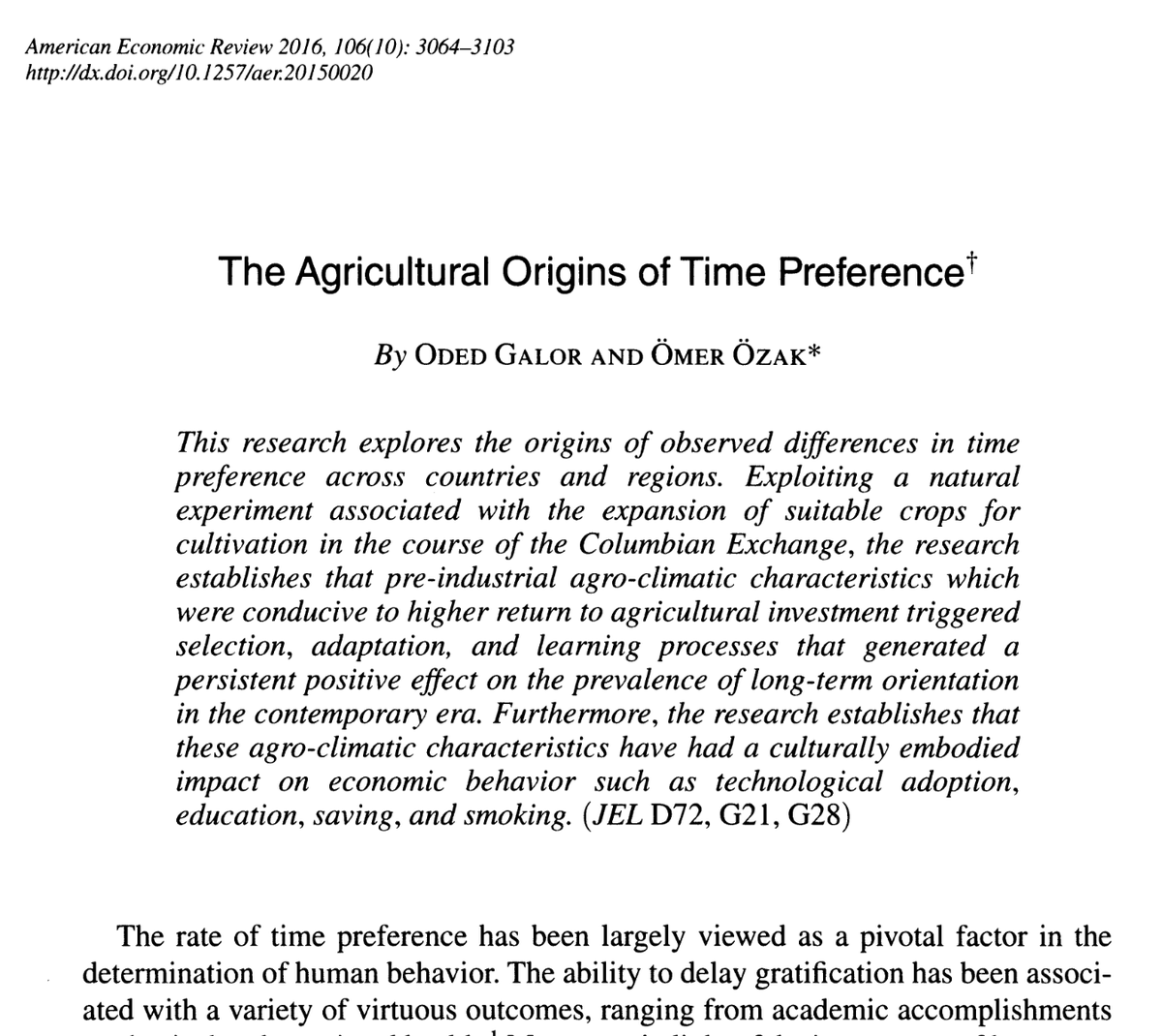
Many of you sent me messages or left comments with more papers linking economic growth and directional selection. Thanks very much! Oded Galor, @GalorOded, reminds me, in particular, of his paper with Ömer Özak, @OmerOzakEcon, in the AER, “The Agricultural Origins of Time Preference,” which links pre-industrial agro-climatic conditions favorable to higher returns to agricultural investment with a persistent positive effect on long-term orientation today. This is at the core of yesterday’s discussion. Omer Moav, @Omer_Moav, posts a short review of recent findings: warwick.ac.uk/fac/soc/econom… and a discussion of the relation with Gregory Clark’s (@GregoryClarkUCD) “A Farewell to Alms.” I apologize to Gregory for not mentioning his book (which I use when teaching undergrads!). There was no deeper motivation than wanting to keep the post short. Unfortunately, X is not the best platform to acknowledge everyone’s contributions. Radoslaw Stefanski (@stefanski_radek) and Alex Trew follow a similar line of argument in “Selection, Patience, and the Interest Rate” in JPE: Macro, arguing that endogenous selection on patience helps explain falling interest rates. It also predicts a long transitional rise in savings rates, generating transitional growth. After all, selection is the ultimate driver of economic growth. We do not see much increase in the income per capita of squirrels. Without evolution, there would be no technological improvement or sophisticated division of labor (yes, among some animals, there are degrees of cultural improvement or division of labor, but nothing that sustains long-run growth). The discussion is only whether directional selection made a difference over the last few thousand years. Paul Novosad, @paulnovosad, draws my attention to “Cognitive Endurance as Human Capital” in the QJE by Christina Brown, @christinalbrown, Supreet Kaur, Geeta Kingdon, and Heather Schofield, who show that schooling may build human capital by expanding the capacity for cognition. In particular, they document that the experience of effortful thinking itself, even when devoid of any subject content, improves general cognitive capacity. So, yes, practicing the five declensions of Latin and the three voices of Ancient Greek is probably a much more useful allocation of time than “At Lincoln Elementary, we inspire every child to become a confident, curious, lifelong learner ready to thrive in an ever-changing global community.” There are many more papers and books, but I do not want to overextend myself. I only want to point out to young students and researchers what a vibrant field economics is. Check the webpages of Oded, Ömer, Omer, Gregory, Radoslaw, Alex, and everyone I cited here, and you will find dozens of fascinating papers. Also, on a personal level, I have had the good fortune to interact a bit with Oded and Omer. Both are true scholars in the best sense of the word, curious about the world and seeking to get things “right,” not just another publication. I do not always agree with their readings of the evidence, but even when I do not, I learn an immense amount from them. And guess what? It seems that time is vindicating their views.
Jesús Fernández-Villaverde tweet media
English
4
70
382
27.8K
Oliver Pardo retweetledi
Philipp Heimberger
Philipp Heimberger@heimbergecon·
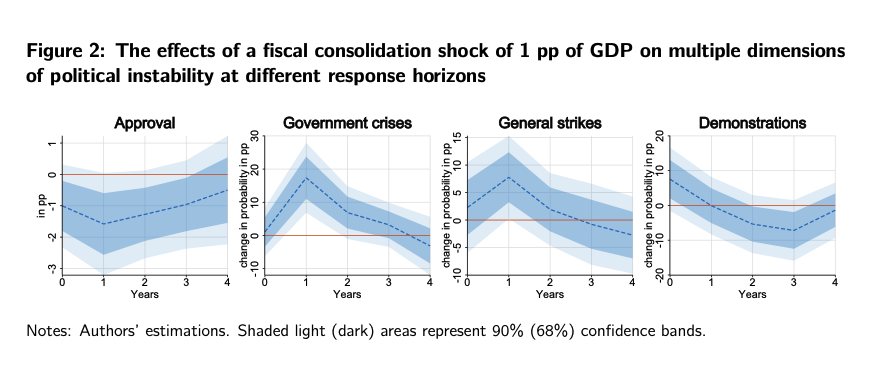
Our paper on fiscal consolidation and political instability in advanced economies: fiscal consolidation carries political costs. It lowers gov. approval and increases the likelihood of protests and government crises. However, costs vary with econ. conditions and policy design. 🧵
Philipp Heimberger tweet media
English
2
37
143
13K
Oliver Pardo retweetledi
Prakash
Prakash@8teAPi·
Crazy. “In Columbia today 95% of the Y chromosome (passed down from fathers) is European and 95% of the mitochondrial DNA (passed down from mothers) is Native”
Dwarkesh Patel@dwarkesh_sp

David Reich on how much ancient DNA evidence has overturned so much consensus thinking how ancient cultures spread. "It wasn't peaceful, it wasn't friendly, it wasn't nice. Some of our archaeologist co-authors were just really distressed."

English
93
220
3K
315.3K
Oliver Pardo
Oliver Pardo@opardor·
El país debe continuar con el desmonte de beneficios tributarios, entre ellos aquellos capturados por la industria financiera a través de comisiones de administración, como se reconoce aquí sin pudor @marimatamoros
Nexo Valor@SebastianG20039

@FulanoZuluaga @JoseILopez @trespunto14 2.Criticar el techo de la comisión sin mencionar el suelo del 0,75% es sesgado. Para quien busca eficiencia tributaria, el ahorro en impuestos aplasta ese costo. Si no le alcanza para bajar la tasa por saldo, simplemente no es el producto para usted. Así funciona el mercado

Español
0
2
4
292
Oliver Pardo retweetledi
Jesús Fernández-Villaverde
Jesús Fernández-Villaverde@JesusFerna7026·
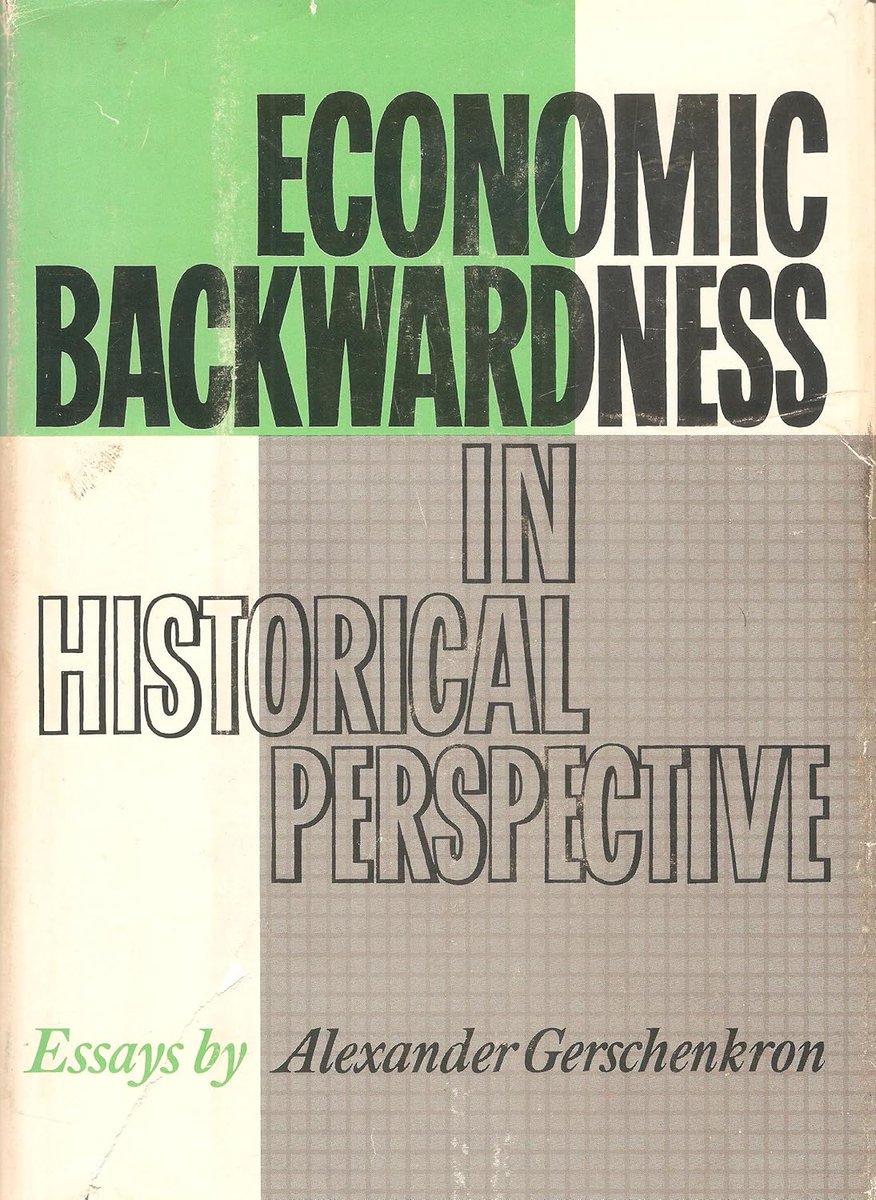
A post of mine on industrial policy from last July is having a second life, so let me rewrite it more clearly now that I have more experience with X. Can industrial policy work? Yes. The East Asian experience shows it can, at least partially. But its success rests on a key condition: labor control. Japan, South Korea, and Taiwan industrialized rapidly under authoritarian (e.g., Park’s South Korea) or semi-authoritarian regimes (e.g., Japan). Wages and labor rights were systematically repressed to favor capital accumulation and export competitiveness. This was especially stark in South Korea during the 1980s and 1990s, when unions clashed with the state and big business. China’s recent experience basically follows the same pattern. Authoritarianism in East Asia was not incidental to the success of industrial policy. It was functional. No labor repression, no successful industrial policy. Let me be careful about what I am NOT claiming: 1) I am not claiming labor repression is sufficient for industrial policy to succeed. You need many other ingredients. Best counterexample? Brazil under import substitution: labor repression, but without the other key pieces, such as aggressive export orientation. Labor repression is a necessary condition. If you do not get the difference between necessary and sufficient, you have more important priorities than reading about industrial policy. 2) I am not claiming the only path to growth is industrial policy. Many countries have grown without it, or with pretty lousy and ineffectual versions of it. Best example? Spain. 3) I am not saying labor repression means wages do not grow. It means they grow less than they otherwise would have. Think counterfactuals. 4) I am not saying democracies cannot repress labor. They sometimes do. It just happens far less often, and often less effectively. Continental Western Europe after WWII was not an example of industrial policy. France and, to some degree, Italy used some, but the mainstream view is that postwar growth was not driven by it. What many of these countries used was a form of “coordinated capitalism,” in which unions accepted slower wage growth in exchange for higher investment and faster growth. That has a flavor similar to my argument. As far as I can tell, there is no clean example of large-scale industrial policy that has succeeded without labor repression. Why so many people on the left are in love with industrial policy is a mystery to me. More generally, why so many people on the left admire China, given that its economic policy is 100% contrary to what they support (low taxes, little industrial regulation, little concern for the environment, labor repression, as little economic and political power to women and minorities as possible) is even more of a mystery except for some infantile contrarian positioning (“since this is not what The Economist like, I support it”) Alexander Gerschenkron made this point better than anyone. But it was also Marx’s point about “primitive accumulation,” and Stalin’s logic in the five-year plans, which were all about repressing labor (mostly agricultural, but to a lesser degree in manufacturing too). I am not going to praise Stalin in public, but he understood economics better than the average poster on X. Read Gerschenkron. Seriously. The original post: x.com/JesusFerna7026…
Jesús Fernández-Villaverde tweet media
English
24
184
710
121.6K
Oliver Pardo retweetledi
Flor Esther Salazar
Flor Esther Salazar@fesalazarg·
Comparto esta columna sobre el sistema de salud. Para mejorarlo no basta con cambiar quien maneja los recursos, se requiere alta capacidad institucional para gestionarlos-Intermediación y fallas institucionales:una lectura del sistema de salud en Colombia razonpublica.com/intermediacion…
Español
0
2
6
242