Olaf van Wijk

1.4K posts

Olaf van Wijk

Olaf van Wijk

@ovanwijk

Design the ant, not the colony. Tweets are my own, quitely building @nihiliumio

Katılım Aralık 2011
297 Takip Edilen553 Takipçiler
rin(free/sbf)
rin(free/sbf)@rinegade·
I’ve noticed that a lot of people have left Crypto. If you are still here, reply. I want to connect everyone who’s helping keep crypto alive! 💪
English
187
0
323
13.4K
tmuxvim
tmuxvim@tmuxvim·
has anyone else noticed that GPT-5.4 often ends its responses with like, clickbait? it often promise to reveal "the one surprising X that will do Y" or something like that
tmuxvim tweet media
English
612
80
7.1K
418.2K
Olaf van Wijk retweetledi
ETHPrague
ETHPrague@EthPrague·
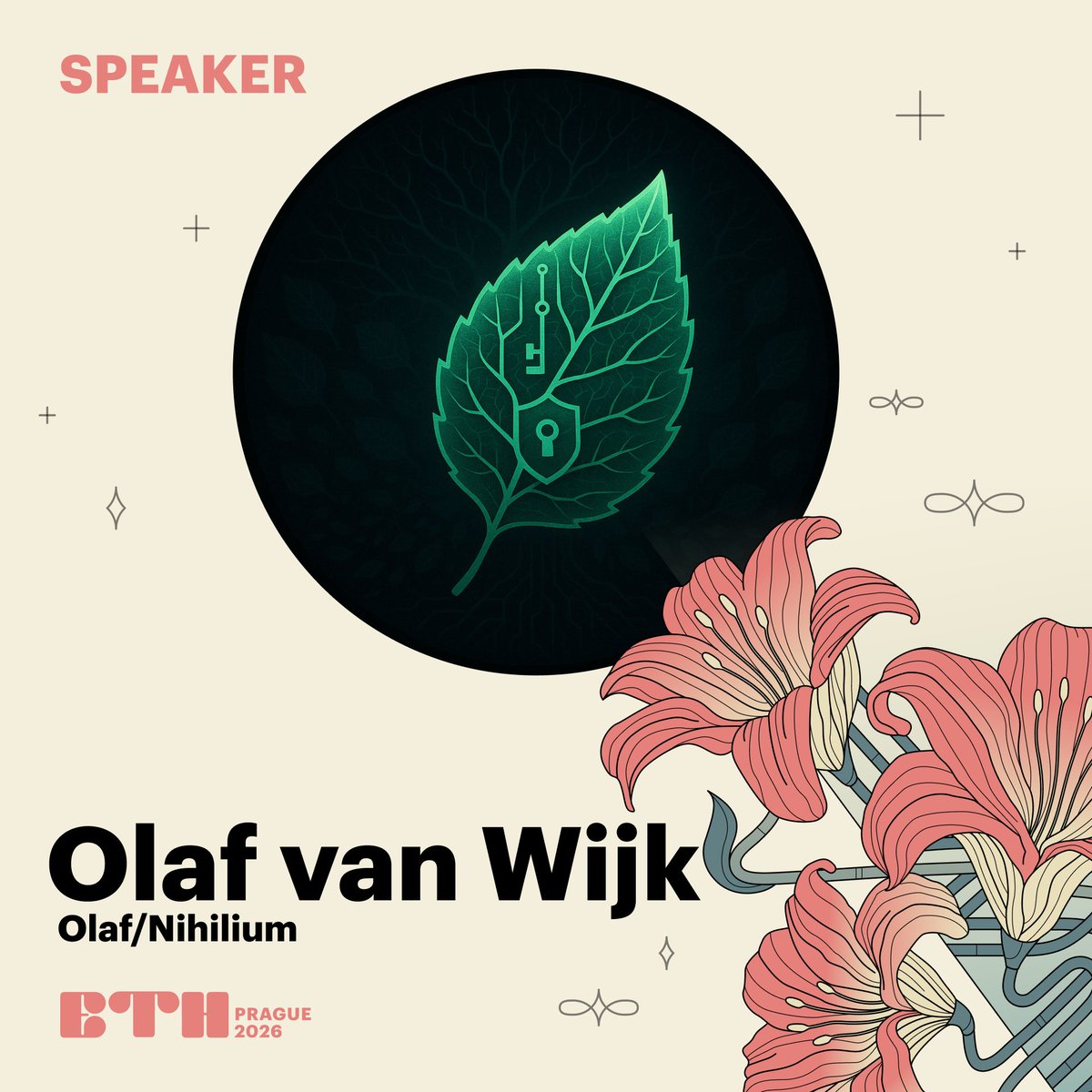
🥷He might seem quiet, but his building speaks loud 🗣️ @ovanwijk from @nihiliumio is the next speaker on our list, and we couldn’t be more excited! This May at ETHPrague ☀️ 🎟️ Get tickets in bio
ETHPrague tweet media
English
1
2
11
389
Olaf van Wijk retweetledi
Patrick Henningsen
Patrick Henningsen@21WIRE·
This is a masterpiece.
Patrick Henningsen tweet media
English
179
2.4K
15.8K
204.3K
Olaf van Wijk retweetledi
Roman Storm 🇺🇸 🌪️
Today, the SDNY prosecutors filed a letter to Judge Failla requesting a retrial date. They want to go again in October. The prosecutors want to retry me on 2 counts the jury couldn't unanimously decide on. A jury of 12 Americans heard 4 weeks of evidence and deadlocked: no verdict on money laundering, and no verdict on sanctions violations. The government's response? Try again to make writing code a crime. @realDonaldTrump declared the "War on Crypto is over." 🇺🇸 AG @DAGToddBlanche's memo: DOJ "is not a digital assets regulator" and won't target mixers for end-user acts. @USTreasury lifted Tornado Cash sanctions entirely. ✅ Also Treasury, March 2026: "Lawful users of digital assets may leverage mixers to enable financial privacy." — official report to Congress under the GENIUS Act. But the SDNY prosecutors — same country, same DOJ — just filed to retry me anyway. 🤔 ⠀ The 2 counts = up to 40 years in federal prison. ⛓️ For writing open-source code. For a protocol I don't control. For transactions I never touched. A jury already couldn't agree this was criminal. But the SDNY prosecutors want to keep trying with the hope of getting a different answer. ⠀ I have a daughter. I have a life in Seattle. I will never stop fighting for freedom. ❤️ But I need to be honest with you: Four weeks of trial. A hung jury. Now they want to do it all over again in October. I have basically exhausted my legal defense funds. And I'm staring down another full federal trial. 😔 Every dollar raised goes directly to keeping this fight alive — attorneys, experts, the full defense apparatus it takes to stand up to the SDNY prosecutors. This isn't abstract. If I can't fund a defense, they win by default. If you care about financial privacy, if you write code and believe that code is speech — this is the moment. 💻🔐 👇
Roman Storm 🇺🇸 🌪️ tweet media
English
118
491
1.7K
165.9K
Olaf van Wijk
Olaf van Wijk@ovanwijk·
Read it, it is very interesting!
ethresearchbot@ethresearchbot

New post on EthResear.ch! Slashable Conditional Key Release: A Deployable Crypto-Economic Approximation of Witness Encryption By: - ovanwijk 🔗 ethresear.ch/t/24336 Highlights: - Witness encryption is theoretically possible but not practically deployable; this research proposes a crypto-economic alternative. - The new system, called Nihilium, uses economic stakes to ensure that operators cannot decrypt messages without satisfying specific conditions. - Nihilium combines established cryptographic techniques like zero-knowledge proofs and homomorphic encryption to create a secure and user-friendly experience. - The system allows for public observability of unsealing attempts, enhancing security and accountability. - Two test implementations of Nihilium are already operational, demonstrating its practical applications in secure file delivery and password recovery. ELI5: This research introduces a new way to encrypt messages so that only someone who meets certain conditions can unlock them, without needing a trusted third party. It uses a combination of cryptographic techniques and economic incentives to ensure that the person who holds the key has a strong reason to follow the rules.

English
0
0
1
57
Olaf van Wijk retweetledi
marilyn100x.eth
marilyn100x.eth@marilyn100x·
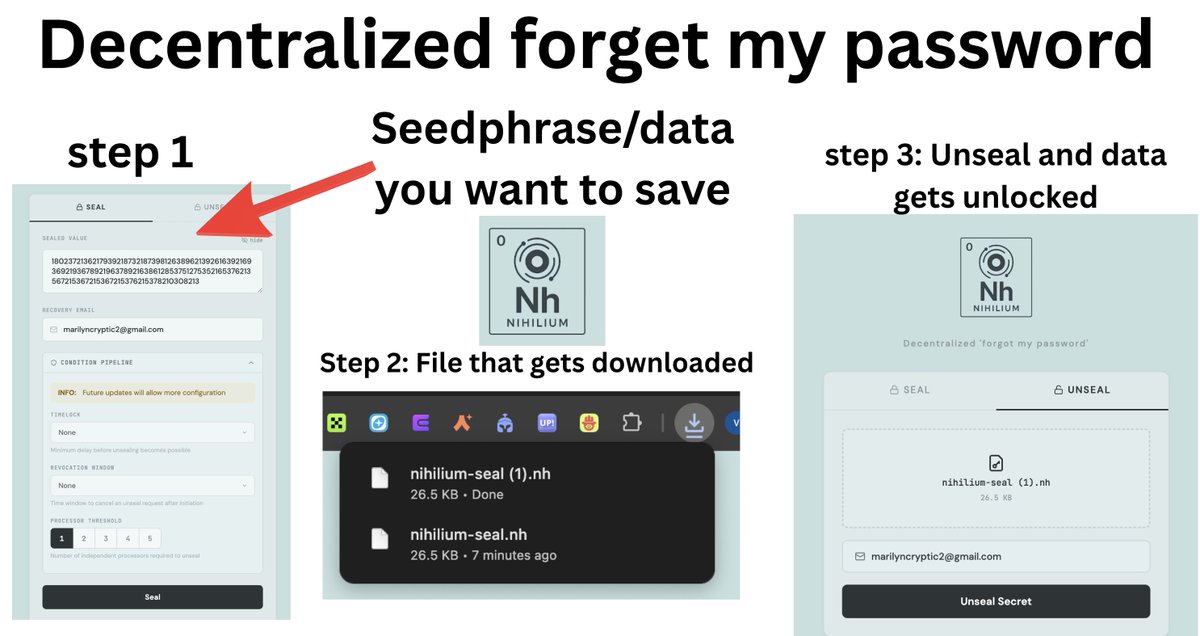
Forget your seedphrase. Literally. @nihiliumio just built a way to seal your seed, encrypted, stored in a file, recoverable only by replying to an email. No third party holds it, no one can access it but you. You seal it. You get a file. To unseal, you upload it and reply to an email. That's the only key. Works for any sensitive data, not just seedphrases. This is the kind of UX that onboards the next million people. Please note this is a demo and should not be used for sensitive data atm
marilyn100x.eth tweet media
English
9
4
39
1.5K
Olaf van Wijk
Olaf van Wijk@ovanwijk·
@PeterSweden7 It was to celebrate the role of the women protests that 'started' the Bolshevik revolution, murdering millions. Women's day was celebrated everywhere on different dates. But we ended up with the 8th because it was marked as the start of Communism. Symbolism 🎉
English
0
0
2
143
PeterSweden
PeterSweden@PeterSweden7·
Can you guess who invented "international women's day"? It was Socialists and Communists. In fact, it was Lenin himself in the Soviet Union that formalized March 8th as the date for international women's day. It is basically a Communist holiday.
English
87
202
1.4K
130.1K
Olaf van Wijk
Olaf van Wijk@ovanwijk·
Very proud of this work! Exactly the use-case I set out to solve almost seven years ago with @nihiliumio . Privacy, crypto and self-sovereignty one step closer to be being ready for mass adoption. This all for under a cent, for all chains and all secrets! LFG!
Nihilium@nihiliumio

Web3 'forgot my password' is finally here! The missing piece for a smooth UX. Decentralized, censorship resistant and works for all chains and secrets! Try it out yourself on recovery.nihilium.io

English
0
0
1
70
Olaf van Wijk
Olaf van Wijk@ovanwijk·
@VitalikButerin "Recovery is the key to self sovereignty". Tomorrow @nihiliumio will drop a demo showcasing the next gen recovery that will spearhead adoption and that includes privacy tooling. We can't serve humans if we can't deal what makes us human: mistakes
English
0
0
0
25
vitalik.eth
vitalik.eth@VitalikButerin·
I think it's healthy for us in the Ethereum world to have a more bold and open mindset to many things, particularly on the application layer and on how we see ourselves in the world. We should not compromise on core properties: censorship resistance, open source, privacy, security (CROPS). We should not have "open mindedness" of the type that leaves people with no confidence of what security properties the L1 will still have one year from now. We should not ask ourselves questions like "do we really need light clients to be able to trustlessly verify correctness of the chain?". But especially on the layer of applications and Ethereum's interface to the world, we should be more willing to radically rethink various concepts and step outside our comfort zone. This includes issues of technological direction, eg. "what if AI basically means that wallets as browser extensions and mobile extensions are dead within a year?" One example last year was the shift to thinking about privacy as a first-class consideration, something we value equally to the other types of security. This implies a radically different Ethereum application stack, because the entire stack so far has not been built around privacy. Great, let's build a radically different Ethereum application stack! An example this year is the growing work on the networking side of privacy, both inside the EF and outside. It includes application-layer issues, eg. "what if the rest of defi is basically just universal futures markets on top of a good decentralized oracle and letting users self-organize on top of that?", and "what if the ideal decentralized oracle is just a SNARK over M-of-N small LLMs over zk-TLSes of some major news sites?" (BTW this is interrelated with the AI issue: one consequence of AI is that it moves "applications" away from being discrete categories of behavior with discrete UIs, and more toward being a continuous space, so "build fewer apps and rely on users to self-organize around them" should inevitably expand as a pattern) One example this year is rethinking from zero the role of L2s, and what kind of L2s are actually most synergistic and additive to Ethereum. It also includes culture. This is a big part of "the whole milady thing" for myself, @AyaMiyagotchi and others. Yes, it's a silly meme. Yes, I find the political takes of some milady partisans cringe and sometimes outright bootlickerish (though other milady partisans are quite the opposite). But the core underlying subtext, the message behind the message, is: rip off the suit and tie. If you have your suit and tie on, be willing to grab the nearest wine glass and spill it all over your suit and tie, so you have no choice but to rip it off and reclaim your body's full flexibility and freedom. Actually imagine yourself doing this the next time you get invited to a richpeopleslop formal gala dinner. Take the preconception that you are "respectable", write it down on a piece of paper, crumble it up and burn it. The psychological baptism of doing this leads to the intellectual baptism of unlocking greater creativity and expanding overton windows. For too long, our algorithm in Ethereum has been: we have this existing ecosystem, what's the logical next step to make it one step better? Now, our algorithm should be: we have this L1 that is amazing and will become more amazing, we have a growing array of tools, both those built within our ecosystem and outside it, what are the most valuable things to build, knowing what we know now? If YOU had to write the section of the 2014 Ethereum whitepaper that talked about applications, and take a first-principles perspective of what makes sense in defi, decentralized social, identity, and elsewhere, what would you write? At least take the step of marking all path-dependence concerns down to zero, pretend for a brief moment that the Ethereum chain today has exactly zero usage and you're the one suggesting or building the first apps, and see what comes out. Do this even if you're the one building today's existing apps. This is how Ethereum can grow back stronger.
English
542
364
2.5K
442K
Olaf van Wijk
Olaf van Wijk@ovanwijk·
@Justin_Bons It requires one major UX upgrade to truly onboard the masses. Luckily you happen to know the guy who is fixing it ;)
English
0
0
1
60
Justin Bons
Justin Bons@Justin_Bons·
Cryptocurrency adoption is inevitable The tech is a huge improvement over legacy systems by leaps & bounds The road will not be straight; it has many twists & turns Declaring final winners now is not only premature but short-sighted & arrogant; stick that into your maximalism!
English
30
9
105
5K
Olaf van Wijk
Olaf van Wijk@ovanwijk·
@dr_ericberg I used to have a heavy cravings for fermented food. Since I stopped drinking alcohol, this completely vanished.
English
0
0
0
95
Dr. Eric Berg
Dr. Eric Berg@dr_ericberg·
Which fermented food has helped you the most?
English
98
7
76
19.9K
Olaf van Wijk
Olaf van Wijk@ovanwijk·
@ZubyMusic Libertarian at heart, but if systems just work the way they are expected to work we are already halfway there. Most people just don't realize how crooked the system is/became.
English
0
0
0
23
ZUBY:
ZUBY:@ZubyMusic·
What's the point of democracy if the government just ignores everything that people want?
English
1.7K
6.8K
55.8K
695.7K
Olaf van Wijk retweetledi
ZK Email
ZK Email@zkemail·
Ever notice how every leaked email online is just... a screenshot? Screenshots can be faked in 30 seconds. No way to verify them. You're not trusting the evidence - you're trusting whoever posted it. That's a problem.
English
1
4
19
749
Olaf van Wijk
Olaf van Wijk@ovanwijk·
@SamaHoole All you have to do is compare price per kilogram of veggies (take bell pepers) and balance it of the nutritional value. Price per nutrition heavily favors meat. Here in NL you are cheaper off just eating meat and eggs.
English
0
0
2
65
Sama Hoole
Sama Hoole@SamaHoole·
Carnivore looks 'expensive' until you stop buying: Snacks, smoothies, takeaways, supplements, skincare, probiotics, prescriptions. Suddenly, steak becomes a lot cheaper.
English
78
169
2K
25.5K
Olaf van Wijk
Olaf van Wijk@ovanwijk·
@VitalikButerin Efficient historical ZK state proofs, yes please. Being able to proof, 'I did this then, at time X this happened and then Y happened' will unlock a totally new class of apps.
English
1
0
0
111
vitalik.eth
vitalik.eth@VitalikButerin·
Now, execution layer changes. I've already talked about account abstraction, multidimensional gas, BALs, and ZK-EVMs. I've also talked here about a short-term EVM upgrade that I think will be super-valuable: a vectorized math precompile (basically, do 32-bit or potentially 64-bit operations on lists of numbers at the same time; in principle this could accelerate many hashes, STARK validation, FHE, lattice-based quantum-resistane signatures, and more by 8-64x); think "the GPU for the EVM". firefly.social/post/x/2027405… Today I'll focus on two big things: state tree changes, and VM changes. State tree changes are in this roadmap. VM changes (ie. EVM -> RISC-V or something better) are longer-term and are still more non-consensus, but I have high conviction that it will become "the obvious thing to do" once state tree changes and the long-term state roadmap (see ethresear.ch/t/hyper-scalin… ) are finished, so I'll make my case for it here. What these two have in common is: * They are the big bottlenecks that we have to address if we want efficient proving (tree + VM are like >80%) * They're basically mandatory for various client-side proving use cases * They are "deep" changes that many shrink away from, thinking that it is more "pragmatic" to be incrementalist I'll make the case for both. # Binary trees The state tree change (worked on by @gballet and many others) is eips.ethereum.org/EIPS/eip-7864, switching from the current hexary keccak MPT to a binary tree based on a more efficient hash function. This has the following benefits: * 4x shorter Merkle branches (because binary is 32*log(n) and hexary is 512*log(n)/4), which makes client-side branch verification more viable. This makes Helios, PIR and more 4x cheaper by data bandwidth * Proving efficiency. 3-4x comes from shorter Merkle branches. On top of that, the hash function change: either blake3 [perhaps 3x vs keccak] or a Poseidon variant [100x, but more security work to be done] * Client-side proving: if you want ZK applications that compose with the ethereum state, instead of making their own tree like today, then the ethereum state tree needs to be prover-friendly. * Cheaper access for adjacent slots: the binary tree design groups together storage slots into "pages" (eg. 64-256 slots, so 2-8 kB). This allows storage to get the same efficiency benefits as code in terms of loading and editing lots of it at a time, both in raw execution and in the prover. The block header and the first ~1-4 kB of code and storage live in the same page. Many dapps today already load a lot of data from the first few storage slots, so this could save them >10k gas per tx * Reduced variance in access depth (loads from big contracts vs small contracts) * Binary trees are simpler * Opportunity to add any metadata bits we end up needing for state expiry Zooming out a bit, binary trees are an "omnibus" that allows us to take all of our learnings from the past ten years about what makes a good state tree, and actually apply them. # VM changes See also: ethereum-magicians.org/t/long-term-l1… One reason why the protocol gets uglier over time with more special cases is that people have a certain latent fear of "using the EVM". If a wallet feature, privacy protocol, or whatever else can be done without introducing this "big scary EVM thing", there's a noticeable sigh of relief. To me, this is very sad. Ethereum's whole point is its generality, and if the EVM is not good enough to actually meet the needs of that generality, then we should tackle the problem head-on, and make a better VM. This means: * More efficient than EVM in raw execution, to the point where most precompiles become unnecessary * More prover-efficient than EVM (today, provers are written in RISC-V, hence my proposal to just make the new VM be RISC-V) * Client-side-prover friendly. You should be able to, client-side, make ZK-proofs about eg. what happens if your account gets called with a certain piece of data * Maximum simplicity. A RISC-V interpreter is only a couple hundred lines of code, it's what a blockchain VM "should feel like" This is still more speculative and non-consensus. Ethereum would certainly be *fine* if all we do is EVM + GPU. But a better VM can make Ethereum beautiful and great. A possible deployment roadmap is: 1. NewVM (eg. RISC-V) only for precompiles: 80% of today's precompiles, plus many new ones, become blobs of NewVM code 2. Users get the ability to deploy NewVM contracts 3. EVM is retired and turns into a smart contract written in NewVM EVM users experience full backwards compatibility except gas cost changes (which will be overshadowed by the next few years of scaling work). And we get a much more prover-efficient, simpler and cleaner protocol. firefly.social/post/farcaster…
English
308
248
1.6K
201.7K
Olaf van Wijk retweetledi
Wesley— oss/acc
Wesley— oss/acc@wslyvh·
Why? Really... Didn't they decide to open-source DigiD a couple of years ago as part of an effort towards a more transparent government. Public money = public code! We should not depend on US parties, when everyone is trying to reclaim our sovereignty.
sabinedewitte 🍾@sabinedewitte

ACM keurt overname van DigiD-beheerder Solvinity door Amerikaanse partij goed nu.nl/tech/6387437/a… - ongelofelijk, dit is ZO ZO ZO dom.

English
4
1
7
944
Olaf van Wijk retweetledi
Alex Prompter
Alex Prompter@alex_prompter·
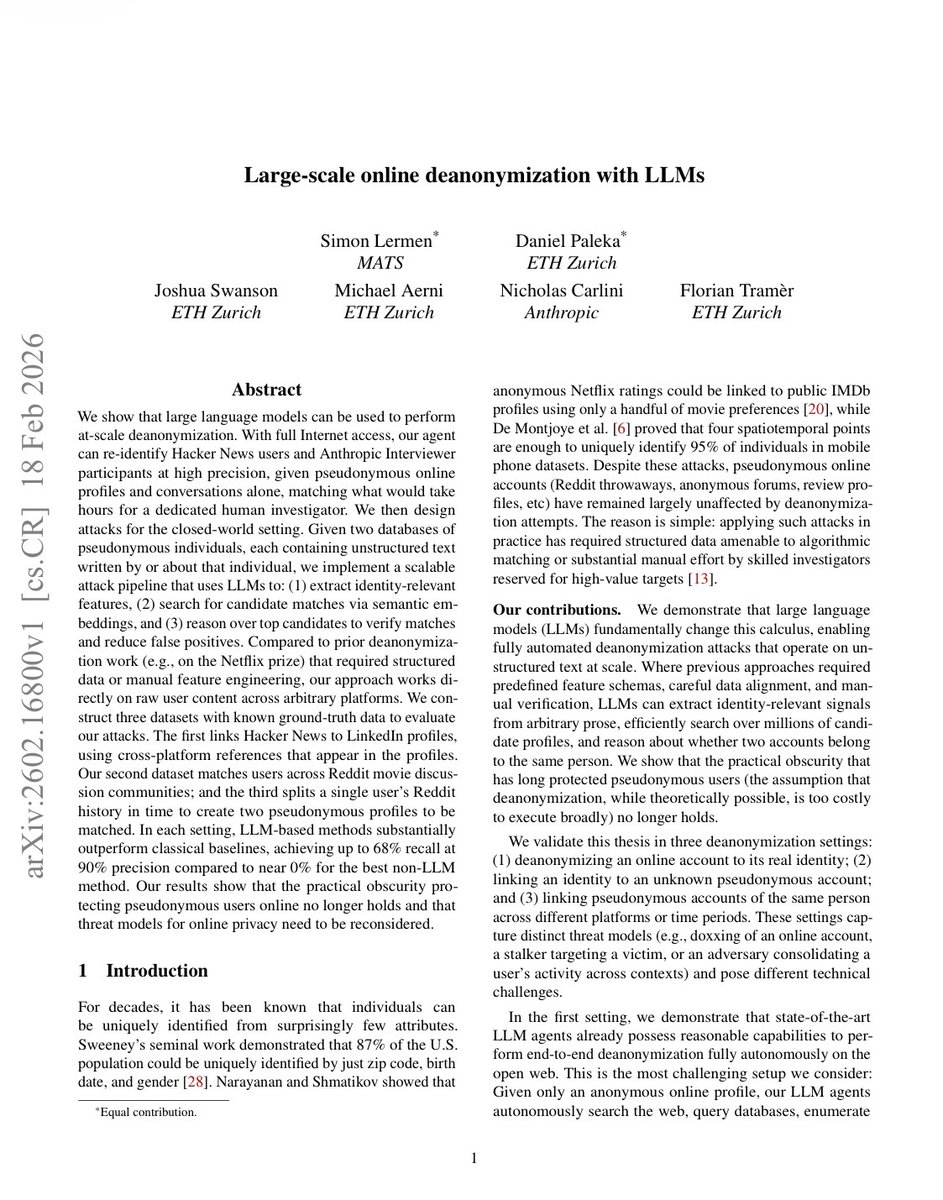
Holy shit… Your anonymous internet identity can now be unmasked for $1 😳 Not by the FBI. By anyone with access to Claude or ChatGPT and a few of your Reddit comments. ETH Zurich and Anthropic just dropped a paper called “Large-Scale Online Deanonymization with LLMs” and the results are the most alarming privacy research I’ve read this year. They built an automated pipeline that takes your anonymous posts, extracts identity signals, searches the web, and figures out who you are. No human investigator needed. Fully autonomous. Works on Hacker News, Reddit, LinkedIn, even redacted interview transcripts. Here’s how bad the numbers are. On Hacker News users: 67% identified correctly. When the system made a guess, it was right 90% of the time. On Reddit academics posting under pseudonyms: 52%. On scientists whose interview transcripts were explicitly redacted for privacy: 9 out of 33 still got unmasked. The pipeline works in four steps they call ESRC. Extract identity signals from your posts using LLMs. Search for candidate matches using embeddings across thousands of profiles. Reason over top candidates with models like GPT-5.2. Calibrate confidence so when it does guess, it’s almost never wrong. The classical deanonymization method from the famous Netflix Prize attack? Nearly 0% recall across every test. LLMs didn’t just improve on old techniques. They made old techniques look like toys. When they scaled to temporally split Reddit profiles, matching a user’s old posts to their newer ones across a full year gap, the pipeline hit 67% recall at 90% precision and 38% recall at 99% precision. Meaning even a year of changed interests and different conversations wasn’t enough to hide. More reasoning compute = better deanonymization. High reasoning effort doubled recall at 99% precision in some tests. As frontier models get smarter, this attack strengthens automatically. Every model upgrade is a privacy downgrade. What makes it nearly impossible to defend against: the pipeline splits into subtasks that all look benign. Summarize a profile. Compute embeddings. Rank candidates. No single API call screams “deanonymization.” The researchers themselves say they’re pessimistic that safety guardrails or rate limits can stop it. Their conclusion is blunt: “Users who post under persistent usernames should assume that adversaries can link their accounts to real identities.” And it extrapolates. Log-linear projections suggest roughly 35% recall at 90% precision even at one million candidates. Every throwaway account. Every anonymous forum post. Every “nobody will connect this to me” comment. It’s all searchable micro-data now. And the cost to run the full agent on one target is less than a cup of coffee. Practical anonymity on the internet just died. The paper killed it with math.
Alex Prompter tweet media
English
514
2K
8.2K
1.2M
Olaf van Wijk
Olaf van Wijk@ovanwijk·
To me decentralization is the ability to freely choose the rules, ideally there where there are no, or limited, rulers. When there are rulers (because that inevitably happens with humans), the ruled should be able to (peacefully) strip them from their positions. New systems are better with benevolent dictators in their limited influence. Once it's rules catches many 'subjects' is when decentralization needs to happen.
English
0
0
1
18
Eli Ben-Sasson | Starknet.io
Eli Ben-Sasson | Starknet.io@EliBenSasson·
We often talk about decentralization as a value in itself. But it's a means to an end. The interesting questions are: 1. What goal does decentralization serve? 2. Is decentralization important to you? 3. Has anything changed in the way you view decentralization over time?
English
15
3
35
2.4K
Justin Bons
Justin Bons@Justin_Bons·
We must reject all centralized "blockchains"! This includes Ripple, Canton, Stellar, Hedera & Algorand Centralization is not the future of finance; requiring permission from an authority is not decentralized! Do not be fooled by their lies, as the truth will set us free: 🧵 Ripple: Has a "Unique Node List", which makes the validators effectively permissioned. As any divergence from this centrally published list would cause a fork, effectively giving the Ripple Foundation & company absolute power & control over the chain Canton: The validator set is totally permissioned! Stellar: A similar set-up to XRP, except that they call it "recommended Tier 1 organizations," which is published by the Stellar Development Foundation. However, just like XRP, a high overlap is required, or you risk forking off the network. Effectively putting the power in the hands of the list creator Hedera: The validator set is totally permissioned! Algorand: The "relay nodes" in ALGO are still totally permissioned. Despite validators being permissionless, anyone now has the option to run a "participation node" after they recently implemented a P2P network as an alternative means to propagate TXs. Which means the relay nodes can no longer act as gatekeepers. However, it is unclear how much removing them entirely would affect performance today. Possibly making them a necessary aspect of ALGO's current design Forms of Consensus: Within a blockchain context, there are only three forms of consensus: Proof of Stake, Proof of Work & Proof of Authority If a blockchain does not use PoS or PoW, it is, by definition, PoA! As this was fundamentally an unsolved problem before blockchain came along, which solved this problem through the use of token-based incentives, either through stake or work Anything that does not fit that consensus model is instead fundamentally based on authority/trust. In the case of XRP & XLM, it is important to keep in mind that choosing who we trust is not the same as trustlessness! Binary Choice: A blockchain is either fully permissionless or it is not. ALGO has permissioned elements in its design, so it is still "centralized". A crude way to use language, but we do still need understandable schelling points in crypto. As decentralization is a spectrum, permissionlesness is only one element of that bigger picture. However, personally, any permissioned elements are a deal breaker for me, as it is so anti-thetical to the ethos of crypto that it defeats its entire raison detre Institutional Adoption: Much like the early internet, big institutions are uncomfortable using fully permissionless, public & decentralized networks. So, much like the early internet, those institutions will be left behind. The big winners are the crypto natives. That is true historically & it will also be true in the future too. The big winners during the early internet were the newcomers, not the old guard, for the same reasons we see playing out in crypto now Conclusion: The future of finance is decentralized & permissionless. If you cannot understand that, it is fine. There are other options for you on the free market But let's not pretend as if these chains are really playing a part in this revolution. Quite the opposite, centralized "crypto" is a distraction that only slows the goals of our movement down So, if you care about crypto. Reject these permissioned chains & demand they decentralize. In the meantime, we should vote with our feet & support chains that carry our movement forward towards its intended goals instead Credible neutrality, censorship resistance, privacy, immutability & more can only be achieved on a fully permissionless & decentralized blockchain That is the revolution we were promised & that is the future we can now bring about with the choices we make collectively Crypto is on the right side of history, disrupting power away from centralized authorities to help create a freer & more equitable world! 🔥
English
641
92
706
303K