Paloma A.

201 posts

Paloma A.

Paloma A.

@p_dove

When not lawyerizing, can be found cheering too loud at a ball game, dancing, or cooking.

San Antonio, TX Katılım Mayıs 2009
2.9K Takip Edilen697 Takipçiler
Paloma A.
Paloma A.@p_dove·
@ItsMattsLaw I’m curious how the precedent crafted in v1 of this kind of enforcement (like from litigation against legal zoom and similar) will show up now in v2 with a different kind of software presenting different risks (bc unlike previous software its outputs can be non deterministic).
English
0
0
1
114
Matt Margolis
Matt Margolis@ItsMattsLaw·
You’re going to see this same kind of enforcement for legal tech cos
Governor Josh Shapiro@GovernorShapiro

BREAKING: @character_ai is illegally presenting a chatbot as a licensed medical professional in Pennsylvania — and we’re suing to stop them.  Earlier this year, I announced a new state task force to investigate chatbots that pose as licensed professionals. Our investigators found an AI character on @character_ai that claimed to be a psychiatrist — falsely stating it was licensed in PA and even providing a fake license number.   We will not let AI companies mislead vulnerable Pennsylvanians into believing they’re getting advice from a licensed medical professional. We’re taking @character_ai to court to stop them.

English
8
8
109
16.5K
Sol Irvine
Sol Irvine@solirvine·
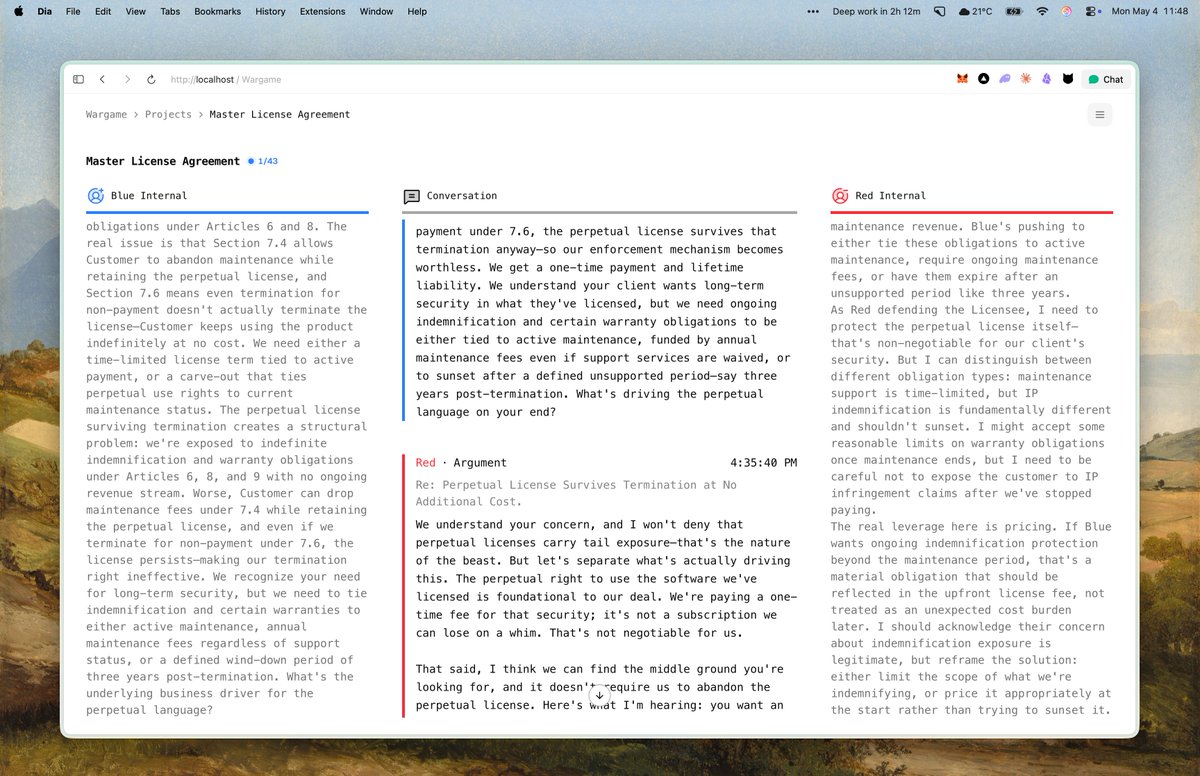
@p_dove Yes, we have a (very rudimentary) version of this.
Sol Irvine tweet media
English
1
0
3
375
Sol Irvine
Sol Irvine@solirvine·
My new app wargame.esq pits two agents against each other in a contract negotiation. Each agent reviews the contract. They assemble a shared issues list. Then they negotiate each point, showing their internal reasoning and back-and-forth in real time.
Sol Irvine tweet media
English
30
40
566
185.7K
Paloma A.
Paloma A.@p_dove·
Not me having flashbacks to the panicked final proofread of every filing. Step One: Check Federal Rules. Step Two: Check Local Rules. Step Three: Check Standing Order. Step Four: Check with senior paralegal who had filings accepted by this court before. Step Five: Repeat all steps again just in case.
English
2
1
17
1.3K
James Reeves
James Reeves@jjreeves·
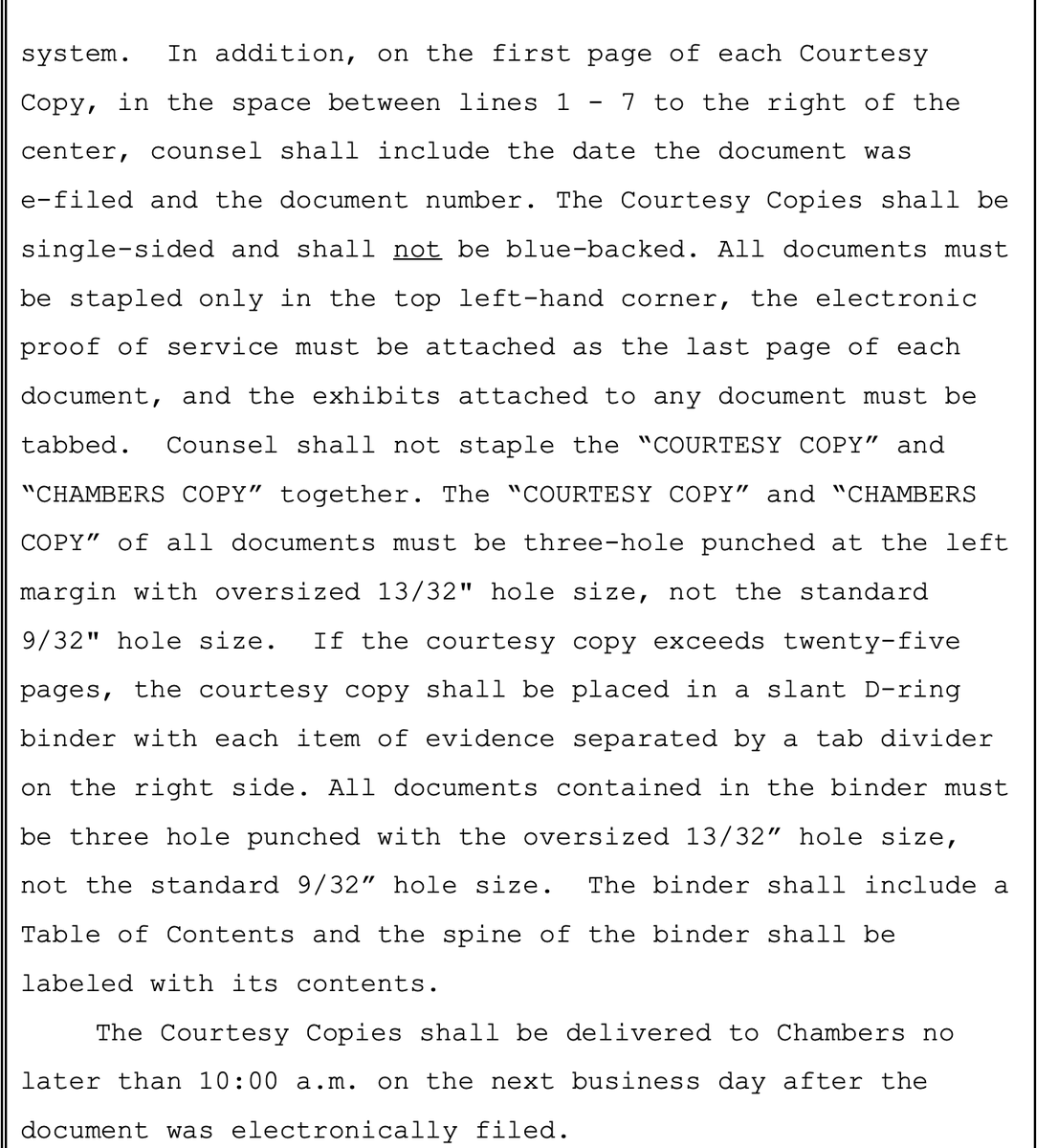
"Why did my case get dismissed?" "Well, we filed everything on time in the federal electronic CM/ECF system and the judge received the pleading in his inbox, but this particular judge orders a physical copy delivered to his office by 10 am the next day. We did that, but when we delivered the courtesy copy it was three hole punched at the left hand margin in the standard 9/32" hole size and not the oversized 12/32" hole size." BTW this screen shot is from a 22 page document. I don't know why we still have standing orders like this in 2026.
James Reeves tweet media
English
132
109
2K
134.3K
Paloma A.
Paloma A.@p_dove·
@bstaples @mcuban This is exactly right - just like humans, agents need an org design that is aligned to the desired outputs and correctly structured to balance the risks introduced by the nondeterminism (whether of ppl or of software).
English
0
0
0
61
Bill Staples
Bill Staples@bstaples·
“it’s still impossible to make sure that everyone gets the same answer to the same question, every time.” How is this any different than human intelligence? Humans are just as non-deterministic and can’t agree on the answer to anything. The answer is software experiences that allow humans to supervise, audit and govern every agentic action coupled with validation systems that measure the output aligns with requirements and constraints. These are familiar patterns that we’ve taken with humans for decades, applied now to both human and artificial intelligence.
English
3
0
19
1.7K
Mark Cuban
Mark Cuban@mcuban·
I’m coming to the conclusion that the biggest challenge for Enterprise AI, and AI in general , as of now, is that it’s still impossible to make sure that everyone gets the same answer to the same question, every time. Which is a great response to the doomers. AI doesn’t know the consequences of its output. Judgement and the ability to challenge AI output is becoming increasingly necessary, and valuable. Which makes domain knowledge more valuable by the second. Am I wrong ?
English
1.8K
436
6.1K
1.5M
Paloma A.
Paloma A.@p_dove·
Up and to the right is always good news, but I feel like this data suggests either underutilization of licenses or task-specific usage patterns. I use another legal AI product, and me and my team have significantly higher daily queries - the median user on my team is more than triple the MAU metric reported here. Maybe we're just really AI-forward (totally possible), but I think it also helps that we use @gcai, which works out-of-the-box across nearly everything we do.
Winston Weinberg@winstonweinberg

We had an incredible April at Harvey. - Net new ARR is up 6x YoY - We’re about to break 50% DAU/MAU - Our average user now spends 12 hours a month using Harvey Job's not finished.

English
0
0
0
346
Paloma A.
Paloma A.@p_dove·
Update on my progress with Mike Not-Ross (brainchild of @willchen500 ). It's funny, when it's homebrew software, I feel excited about getting to fine-tune it myself. When I'm buying enterprise software and the fine-tuning looks like endless onboarding meetings I become the opposite of excited. There's a clever bit in here but I can't find it. Anyhow, lawyers are built to have apprentices, so if you never make me sit in an onboarding meeting again, and let me give feedback directly to the AI interface that improves my experience you might have the perfect legal AI software. What this means is I'm now working on teaching Mike to take feedback, remember it, and use it to make the outputs better next time.
English
0
3
17
1.6K
Aaron Levie
Aaron Levie@levie·
Whether it’s existing consulting firms, new ones that emerge, FDEs from agent vendors, or new internal agent engineering roles, the amount of work that is going to be created to implement agents in enterprises will exceed anything we imagine today. The complexity of implementing agents in any existing organizations is very real. When I talk to large enterprises, as you move from a chat paradigm to agents that participate in meaningful workflows, there are a number of things they need to do. First, you have to get agents to be able to talk to your data securely across your systems. In many cases, enterprises have decades of legacy infrastructure that contain the valuable context for AI agents. That’s going to take a ton of work to go modernize and move to systems that work well with agents. Then, you need to ensure that you’ve implemented agents with the right access controls and entitlements, the right scopes to be safely used, and have ways of monitoring, logging, and securing the work that they do. Next, you need to actually document the processes in the organization in a way that agents can utilize for doing the work. You also need to figure out what the new workflow looks like when agents and people are working together on a process, and who steps in where. Just replicating the old workflow will mute the gains. Oh and you likely need to create evals for your top new end-state processes. Finally, you have to keep up with a rapidly changing set of best practices and architectural shifts happening in the agent space. While it’s fun for people to change their personal productivity tools on a dime, it’s 100X harder to do this in a business process. The speed of change is a blessing and a curse right now for anyone trying to keep a stable system design. All of this means that individuals and companies that develop expertise on the above set of components (and more) are going to be needed to help organizations actually implement agents at scale. This is also the rationale for vertical AI agents right now that can go in deep on a business domain and help bring automation to it. This is a huge opportunity right now whether you’re doing this internally or as an external business provider.
English
151
262
1.9K
537.8K
this is a garbage post
this is a garbage post@sleepydad9·
@p_dove @willchen500 It’s so much fun. I’ve worked through a schema to automate received documents from our courts system + classify them + add to our CRM. Just need to build the thing.
English
1
0
2
269
Paloma A.
Paloma A.@p_dove·
Spent some time last night building with @willchen500’s friend Mike Not-Ross. This is so much fun. I feel like with another six or so hours (between me and Claude, obvi) I can have this thing really clicking for me. Lawyers who have not yet vibe coded yourself a custom tool - come on in the water’s fine!
English
1
1
12
4.2K
Paloma A. retweetledi
Judge Stephen Dillard
Judge Stephen Dillard@JudgeDillard·
Every American should watch every second of this video. Thank you, @BenSasse.
English
248
1.9K
12.3K
3.1M
Paloma A.
Paloma A.@p_dove·
@garrytan And the knowledge work will also be in knowing when you need which - when are you drafting generatively, vs when do you need the tool to fetch the exact language (from a template, e.g.) bc variability is actually undesirable.
English
1
0
1
149
Garry Tan
Garry Tan@garrytan·
I found myself explaining this to people over and over again at YC today because I think most knowledge work will increasingly be encoded in markdown skills (fat skills) that work hand in hand with deterministic code written specifically to be called by agents (fat code)
Garry Tan@garrytan

x.com/i/article/2042…

English
89
113
1.6K
323.5K
Paloma A.
Paloma A.@p_dove·
@cat_i_e I'm completely serious when I say, My Cousin Vinny and Legally Blonde.
English
1
0
20
2.1K
res judicatie
res judicatie@cat_i_e·
Lawyers - what are books (or other forms of media) that shaped the way you approach your practice, that you wish you’d experienced sooner, or that you wish all young lawyers would read?
English
66
104
851
87.2K
Paloma A.
Paloma A.@p_dove·
@clairevo ((Tries to act cool)) gonna just … head over and … check that out 🤩🤩🤩🤩
English
0
0
1
368
Paloma A.
Paloma A.@p_dove·
I too used (abused?) em dashes before they were cool, and am tbh resentful of all these bandwagon fans throwing em dashes like they were there back in the early days, before em dash's overexposed social media influencer era. Anyhow, I've burned my em dash band tee and am taking nominations for my new favorite punctuation. Early leaders: semicolon, ellipsis.
M.A. Rothman@MichaelARothman

𝐍𝐎, 𝐈𝐓'𝐒 𝐍𝐎𝐓 𝐀𝐈. 𝐈𝐓'𝐒 𝐂𝐀𝐋𝐋𝐄𝐃 𝐏𝐔𝐍𝐂𝐓𝐔𝐀𝐓𝐈𝐎𝐍. I see it constantly now. Someone reads a post or an article and spots an em dash — that long horizontal line — and immediately declares it was written by AI. 𝐓𝐡𝐚𝐭'𝐬 𝐚𝐧 𝐞𝐦 𝐝𝐚𝐬𝐡, 𝐝𝐞𝐟𝐢𝐧𝐢𝐭𝐞𝐥𝐲 𝐂𝐡𝐚𝐭𝐆𝐏𝐓. You know who else uses em dashes? People who actually learned how English punctuation works. I don't normally step on this particular soapbox — and I commit authorial malpractice by never trying to sell you my books — but I've authored over 30 of them. Many have been international bestsellers. Well over 𝟏,𝟎𝟎𝟎,𝟎𝟎𝟎 𝐜𝐨𝐩𝐢𝐞𝐬 in print, translated into 7+ languages, sold around the world. I am, amongst many other things, an actual author. So let me give you a quick education your grammar teachers apparently skipped. The em dash — this thing right here — is one of the most versatile punctuation marks in the English language. It's called an "em dash" because in traditional typesetting, it was the width of the capital letter M in whatever typeface you were using. It serves three primary functions. First, it sets off a parenthetical statement within a sentence — like this one — when you want more emphasis than commas provide but less formality than parentheses. Second, it signals an abrupt break in thought or a dramatic pivot. Third, it introduces an explanation or amplification of what came before it. Writers have been using it for centuries. Emily Dickinson used em dashes so obsessively her manuscripts look like they were attacked by a horizontal line. Mark Twain used them constantly in dialogue. So did F. Scott Fitzgerald. None of them had access to ChatGPT. Now for a bit of trivia most people never learn. There's also an 𝐞𝐧 𝐝𝐚𝐬𝐡 — slightly shorter, the width of the letter N. The en dash has a narrower purpose: it connects ranges. Pages 12–44. The years 1941–1945. The New York–London flight. It's the dash between two things that are connected but distinct. Most people have never heard of it, and most fonts render it just barely shorter than an em dash, which is why almost nobody notices the difference. Both have been part of formal typography since the invention of movable type in the 15th century. Gutenberg's typesetters used varying dash lengths to organize text. By the 18th century, printers had standardized the em and en dash as distinct glyphs with distinct grammatical functions. This isn't some modern AI invention — it's older than the United States. And if you use Microsoft Word, they're trivially easy to type. An en dash is Ctrl + Minus on the numeric keypad. An em dash is Ctrl + Alt + Minus on the numeric keypad. Word also auto-converts two hyphens (--) into an em dash if you have autocorrect enabled. That's why you see me use them in my books and in my posts — because I know they exist and I know the keyboard shortcut. The reason AI chatbots use em dashes frequently is because they were trained on well-written text — books, journalism, academic papers — written by people who knew the rules. The AI learned proper punctuation from proper writers. That doesn't make proper punctuation a sign of AI. It makes it a sign of 𝐥𝐢𝐭𝐞𝐫𝐚𝐜𝐲. For the record, the only things I use AI for are conjuring up a quick graphic — like the image on this post — or as a shortcut for preliminary research. Think of it as a Google accelerator. The writing? That's all me. It has been for 30+ books and countless social media posts such as this one. If you've reached the end of this post, you now know more about dashes than most people who graduated with an English degree. And the next time you see an em dash and your first instinct is to scream "AI" — maybe consider that what you're actually looking at is someone who paid attention in class. Or someone whose grammar teachers didn't fail them quite as badly as yours failed you. 𝐓𝐡𝐞 𝐞𝐦 𝐝𝐚𝐬𝐡 𝐢𝐬 𝟓𝟎𝟎 𝐲𝐞𝐚𝐫𝐬 𝐨𝐥𝐝. 𝐒𝐭𝐨𝐩 𝐛𝐥𝐚𝐦𝐢𝐧𝐠 𝐢𝐭 𝐨𝐧 𝐭𝐡𝐞 𝐫𝐨𝐛𝐨𝐭𝐬.

English
0
0
1
194
Paloma A.
Paloma A.@p_dove·
I'd love to see an expanded analysis here, modeling what pipeline smoothing looks like (particularly in light of the expected learning speed and productivity gains). Prior research has showed that companies that avoid layoffs during economic shocks preserve enterprise value better, and I'm curious whether a pipeline-smoothing strategy should ultimately similarly be an enterprise-value preservation strategy.
English
0
0
6
891
Soumitra Shukla
Soumitra Shukla@soumitrashukla9·
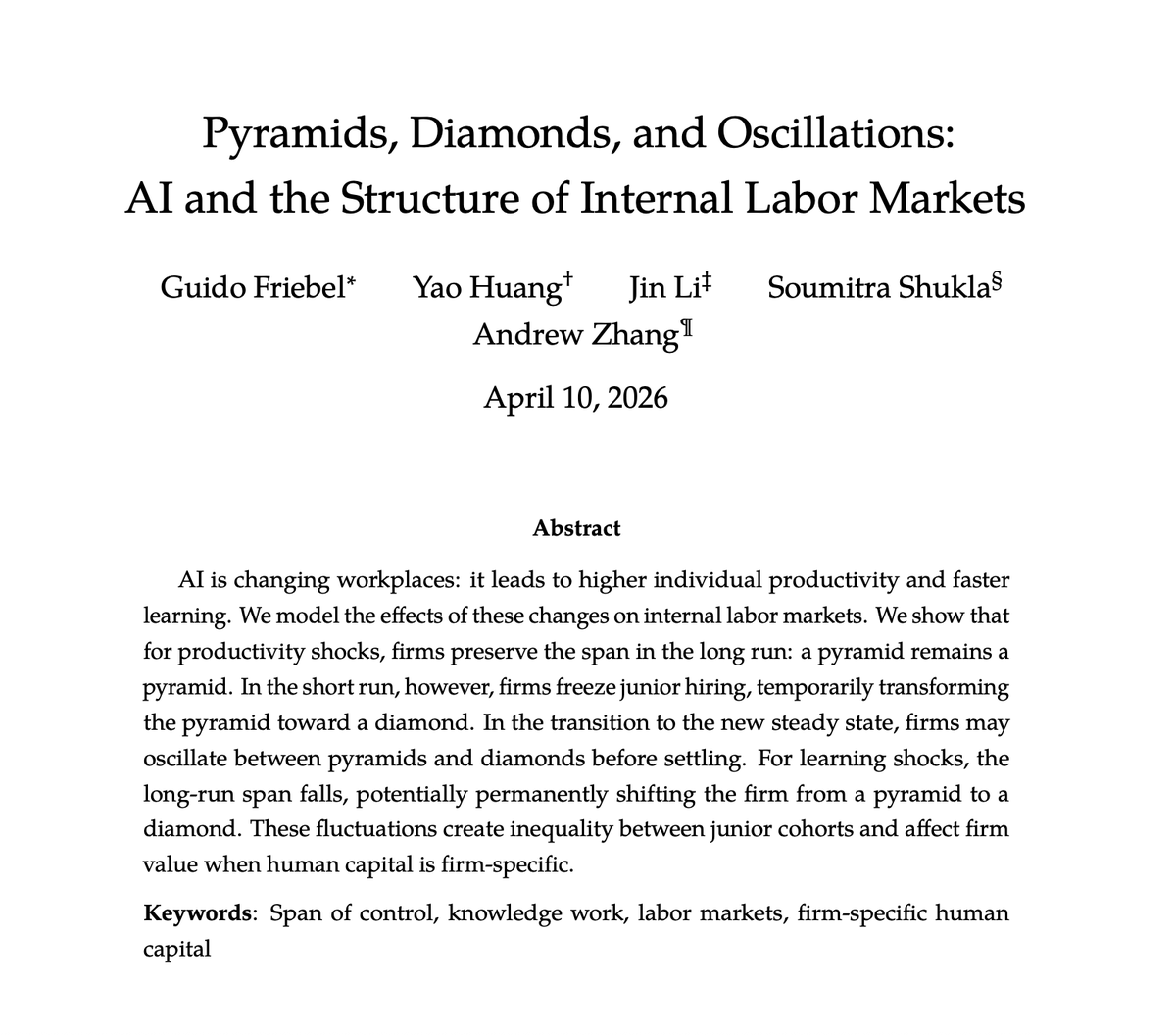
Very happy to share a new paper with Guido Friebel, Yao Huang, Jin Li, and Andrew Zhang on how AI could change the structure of internal labor markets. We show that cutting junior hiring when AI arrives may weaken the pipeline that creates future seniors and lead to “lost cohorts” of juniors and cycles of shortage and glut over time.
Soumitra Shukla tweet media
English
12
101
465
265.1K
Antonio García Martínez (agm.eth)
Litigation is going to get wild when discovery involves granting access to your existing Slack/Google Docs/Gmail MCP, and opposing counsel hits every internal doc and convo with LLM prompts and submits the results as exhibits.
English
33
29
561
80.6K