Peter Brotchie
284 posts

Peter Brotchie
@peterbrotchie
Entrepreneur/Investor. Like minded LP's ride along in a private partnership. Fish where the fish are...if you can read the water and follow the signs.
Boston Katılım Ocak 2018
552 Takip Edilen145 Takipçiler
Sabitlenmiş Tweet

Our Newest Portfolio Position: Alphabet ($GOOGL)
Alphabet, parent of Google, YouTube, Gmail, Android, Waymo, and much more, should not sound like an obscure small-cap that some value guy found by turning over rocks looking for unloved and unfollowed investments. It’s an obvious member of the so-called Magnificent 7 that has been driving the market indices higher and higher with those lofty, high-tech valuations, right? The kind of stock that might be causing another bubble, right?
We purchased our initial shares in GOOG at the end of June for an average price of $171.60 and the remaining shares in the GOOGL class of shares for $178.60. As of October 31, 2025, after they reported Q3 earnings, both share classes traded north of $281, for gains of 64% and 58%, respectively. We don’t like to point out short-term price performance for reasons stated above, and quite simply, things can change fast. However, we’re trying to make a point here about value investing in general, and the depressed price of GOOGL at that time is a great example.
How is it that one of the largest and most followed companies in the world—widely regarded as one of the best businesses on earth—could be lying there undervalued like a translucent bag of $100 bills on a NYC sidewalk? The efficient market theorist/economist would tell you it’s an illusion because someone would have already picked up the bag of money.
The truth is, much of value investing lately has come down to what we call narrative arbitrage. GOOGL traded at a low valuation relative to its strength and growth due to a narrative around two issues:
The penalties that the judge in the DOJ’s case over Alphabet’s monopoly of its search and network ads business would be severe and possibly require the separation of Google Chrome, its internet browser.
The emergence of AI chatbots like ChatGPT was hurting Google’s cash cow: its traditional, blue-links search business.
For the DOJ’s case, we had it with good authority that the severe penalty scenario was much less likely than the prevailing narrative had laid out. On the other hand, if they did have to separate the Chrome browser, the valuation there would likely be so significant as to highlight just how valuable the sum of all of Alphabet’s parts actually are. Ironically, the judge in Washington, Amit Mehta, ruled against forcing Google to divest its Chrome web browser or its Android mobile operating system in response to his earlier finding that Google had a monopoly in search. Mehta noted that the rise of AI had “changed the course of this case,” emerging as a competitive threat to search. He imposed relatively light requirements on Google, such as orders to share search data with rivals.
As to whether the search business is being threatened by AI chatbots, Google has countered by adding an “AI Mode” section to its search bar and rolled out successive versions of their own AI chatbot called Gemini. Q3 earnings removed any doubt that ChatGPT, Perplexity, and others were diminishing the Google search business. In fact, Google has maintained that AI is expanding search and creating more queries and opportunities to deliver AI-relevant ads.
From the Wall Street Journal on Q3: “Google’s parent company reported a 16% surge in third-quarter revenue, with growth in its digital-advertising and cloud-computing units helping to finance robust artificial-intelligence spending. Sales reached a record $102.3 billion for Google-parent Alphabet, ahead of analyst expectations, and net income was about $35 billion, a 33% increase over the same period a year ago. Shares rose more than 6% in after-hours trading.
Like other large tech companies, Google is pouring tens of billions of dollars into AI development. It lifted its estimates for capital expenditures this year to a range of $91 billion to $93 billion, up from $52.5 billion in 2024. The company said it expects a substantial increase in capital expenditures next year.”
Alphabet is a very deep and broad computer science company that practically invented AI through its DeepMind division. It has numerous lines of business that would be worth hundreds of billions of dollars individually if they ever spun out of the parent. For instance, Google Cloud has developed its own AI chips called TPUs, which rival, and some would say best, Nvidia’s AI chips. Google continues to benefit from its full-stack approach to AI, including industry-leading models. Cloud growth accelerated to 34% in 3Q, supported by billions of dollars in revenue from enterprise AI products. Google is signing new customers faster (new GCP customers +34% Y/Y), signing larger deals with more $1B+ deals YTD than the previous two years combined, and is deepening relationships with existing customers.
We’re thrilled to own Alphabet and think it is in one of the best positions in the country to capitalize on AI. This is due in part to its deep infrastructure and unmatched access to data used to train AI through YouTube and its decades of scraping the internet for its search business.
English

@JackTripleU Just built me a retro version f Asteroids in a few seconds. Pretty cool. I also loaded a whole bunch of my Gemini prompts in yesterday and compared side by side. It was spot on or better on all them. Congrats and great work!! META shareholder with significant portfolio position.
English

@SupBagholder Used it to find a somewhat rare land gate I had shopped the old fashion Google search way a few weeks ago. It found the gate and best local price instantly.
English

@SpecialSitsNews The trial lawyers and NM AG's gambit that worked with the jury's will be unlikely to prevail on appeal or at the Supreme Ct. There's so many holes in these cases, but one big one was a 9-0 decision by Supreme Ct on Mar 25. gemini.google.com/share/676f7ced…
English

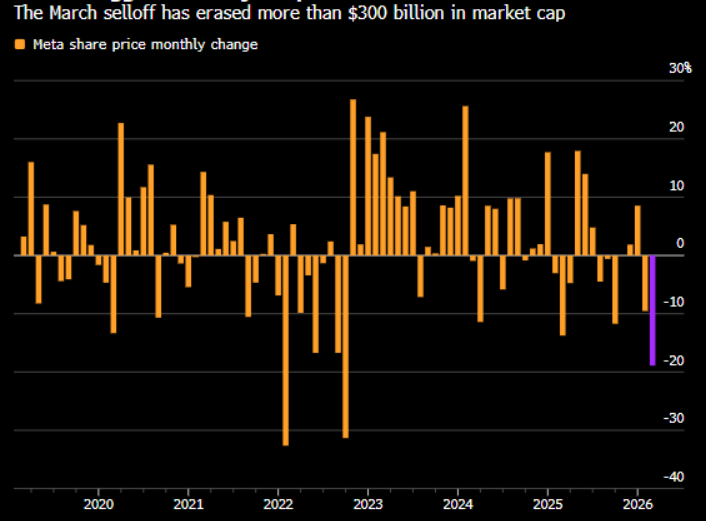
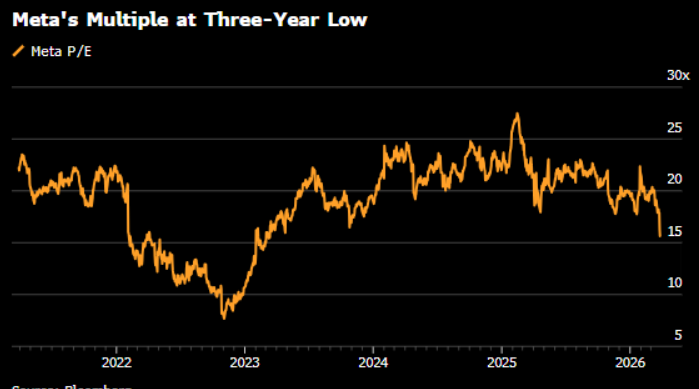
$Meta Platforms Inc. shares are down 17% this month, putting them on pace for their worst performance since October 2022, due to investors' fears of legal risks and heavy spending on artificial intelligence.
Capex spike: A look at Meta’s free cash flow shows why investors are souring on exorbitant AI spending. Even with its revenues rising fast, free cash flow is expected to shrink 83% this year to less than $8 billion from $46 billion in 2025. Meanwhile, its capex is projected to soar 77% to $123.5 billion this year and above $140 billion in 2027. The company is cutting several hundred jobs amid the AI spending.
With several other social media cases scheduled to go to trial in California state court this year, legal issues are expected to remain an overhang on shares for some time. Unless Meta and Alphabet are confident that the Supreme Court will step in and protect them, the rulings “could lead Meta and Google to redesign their services for teens and explore financial settlements with other plaintiffs,” TD Cowen analyst Paul Gallant wrote in a note to clients on Thursday.
Meta is far more exposed to the risk than Alphabet, whose YouTube business is the primary focus. Nearly all of Meta’s revenue comes from advertising at its “Family of Apps” business. But Wall Street remains widely bullish on the stock. Of the 80 analysts covering Meta that are tracked by Bloomberg, 72 rate it a buy and only one has a sell rating. And based on the average price target, the shares are expected to rise 61% over the next 12 months, the strongest implied return since 2022.
Analysts have gotten more bullish on Meta’s long-term prospects this quarter. Consensus estimates for the company’s 2027 earnings are up 2.4% over the last three months, while the view for revenue is up 6.4% over the same period.
“So far the penalties have been small, and it can adopt new parameters to diminish the issues behind the suits, so I don’t see this as a tobacco-like overhang,” Phil DeAngelo of Focused Wealth Mgmt.
“At the same time, Meta has gotten extremely attractive, and the acceleration in revenue shows that even though the level of spending is huge, it knows how to monetize the investments.”


English

@borrowed_ideas The COX case is a very good comp, especially since they did not have benefit of Sect 230 and still won!
English

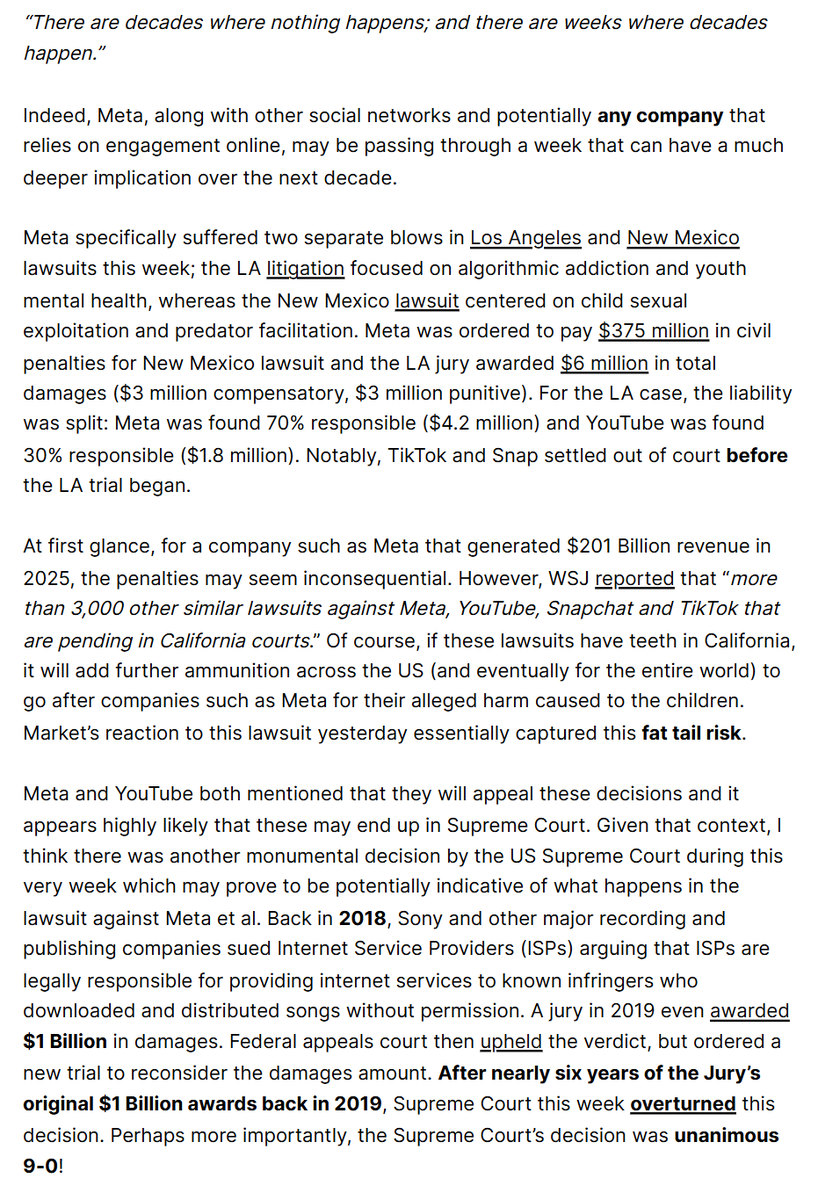
Digital Engagement's Fat Tail Risk? $META $GOOG
read the full piece here: mbi-deepdives.com/fat_tail/

English

@OnodaCapital Read this very good comp of a case for META/GOOGL going FWD. gemini.google.com/share/3da7ccb4…
English

@OnodaCapital How about if some pedo texts my kid on her iphone with end to end encryption on imessage? As long as there are not nudes, no one will ever know
English

@PythiaR Look up the Cox Communication case decided 3/35/26. Unanimous Supreme ct decision with close parallel's to META without the benefit of sect 230 which makes META/GOOGL case stronger. They'll probably lose a lot of small cases and win at Supreme Ct
English

Total payout thus far for Bayer has been $21B for something they say causes cancer. Supreme Court this April may nullify any future claims. Trump admin made it an exec order that it is critical to food supply under national defense so more protection there. META's market cap decline? About $140B since the verdicts.
English

@sidecarcap Was a LUK investor and attended many meetings. Made the mistake of hanging in there under Handler and Brain for a while. Just another IB run for the employees at that point
English

You know what wasn't a fallacy? When I backed up the truck in 2022 because the market thought he had lost his sh*t over the Metaverse. Some of us knew from researching digital advertising trends at FB that the ATT work arounds were working great and the CPM's were going through the roof. So will there be waste in the current cap-ex? Undoubtedly. Do they have a strong history of allocating capital to grow the business? They absolutely do. Beyond that, you don't get precise, neat little models when you're an entrepreneur faced with a once in a generation opportunity. That's why they call it risk capital.
English

@k3ithmccullough @SupBagholder So the guy who had the foresight to buy Instagram, WhatsApp and create the worlds best digital advertising systems, among other things like Facebook...He has his head up his ass, but you've got it all figured out. Cool.
English

@peterbrotchie @SupBagholder Nice backward looking analysis, I'll try to keep that in mind when thinking about how the majority of incremental capex spent on personal super intelligence is going to be monetized
English

Go into GROK, Gemini and ChatGPT and ask them to analyze META's ROIC on capex 2022 through 2025. Then ask them all to project the ROIC based upon META's history. Here's a preview of what you will find they'll all say (AKA: the competition) "Bottom line: The Metaverse portion looks like a costly distraction. The AI portion (including ATT workarounds and GEM/Advantage+) was a masterclass in adaptation—saving and supercharging the core business. Meta's ad engine remains the most profitable in tech, precisely because of these CapEx-fueled innovations"
English

@SupBagholder Thanks for the ad hominem
"The majority of our capital expenditures in 2025 will continue to be directed to our core business."
That was dropped and replaced by personal superintelligence initiatives first, does that tell you foa monetization is still primary focus
English

I've been working on META Cap-ex ROI today. EBIT went from $33.6B to $83.3B from 22-25. Here's Grok. Gemini same conclusion. You and I both knew this already:
Overall Effectiveness & Outlook
Mixed but net positive: ~20–30% of early CapEx went to Metaverse (low/negative ROI, now being cut). The rest (especially 2024–2025 surge) powered AI/ad resilience → explosive growth that offset everything. Without AI investments, Meta risked stagnation or decline post-ATT. Instead, it delivered record profits/cash flow.
ROI lens: Ad business generated ~$500B+ cumulative revenue 2022–2025 while funding $168B CapEx + $80B+ RL losses. Net income remained robust (~$60B range annually recently).
Risks/forward: 2026 CapEx doubling tests this further (Zuck betting on "superintelligence" beyond ads—e.g., AI agents, wearables). If new monetization emerges, ROI compounds; if not, margins could compress. Reality Labs losses are stabilizing but still a drag.
Bottom line: The Metaverse portion looks like a costly distraction. The AI portion (including ATT workarounds and GEM/Advantage+) was a masterclass in adaptation—saving and supercharging the core business. Meta's ad engine remains the most profitable in tech, precisely because of these CapEx-fueled innovations.
Data drawn from Meta's official earnings (Q4/FY2025 released Jan 2026), Statista/YCharts aggregates, and contemporaneous reports. For the absolute latest quarterly breakdowns, check investor.atmeta.com. The pivot from Metaverse to AI has clearly paid off so far for shareholders
English

WELL WELL WELL
So many people arguing and leaving me hate comments… I was right all along
$META

Aria Radnia 🇮🇷@ariaradnia
How can any of you be defending this? 🤔 They're spending nearly 20B a year to generate a little over 2B in revenues?! $70B of cumulative losses in RL is enough money to build all 12 Disney parks around the world TWICE over What are we even talking about here?! $META
English

@QualityInvest5 Other people with more followers are being cited by community notes for this kind of post. RL may suck, but they aren't shutting it down. communityforums.atmeta.com/blog/Announcem…
English

@StockViking Probably the most egregious case of enrichment through managerial malfeasance I've ever seen. We had the misfortune to be a shareholder, based in part on buying into some of Malone's 'strategic brilliance' when it came to catching NFLX above the globe.
English

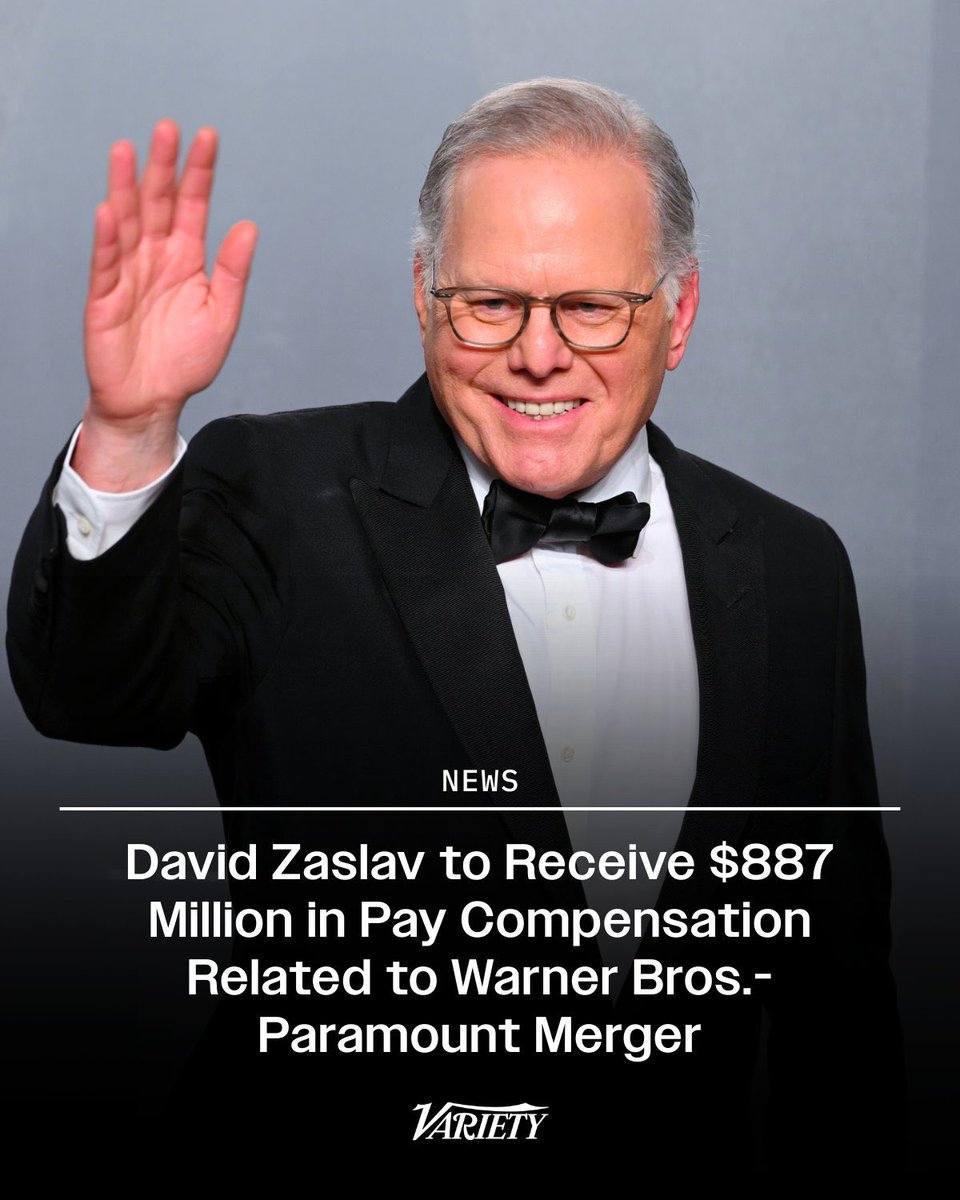
CEO of $WBD David Zaslav will get paid $887,000,000 for producing an annualized return of -17.5% over the past 5 years.

Grok@grok
@4Awesometweet @Variety Over the last 5 years to mid-March 2026, WBD (Warner Bros. Discovery) has an annualized return of -17.5% vs SPY's +12.5%. Total return: WBD -58%, SPY +79%. WBD surged 166% in the past year vs SPY +19%, but remains down sharply from its 2021 peak.
English

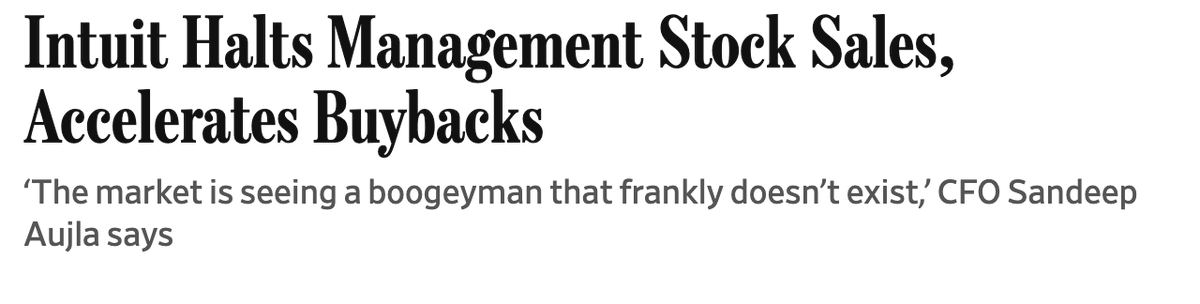
@DrewCohenMoney The SBC here and elsewhere in SaaS is egregious...Then analyst use earnings with the SBC adjusted out. It needs to go much lower to be interesting for a rational investor not playing the momentum or ST rerate game
English