Sarim Rajput

715 posts

Sarim Rajput

Sarim Rajput

@playb0ymvp

Exploring the WEB3 world | Crypto and Forex Trader | Content Creator | Open to Collabs | MOD at @syntraxXYZ

Pakistan Katılım Mayıs 2026
233 Takip Edilen250 Takipçiler
Sabitlenmiş Tweet
Sarim Rajput
Sarim Rajput@playb0ymvp·
Syntrax Beta is live ⚡ Now is the time to join early and start building your STRX identity. Inside the beta, users can: • Daily check-in to build streaks • Solve riddles and complete tasks • Spin daily for rewards • Earn USDT rewards from spin • Track points, rank, streaks, and history • Climb the leaderboard • Grow through referrals @SyntraxXYZ is turning activity into reputation, rewards, and future ecosystem value. 🚀 Join Beta: syntrax.xyz/?ref=GS6YBF 💬 Discord: discord.gg/syntraxxyz Don’t just watch the beta launch. Join early, stay active, and build your place. #SyntraxXYZ #SyntraxXYZFam #STRX #Web3 #Airdrop
Sarim Rajput tweet media
English
16
0
21
509
LAMI
LAMI@0x_Lamiya·
Most people think redundancy and duplication mean the same thing. In distributed systems, they don't. Redundancy means the network has enough information to recover from failures. Duplication means the network keeps sending the exact same information over and over again. One improves reliability. The other often wastes resources. Imagine 1,000 people in a stadium trying to spread a message. A traditional approach would be for everyone who receives the message to immediately repeat the exact same thing to multiple others. The message eventually reaches everyone, but thousands of identical copies end up moving through the network. The system is reliable, but extremely inefficient. Many blockchain networks work in a similar way. Transactions, blocks, and state updates are repeatedly forwarded between nodes to make sure everyone receives the same information. This works well when networks are small. As validator sets grow and blockchains become more decentralized, the amount of duplicate traffic grows as well. At some point, the network spends more effort moving information than processing it. That is where scalability starts to suffer. The interesting challenge is that decentralized systems cannot simply remove redundancy. Without redundancy, a single node failure, network interruption, or lost packet can prevent information from reaching part of the network. Reliability would collapse. What networks actually need is redundancy without excessive duplication. In other words, every node should have enough information to recover missing data, but the network should not have to flood itself with countless identical copies to achieve that goal. This is becoming an increasingly important infrastructure problem. As blockchain networks scale, communication costs often grow faster than transaction volume itself. Bandwidth consumption rises, congestion increases, and information takes longer to reach validators. The bottleneck is no longer computation. It becomes communication. This is one reason @get_optimum are exploring more advanced networking approaches. Instead of relying on constant retransmission of identical data, the goal is to make information easier to recover even when parts of the network miss some of it. The result is a network that remains resilient while moving less data overall. The future of blockchain infrastructure may not depend on how many copies of information can be created. It may depend on how little duplication is needed to maintain reliability. That is a very different way of thinking about scale, and it is one of the ideas driving the work being done at @get_optimum.
LAMI tweet media
English
15
0
24
60
NextGenAi𒆜☆
NextGenAi𒆜☆@NextGenAI_0·
Gmum! ⚡ Networks shouldn't be the bottleneck for blockchains. Optimum is redefining the speed of Web3 with our mump2p engine. Powered by Random Linear Network Coding (RLNC), we are freeing Ethereum from data propagation limits and prepping for mainnet. ⛓️💨 Stop guessing and see the future of data movement in action. Try the simulation: 🔗 gmum.cc/simulation @get_optimum @cryptooflashh @aqccapital #Optimum #DataMovement #RLNC #Ethereum #Web3
NextGenAi𒆜☆ tweet media
English
20
1
29
167
Ari 🥀
Ari 🥀@Ari_qen1·
Late GM CT Now let's continue our knowledge increment on @ritualnet If you look deeper the most valuable AI asset of the next decade probably won't be the model. It will be memory. Not model memory. Your memory. Every conversation. Every preference. Every workflow. Every correction. Every habit. Every decision pattern. Every piece of context accumulated over years. We're entering a future where AI won't simply answer questions. It will know how you think. It will know what you prioritize. It will know which opportunities you ignore. It will know what makes you change your mind. And that's where an uncomfortable question appears. Who owns that intelligence layer? Most discussions around AI focus on models. Bigger models. Smarter models. Faster models. Cheaper models. Meanwhile, a much more important resource is quietly being created in the background. Behavioral memory. A personal dataset that becomes increasingly unique over time. The scary part? You can switch models. You can switch interfaces. You can switch applications. But if you lose years of accumulated memory, context, and behavioral understanding, you're not really starting from where you left off. You're starting over. That's a form of lock-in that most people haven't recognized yet. The next generation of AI infrastructure won't just compete on intelligence. It will compete on portability. Can your memory move? Can your context move? Can your digital identity move? Can you prove ownership of the intelligence you've helped create? Today, most users are effectively renting their AI memory. Tomorrow, they may demand ownership. The companies building for the next decade should probably be thinking about that now. Because whoever controls memory may ultimately control the relationship between humans and AI. Not many people are talking about this yet. But they will. Dropping more details tomorrow stay tuned y'all
Ari 🥀 tweet media
English
36
5
52
646
Sarim Rajput
Sarim Rajput@playb0ymvp·
@orihimay The best thing about UTexo is RGB for private asset ownership.
English
0
0
0
5
𝐒𝐡𝐚𝐧𝐚𝐲𝐚
Everyone talks about bringing stablecoins to Bitcoin. Very few talk about what actually makes it possible. That's where Utexo comes in. Instead of building a new blockchain, Utexo combines three technologies into one simple stack: • Bitcoin for security and final settlement • RGB for private asset ownership • Lightning Network for fast payments The interesting part is RGB. Unlike many blockchains where balances and transactions are public, RGB keeps most asset data off-chain. Only cryptographic proofs are anchored to Bitcoin. This means: • Better privacy • Less blockchain congestion • Bitcoin level security Utexo handles the difficult parts in the background. Developers don't need to manage RGB nodes, Lightning channels, or complex infrastructure. They can simply use the API and SDK to build applications. The result is: • Fast USDT payments on Bitcoin • Private asset transfers • Self custody • No wrapped assets or bridges for native RGB assets What I like about Utexo is that it isn't trying to replace Bitcoin. It's making Bitcoin more practical for real payments and stablecoin use while keeping the user experience much simpler. If Bitcoin based payments continue to grow, infrastructure like this could play an important role behind the scenes. @utexocom
𝐒𝐡𝐚𝐧𝐚𝐲𝐚 tweet media
𝐒𝐡𝐚𝐧𝐚𝐲𝐚@orihimay

If we expect our bank account to be private, why are we okay with every stablecoin transaction being public? Every time you send USDT on most blockchains, anyone can see: • Your wallet balance • Your transaction history • Who you're sending money to • How you move your funds ─────────────── That's normal in crypto today. RGB on Bitcoin takes a different approach. Instead of putting transaction details on a public ledger, it uses client side validation. Bitcoin verifies that the transaction is valid, while the actual transfer details stay with the people involved. ─────────────── That means: • No public record of your financial activity • Better privacy for businesses and individuals • Less opportunity for competitors to track your moves • Bitcoin security without exposing every transaction ─────────────── Privacy shouldn't be treated like a premium feature. It should be a basic part of digital finance. Private USDT on Bitcoin could be much more important than most people realize. @utexocom

English
22
1
30
235
MAKHULU
MAKHULU@MAKHULU169·
Most people already have everything they need to earn yield on-chain. They just don't know it yet because DeFi made them feel like they don't. It convinced you that you needed: Quantitative modeling risk analytics multi-chain expertise protocol-by-protocol research constant portfolio rebalancing You don't. The complexity was never a feature. It was a barrier. The protocols that win the next cycle won't be the ones with the most options. They'll be the ones that removed them. One click. Diversified yield. Automated optimization. Embedded risk management. Institutional-grade infrastructure invisible under the hood. @ConcreteXYZ isn't simplifying DeFi. They're exposing how unnecessarily complicated it always was. The future of on-chain finance isn't more buttons. It's realizing you never needed them. @crypttoji @nic_builds @d3crypt0r25
MAKHULU tweet media
English
17
0
21
119
S H A HE D (build szn)
S H A HE D (build szn)@shahed05miazee·
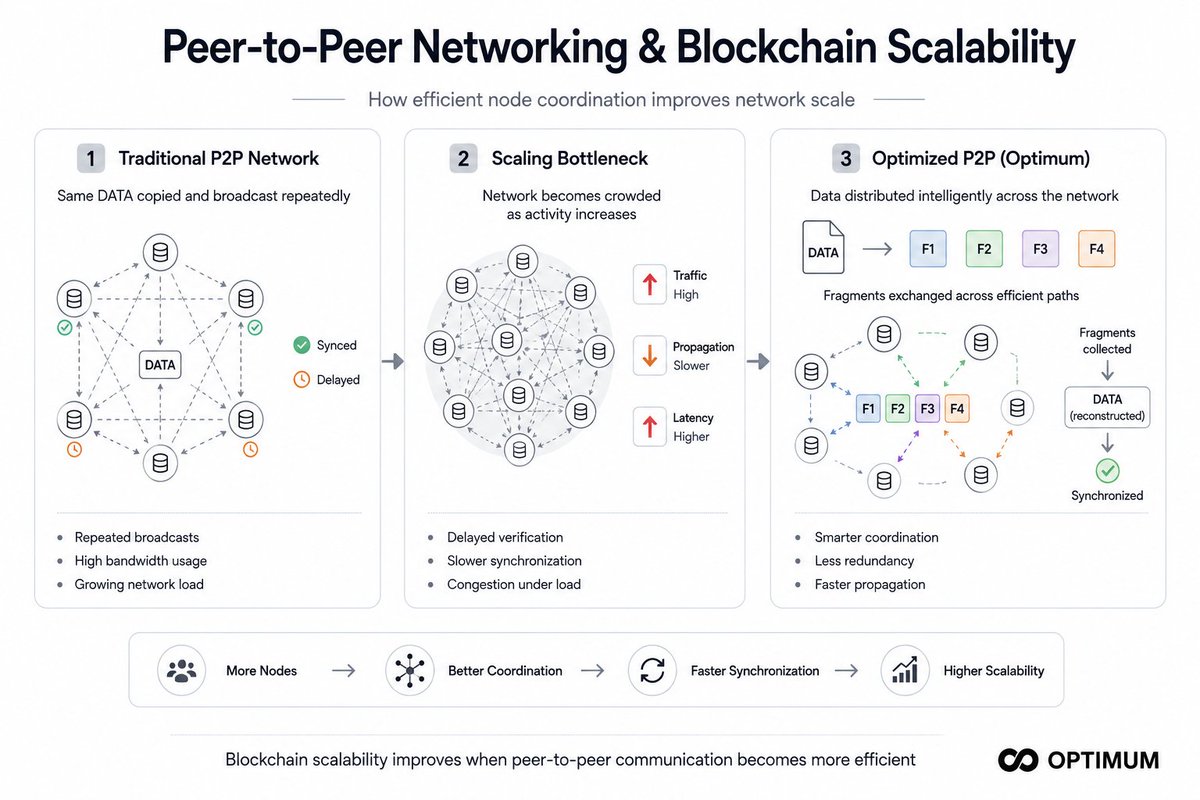
When people talk about blockchain scalability, most of the attention goes to execution. Faster blocks. Higher TPS. Cheaper transactions. But there’s another layer quietly carrying the whole system. Peer-to-peer networking. Because blockchains do not run from a central server. Every validator and node depends on receiving information from other nodes across the network. Blocks. Transactions. State updates. Synchronization messages. Everything moves through peer-to-peer communication. At smaller scale, traditional P2P models work well. Nodes receive data and forward it to others until the network becomes synchronized. But as throughput grows, this model starts becoming expensive. The same information gets copied and retransmitted again and again. That creates unnecessary traffic. More traffic means: • more bandwidth consumption • slower propagation • delayed verification • reduced efficiency under load Eventually the network spends too much effort distributing data instead of processing it. That’s why networking is becoming a scalability problem, not just an infrastructure detail. The role of peer-to-peer networking is no longer simply connecting nodes. It’s about coordinating information efficiently. That means: • reducing redundant transmission • improving propagation paths • keeping nodes synchronized faster • delivering data with less overhead Optimum explores this layer through optimized networking approaches. Instead of relying only on repeated broadcasting, data can be distributed more intelligently across multiple paths. Nodes exchange useful information instead of duplicating everything. This helps the network stay coordinated even as activity increases. Because blockchain scalability is not only about producing more blocks. It’s also about helping those blocks move efficiently between thousands of participants.
S H A HE D (build szn) tweet media
English
19
0
21
143
Mubashir
Mubashir@mubashir_097·
Ritiliow dropping absolute heat like a premium NFT This piece is straight fire – moody vibes, insane details, and that signature style Supply only 777 on @ethereum Rare gem alert! What y'all think? @Ritiliow
Mubashir tweet media
English
17
0
28
210
Noob Turaf
Noob Turaf@noobturaf·
𝗡𝗮𝘃𝗶𝗴𝗮𝘁𝗶𝗻𝗴 𝘁𝗵𝗲 𝗱𝗶𝗴𝗶𝘁𝗮𝗹 𝗳𝗿𝗼𝗻𝘁𝗶𝗲𝗿 𝘄𝗶𝘁𝗵 𝗢𝗽𝘁𝗶𝗺𝘂𝗺 - 𝘄𝗵𝗲𝗿𝗲 𝗶𝗻𝘁𝗲𝗹𝗹𝗶𝗴𝗲𝗻𝗰𝗲, 𝗲𝗳𝗳𝗶𝗰𝗶𝗲𝗻𝗰𝘆, 𝗮𝗻𝗱 𝗶𝗻𝗻𝗼𝘃𝗮𝘁𝗶𝗼𝗻 𝗰𝗼𝗻𝘃𝗲𝗿𝗴𝗲.
Noob Turaf tweet media
English
31
0
35
278
Muhtasim Muiz
Muhtasim Muiz@muhtasimmuiz·
A recent explanation by Gaylord Warner (@zkGaylord ) highlighted an important reality: privacy in blockchain is not just about hiding data it is about making private systems practical enough for everyday financial use. @0xMiden approaches this challenge with a privacy-first architecture powered by zero-knowledge proofs and client-side execution. Instead of exposing sensitive account information on-chain, users maintain private account states while the network verifies activity through cryptographic commitments. This creates a balance between transparency, security, and confidentiality that traditional public blockchains often struggle to achieve. But privacy infrastructure alone is not enough. Real-world adoption requires secure account recovery, device synchronization, backup mechanisms, and coordinated account management. That is where Guardian enters the picture. Built as a Private State Manager, it helps users manage private accounts without taking custody of funds or requiring blind trust. Together, Miden and Guardian represent a broader shift in blockchain design moving beyond simple transaction processing toward infrastructure capable of supporting private payroll, remittances, treasury operations, and next-generation digital banking services at scale.
Muhtasim Muiz tweet media
English
25
0
40
394
SAMIR
SAMIR@__Samir_broz·
The difference between Rialo and many projects is the clarity of its direction. @RialoHQ Spend enough time in crypto and you develop a sense for the difference between a project that knows where it is going and a project that is figuring it out as it goes. The ones figuring it out as they go are not always bad projects. Sometimes they stumble into something real. But they are easy to recognise because their direction keeps shifting. The narrative changes with the market. The roadmap updates every few months to reflect whatever is trending. The features announced are often responses to what competitors shipped rather than logical extensions of a coherent vision. When you ask what the project is fundamentally trying to accomplish the answer feels different every time you ask it. Rialo does not feel like that at all. Ask what Rialo is building today and you get the same answer you would have gotten on day one. A blockchain that connects to the real world so that developers can build applications that real people actually want to use. That answer has not changed. It has not been replaced by a trendier version of itself. It has not been quietly updated to fit a new narrative. It has just been the direction and everything built since then has followed from it with a consistency that is genuinely rare in this space. The clarity shows first in the problem statement. Most projects describe their problem in terms of what competitors are doing wrong. Rialo described its problem in terms of what real users and real developers actually need. Normal people do not use blockchain applications not because transactions are slow or fees are high but because blockchains are completely disconnected from the real world. They cannot access real data privately. They cannot automate responses to real events. They cannot handle sensitive information without exposing it. They cannot feel like the software billions of people already use comfortably. That is a specific diagnosis and every single feature Rialo has built since then is a direct answer to one specific part of it. The clarity shows next in the features. Native web calls because the real world runs on APIs. REX because the real world runs on private data. Conditional transactions because the real world runs on automated workflows. Guarded Multisig because real money needs security that understands risk. Gauss because infrastructure designed to last needs to upgrade itself safely. CBOE integration because serious finance needs institutional grade data. Every feature makes immediate sense the moment you understand the direction. Nothing feels random. Nothing feels like it was added to match a competitor or please a community vote. Everything is the logical next step in a plan that was clearly thought through before the first line of code was written. The clarity shows in the partnerships. CBOE is not a partnership chosen because it sounds impressive. It is a partnership chosen because institutional grade market data is exactly what developers building serious financial applications on Rialo will need. The partnership makes sense inside the direction. It is not a detour from it. The clarity shows in the hiring. Jan Camenisch is not a hire made to add a famous name to the website. He is a hire made because the privacy and cryptography problems Rialo is solving are deep enough to require someone who has spent decades at the frontier of that specific field. The hire makes sense inside the direction. It is not a signal about what is trendy. It is a signal about what the direction actually demands. The clarity shows in what Rialo has not done. No early token launch to generate hype before the product was ready. No rebrand around a trending narrative. No feature announcements designed to sound exciting rather than solve real problems. Clarity of direction means knowing what not to do just as clearly as knowing what to do. And the discipline to say no to short term attention in favour of long term coherence is one of the most visible expressions of genuine directional clarity. Most projects give you a different answer every six months when you ask what they are building and why. Rialo gives you the same answer every time. And that answer keeps being validated by every decision the team makes. In a space full of projects searching for their direction Rialo already found its. And it has been walking that direction every single day since.
SAMIR tweet media
English
14
0
22
107
M𝑒r𝑖kO
M𝑒r𝑖kO@M3rik00·
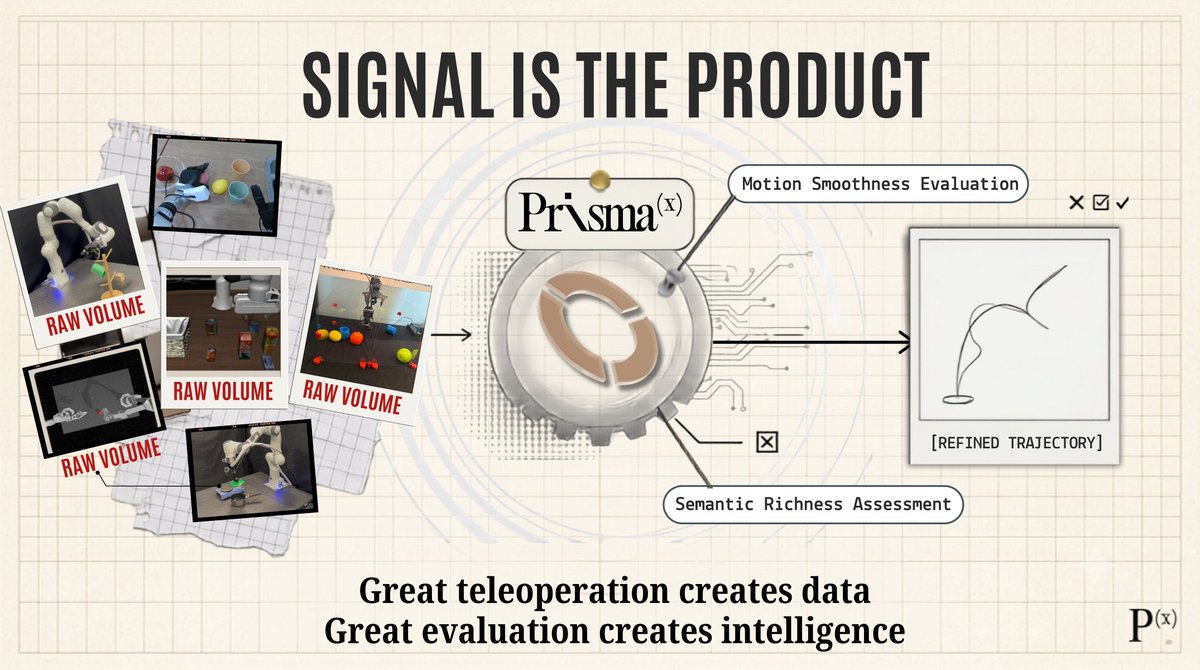
𝗧𝗵𝗲 𝗘𝘃𝗮𝗹 𝗘𝗻𝗴𝗶𝗻𝗲: 𝗪𝗵𝘆 "𝗚𝗼𝗼𝗱 𝗧𝗩" 𝗜𝘀𝗻'𝘁 𝗔𝗹𝘄𝗮𝘆𝘀 "𝗚𝗼𝗼𝗱 𝗗𝗮𝘁𝗮" A robot sorting packages on a livestream makes for great TV. The movements look smooth. The task gets completed. The comments fill up with people saying, "the future is here." But an AI model does not care whether the demonstration looked impressive. It cares about signal. 𝗪𝗵𝗮𝘁 𝗛𝘂𝗺𝗮𝗻𝘀 𝗦𝗲𝗲 𝘃𝘀 𝗪𝗵𝗮𝘁 𝗠𝗼𝗱𝗲𝗹𝘀 𝗦𝗲𝗲 When we watch a robot operate, we tend to judge it aesthetically. Does it look natural? Does it move smoothly? Does it appear human-like? Those are the things our eyes naturally focus on. A foundation model sees something completely different. It is paying attention to: • motion quality. • action trajectories. • force application. • task completion efficiency. • behavioral diversity. Because what looks good to humans is not always what trains intelligence effectively. 𝗧𝗵𝗲 𝗛𝗶𝗱𝗱𝗲𝗻 𝗥𝗶𝘀𝗸 𝗜𝗻𝘀𝗶𝗱𝗲 𝗧𝗲𝗹𝗲𝗼𝗽𝗲𝗿𝗮𝘁𝗶𝗼𝗻 This is something I think gets overlooked when people talk about data generation. Teleoperation by itself is not automatically high quality data. If an operator completes a task inefficiently: • unnecessary movements get recorded • poor trajectories become examples • bad habits enter the dataset And the model learns from all of it. The AI does not know whether the action was optimal. It only knows that the action happened. Which means sloppy teleoperation can quietly create sloppy intelligence. 𝗪𝗵𝘆 𝗣𝗿𝗶𝘀𝗺𝗮𝗫 𝗕𝘂𝗶𝗹𝘁 𝗧𝗵𝗲 𝗘𝘃𝗮𝗹 𝗘𝗻𝗴𝗶𝗻𝗲 This is where PrismaX's Eval Engine becomes interesting. Instead of treating every teleoperation session equally, the system actively evaluates the quality of the interaction itself. The goal is not simply collecting more demonstrations. It is filtering signal from noise. Sessions are assessed using factors such as: • motion smoothness • task diversity • semantic richness • overall execution quality Because not all completed tasks contribute equally to learning. Some interactions teach intelligence. Others simply add noise. 𝗧𝗵𝗲 𝗗𝗶𝗳𝗳𝗲𝗿𝗲𝗻𝗰𝗲 𝗕𝗲𝘁𝘄𝗲𝗲𝗻 𝗗𝗮𝘁𝗮 𝗖𝗼𝗹𝗹𝗲𝗰𝘁𝗶𝗼𝗻 𝗔𝗻𝗱 𝗗𝗮𝘁𝗮 𝗥𝗲𝗳𝗶𝗻𝗲𝗺𝗲𝗻𝘁 A lot of projects focus on generating more data. @PrismaXai seems focused on something different: making sure the data deserves to exist in the first place. That distinction matters. Because the future bottleneck in Physical AI may not be collecting interactions. It may be identifying which interactions are actually worth learning from. 𝗦𝗶𝗴𝗻𝗮𝗹 𝗜𝘀 𝗧𝗵𝗲 𝗣𝗿𝗼𝗱𝘂𝗰𝘁 The more I explore Physical AI, the more it feels like robotics is becoming a calibration problem. Not every successful task should influence a model equally. Not every operator should shape intelligence equally. And not every piece of data deserves a place in the training pipeline. The role of systems like the PrismaX Eval Engine is to ensure that human input remains a source of signal rather than noise. Because in the end, world-class models are not built from the most data. They are built from the highest-quality decisions hidden inside that data ___ 𝗗𝗶𝘀𝗰𝗼𝗿𝗱: discord.gg/prismaxai 𝗪𝗲𝗯𝘀𝗶𝘁𝗲: prismax.ai @PrismaXai
M𝑒r𝑖kO tweet media
English
21
0
34
206
Conso Labs
Conso Labs@Conso_xyz·
Wallet Abstraction with ZKLogin One of the biggest barriers to Web3 adoption is wallet creation and management. That's why we're integrating ZKLogin-powered wallet abstraction into Conso ✅ No wallet setup ✅ Seamless Web2-style onboarding ✅ Secure wallet experience powered behind the scenes The best onboarding experience is one users don't have to think about
Conso Labs tweet mediaConso Labs tweet media
English
39
16
79
3.6K
Phazee🌸💜
Phazee🌸💜@phazeeconcepts·
Good morning CT Gloombles morning y’all Wishing you all a lovely day
Phazee🌸💜 tweet mediaPhazee🌸💜 tweet media
English
48
2
59
488
twinkle
twinkle@TWINKLE534qs·
Finally got the DCO role on Dlicom From showing up every day supporting the community creating content and staying consistent every small effort added up This role isn't just a badge it's a reminder that dedication gets noticed @DlicomApp @dimakuncik @retreeq_
twinkle tweet media
dima kuncik@dimakuncik

✧ New Role Upgrade Batch ✧ congratulations to everyone who earned a new role this week! behind every promotion are hours of activity, creativity, community support, and dedication to the project together, we've helped @DlicomApp grow to over 23,000 Discord members and nearly 17,000 followers on X thank you for everything you do ^3^ let's celebrate our newly promoted members! ⤵︎

English
58
0
105
2.1K
Sarim Rajput
Sarim Rajput@playb0ymvp·
@SyntraxXYZ A very good opportunity to gather your role in SyntraX👾 Let's see who gets the role earlier than other
English
0
0
1
78
Sarim Rajput retweetledi
Syntrax
Syntrax@SyntraxXYZ·
Syntrax is opening the gates for its Community Champions Campaign. This isn’t about noise — it’s about contribution, creativity, and real community value. 📷 Top contributors will be rewarded with: • Ambassador (Top 10) • Scribe (Top 20) • OG (Top 20) Think, build, share, and engage — and let your work speak. Join & participate here: syntrax.xyz #SyntraxXYZ $STRX Let’s see who’s building, not just talking.
Syntrax tweet media
English
55
53
89
2K
Shah Eshtiyak
Shah Eshtiyak@EshtiyakSh42152·
Rise and shine, Dlicom community! 🌅 Good morning 🌄 A brand new morning calls for a brand new project This dlicom project growth first This $DLI co-founder @MQadriah @DlicomApp is the best project of 2026 #CryptoAlert
Shah Eshtiyak tweet media
English
6
3
23
496
Sarim Rajput
Sarim Rajput@playb0ymvp·
Syntrax is becoming bigger than one product ⚡ It’s evolving into a hybrid Web3 ecosystem built around real activity, fair rewards, and long-term utility. The key systems coming together: • Task System Earn airdrop points and USDT through real tasks. • AI + Human Verification Sybil protection, wallet checks, and fair user validation. • Play-to-Earn Daily Spin is already live, with more games coming. • Mindshare Rewards A hybrid content reward model inspired by Kaito + GenLayer. • Premium System Extra benefits for users who want stronger ecosystem exposure. • Roles + Identity Discord reputation roles, STRX on-chain ID, and future NFT layers. @SyntraxXYZ is building a connected ecosystem where contribution, creativity, and participation can be rewarded fairly. This is still early. #SyntraxXYZ #SyntraxXYZFam #STRX #Web3‌‌
Sarim Rajput tweet media
English
14
0
15
155
saze(revival arc)
saze(revival arc)@sazexbt·
> @Kuzey just announced some big updates to the Æ ecosystem. Æ(.)com isn't just accelerating but actually siting down and building with you product, design, dev, branding, launch strategy, ecosystem integration. Not just funding and a few calls. first project was @netrun_xyz . Æ built the app, the website, shaped how the product works end to end. In return they took 33% ownership. No fixed structure either , every deal is customized based on what they contribute. not limited to startups. Creators, influencers, communities, games, music, fashion, if the idea has legs, Æ wants to help build it into something real. token launches are going through Pump(.)fun on Solana. Yeah it has a memecoin reputation but that's changing and Æ is building on what it's becoming, not what it was. $Æ coin is the center of it all. Every project Æ helps build, revenue from that flows back into buybacks. So the coin basically reflects the health of everything in the ecosystem. Public dashboard coming so anyone can track the transactions themselves. early but the model is straightforward. $Æ - H8aWzESMpR8drxau9QYi95xPBdFZyFix1n5peFQKpump @0gmaestro @jadoncarter
saze(revival arc) tweet media
saze(revival arc)@sazexbt

bitcoin Ordinals proved something important. on-chain digital artifacts don't need smart contracts. you can inscribe data directly onto a satoshi image, text, metadata and it lives on Bitcoin permanently. -no wrapping layers -no middlemen. concept was airtight but failed on execution. fees spiked to $50+ during peak demand. block times averaged 10 minutes. the tooling was fragmented and the UX was hostile to anyone outside of a small technical circle. most people who wanted in couldn't figure it out. the ones who could often get priced out. --- @netrun_xyz takes the same primitive and rebuilds it where it actually makes sense. Solana, 400ms block times, sub-cent fees. an ecosystem with millions of active users who already know how to move assets, connect wallets, and trade. the inscription logic stays intact assets are still imprinted on-chain, still carry permanent identity, still don't rely on a contract to exist. what changes is everything around it. -speed -cost -accessibility. ordinals showed the world that on-chain ownership could be direct and permanent. Netrun is the version that doesn't ask you to suffer through the experience. Cc : @jadoncarter @0gmaestro

English
13
0
31
850
𝕷𝖚𝖙𝖍𝖊𝖗🥷🏾
🧵 @PrismaXai contends that the primary constraint in Physical AI is not neural architecture but information quality. Contemporary robotics repositories are frequently fragmented, repetitive, heavily reliant on a limited number of hardware ecosystems, and populated with inferior
𝕷𝖚𝖙𝖍𝖊𝖗🥷🏾 tweet media
𝕷𝖚𝖙𝖍𝖊𝖗🥷🏾@Lutt33r

🧵 @PrismaXai Tele-Op engagement illustrates how physical AI architecture can revolutionize robotic cognition through tangible interaction. Instead of depending exclusively on artificial simulations, Tele-Op empowers remote operators to maneuver robotic platforms…..

English
12
1
15
237