
Pratap Tokekar
687 posts

@ptokekar
Associate Professor at @umdcs, @umiacs, and @amazon Scholar. Previously @vt_ece @grasplab @umncomputersci


Sharing the slides for a talk on faculty job search Hope it's helpful to people exploring and preparing for the process. Feedback is welcome! dropbox.com/scl/fi/p7xdtsq…

🆕Fast #kconnectivity restoration in #multirobotsystems for robust communication maintenance: algorithmic and learning-based solutions by @guangyao_shi, Md Ishat-E-Rabban, Griffin Bonner & @ptokekar. 🔗bit.ly/47JMCYI @DARSSymposium @RAASumd @umdcs @iribecenter

Honored to be featured by @umiacs_umd for showcasing my work in robot learning at the @Amazon Robotics Research Symposium in Boston! Grateful for my advisor @ptokekar, collaborators & the UMD community for their support. 🔗 umiacs.umd.edu/news-events/ne…


Can robots get to the point?🎯 We’re sharing AFFORD2ACT—a way for robots to use semantics from a short prompt to keep only the pixels that matter and then act. This replaces heavy, dense inputs with a small state for control. 1/6 #Robotics #AI #Manipulation #Affordance #Keypoints

How can we utilize cross-embodiment action-free videos in learning generalizable and robust policies? Introducing our paper in ICCV 2025 @ICCVConference (also best paper nomination at the ICRA FMNS WS), GenFlowRL: an reward shaping method with generative object-centric flow. 1/6

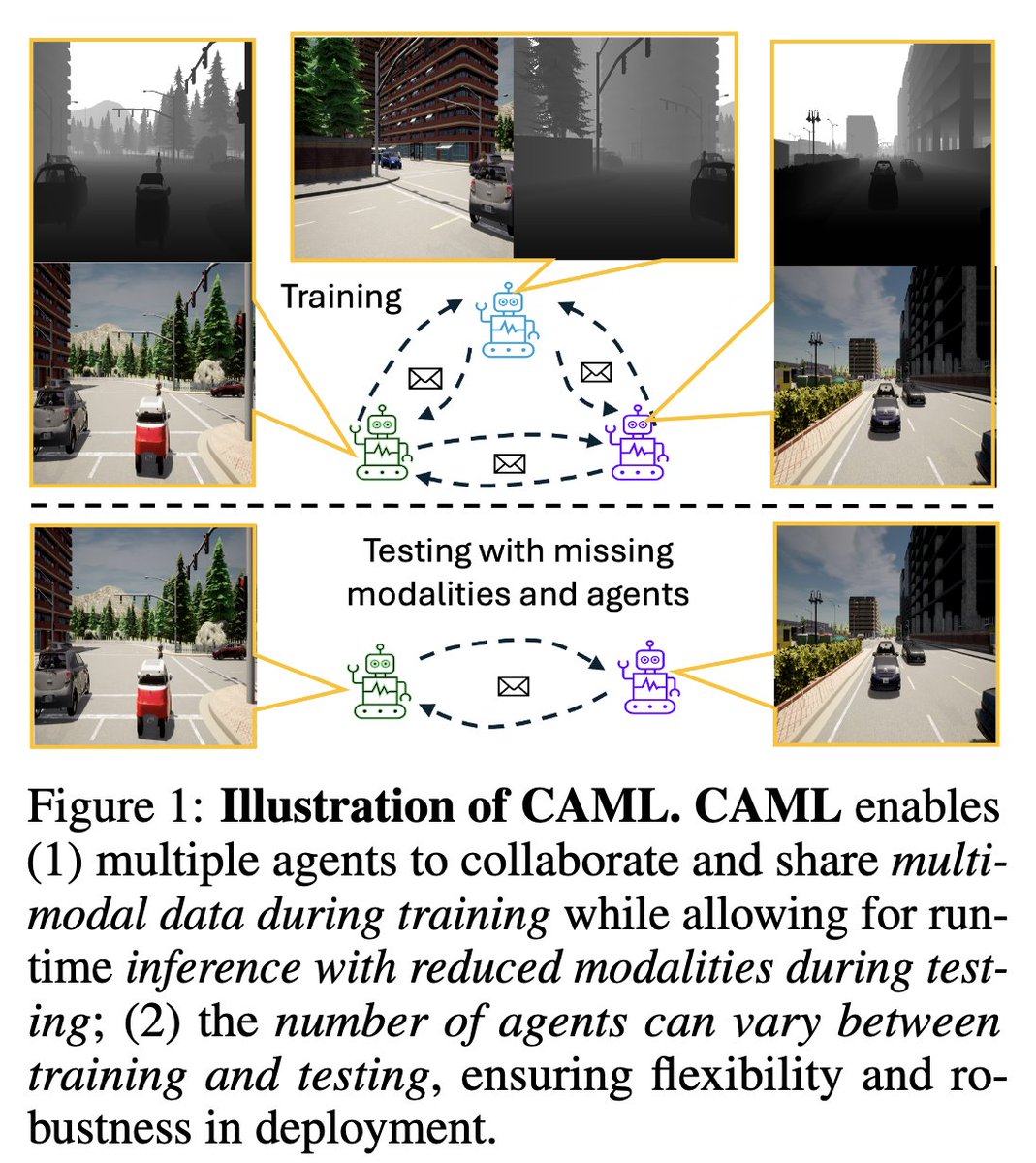
(1/n) CAML: Collaborative Auxiliary Modality Learning for Multi-Agent Systems Authors: @ruiliu0, Yu Shen, @penggao41252277, @ptokekar, @MingCLinCS Link: arxiv.org/abs/2502.17821 This Paper proposes Collaborative Auxiliary Modality Learning (CAML), a multi-modal multi-agent framework that enables collaborative training with shared modalities while supporting reduced-modality inference, achieving significant gains in accident detection for connected autonomous vehicles and semantic segmentation in aerial-ground robot data.

🚀 It feels refreshing to share some new theoretical results! #NeurIPS2025 🎉 🔑 One-line takeaway: We prove that policy gradient methods can achieve global optimality even in the broader setting of general utility RL More details coming soon!!


📢 @umdcs is welcoming 8 new faculty in 2025–26 with expertise in AI policy, robotics, bioinformatics, vision, language models, simulation & sound design. They’ll strengthen research & teaching across computing. Read more: go.umd.edu/New-Faculty7-2…


Thrilled to present Sketch-to-Skill at #RSS2025 🎉 📍 USC, Bovard Auditorium 🗓️ June 24 | 11:30am talk + 12:30pm poster Teach robots by drawing ✏️➡️🤖 w/ @peihong_yu, @singhanukriti , @zahir_mahammad & @ptokekar Paper: lnkd.in/eGmjke3h website:lnkd.in/eWEMsZ74