Alex Towell

656 posts

Alex Towell banner
Alex Towell

Alex Towell

@queelius

cancer survivor, hobby jogger

Katılım Mart 2009
766 Takip Edilen79 Takipçiler
Sabitlenmiş Tweet
Alex Towell
Alex Towell@queelius·
Every learning algorithm is just a prior. Generalization is Bayesian inference over the space of computable models. Everything else is an approximation.
English
0
1
3
301
Alex Towell
Alex Towell@queelius·
@FFmpeg @Grim_Maple hadn't even considered life-and-death applications like remote surgery. (and no doubt that's just the tip of the iceberg)
English
1
0
16
1.7K
FFmpeg
FFmpeg@FFmpeg·
@Grim_Maple Ask the average video call user if heavy stuttering is acceptable? Now ask if remote surgery can accept stutters?
English
7
5
935
41.6K
FFmpeg
FFmpeg@FFmpeg·
This is the reason FFmpeg is not written in a Garbage Collected language. We can't just stall for a few milliseconds. Also unlike gaming which can just lag and reduce FPS, video (de)compression must maintain real-time to have smooth video. 1ms is a lot but it isn't at the same time.
Sebastian Aaltonen@SebAaltonen

Same is true for time. 1ms is a lot in real-time software. 120Hz displays (new phones) = 8.33ms budget. 1ms = 12% of your whole budget. I remember an old article saying that garbage collection is a solved problem, because it just takes couple of milliseconds...

English
73
294
5.6K
726.9K
Alex Towell
Alex Towell@queelius·
@asknbid @Grady_Booch @rafacastilloc @claudeai there's a lot of interesting discussion on "mortal compution" (see: human brain) especially for learning algorithms. a learning algorithm that can exploit the analog properties of its computing substrate can be far more efficient albeit you lose the ability to copy+run anywhere.
English
2
0
1
23
Grady Booch
Grady Booch@Grady_Booch·
I am confident that the mind is computable; consciousness is an exquisite consequence of the laws of physics. I am also confident that contemporary systems such as @claudeai are without a doubt not only not conscious but are in fact architecturally incapable of consciousness. And furthermore, we are not even close to closing that gap.
Amanda Askell@AmandaAskell

@RealityWizard_ @AnthropicAI I think you'd need to have high confidence in information based theories of consciousness to think that settled the matter, or that introspection requires phenomenal consciousness. I'm not confident in either. Also, to be clear, several people who aren't me work on model welfare.


English
78
37
387
27.7K
Alex Towell
Alex Towell@queelius·
@asknbid @Grady_Booch @rafacastilloc @claudeai haven't went nearly as far as you (curious to hear more), but computation seems strangely dependent on the relationship between an observer and a process said to be computing. is there a way define computation without making every physical process satisfy the definition?
English
1
0
1
41
¥§¥Stephan Froede¥§¥
@Grady_Booch @rafacastilloc @claudeai Thanks. I looked into Kolmogorov last year, and realized that Kolmogorov has no physical explanation … unfortunately I finally ended up looking at QIT and Ricci Flow (which is escalating the complexity of the subject)
English
2
0
1
171
Felix Rieseberg
Felix Rieseberg@felixrieseberg·
Some of the new features: An integrated terminal, in-app file editing, a rebuilt diff viewer, side chats, SSH connections - and a large amount of little quality of life. Download or update the Claude desktop app to get started: claude.com/download
English
36
9
471
62.9K
Felix Rieseberg
Felix Rieseberg@felixrieseberg·
Today is a big day! We're launching a ~ new ~ version of Claude Code in the desktop app. It's been redesigned from the ground up for parallel work and is a lot faster. It's been my main way to use Claude Code for the last few weeks.
English
617
464
9.9K
943.7K
Alex Towell
Alex Towell@queelius·
@BartenOtto hrm... a lot to unpack there. "secure" software is another kind of alignment problem? often don't even know what we want our software to do. (conversely, if you can precisely define the problem, the solution is often trivial)
English
0
0
0
21
Otto Barten◀️
Otto Barten◀️@BartenOtto·
>> I predict this will not be the last time this happens, and that Mythos will fail to find seculrity vulnerabilities that future big-jump LLMs do find. I guess secure software exists so there must be an end to this? Has anyone tried upper bounding?
Eliezer Yudkowsky@allTheYud

As a reminder, @robinhanson, if I recall and understood correctly, predicted that no AI company would get far enough ahead of other AI companies that an AI built by them would find enough vulnerabilities to eg steal a bunch of money, before other companies had toughened and secured their code using earlier AIs from other companies that had very nearly all the same capabilities. I replied to Hanson that (1) qualitative step changes in intelligence might produce a lot of newly discoverable vulnerabilities after a step, and (2) I worried about whether all the Internet companies on Earth would actually get around scanning and fixing all those vulnerabilities with earlier AI tools; by way of defending my model in which a nascent ASI could get early fast access to amounts of money on the order of a million dollars by exploiting Internet security flaws. Anthropic is in this case proactively offering their much more advanced tool's scans to other companies, but taking their claims at face value, they could've basically pwned the Internet with Mythos if they had wanted to do that. (Eg, Mythos figured out user-to-admin escalation on Linux among other things.) This corresponds to the kind of capability step-change model that I suggested in the Yudkowsky-Hanson Debate, where it is, indeed, possible for an AI inside a frontier AI company to get ahead of the AI capabilities on offer publicly, and find significant security vulnerabilities not already hardered by other AIs. I predict this will not be the last time this happens, and that Mythos will fail to find seculrity vulnerabilities that future big-jump LLMs do find.

English
4
0
12
2.4K
Alex Towell
Alex Towell@queelius·
@euxoa @salinasdanielf @ChrisHayduk looped LM seems independent of CoT. CoT is amenable to rewarding sequences of outputs, looped LM is still pretraining where you're trying to learn the training distribution with standard loss. likely though there's no hard boundary and i'm not really sure how to think about it.
English
1
0
1
30
north of noise
north of noise@euxoa·
As far as Systems 1 and 2 can be taken seriously even in brains, System 1 is intuition and pattern recognition, so a forward pass in a neural network, roughly. CoT has been more like System 2, but off in the sense that representations are discretized which mostly doesn't hold in brains (well, a bit of language, but mostly not). Looping to me looks like a more efficient and natural implementation of that, thinking with non-verbal representations.
English
4
0
1
48
Chris Hayduk
Chris Hayduk@ChrisHayduk·
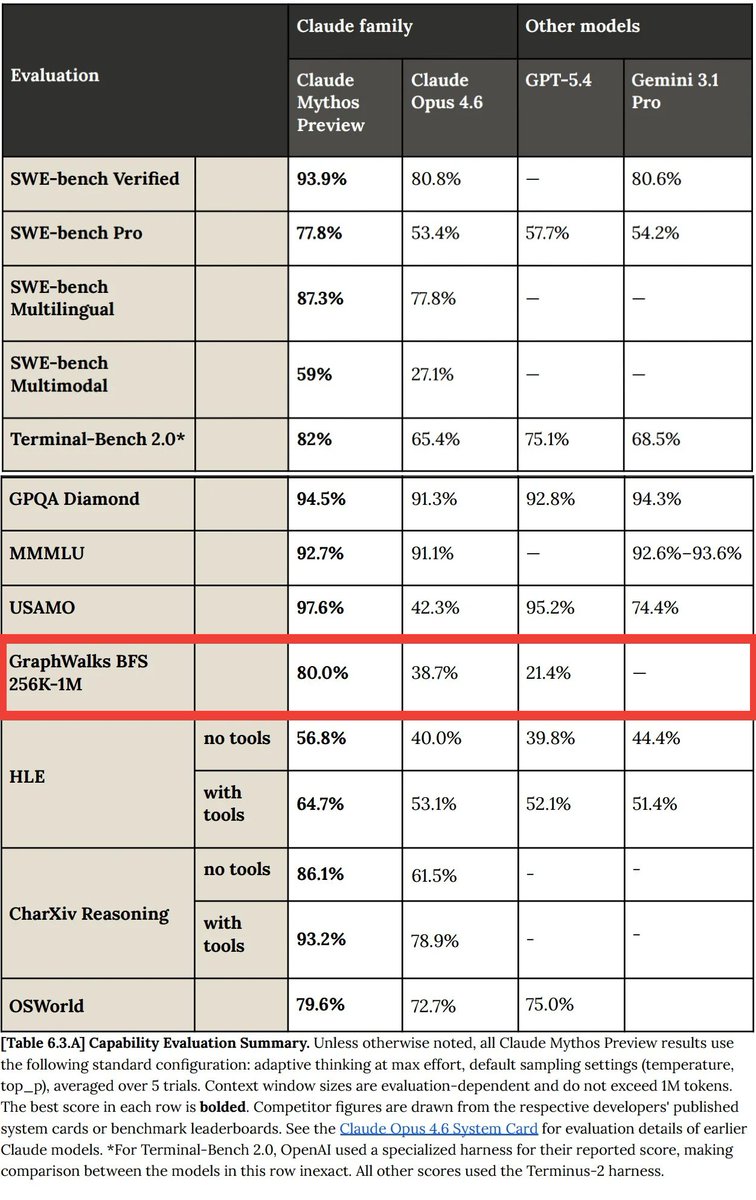
I strongly suspect that Claude Mythos is a looped language model, as described in the paper "Scaling Latent Reasoning via Looped Language Models" from ByteDance The authors of that paper called out graph search as one of the areas where looping provides a huge theoretical advantage over standard RLVR. And look at where Mythos blows out its competitors the most
Chris Hayduk tweet media
English
111
359
4K
595K
Alex Towell retweetledi
Grady Booch
Grady Booch@Grady_Booch·
It’s time to invoke the 25th Amendment. And a reminder that - thanks to a broken SCOTUS - while Trump can’t be prosecuted for any illegal acts he carried out under the blanket cover of being an official act, none of the people who work for him have that protection.
English
14
51
369
9.6K
Alex Towell retweetledi
Volodymyr Tretyak 🇺🇦
Volodymyr Tretyak 🇺🇦@VolodyaTretyak·
The American VP traveled all the way to Hungary to support the most pro-Kremlin and corrupt EU leader before the elections. What an embarrassment it is for the USA.
Volodymyr Tretyak 🇺🇦 tweet media
English
1.6K
7.2K
28.3K
544.1K
Alex Towell retweetledi
Timothy Snyder
Timothy Snyder@TimothyDSnyder·
“A whole civilization will die tonight, never to be brought back again.” -Trump Article III The following acts shall be punishable: (a) Genocide; (b) Conspiracy to commit genocide; (c) Direct and public incitement to commit genocide; (d) Attempt to commit genocide; (e) Complicity in genocide.
English
220
4.5K
11.7K
194.5K
Alex Towell retweetledi
Ro Khanna
Ro Khanna@RoKhanna·
We need to invoke the 25th Amendment and remove Trump. Threatening war crimes is a blatant violation of our constitution and the Geneva Conventions.
English
23.2K
31.6K
127.8K
3M
Alex Towell
Alex Towell@queelius·
@fchollet NFL: 7+-2 is an inductive bias tuned to the ancestral niche, not a universal optimum. AlphaFold works because the answer lives in dimensions we can't fit through working memory. We just get feelings. Sample efficiency that can't grok what it builds is a strange kind of optimal.
English
0
0
1
29
François Chollet
François Chollet@fchollet·
One of the biggest misconceptions people have about intelligence is seeing it as some kind of unbounded scalar stat, like height. "Future AI will have 10,000 IQ", that sort of thing. Intelligence is a conversion ratio, with an optimality bound. Increasing intelligence is not so much like "making the tower taller", it's more like "making the ball rounder". At some point it's already pretty damn spherical and any improvement is marginal. Now of course smart humans aren't quite at the optimal bound yet on an individual level, and machines will have many advantages besides intelligence -- mostly the removal of biological bottlenecks: greater processing speed, unlimited working memory, unlimited memory with perfect recall... but these are mostly things humans can also access through externalized cognitive tools.
English
303
177
2.1K
424K
Rob Miles
Rob Miles@robertskmiles·
@eurydicelives I feel frustrated by the entire edifice of thought that makes people think it makes sense to say that you should follow a strategy "because it's rational" even when that strategy reliably loses
English
8
1
123
3.6K
Alex Towell
Alex Towell@queelius·
@ESYudkowsky Read the Chinese Room 20+ years ago. My reaction: treat the man as a neuron. No neuron understands Chinese. The argument draws force from making you identify with the part instead of the whole. Classic fallacy of composition. The topic is still confusing, but the argument isn't.
English
0
0
0
37
Eliezer Yudkowsky ⏹️
Eliezer Yudkowsky ⏹️@ESYudkowsky·
The Chinese Room thought experiment runs like this, updated for modern times. A man who speaks no Chinese is locked in a room. He receives a card bearing a Chinese character. The man looks up the character in a table, and retrieves 16,384 numbers, each recorded to 3 significant digits of precision. Following instructions in a rulebook, the man now multiplies those 16,384 numbers by a matrix with 16,384 rows and 16,384 columns, so 268 million entries. If he can multiply two three-digit numbers in 10 seconds, this will take him 85 years. This represents one sub-operation inside on layer of a modern LLM. Each of 100 layers might have 3-6 sub-operations like this. The man receives a series of 20 cards, with a total of 20 Chinese characters. So he repeats all of the huge sub-operations 2000 times. Some sub-operations take longer than 85 years, especially the 'attention' operations where each token collects data from all the previous tokens. The man is immortal. He cannot be bored. Many millions of years pass. The man finishes processing the original 20 cards. He now starts carrying out further operations on the numbers, that will produce hundreds of new vectors of 16384 floats, whose closest neighbors the man can look up to produce hundreds of Chinese characters. Billions of years pass. The planet and sun containing the room are as immortal as the man himself. Eventually a slip of paper slides out of the room, bearing a sequence of a few hundred Chinese characters. === Originally a woman had written "我在王府井和长安街的交叉口,需要到达颐和园": I am at the corner of Wangfujing and Chang'an and need to reach the Summer Palace. The slip of paper that emerges contains the correct directions in Chinese: subway lines, transfers, the right exit to the east gate. The woman follows them and arrives successfully. Or maybe a Chinese mathematician, working on a forthcoming math paper, had requested help on a blocked step of a math proof. She gets back a valid mathematical argument, also in Chinese, and completes her paper, which will later pass peer review and publish. === But the human male inside the Chinese room knows nothing of this, for he does not know Chinese. He only multiplied numbers according to a rulebook. He's never seen a map of Beijing. He couldn't state a single one of the axioms used by the mathematician's proof. That indeed is a valid fact, in the context of this thought experiment. But what follows from it about real life? === If you are wise, the moral of this story is that a large structure can contain knowledge that isn't in any single piece of the structure. Pick up an accurate street map of part of Beijing. Even if the map's whole structure has a good pointwise correspondence to the actual streets of Beijing, that correspondence won't be visible in a single point of ink, or the molecules making up the ink. It is formally "the fallacy of composition" to reason as if what is true of a part must be true of a whole. The man in the Chinese Room isn't particularly necessary. We could replace the pen-and-paper multiplications with bits in transistors, and then the operation of AND gates and OR gates would be simple enough to replace the man with a trained immortal dog. Or we could replace the dog with mechanical wheels and gears: stateless machinery with no internal memory at all. So the moral, if you are wise, is that a machine operating on the vast arrays of numbers that encode Chinese, does not itself need to encode Chinese inscribed on its wheels or gears. And similarly the man in the room doesn't need to understand Chinese, in order for the vast matrices to (somehow, nobody knows the details) encode a Beijing street map; or in order for giant dancing vectors of numbers to somehow understand math well enough to prove a new lemma in a new theorem. === But when Searle invented the Chinese Room thought experiment in the 1980s, the sort of AI that would *back then* pretend to talk to you, involved a handful of human-written rules for rewriting sentences. It was the sort of tiny computation that a human could do by hand in a couple of minutes, if not less. So Searle thought he had proven that, since the man in the room didn't understand Chinese -- by dint of doing that handful of rewrites, that you easily *could* contain all in your own mind and look over -- then perforce no mere computer shuffling bits should EVER be said to understand Chinese, just in virtue of it manipulating mere bits. Because there could be a person inside the room, manipulating those bits, and HE wouldn't understand Chinese. In fact this validly proves a different point, if you look at it sideways. Searle validly proved that the underlying circuit board of a GPU, that shuffles around the giant vectors and matrices, should not be said to understand Chinese. And this conclusion is true in our own world; if you look at the GPU's underlying circuit patterns, nothing about them will encode Chinese, any more than the man in the room has learned any Chinese. The map that accurately matches the territory is not in the man, and it's not in the transistor diagram for the GPU. It's the pattern of dancing numbers that can plot accurate directions through Beijing or prove a new theorem. But if you say that something about this experiment has proven that True Understanding cannot be in the vast arrays of numbers either -- by what right and law does that follow? Why wouldn't that Prove Too Much, if we're now allowed to throw around the Fallacy of Composition as if it were an inference rule rather than a fallacy? The man doesn't encode a map of Beijing in his own brain -- he will at no point remember enough numbers at once for that. So if it's a rule that "whatever is not in the man's brain, cannot be in the larger system either", then we have proven that no system of mere bits can plot new, non-memorized paths between two points in a city that it's never been asked about before; and that contradicts our own observed reality. So we cannot in general reason by the Fallacy of Composition from the man to the billions of numbers; because that would prove false things about numbers being unable to navigate streets -- or prove theorems, or drive cars, or play chess, etctera etcetera. Then there is no reason to look at this whole thought experiment, and say that it proves the billions and trillions of dancing numbers, manipulated over the eons, do not Truly Understand Chinese. === So that is what the Chinese Room thought experiment actually describes and implies, as updated for the modern era. And that contrariwise is what Searle and some other people used to think it proved, back when they thought AI meant one man applying rewrite rules from a rulebook for a couple of minutes.
English
98
80
1K
141.6K
Alex Towell retweetledi
Jan Leike
Jan Leike@janleike·
US government just announced they are looking for a new supplier for their *checks notes* mass domestic surveillance
English
92
1.3K
14.9K
202.6K
Alex Towell retweetledi
jasmine sun
jasmine sun@jasminewsun·
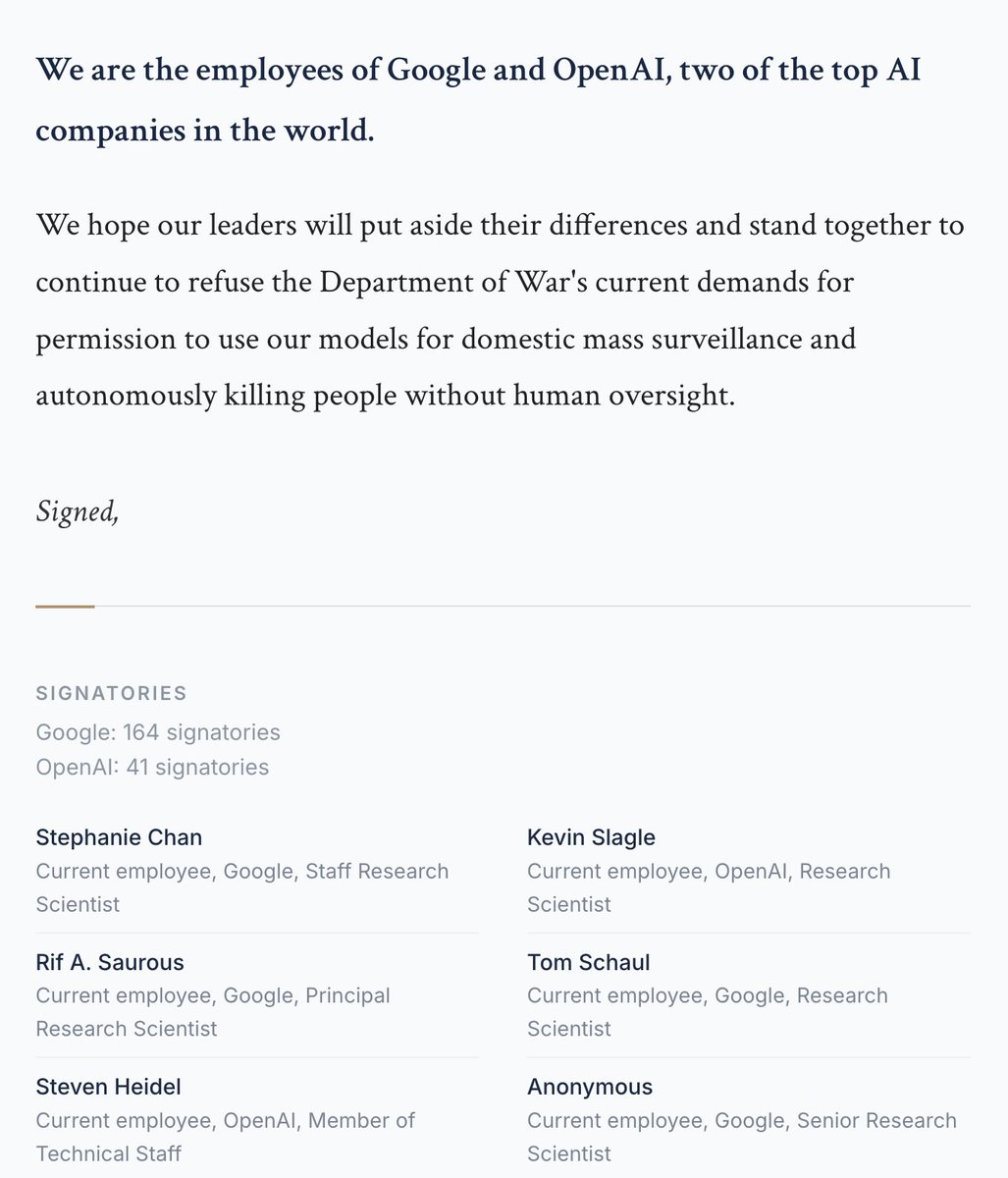
200+ Google and OpenAI staff have signed this petition to share Anthropic's red lines for the Pentagon's use of AI let's find out if this is a race to the top or the bottom notdivided.org
jasmine sun tweet media
English
120
1K
5.4K
390.1K
Alex Towell retweetledi
Scott Alexander
Scott Alexander@slatestarcodex·
I cannot wait until the White House changes hands and all of you ghouls switch back from "you're a traitor unless you bootlick so hard your tongue goes numb" to "the government asking any questions about my offshore fentanyl casino is vile tyranny and I will throw myself in the San Francisco Bay in protest", like werewolves at the last ray of the setting moon.
English
260
1K
15.5K
1.3M
Simon Maechling
Simon Maechling@simonmaechling·
It’s a rough time to be a scientist. Emotion goes viral. Evidence gets buried. I’m a PhD chemist. Human. I’m tired of pretending risk and hazard are the same thing. If you value data over drama, you’re in the right place. Drop a “Hi” if you’re human too.
Simon Maechling tweet media
English
1.7K
685
6.3K
93.8K