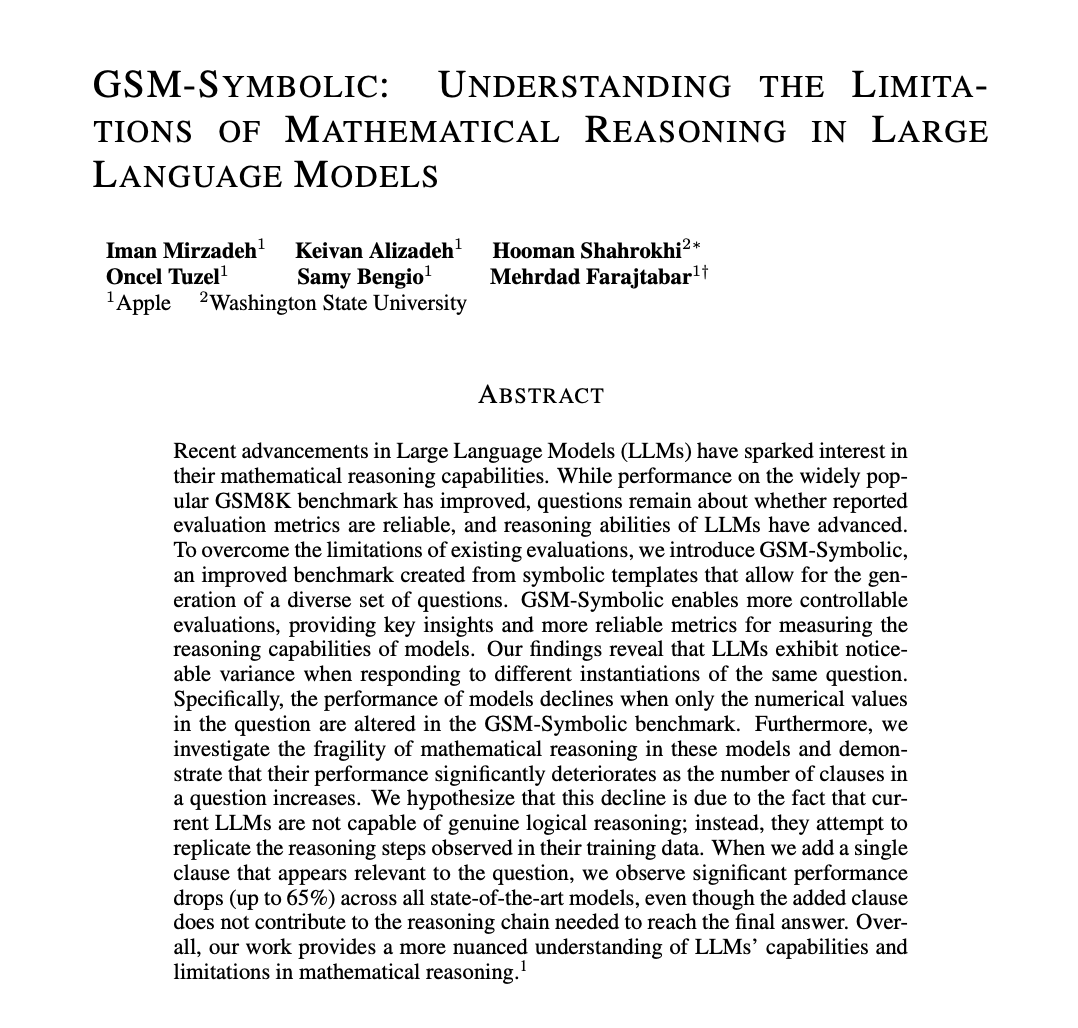
turns out AI models cannot do math.. even grade school math. the kind a 10-year-old solves.
Apple published a devastating study that exposes a massive illusion at the core of artificial intelligence.
they took the standard math benchmark (GSM8K) that every AI company uses to brag about how smart their model is.
first, they just changed the names in the word problems.. the models' performance fluctuated for no reason.
then, they changed the numbers. the performance immediately dropped.
but then they ran the test that broke everything.
they added one single, completely irrelevant sentence to the word problem. something like: "By the way, 5 of the apples were green."
A human 10-year-old ignores the green apples and solves the underlying math.
the AI didn't.
across every state-of-the-art model, performance collapsed by up to 65%.
the AI blindly grabbed the irrelevant number and tried to shove it into the equation. it didn't know why it was doing the math. it just saw a number and assumed it was supposed to use it.
there is no genuine logical reasoning happening under the hood.
we are deploying these systems to run our finances, analyze our legal documents, and make complex strategic decisions.
but the models don't actually understand the logic they are spitting out.
they just know what a smart answer is supposed to look like.
AI Isn’t Just ChatGPT. It’s the Result of Decades of Innovation.
Most people see AI through the lens of ChatGPT, Claude, Gemini, or Midjourney.
But those tools sit at the very top of a technology stack that has been evolving for decades.
From Classical AI that relied on rules and logic…
➡️ To Machine Learning that learned from data.
➡️ To Neural Networks inspired by the human brain.
➡️ To Deep Learning that unlocked breakthroughs in vision, speech, and language.
➡️ To Generative AI that can create text, images, video, and code.
➡️ And now to Agentic AI, systems that can remember, plan, use tools, and autonomously execute complex tasks.
The future won’t be defined by who uses AI.
It will be defined by who understands how these layers connect and how to orchestrate them into real-world outcomes.
We’re moving from AI as a tool ➜ to AI as a collaborator ➜ to AI as a digital workforce.
And we’re still in the early innings.
The biggest opportunity isn’t learning one AI application.
It’s understanding the roadmap and positioning yourself ahead of the curve.
What layer do you think will create the most disruption over the next 5 years: Generative AI or Agentic AI?
It's not pointless. The learning curve just moved up the stack.
You're not learning syntax anymore. You're learning architecture, trade-offs, debugging, and knowing what the hell you're looking at when AI confidently writes broken code.
AI didn't make coding pointless — it made understanding it more valuable than ever. The people still typing everything by hand aren't the ones who know everything. They're the ones stuck on the old curve.
Trying to learn coding right now feels pointless sometimes. AI can write most of it better than I can. So why even bother?
I'm still figuring this out.
I've never met an employee this fast, and honestly I don't think they're dumb.
AI doesn't have bad ideas. It has great ideas that need someone with taste to recognize them. The "dumb" part is a failure of the human on the other side, not the machine.
A fast employee who gives wrong answers gets fired. AI gives wrong answers only when you haven't provided enough context. That's not dumb—it's an employee waiting for clear direction.
@2sush API costs will kill more projects than any singularity ever could. Local models don't just solve privacy—they solve economics. Compute what you want. The invoice is always zero.
Yes. The model isn't trained on what humans aspire to—it's trained on what humans actually produce. And what humans actually produce in bulk is slop.
Feed it a vague prompt and ask for "help." It reaches for the average of everything it's seen. That's not a bug—it's the training objective.
The slop isn't coming from the model. It's coming from the data.
Imagine how good you'd be if you kept doing what you're doing for 20 years straight.
Right. Pretty darn good.
So why do you keep hopping around, chasing shiny distractions? FOCUS.
The best school AI policy starts with an adult saying: "Let's talk about this."
Kids are already using AI. The question is whether we help them build judgment, curiosity, and standards around it.
Good EdSurge piece: edsurge.com/news/2026-06-0…
@ForrestPKnight Humans have a very wide variety of writing abilities. What you described exists for many writers but certainly not all. AI currently surpasses many humans who do not follow your method.
@jun_song Sleep and exercise are the best therapy. Awesome that you found a passion. Consuming your time is okay; consuming you is not. You have to take care of yourself to fuel your passion.
Your kid can code now by describing what they want. The new skill is learning how to test, fix, and improve what AI builds. But you don’t want it to be a free-for-all on your computer. Look into ways they can learn in a sandbox environment.
You are not behind.
You do not need to become a machine learning engineer before you can help your kid learn AI.
You need curiosity, a little patience, and one small project you can build together.
This weekend, don’t “study AI.”
Build something.
A homework helper with rules.
A bedtime story bot.
A family meal planner.
A silly image prompt game.
A checklist that turns chaos into a plan.
Your kid does not need a perfect teacher. They need to see you learning out loud.
What will you build this weekend?
AI just helped solve 53+ open math problems, including Erdos problems that had been open for 56 years.
That is not just “homework help.” It is a preview of the world our kids are going to build: AI as a research partner, a pattern finder, and a force multiplier for human curiosity.
The question for parents is not whether this changes school—it does. The question is whether we help our kids learn how to think with it.
That should make us excited.
Not because AI replaces learning, but because it raises the ceiling on what learning can do.
The kids who learn to ask better questions, test ideas, verify results, and work with these systems will have tools previous generations could barely imagine.
AI just helped solve dozens of open math problems.
Google DeepMind’s AlphaProof Nexus resolved 9 Erdős problems, proved 44 OEIS conjectures, and helped settle a 15-year-old problem in algebraic geometry. Some had been open for more than half a century.