Ready Forit

625 posts

Ready Forit

Ready Forit

@ready_forit

People person.

Katılım Ekim 2020
544 Takip Edilen9 Takipçiler
Ready Forit
Ready Forit@ready_forit·
@SethDavisHoops many complainers should move to Europe, especially France. if you love strict rule books and zero contextual human bending of rules & regulations, then France is perfect for you. me personally, I prefer America, where being human means thoughtfulness about situations/moments
English
0
0
1
652
Seth Davis
Seth Davis@SethDavisHoops·
Hoping this is the last time it needs to be addressed, but there seems to be confusion as to what the rules are regarding contact between a coach and official. Many seem to assume that any contact between a coach and official by rule must result in a technical. This is not true. This is what's in the rulebook, specifically rule 10.2.h which says an unsporting Class A technical should be assessed to a coach or player who "disrespectfully contacts an official or makes a threat of physical intimidation or harm to include pushing, shoving, spitting, or attempting to make physical contact with an official." The phrases "disrespectfully" and "physical intimidation or harm" are by definition subjective. So it's up to the official in that situation to decide whether he is being disrespected or intimidated. The ref in this situation did not believe he was. Seeing as how the "contact" came right after Mullins' game winning shot, it's reasonable to interpret that Hurley was pumped about the shot and not trying to intimidate or threaten the official. That is my interpretation as well. Reasonable (and especially unreasonable lol) minds can differ, but to assert that the referee did not follow the rules in this situation is factually inaccurate. Thank you for you attention to this matter.
English
149
34
372
92.4K
Ready Forit
Ready Forit@ready_forit·
@tjmcaulay @jramseymmo Terry--maybe it's to appease ppl like you who are fussing. you are endorsing neutralizing one of the most epic moments we have ever seen as sports fans...to decide the game on a technical foul. why not just let a robot decide the game if you want to eliminate all human judgement?
English
0
0
0
69
Terry McAulay
Terry McAulay@tjmcaulay·
The official who failed to penalize Hurley’s abhorrent conduct is conspicuously missing. Speaks volumes. Reminds me of the situation in 1987 when three of the best failed to penalize Bobby Knight when he slammed the table during a Regional Final game. Everyone in the basketball community knew those three were done.
Jeff Goodman@GoodmanHoops

FINAL FOUR OFFICIALS: Jeff Anderson James Breeding Lee Cassell Ron Groover Keith Kimble Kipp Kissinger Greg Nixon Marques Pettigrew Doug Shows Doug Sirmons Paul Szelc

English
225
46
438
259.8K
Ready Forit
Ready Forit@ready_forit·
@dekker .@dekker--it's one of the craziest sequences in sports history. Everyone either lost their mind or was in disbelief. Even announcers trained for that kind of moment looked comatose. And your take is: Refs should decide the game with a technical foul? Being human doesn't count?
English
0
0
0
276
Anish Moonka
Anish Moonka@anishmoonka·
The research behind this is wild. Your brain can’t flip from full alert to sleep like a light switch. It needs a runway. And reading builds it faster than almost anything else. A University of Sussex study found that just 6 minutes of reading cut stress by 68%, more than music (61%), tea (54%), walking (42%), or video games (21%). The effect is surprisingly physical. When you read, your nervous system shifts from fight-or-flight into rest-and-digest mode. Heart rate slows, breathing deepens, muscles release tension. The neuropsychologist who ran the study, Dr. David Lewis, described it as entering “an altered state of consciousness,” where focused imagination activates the part of your brain that tells your stress response to stand down. A 2021 randomized trial tested this directly. Researchers split nearly 1,000 people into two groups: read a book in bed for seven nights, or don’t. After one week, 42% of readers reported better sleep versus 28% of non-readers. Nothing else changed. Now compare that with what 86% of Americans actually do before bed: scroll their phones for an average of 38 minutes a night. A 2025 Norwegian study of 45,000 university students found that every additional hour of screen time in bed raised insomnia risk by 59% and cut sleep by 24 minutes. A separate American Cancer Society study of 122,000 adults found daily screen use before bed was tied to 50 fewer minutes of sleep per week. Screens hit you with two sleep-blockers at once. Blue light suppresses melatonin, the hormone that tells your body it’s time to sleep, by about 50% according to a Harvard study. But the bigger problem is the content itself. News, social media, work emails, all of it fires up your brain’s threat-detection mode and spikes your stress hormones right when they’re supposed to be at their lowest point of the day. A physical book sidesteps both problems entirely. The long game matters too. A Yale study tracked 3,635 adults over 12 years and found that people who read 3.5+ hours per week were 23% less likely to die during the study. That worked out to living roughly 2 years longer, regardless of gender, wealth, or education. Books beat newspapers and magazines. The researchers pointed to deep, sustained reading creating a kind of workout for the brain that protects it as it ages. So the 5-10 minutes he’s describing? The science says 6 minutes is the threshold where your body starts winding down. His brain is switching off its stress response and easing into a state where sleep becomes almost automatic.
Mayne@Tradermayne

Reading before bed has improved my sleep hygiene more than anything else. 5-10 mins of a book in bed and I’m out like a light no matter what I’ve done before.

English
48
835
6.5K
658K
Ready Forit
Ready Forit@ready_forit·
@DanielJPerafan @PeterMcCormack Listen, Actor/Comedian. Have you managed a team? Hired people? Run payroll? Any idea how difficult it is to run a company of 25 people, let alone 10 thousand people or 100k people, like most billionaires run? None of the tools you love is from someone at the "end of the process"
English
4
0
9
515
Slaughter house guy
Slaughter house guy@DanielJPerafan·
That infrastructure wasn’t created by “billionaires.” It was built by millions of workers, engineers, scientists, and publicly funded research. The internet itself came from government-funded projects like DARPA and the early ARPANET network. GPS came from the U.S. Department of Defense. Much of the core technology in smartphones was developed through publicly funded research as well. Innovation is overwhelmingly collective. Billionaires usually arrive at the end of the process.
Brooklyn, NY 🇺🇸 English
18
6
78
4.9K
stepfanie tyler
stepfanie tyler@stepfanie·
Before I rip Mark a new asshole, I'll say he isn't wrong in the narrow, psychological sense. Baseline temperament, coping styles, meaning-making, whatever, are relatively stable across income changes However, Elon's OP is a weary observation from someone who's clearly fatigued by hitting the ceiling and realizing there's nothing above it except more responsibility and more heat Elon creates enormous positive externalities (EV adoption, private spaceflight, satellite internet, open technical ambition, getting to Mars, allowing people to *see and walk again* trying not to let the tiny candle of light that is life go out etc etc) and absorbs an equally enormous amount of social aggression, and that asymmetry matters psychologically Humans are not built to be constant targets of millions of hostile narratives, many of which are bad-faith, flattened, or outright false. Status doesn’t immunize you against that, if anything, it amplifies it Mark is talking from the tier of wealth where money mostly buys comfort, insulation, and applause. Private jets, courtside seats, optional relevance. A long-running TV show where wannabe entrepreneurs pitch novelty sponges for equity. That’s rich, but it’s still human-scale rich. You can log off, be liked... be a fun billionaire! Meanwhile, Elon is treated like a moral hazard while operating at civilizational scale. Sustained public contempt paired with sustained responsibility is a uniquely corrosive psychological environment. No amount of money solves that. Different animal entirely. At Elon's level, money isn’t about lifestyle, it’s about responsibility density. Millions of people, governments, markets, activists, and ideologues projecting onto you at once. You don’t get to be “happy” or “miserable” in the way Mark is describing bc your inner life is constantly being stress-tested by forces that don’t exist at Mark’s altitude The regional pilot explaining turbulence to the astronaut is laughable If Mark Cuban retires, Luka gets traded. If Elon retires, we miss out on Kardashev II
Mark Cuban@mcuban

If you were happy when you were poor, you will be insanely happy if you get rich. If you were miserable, you will stay miserable, just with a lot less financial stress


English
153
139
1.7K
209K
DAE.eth
DAE.eth@QeYcc·
Short answer: history compounded into institutions, then locked in by incentives. Not DNA. Not fate. Not even culture in the lazy sense. Structure did the damage. ⸻ 1. Italy unified late, and unevenly Modern Italy is young. Before 1861 it was different states with different economic models. The North already had: •guilds, banks, proto industry •ties to Central Europe •capital accumulation The South was: •agrarian •feudal •extractive, run by landlords not merchants Unification did not merge two equals. It absorbed the South into a Northern state and then taxed it like an industrial economy before it was one. Path dependence matters. Early advantages compound. Early wounds scar. ⸻ 2. Geography quietly decides winners This part is boring but brutal. Northern Italy sits on: •the Po Valley •flat land •navigable rivers •proximity to Germany, Switzerland, France, Austria That means cheaper transport, faster trade, earlier factories. Southern Italy is: •mountainous •fragmented •farther from core European trade routes Geography does not determine destiny, but it tilts the table before the game starts. ⸻ 3. Institutions diverged, then froze Same laws on paper, wildly different enforcement in practice. In the North: •courts function faster •contracts are enforced •bureaucracy is predictable •firms scale In much of the South: •slow justice •regulatory uncertainty •clientelism •parallel power structures Capital hates uncertainty. It leaves quietly and never comes back. ⸻ 4. The shadow economy became a trap Organized crime did not cause poverty at first. It filled the vacuum when the state failed. But once embedded, it: •raises the cost of doing business •deters outside investment •redirects talent toward rent seeking, not creation This becomes self reinforcing. Honest firms cannot compete. The best people leave. ⸻ 5. The welfare paradox Postwar Italy tried to fix the gap with transfers. Money flowed south. Productivity did not. Why: •funds often went to consumption, not capital formation •public jobs replaced private enterprise •incentives rewarded dependency, not risk This is the quiet tragedy. Help that stabilizes also anaesthetizes. ⸻ 6. Brain drain seals the loop The most ambitious southerners do exactly what rational people do. They move to: •Milan •Turin •Bologna •or abroad The South loses: •entrepreneurs •managers •engineers •institutional builders What remains is not inferior DNA. It is selection bias. ⸻ About mentality Mentality follows incentives. Change the payoff structure and mentality changes shockingly fast. Put a predictable court system, real credit access, and enforceable contracts in Naples for twenty years and you will see Milanese behavior emerge without a single sermon. People respond to systems, not sermons. ⸻ The uncomfortable truth Italy is one country legally. It is two economic equilibria. One compounds capital. The other manages scarcity. Different outcomes do not require different DNA. They only require different feedback loops, sustained long enough. History whispers. Institutions remember. And the map you shared is simply history still charging interest.
English
33
50
1.2K
452.8K
Mambo Italiano
Mambo Italiano@mamboitaliano__·
Who’s gonna tell him? 🇮🇹
English
291
111
4.3K
6.3M
Ready Forit retweetledi
Brian Halligan
Brian Halligan@bhalligan·
One of the smartest things @PaloAltoNtwks CEO @nikesharora said about M&A on the pod had nothing to do with price. When Palo Alto acquires a company, they don’t “integrate” it the traditional way. They flip the org chart. If the founders beat you with fewer people and less capital, why would you put them under your bureaucracy? Nikesh’s rule is simple: they run it. That one decision helps explain why their M&A actually works - and why most corporate acquisitions quietly die. If you’re a founder thinking about selling, or a CEO thinking about buying, his is a masterclass in how talent (not technology) is the real asset.
English
21
89
962
159.6K
Ready Forit retweetledi
Adam Grant
Adam Grant@AdamMGrant·
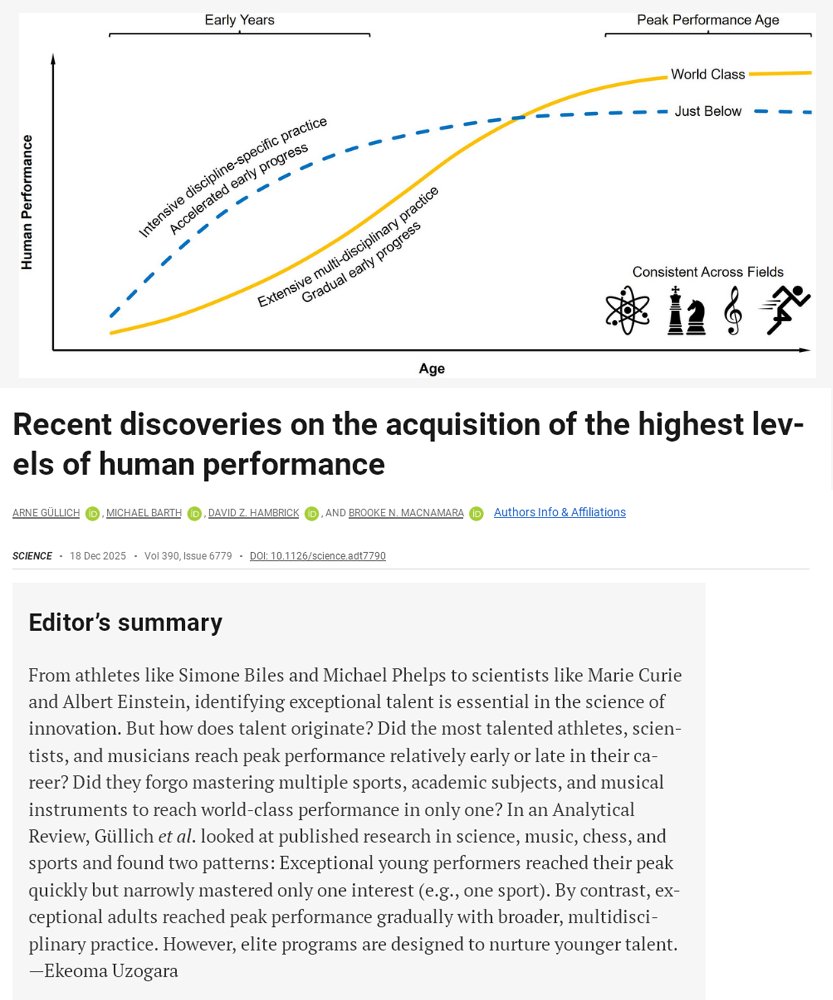
Early specialization is overrated. Generalists excel over time. Data on >34k stars in sports, music, science, and chess: Focusing on a single field predicts a faster rise, but cross-training foreshadows a higher peak. The most successful adults start off as well-rounded kids.
Adam Grant tweet media
English
171
1.2K
4.6K
1.4M
Ready Forit retweetledi
nic carter
nic carter@nic_carter·
"What the smartest people do on the weekend is what everyone else will do during the week in ten years" – chris dixon, 2013 what is the smartest person you know doing this weekend?
English
274
42
2.3K
460.6K
Ready Forit retweetledi
Arnav Gupta
Arnav Gupta@championswimmer·
From the perspective of a caveman or even farmer from few hundred years back - most of our jobs (us city dwellers) are like UBI (universal basic income). You cannot convince a 15th century person that what a typical MBA grad does is a legit profession, let along one of the highest paid ones. In light of what is happening with AI - I have had an lightbulb moment - that Graeber’s “bullshit jobs” are actually a form of UBI. We need bullshit jobs to sustain the economy and the society. Just growing food, packaging it and feeding the 8B people of earth needs just 1-2% of the population to do it. What will the rest 98% do? Initial days of COVID lockdown showed us how the economy needs to constantly “move”. It collapses if stationery. If for even few weeks, people stop spending money, entire economy stalls, GDP free falls, everyone’s income becomes zero because everyone’s income after all comes from someone else spending money. So when people say that “if AGI automated everything then we need UBI” I guess they are not realising that before AI there has been electricity, computers, Internet, industrial manufacturing and lots of other paradigm shifts that have already done a wave of “automate everything”, and the human race just went ahead and invented yet another hundred million bullshit jobs to keep the displaced population busy with something to keep the economy moving. And we will do exactly the same after AGI as well.
David Shapiro (L/0)@DaveShapi

They're catching on.

English
481
738
9.7K
2.7M
Ready Forit
Ready Forit@ready_forit·
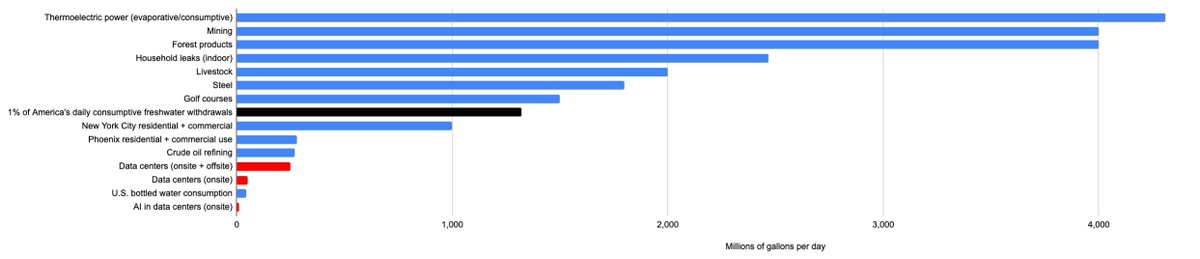
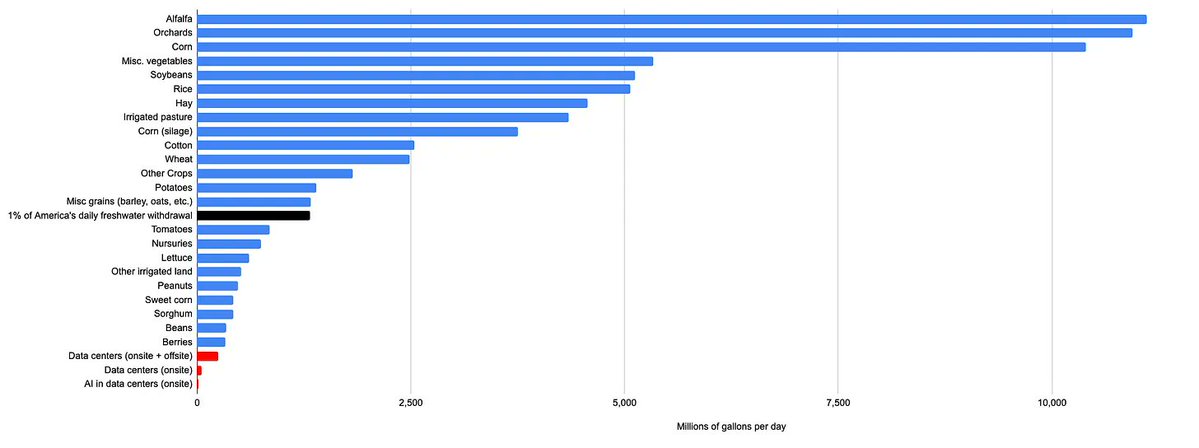
@emollick @grok give me percentage -- how much water do all AI companies use for all their purposes compared to how much golf uses?
English
1
0
0
71
Ethan Mollick
Ethan Mollick@emollick·
On AI & water, looks like all US data center usage (not just AI) ranges from 628M gallons a day (counting evaporation from dam reservoirs used for hydro-power) to 200-275M with power but not dam evaporation, to 50M for cooling alone So not nothing, but also a lot less than golf.
Ethan Mollick tweet mediaEthan Mollick tweet media
English
37
98
669
105.6K
Ready Forit retweetledi
Vipin Gautam (Viipin I Gautam)
1/ Hidden Fare Window Finder Prompt: "I want to fly from [insert origin city/airport] to [insert destination] around [insert date range]. Act like a flight pricing analyst and tell me the cheapest time frame (days & hours) to book this route based on airline pricing patterns and historical trends."
English
12
66
666
294K
Ready Forit retweetledi
Talkin’ Giants
Talkin’ Giants@TalkinGiants·
Every Touchdown from Jaxson Darts Rookie Season
English
12
475
3K
81.8K
Ready Forit retweetledi
Startup Archive
Startup Archive@StartupArchive_·
Ben Horowitz tells the story of Mark Zuckerberg firing his executive team for the second time “The very first conversation I had with Zuck was I think in 2007,” a16z co-founder Ben Horowitz begins. “At that time, Facebook traffic had flattened and the executive staff that he had was trying to run a coup to force him to sell it to Yahoo. So they were leaking all this stuff to Valleywag and Valleywag was calling for Zuck to be fired and that whole stupidness.” A young Mark Zuckerberg asked Ben a question: “If I fired my executive team for the second time, would the board be nervous?” Ben replied: “Well, that’s not even the question Mark because if you’re asking that question you know you have to do it. You can’t succeed with them so whether or not you can succeed without them is still at least a question mark. But let’s talk about why they’re doing this. Why has traffic been flat?” Mark explained that after doubling the size of the engineering team from 400 engineers to 800, a lot of the new engineers were directly querying the database rather than using the API layer which broke the system and was resulting in performance issues (e.g. it taking 10 seconds to log into the app). “Well how do you train these guys?” Ben asked. “Train these guys?” Mark replied confused. Ben explained: “Zuck, when you’re 10 people there’s no knowledge in the company. Everyone who comes on just jumps in and starts working. But when you get to 800 people, you have a lot of knowledge that’s in your company about how the product works and how you check in code. You actually have to teach people that.” Mark would go on to create Facebook’s world-class 2-month bootcamp that every engineer who joins the company has to go through. “He’s a phenomenal student of management,” Ben remarks. “And the [leaders] who don’t truly understand people don’t turn out to be good CEOs. They don’t get to that level. You can make fun of Larry Page or Elon or Zuck, but they are very smart about people. All three of them.” Video source: @myfirstmilpod @a16z (2025)
English
19
49
768
100.7K
Ready Forit retweetledi
David Perell
David Perell@david_perell·
People imagined the Internet as a utopia because it'd put all the world's information in our pocket, but instead of enjoying the great books and watching the great movies, we've become obsessed with what's happening now. The majority of what people consume online was created in the past 24 hours. It's good for business, but bad for the soul. News and gossip and your friends' Instagram stories seem important in the moment, but they're little tricksters because of how they pull our attention away from true quality. Sure, some of it is worthy. But the vast majority of it is a distraction. And this, I insist, is a root cause of the anxiety and dizziness that plagues modern life. We're stuck in a Never-Ending Now, and no matter how hard you try to resist, the Internet pulls you right back into it.
English
65
171
975
136.6K
Ready Forit retweetledi
David Perell
David Perell@david_perell·
Talk to a top-tier creative and chances are, you’ll be blown away by how prolific they are in their consumption: The musician who listens to 10 albums a week, the designer who’s visited antique stores in 57 countries, the architect who’s living room is stacked with piles of reference guides, the writer who’s read 1,000 novels, the filmmaker who watches 400 movies per year. The method varies, but the core pattern stays the same… it’s constant consumption, day after day.
English
178
558
5.7K
984.5K
Ready Forit
Ready Forit@ready_forit·
@tamarawinter COMEDIES perpetually underrated. What about Bob? SOMETHING'S GOTTA GIVE THIS IS THE END STEP BROTHERS DEFENDING YOUR LIFE BAD TRIP (2021) LOVE ACTUALLY The John Hughes oeuvre also, prime miramax movies are must sees-- SHAKESPEARE IN LOVE ROUNDERS GOOD WILL HUNTING TO DIE FOR
English
0
0
0
10
Tamara Winter
Tamara Winter@tamarawinter·
Developing a film curriculum for myself (I like movies, but I’m trying to make a serious study of the medium). Is there anything I *definitely* have to include? Interested in the classics, but I’m most curious about films people personally find exceptional.
English
240
20
503
73.1K