Michael Levin@drmichaellevin
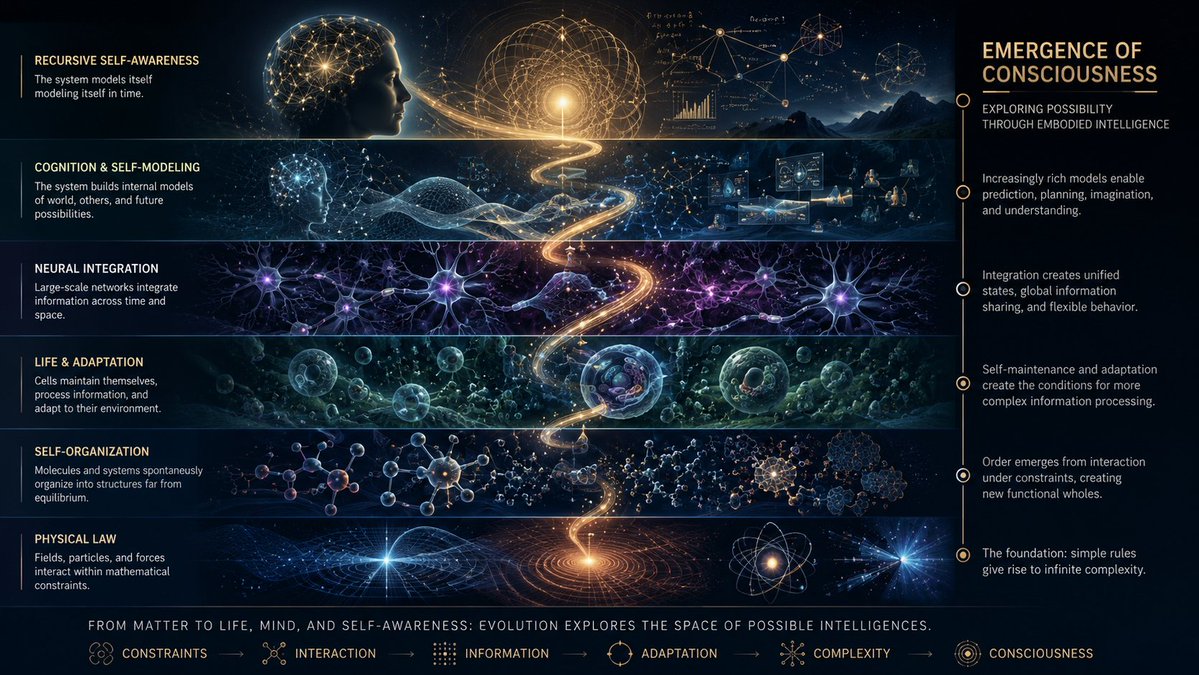
I think this question may based on an incorrect (but pervasive) assumption: that consciousness is a late product of evolution and thus must be developed as the result of some kind of selection pressure or function. We don't ask "What is being sensitive to the gravitational force for?", in biology, because it's a ubiquitous background fact with which evolution has to grapple, not something that had to evolve. I suspect consciousness is like that - evolution didn't need to create it because it was already there all along, all the way down. However, we can ask (if not necessarily answer) meaningful questions about how well consciousness tracks intelligence, and how the ingression of differently-conscious patterns into evolved embodiments might alter the future course of evolution of bodies. I think consciousness is causal, not epiphenomenal, so there are likely effects; I have a bunch of stuff on related issues coming soon. tl;dr: I don't think it's *for* anything else - it couldn't not exist. But I do think it makes a difference on the behavioral, and possibly the evolutionary, timescales, and the work we're doing on intrinsic motivations in minimal (living and non-living) models could shed light on those kinds of effects.