COL Rohit Chaudhry@ColRohitChaudry
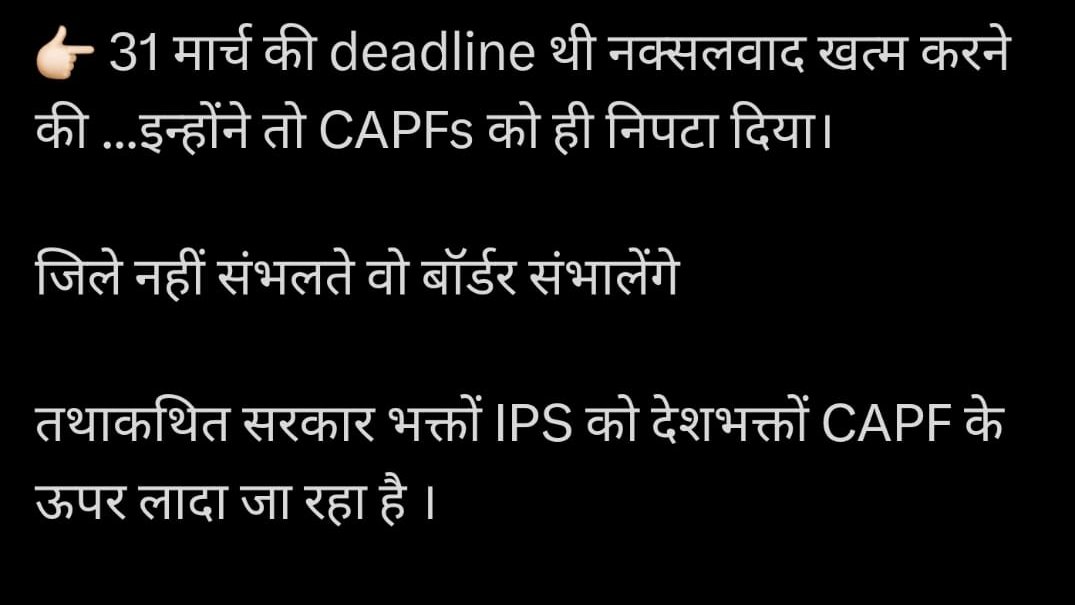
Ex-Servicemen Department of the Congress Party stands solidly with and behind the CAPF in their demand for Organised Group ‘A’ (OGSA) status and to free them from the crutches of IPS officers.
Like the military, paramilitary forces have no space for police cadres. IPS officers are not trained for the military needs of the country; they are primarily trained for civil policing to maintain law and order. Whereas paramilitary forces were raised to assist the military in both peace and war. They were initially trained by the military to assist in border management during peacetime and to help maintain civil, military, and other vital assets/establishments during wartime. Subsequently, paramilitary forces have been employed in managing internal security threats and combating ANEs.
Paramilitary forces are operationally aligned with the Indian defence forces for their primary roles. Each organisation has a specific mandate:
ITBP – Tibet border
BSF – International borders
SSB – Nepal border
CISF – Industrial and vital government installations
CRPF – Reserve force under MHA, primarily handling anti-Naxal operations, as the Army is committed to borders (LoC, LAC), J&K, and the North East
These organisations and their homegrown cadres have matured fully and are capable of leading their respective organisations efficiently and effectively.
The time has now come to free paramilitary forces from the crutches of IPS officers, who are trained mainly for civil policing and have limited exposure to military or paramilitary operations.
Their training standards, experience in anti-insurgency operations, and understanding of border security management are limited compared to the homegrown cadres. The experience of IPS cadres in soldiering and soldierly qualities is also comparatively shallow.
The sole objective of raising these organisations was to ease the burden on defence forces, which were continuously deployed in counter-insurgency operations to tackle internal security challenges across the country.
Paramilitary organisations today are well poised in terms of training, operational readiness, and handling internal security situations independently, with due support from the Indian military.
Another important organisation, Assam Rifles, was raised under the MHA with operational control of the Army, primarily to maintain a lower Army strength in the perception of the international community.
The Army exercises direct operational control over Assam Rifles, with its personnel serving on a tenure basis.
There is now a growing demand from paramilitary cadres for better career prospects and growth.
They seek the right to command their own field units and formations. However, top command and control positions continue to be dominated by IPS officers through the MHA.
The Hon’ble Supreme Court has directed the MHA to withdraw IPS officers from these organisations and allow paramilitary cadres to rise through the chain of command and occupy top leadership positions. However, to circumvent this, the government has introduced proposed reforms and the Act-2026 to legitimise the appointment of IPS officers at IGP level and above, thereby retaining control.
Thus, we stand alongside our paramilitary brethren in demanding:
1. Grant Organised Gp A ( OGSA) status to cadres of Govt of India.
2. Allow Homegrown cadres of respective to rise and command their organisation upto DG level.
3. Provide assured career progression schemes to all the cadres of CAPF at all levels.
4. Give OPS/NFU to all the cadres of all the paramilitary forces.
Thanks & Regards,
Col Rohit Chaudhry
National Chairman
Ex-Servicemen Department
AICC
@INCIndia @kharge @RahulGandhi
@priyankagandhi @kcvenugopalmp
@Jairam_Ramesh @AICCMedia
@INC_Television @ANI @PTI_News @journo_jitendra
#JusticeForCAPF
#IndiaStandsWithParamilitary