Ron Levitin, MD

990 posts

Ron Levitin, MD

Ron Levitin, MD

@rlevitinMD

Board Certified Radiation Oncologist at the Beaumont Health Lenox Outpatient Center in Southeast Michigan views my own

Royal Oak, MI Katılım Haziran 2016
1.4K Takip Edilen1.2K Takipçiler
Ron Levitin, MD retweetledi
Steven David
Steven David@drspdavid·
Huge congrats to Dr Saad Ashraf on his @FrontOncology case report! 👏 This unique case of OPD highlights 8 courses of SABR for 17 metastases over 5 years, delaying systemic therapy changes 8x to prioritize patient QOL in a HER2+ breast cancer. Read: frontiersin.org/journals/oncol…
Steven David tweet media
English
0
22
47
4.7K
Ron Levitin, MD retweetledi
Daniel E Spratt
Daniel E Spratt@DrSpratticus·
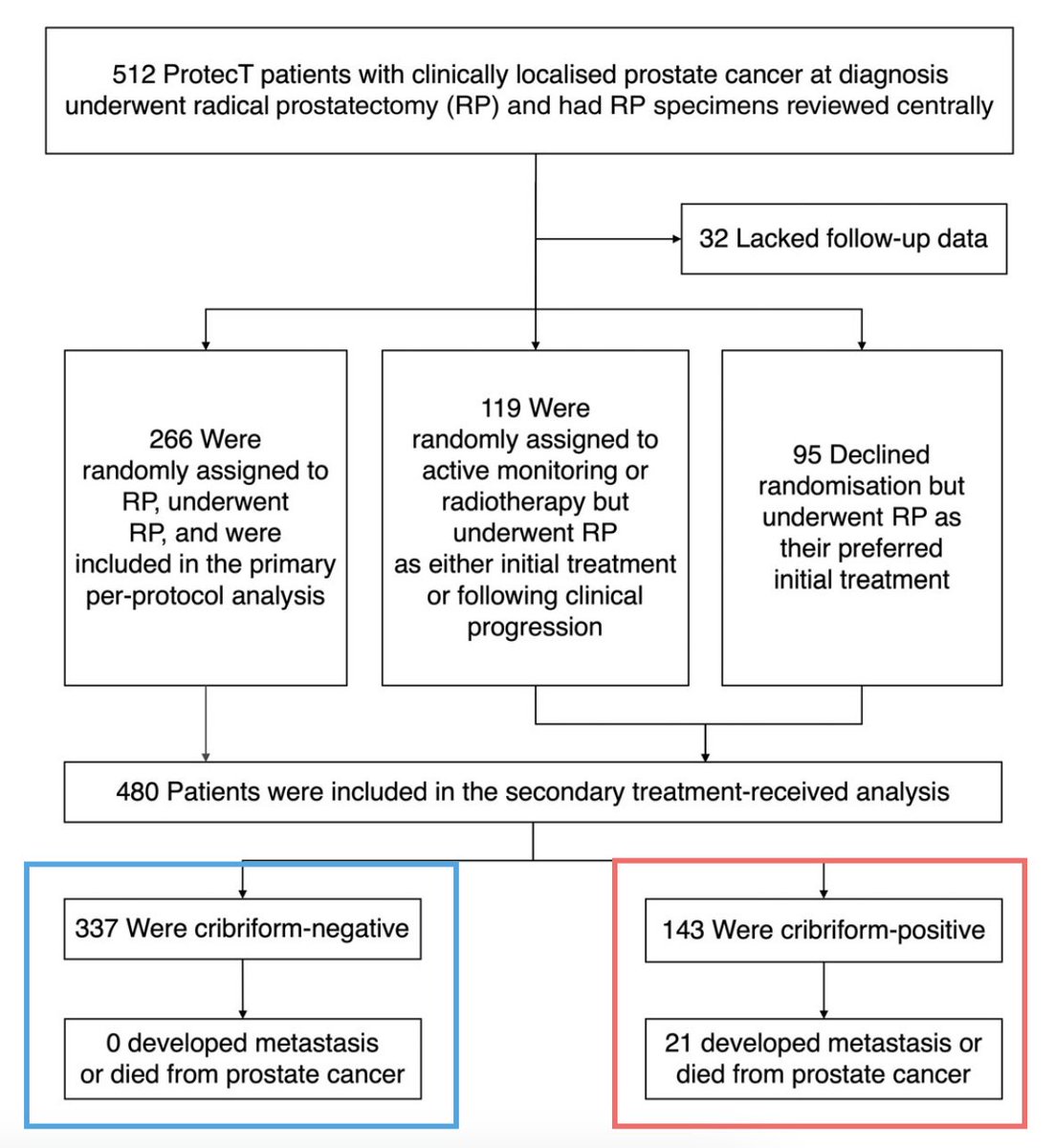
Thanks Tyler! My take home message is that if cribriform present AS not recommended, and cribriform negative GG1 and low volume GG2 and no concern for T3b, that RP and RT and AS similarly effective. However for those with cribriform and/or multiple adverse features the DM rate was high with RP. Similar to what we showed in high risk PCa @Soum_Roy_RadOnc. Likely driven by multimodality treatment of synergy with RT+ADT and low utilization of multimodal treatment with RP. That is getting worse with now people not giving early SRT and waiting for imaging to be positive and find mets.
English
4
15
42
2.6K
Ron Levitin, MD retweetledi
Jeff Ryckman
Jeff Ryckman@jryckman3·
1/ 🚨 New @NEJM: Perioperative enfortumab vedotin + pembrolizumab (EV+pembro) in MIBC (KEYNOTE-905) Congrats to the authors on an important randomized phase 3 trial in a tough, cisplatin-ineligible population 👏 Let’s walk through it 👇
Jeff Ryckman tweet media
English
6
44
131
14.1K
Ron Levitin, MD retweetledi
JeeSuk Chang
JeeSuk Chang@changjeesuk1·
🎉 After 3 yr of work, our paper is finally accepted in @IJROBP! authors.elsevier.com/sd/article/S03… MDT for breast OMD remains highly controversial — NRG-BR002, CURB, and EXTEND all came back negative. So we asked: What actually happens when MBC progresses and can ctDNA predict it?
JeeSuk Chang tweet media
English
2
25
69
5.6K
Ron Levitin, MD
Ron Levitin, MD@rlevitinMD·
@scserendipity1 @CanesDavid @piet_ost It also helps if you have a sufficient archive of your own talks. For junior people starting out it might be more challenging to have it match your preferred style.
English
0
0
2
27
Simon C
Simon C@scserendipity1·
@CanesDavid @piet_ost Plenty of skill in that you need to be open and embrace this new World. This sounds very interesting. Thank you
English
1
0
1
53
𝙳𝚊𝚟𝚒𝚍 𝙲𝚊𝚗𝚎𝚜
Any academic physicians give talks? Create a folder with all of your prior talks. Have any of them been recorded? Put that in the folder. Give Claude Cowork or Codex access and it becomes a talk draft generation machine. Custom for your voice.
English
5
2
59
7.3K
Ron Levitin, MD retweetledi
Tony Felefly
Tony Felefly@TonyFelefly·
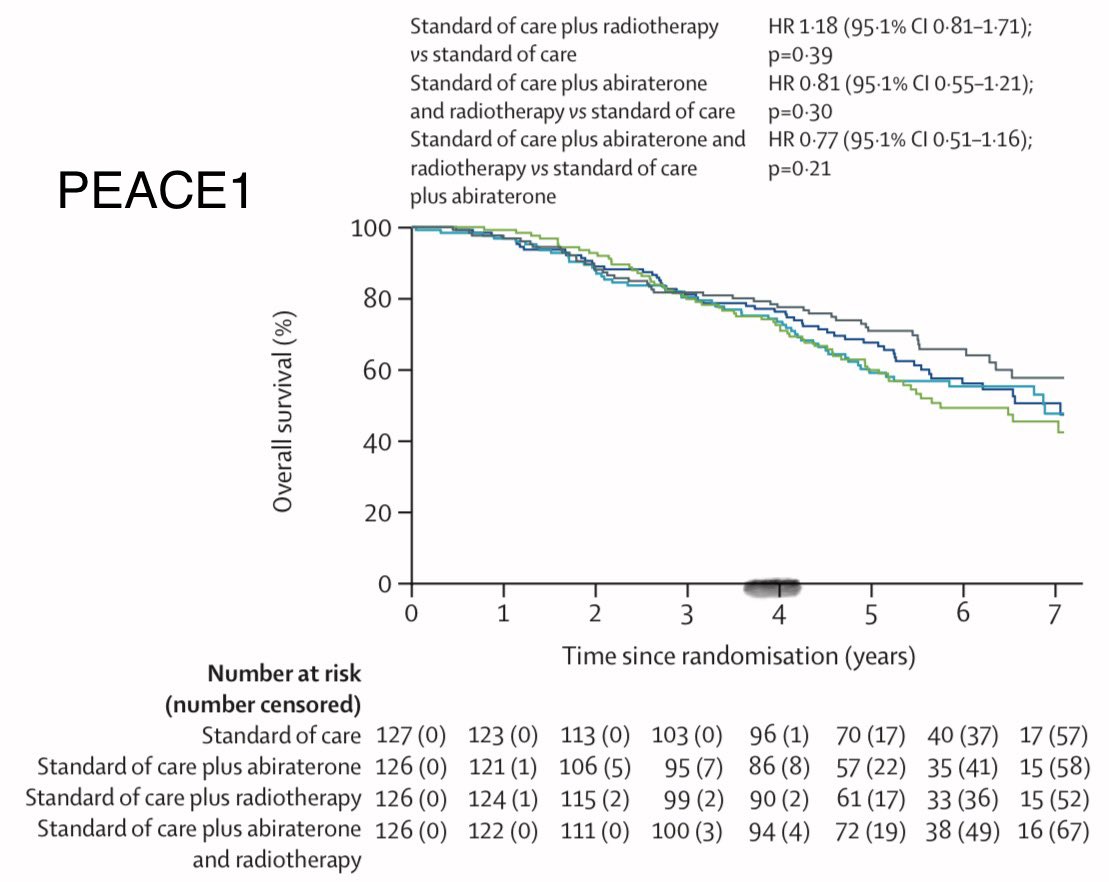
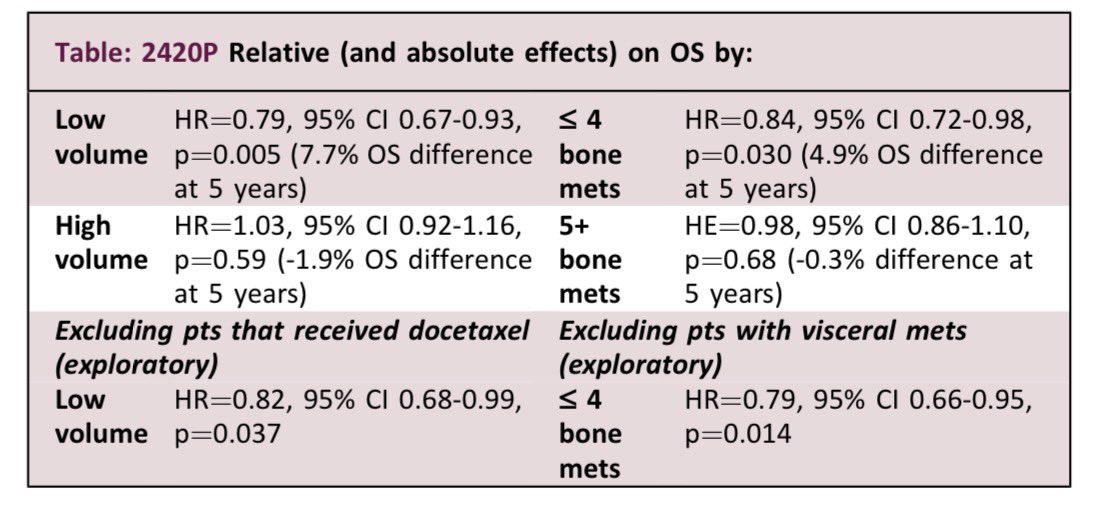
Fair point about ARPI! I don't fully agree. To be clear, I am talking here about low-volume mHSPC. Few points: 1- I wouldn't say PEACE-1 showed no OS benefit. It doesn't prove a benefit, neither does it disprove one. HR for SOC+Abi +/-RT was 0.77 (Curves below). There is certainly a trend. I think we need a higher N for the ARPI subgroup. There was however a signicant improvement in CRFS. 2- In a NMA (@soum_roy_radonc) with Bayesian pairwise comparison, the best treatment was SOC+ARPI+RT, and was associated with reduced mortality wrt SOC+ARPI europeanurology.com/article/S0302-… 3- STOPCAP meta-analysis (including PEACE-1 data) showed an OS HR of 0.92 (0.84-1.0) for RT for all-comers, low and high-volume (Forest plot below). For low-volume, OS HR was 0.79 (0.67-0.93). annalsofoncology.org/article/S0923-… urotoday.com/conference-hig… So based on the above, I think it's safe to say that RT to the primary is beneficial for low-volume mHSPC treated with ADT +/- ARPI. PEACE-1 cannot rule out an OS benefit for the ADT+ARPI subgroup, mainly due to small N and Frequentist design. It does however prove a CRFS benefit. On another hand, a Bayesian comparison (NMA above) showed that these patients most likely benefit from RT. In light of these, I think it's hard to NOT recommend RT even with ARPI. Wondering what is the current practice at your institution. Also curious to know what other Rad-Onc colleagues think about this @pcaparker @soum_roy_radonc @drspratticus @tylersbrt @seanmmcbride @sbrtsean @alison_tree @vedangmurthy @piet_ost @paulsargos @jryckman3 @5_utr @adib_elio @protonstorey @docpriyamvada @_shankarsiva @albertobossial @amarukishan
Tony Felefly tweet mediaTony Felefly tweet mediaTony Felefly tweet mediaTony Felefly tweet media
English
7
20
44
7K
Ron Levitin, MD retweetledi
Brendon Stiles
Brendon Stiles@BrendonStilesMD·
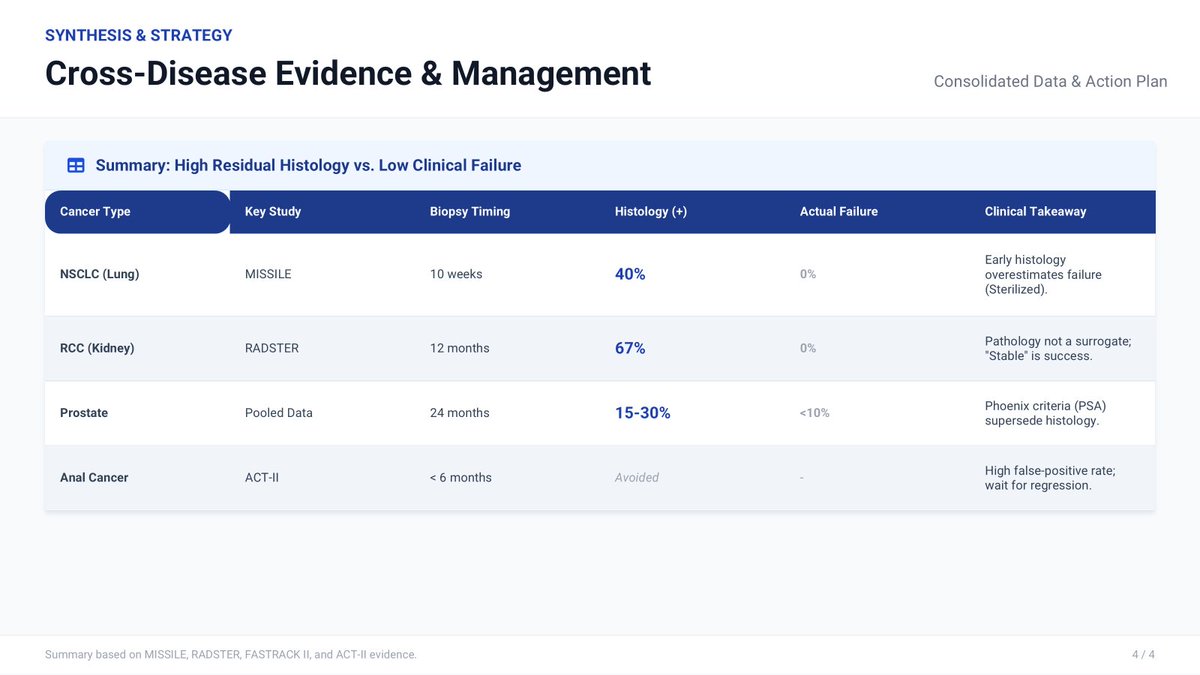
x.com/changjeesuk1/s… I had been trying to quietly disengage from this conversation (I promise!), but this pulled back in. Respectfully, I would suggest that not operating on biopsy proven NSCLC after SBRT should not be promoted as SOC. Several points important to make here:
JeeSuk Chang@changjeesuk1

@jryckman3 @BrendonStilesMD @5_utr 100% agree. Just had a tough case (from a colleague)—post-SABR Bx showed ca without clear indication, and they rushed to surgery. Took a lot to convince them to hold off. MISSLE, RADSTER, ACT-II, and PSA were my go-to references as well.

English
3
2
21
7.8K
Ron Levitin, MD retweetledi
JeeSuk Chang
JeeSuk Chang@changjeesuk1·
@jryckman3 @BrendonStilesMD @5_utr 100% agree. Just had a tough case (from a colleague)—post-SABR Bx showed ca without clear indication, and they rushed to surgery. Took a lot to convince them to hold off. MISSLE, RADSTER, ACT-II, and PSA were my go-to references as well.
JeeSuk Chang tweet mediaJeeSuk Chang tweet mediaJeeSuk Chang tweet mediaJeeSuk Chang tweet media
English
1
5
17
8.9K
Ron Levitin, MD retweetledi
Jeff Ryckman
Jeff Ryckman@jryckman3·
If I had a nickel for every time a friend asked me about prostate focal therapy, I’d be rich. I’ve personally managed 20–30 intraprostatic failures after focal therapy. One patient ended up with a permanent Foley after salvage RT. Nearly all required medical castration, which many likely could have avoided with definitive therapy upfront. The downstream consequences are real. Our group ultimately decided not to offer focal therapy outside of very niche scenarios (for example select reirradiation not ideal for partial or full gland SBRT). If I were a patient, I might assume focal therapy is better than standard options too. The marketing is that good. #OncTwitter
English
5
7
35
3.1K
Ron Levitin, MD retweetledi
Daniel E Spratt
Daniel E Spratt@DrSpratticus·
I have read all of the prostate devices approvals in depth and HIFU tried for fda approval for cancer but was rejected. Ultimately went towards the ablation of tissue path. I am hoping the next generation of urologists and radiologists using these devices will want a higher bar before subjecting their patients to it. Those already doing it off trial already lowered their bar. Major urology societies also already gave in and don’t seem to care about the evidence. We often debate in real EBM if an RCT is enough with PFS vs MFS vs OS and is 5 vs 10 vs 15 year outcomes needed. The bar is so low it is single arm short term outcomes in patients who largely don’t need treatment and even then there is recurrence and toxicity. Everyone knows why this is happening. Not about patients. Not about hospitals even. Companies profit, doctors profit. Everyone else pays the price. Far cheaper if the trials were done as some of these treatments will be harmful, some may be helpful. Will never know.
English
1
7
23
1.7K
Ron Levitin, MD retweetledi
Jeff Ryckman
Jeff Ryckman@jryckman3·
A rough rule of thumb for prostate focal therapies is about a 40–60% risk of intraprostatic recurrence, which is meaningfully higher than established gold-standard options. I haven’t read this particular study yet, but that range tends to be fairly consistent across the prostate focal therapy literature. None of these approaches currently have FDA approval for treating prostate cancer, yet they’re widely marketed. The disclaimers are usually there, just not exactly front and center. Very real downstream implications of failure as well. In context of EBRT salvage, most require medical castration which otherwise likely would have been avoided altogether had definitive treatment been offered upfront. Further FT is not proven to be more safe than radiotherapy, in fact the opposite appears to be true. pubmed.ncbi.nlm.nih.gov/40998272/
English
6
4
21
4.9K
Ron Levitin, MD retweetledi
Matt Spraker
Matt Spraker@SprakerMDPhD·
Truly exceptional piece, we are lucky its in NEJM 😍 Communicates the philosophy of modern radiotherapy and how that's helped patients, all without getting bogged down in discussion of commercial technology. Share it widely.
Matt Spraker tweet media
English
1
20
78
4.3K
Ron Levitin, MD retweetledi
NonsparseOncologist
NonsparseOncologist@5_utr·
@GirvigianMD Once upon a time people looked at “number on treatment”, but we are a long way away from ✍️ fields. Timmerman nailed it largely with analogies of SABR to surgery; we really need to make the case at AMA for complexity and billing imo
English
2
3
6
456
Ron Levitin, MD
Ron Levitin, MD@rlevitinMD·
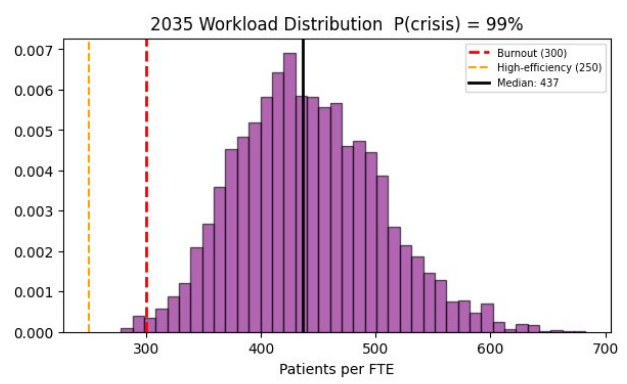
@toddscarbrough @5_utr Yeah he replied to me. This is an estimate of the mean not an estimate of the distribution of patients across individual providers. I understood the Bayesian part to be what you say. Probability of the mean being above crisis level.
English
0
0
1
32
Todd Scarbrough
Todd Scarbrough@toddscarbrough·
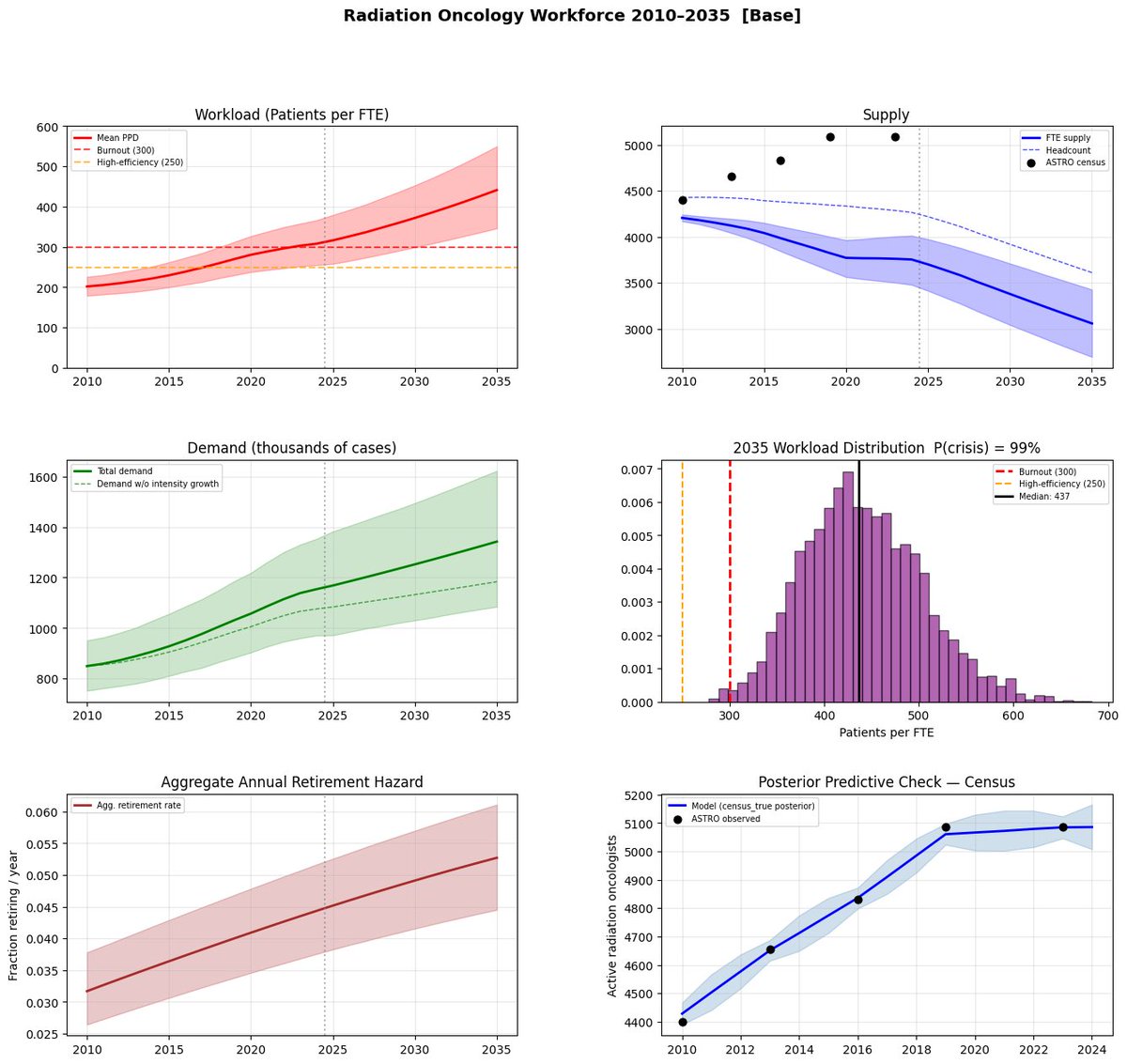
@rlevitinMD @5_utr I *think* he’s made a model of something like what expected workload is per rad onc in the future and his estimate, because it’s using a bunch of guesstimates, would indeed take on a normal; something like 99% of the model estimates say we’ll be in “crisis”. I *think*.
English
1
0
0
19
NonsparseOncologist
NonsparseOncologist@5_utr·
🧵 New analysis of US Radiation Oncology workforce: MD workload ⬆️, aging workforce, ⬆️ case complexity
NonsparseOncologist tweet media
English
3
8
24
6.2K
Ron Levitin, MD
Ron Levitin, MD@rlevitinMD·
@5_utr @toddscarbrough Sorry. So to clarify -- the log-normal distribution is looking at the individual providers, and your chart is looking aggregate across the field? Estimate of the mean patients/cFTE?
English
1
0
1
43
NonsparseOncologist
NonsparseOncologist@5_utr·
@rlevitinMD @toddscarbrough I love this topic! It’s not Pareto. Individual providers follows Log-normal/Gamma—textbook for multiplicative processes (skill × reputation × efficiency), not "winner-take-all" dynamics. Totally expected with health care overall!
NonsparseOncologist tweet media
English
1
0
1
60
Ron Levitin, MD
Ron Levitin, MD@rlevitinMD·
@5_utr @toddscarbrough I guess log-normal and pareto curves are a matter of degree. In your original plot though, you are showing a roughly normal distribution of patient volume ("workload distribution"), not log-normal or otherwise?
English
2
0
0
102