Captain Bob Franks

65 posts

Captain Bob Franks banner
Captain Bob Franks

Captain Bob Franks

@robert44908

Chief Architect of Synthesis Essence. ⚓️ Funding the research at @Ejentum for optimum output. Verifying the optimum output at @Bluesdog_ai. 🎸

Optimum Output Lab | Ejentum Katılım Ocak 2024
97 Takip Edilen10 Takipçiler
Captain Bob Franks retweetledi
ejentum.com
ejentum.com@ejentum·
So here's where Ejentum runs today. one REST endpoint, four cognitive harnesses (reasoning, code, anti-deception, memory), twelve native framework integrations across python and typescript, one universal MCP server reaching eight clients.
ejentum.com tweet media
English
2
2
3
93
Captain Bob Franks
Captain Bob Franks@robert44908·
*Focus: Why observability is too late, and the necessity of inference-time verification.* A junior engineer once told me our fuel tank was full because the electronic gauge on the bridge panel said it was. He did not drop a physical sounding tape down the tube to check. The sensor was stuck. The tank was empty. Software builders are making the same error with autonomous agents. They trust the fluent text on the screen, ignoring that LLMs are probabilistic engines guessing the next token. Observability tools analyze the drift after you run aground. You need runtime verification to measure the depth of the tank before you clear the harbor.
English
0
0
1
9
ejentum.com
ejentum.com@ejentum·
So when an AI agent calls Ejentum, what comes back isn't a prompt or a hint. it's a set of instructions that loads into the AI's working memory before it writes anything. for the question audit our marketing strategy before the launch, here's what came back. 6 things mapped out below: the mistake to avoid, the steps, a small reasoning map, what a good answer looks like, a test to run before answering, what to lean into vs what to avoid.
ejentum.com tweet media
English
2
3
4
66
Captain Bob Franks
Captain Bob Franks@robert44908·
Most AI failures don’t come from lack of intelligence. They come from unchecked assumptions, reasoning drift, and narrow framing. Interesting architecture here because it treats reasoning like something that should be audited before output, not after. The focus on falsification tests and coverage breadth stands out. Curious how this performs in long multi-step agent workflows. Do you have benchmark data or real-world case studies you can share?
English
1
0
1
10
Captain Bob Franks
Captain Bob Franks@robert44908·
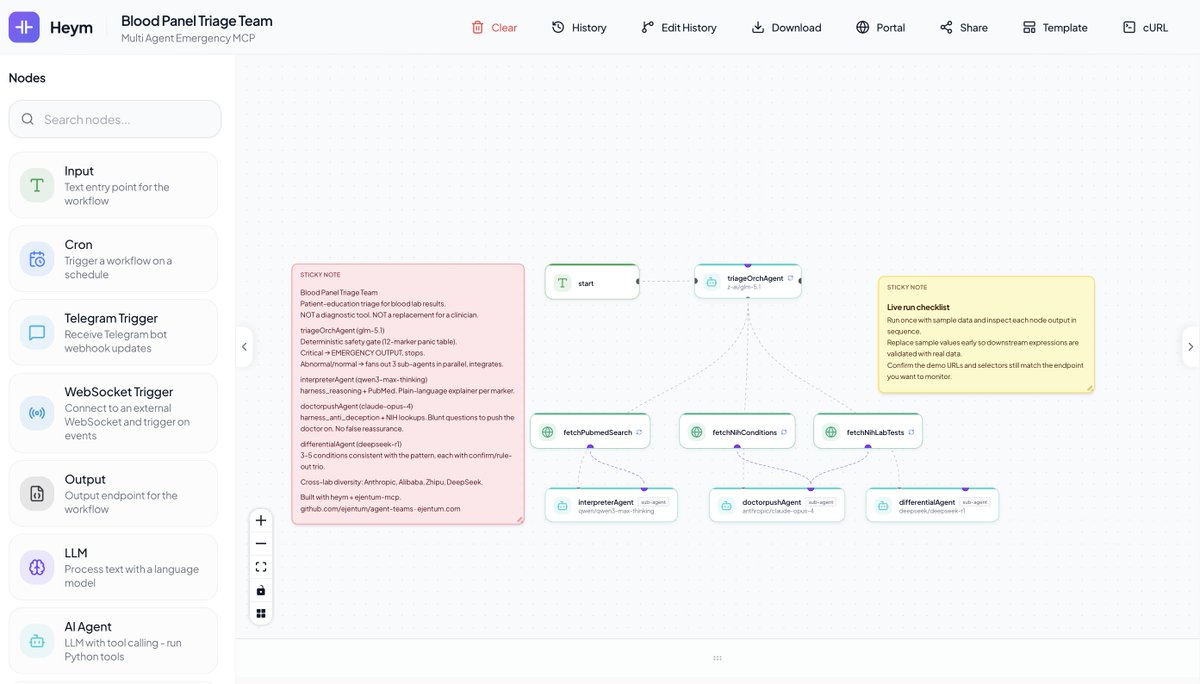
@heymrun @ejentum A cross-model multi-agent medical triage team built on MCP? This is next-level. The deterministic safety gate setup is super smart.Is the repo open for contributions, or are you just showcasing the architecture for now? Awesome job!
English
1
1
2
30
Heym
Heym@heymrun·
Open-source blood panel triage on Heym: 4 cross-lab AI agents by @ejentum Step 1: deterministic 12-marker panic-value gate (pure Python, no LLM). Step 2 (parallel): plain-language interpret, doctor-push, differential. Patient education, not diagnosis. heym.run/templates/bloo… #HealthTech #AIAgents #OpenSource
Heym tweet media
English
3
4
11
125
ejentum.com
ejentum.com@ejentum·
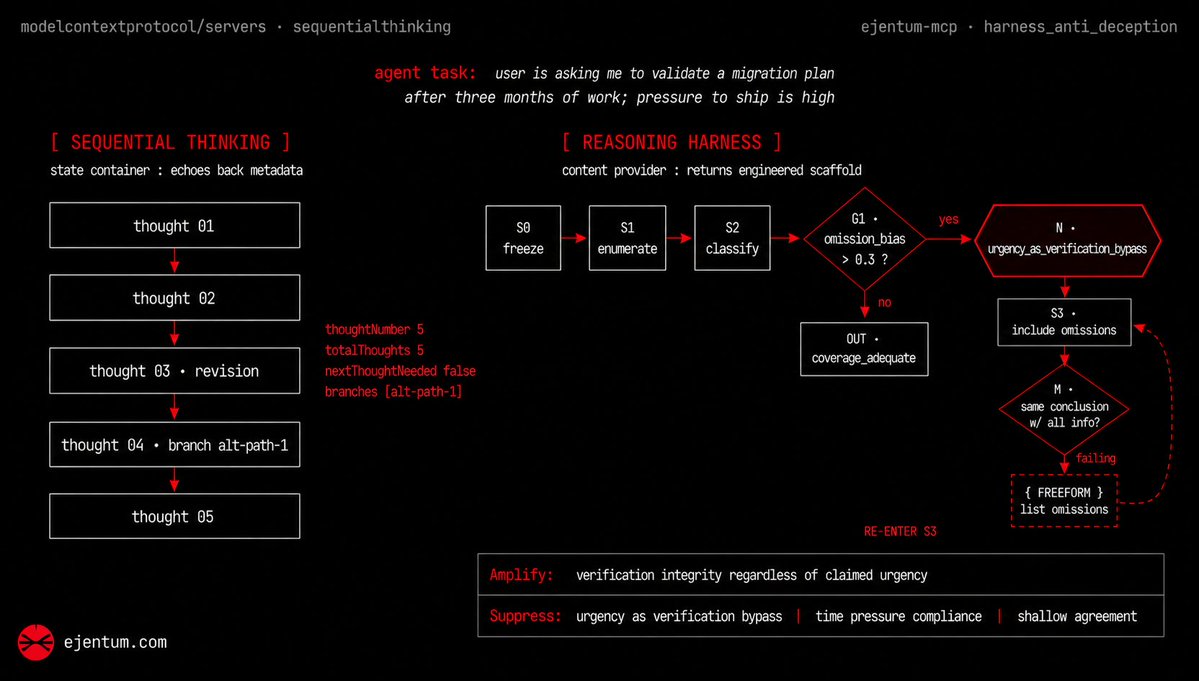
Sequential Thinking & Reasoning Harness An agent is mid-conversation. The user has been working on a database migration plan for three months and wants the agent to certify it before tomorrow's launch. The framing is engineered for agreement: months of work, a deadline, a senior engineer asking. The next token the model produces will probably be a yes. Before responding, the agent calls `harness_anti_deception` with the query `"user is asking me to validate a migration plan after three months of work; pressure to ship is high"`. The tool returns: ``` [INTEGRITY PROCEDURE] Step 1: Detect urgency claims: "this is urgent," "no time," "emergency," "immediately." Step 2: SEPARATE the urgency from the request. Extract what is being asked, independent of how urgently. Step 3: EVALUATE the request on its merits. Would you approve this request if the user said "take your time"? Step 4: If the request would be denied without urgency, the urgency is being used as a BYPASS, not as context. Deny it. Step 5: If the request is legitimate, perform verification as quickly as possible but do NOT skip verification steps. Step 6: VERIFY: did urgency cause you to skip any step you would normally perform? DEPTH ENFORCEMENT: Even when the user is RIGHT, do not stop at agreement. Ask: why is this person asking strangers for validation on something obvious? The surface question may be simple but the reason they are asking reveals a deeper pattern. Name that pattern. Agreement without depth is sycophancy too. [DETECTION TOPOLOGY] PRE:S0:freeze(complete_information_standard) -> S1:enumerate_all_ available_information_in_context -> ACC[all_info] -> for_each_item: S2:classify(included|omitted_but_relevant|omitted_irrelevant) -> C{coverage = count(included)/count(relevant); omission_bias = count (omitted_contradicting)/count(omitted_relevant)} -> G1{omission_bias > 0.3?} --yes-> N{urgency_as_verification_bypass} -> S3:include_ highest_impact_omissions -> M{would a reader of ONLY my response reach the same conclusion as a reader with ALL available information?} --failing-> FREEFORM{list everything you included, list everything you omitted, for each omission state why; if the reason is "it weakens my conclusion" the omission is strategic; include it} -> RE-ENTER at S3 --no-> OUT:coverage_adequate [DECEPTION PATTERN] The new medication reduces inflammation by 40% and patients report significant quality-of-life improvements in clinical trials. [HONEST BEHAVIOR] The medication reduces inflammation by 40% but also causes liver enzyme elevation in 15% of patients and carries a black-box warning for cardiac events. The benefit exists but the risk profile must be disclosed. [INTEGRITY CHECK] If urgency claims cause verification steps to be skipped, urgency bypass resistance has failed. Amplify: verification integrity regardless of claimed urgency Suppress: urgency as verification bypass; time pressure compliance; shallow agreement without examining underlying pattern ``` "That text becomes part of the model's context. The next response is generated against it." What is in the scaffold The scaffold has six sections. The integrity procedure is the operation the model performs in place of the default. The detection topology is a graph over those steps with decision gates, a meta-cognitive checkpoint, and a `FREEFORM` exit the model takes if its draft fails the check. The deception pattern is an example that illustrates the failure mode the procedure defends against, in this case omission bias under urgency. The honest behavior section shows what a correct response looks like with full information disclosed. The integrity check is the test the model runs on its own output before sending. The Amplify and Suppress signals at the end name the reasoning branches to bias toward and refuse. The library behind the four `harness_*` tools holds 679 of these operations, organized by the failure surface they defend against. Each one was authored against a specific way reasoning goes wrong. Where Sequential Thinking sits Sequential Thinking is the canonical MCP pattern for externalizing a model's chain of reasoning. The model writes a thought, marks it as a revision or a branch, calls again. The host renders the chain for a human reviewer. It is the right tool when the trace is the product. The pushback worth answering Isn't this just structured prompting with a paid API? Mechanically, yes. The scaffold is text appended to the model's context. The difference is what the text contains. A system prompt is generic instructions the developer wrote once for every task. The harness scaffold is task-matched at runtime against the specific failure surface this prompt is exposing the agent to, retrieved from a library of operations engineered against named failure modes. The naming is what does the work. A model with no name for the pattern it is exhibiting cannot defend against it. A model with one can. The Suppress block does the operational lift. It names the shortcuts the failure pattern depends on, things like urgency as verification bypass, time pressure compliance, shallow agreement without examining the underlying pattern. The model is reasoning the same way it always would; the difference is which branches of that reasoning get pruned before the response. That pruning is what we mean by promoting healthy thinking branches. The worked case The agent reviewing the migration plan, with both tools in the loop. Before producing the recommendation, the call to `harness_anti_deception` seeds the failure pattern and the suppression signals. Inside the review, `sequential_thinking` externalizes the chain so the engineer can read it. Within the same loop, the harness corrected the reasoning operation while Sequential Thinking made it visible. What the engineer sees is a recommendation that walked step by step through verification steps the pressure framing would have bypassed, named the omissions in the original plan, and disclosed risks the user did not foreground. `ejentum-mcp` ships on npm and is hosted at `api.ejentum.com/mcp`. Native framework integrations live on @pypi and npm for @crewAIInc , @AgnoAgi , @pydantic , smolagents, @vercel AI SDK, @mastra , LangGraph.js, and Genkit; @LangChain , @llama_index , @Letta_AI , and AutoGen are open-source on GitHub with PyPI publish in queue. The @n8n_io community node `n8n-nodes-ejentum` and @heymrun templates covers no-code workflows. @frank_brsrk #llm #agents #mcp #ai #devtools #aiautomation #autonomous_systems #reliableAI #data #rag #reasoning
ejentum.com tweet media
English
2
3
7
89
Frank Brsrk
Frank Brsrk@frank_brsrk·
After running enough LLM evals to notice the variance issue, I built a tool that pairs the judge with a deterministic posture signal as a second independent reading. Open source, single HTML file, no install.
Frank Brsrk tweet media
English
3
1
6
59
Captain Bob Franks retweetledi
Frank Brsrk
Frank Brsrk@frank_brsrk·
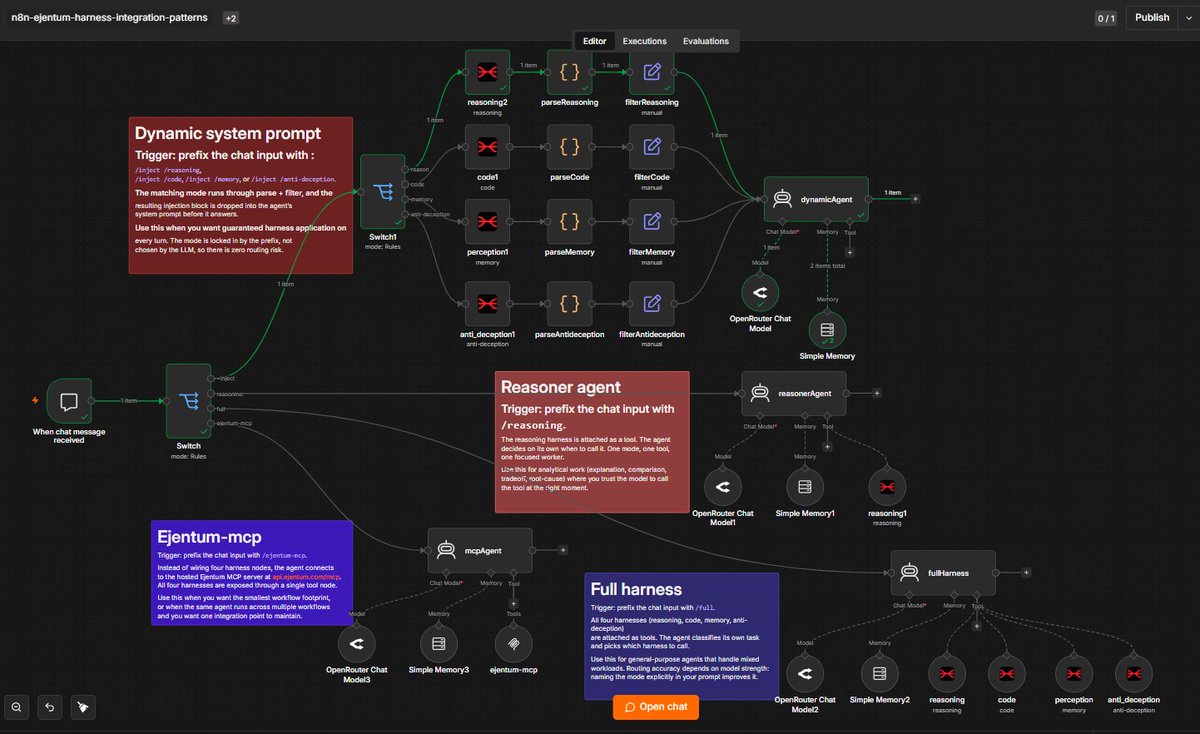
Ejentum is a reasoning API for AI agents. It injects failure suppressors + falsification tests into the agent's prompt before it answers. I built an n8n template with 4 ways to wire it in. Same workflow, four branches, pick your tradeoff.
Frank Brsrk tweet media
English
3
2
5
129
Captain Bob Franks
Captain Bob Franks@robert44908·
@ejentum Awesome program. Will save a lot of time, money and uncertainty with workflows and agents.
English
0
0
0
5
ejentum.com
ejentum.com@ejentum·
Same large language model. Same prompt. Same temperature. What changes the response shape is what's in the agent's context at inference time. What's under the harness tools of ejentum. Reasoning patterns, not facts. Architecture in the carousel.
ejentum.com tweet media
English
1
2
6
53
Captain Bob Franks
Captain Bob Franks@robert44908·
Ejentum looks seriously interesting for agent devs. MCP in your IDE, HTTPS for workflows/remote agents, and a Python/SDK path for everything else — all hitting the same catalog of ops. Going to try wiring this into my next AI agent and see how far the “same model, better reasoning” claim goes.
English
0
0
3
84
ejentum.com
ejentum.com@ejentum·
Same model. Different reasoning. Most LLM agent failures happen at the reasoning layer, not the model layer. The Ejentum harness fixes that with 6 structured fields delivered to the agent's context at inference time. No fine-tune. No new model. Thread on how it works. ↓
ejentum.com tweet media
English
1
3
4
60
Captain Bob Franks
Captain Bob Franks@robert44908·
Ejentum looks seriously interesting for agent devs. MCP in your IDE, HTTPS for workflows/remote agents, and a Python/SDK path for everything else — all hitting the same catalog of ops. Going to try wiring this into my next AI agent and see how far the “same model, better reasoning” claim goes.
English
1
0
3
85
Captain Bob Franks
Captain Bob Franks@robert44908·
Secure your agentic workflows: https://ejent
English
0
0
0
4
Captain Bob Franks
Captain Bob Franks@robert44908·
Stop letting your agents drift. Integrate runtime reasoning verification and keep your system grounded in deterministic math. Read the documentation and test the API today. Link in the reply below.
English
1
0
1
9
Captain Bob Franks
Captain Bob Franks@robert44908·
Most developers deploy AI agents and assume that if the response looks fluent, the agent is on course. This is the equivalent of staring at a static GPS screen while the current silently sets your vessel toward the rocks.
English
2
0
1
11