Robin Fritsch

73 posts

Robin Fritsch

Robin Fritsch

@robin_ethz

PhD Student at ETH Zurich (DeFi, game theory, graph algorithms).

Katılım Eylül 2012
584 Takip Edilen322 Takipçiler
Robin Fritsch
Robin Fritsch@robin_ethz·
@stonecoldpat0 Do I understand correctly that you're saying Timeboost is less extractive than PGAs? And if so, why?
English
0
0
3
75
Patrick McCorry 🐋
Patrick McCorry 🐋@stonecoldpat0·
Timeboost might end up being one of the biggest innovations overlooked by the MEV community who are laser focused on maximally extractive priority gas auctions. First few weeks exceeded my own expectations; very interested to see how it continues. Overview slide I made a few months ago to help explain the rapid auctions & that it only really facilitates back running.
Patrick McCorry 🐋 tweet media
English
2
0
21
2.2K
Alex Nezlobin
Alex Nezlobin@0x94305·
@robin_ethz I don’t think it actually matters how and if LPs hedge because hedging doesn’t increase *expected* returns. You can view the after fee LVR as the expected Fees-IL pnl too. And you are right that IL will be the same, but LPs collect less in fees in expectation.
Alex Nezlobin@0x94305

There are three common ways to calculate the PnL of an LP position: (1) Realized PnL (2) Fees - impermanent loss (3) Markout PnL To understand their differences and when to use which, let's run some simulations. Consider the following price paths for a full-range LP position 1/

English
1
0
2
126
Alex Nezlobin
Alex Nezlobin@0x94305·
Timeboost is worse for DEXes than it first seems. In this post, I'll explain (1) why Timeboost of 200ms is worse than a PGA over 200ms, and (2) why Timeboost is significantly worse than a PGA over the same time. These will be intricate points, so DO NOT expand unless you are an experienced LVR influencer. 1. Why is Timeboost worse for LPs than a comparable PGA? As you remember, LVR is determined by the average amount by which the CEX price overshoots the best bid or ask between arbitrage opportunities: For the price to overshoot the best ask, two things must happen: it must first reach the best ask and then (in the time remaining until the next block!) actually overshoot it. With a PGA over 200ms slots, the price will on average reach the best bid or ask sometime *in the middle* of a slot. This will always leave less than 200ms for the actual overshoot. (@MartinTassy and yours duly will hopefully quantify this effect precisely soon.) With a Timeboost of 200ms, the price will always have a full 200ms for the overshoot. All arbitrageurs except for the boosted one are slowed by 200ms, and it's optimal for the boosted one to wait for the full 200ms. I think this explains the result in the new paper by @kakia1989, Maria Ines Silva, @EdFelten, and @convoluted_code that arbitrageurs make more under TimeBoost than PGA: 2. Why is Timeboost significantly worse for LPs than a comparable PGA? But this is not the full story. One implicit assumption we made above is that when there is an arbitrage opportunity, the boosted arbitrageur (Bob) must take it after 200ms. And what happens if he doesn't? The idea seems to be that then some unboosted arbitrageur, Ursula, would arbitrage the pool instead. Should Bob be afraid of Ursula though? To win the opportunity, Ursula would have to submit her transaction immediately once an arbitrage opportunity appears. But she faces two complications: first, she knows that Bob might take the opportunity if the profit looks good 200ms later. So she is likely to get execution only if the price swings in the opposite direction and her trade is actually losing money. Second, when an arbitrage opportunity first appears, it's likely very small. So even if Ursula were to submit her transaction, it would be a very small one, and there would be no way for her to make it larger if the price continued to deviate in her favor. It's also unclear how much a threat of a small competing transaction would incentivize Bob to act faster. It feels that finding an equilibrium between Bob and Ursula in this game is not trivial, but it's clear that Bob shouldn't take arbitrage opportunities exactly 200ms after they appear. Long story short, to make Timeboost equivalent to a PGA in terms of LP returns, one would have to make the boost amount smaller than the PGA slot time.
Alex Nezlobin tweet mediaAlex Nezlobin tweet media
English
13
4
103
12.4K
Robin Fritsch
Robin Fritsch@robin_ethz·
@0x94305 Do you think this is a reasonable comparison? (In absolute terms, LPs end up with the same final position for path-independent AMMs.) (3/3)
English
1
0
2
56
Robin Fritsch
Robin Fritsch@robin_ethz·
@0x94305 And these profits can be viewed as LP losses, assuming LPs hedge each time an arbitrage trade occurs. However, this approach introduces different hedging strategies when comparing LP profitability between the two scenarios. (2/x)
English
1
0
1
50
Ariah Klages-Mundt
Ariah Klages-Mundt@aklamun·
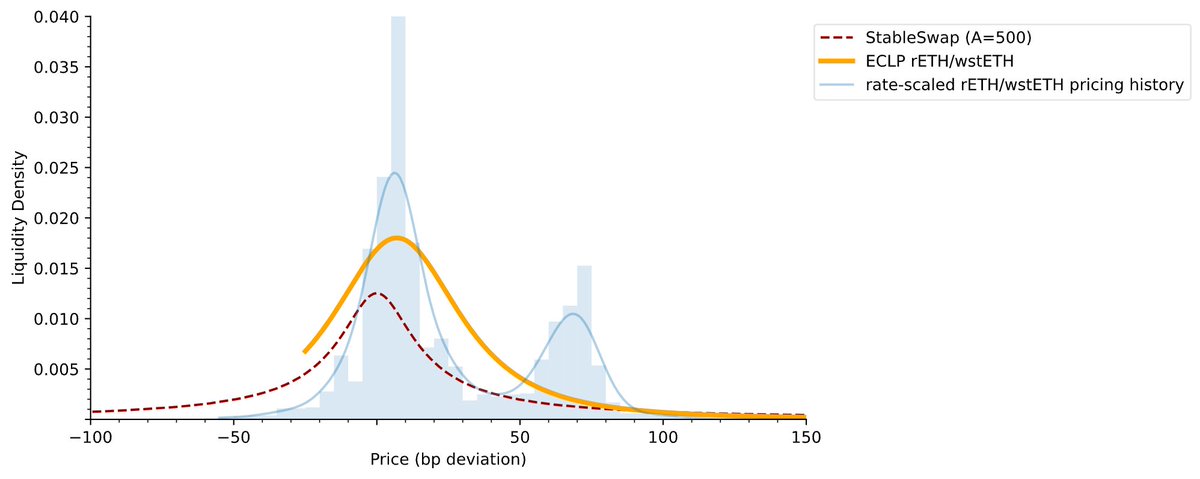
@robin_ethz @ljfgudgeon rETH tends to trade above peg and wstETH below peg for fundamental reasons (having to do with frictions of minting and redemption for each)
English
1
0
2
49
Robin Fritsch
Robin Fritsch@robin_ethz·
@robinhanson Why do you have the impression that they do worse than we expect? I don't really have this impression
English
0
0
0
48
Robin Hanson
Robin Hanson@robinhanson·
The question here is "Why don’t they then do better that we might otherwise expect", not "Why don’t they then do better than average."
English
6
0
7
3.5K
Robin Hanson
Robin Hanson@robinhanson·
Some people are really good at board games. Not just one or a few but they can do well at most any. Why don’t they then do better at life? How do board games differ so systematically?
English
312
19
926
382.7K
Robin Fritsch
Robin Fritsch@robin_ethz·
@hdevalence It's a key feature of many AMMs, right? It enables passive liquidity provision
English
0
0
1
64
Robin Fritsch retweetledi
Lioba Heimbach
Lioba Heimbach@liobaheimbach·
As we have been reminded recently by the Compound DAO incident, governance attacks are a reality. What attack vectors are exploited most often, and which factors facilitate attacks? This is what we set to find out in our Systemization of Knowledge on Attacks on DAOs. (1/8)
English
1
5
15
1.9K
Robin Fritsch
Robin Fritsch@robin_ethz·
@o_herminator Very promising team! :) Looking forward to your findings! Your McAMM ideas have been very influential!
English
0
0
0
31
Herminator
Herminator@o_herminator·
Super stoked to research the MEV-L2 landscape. Looking forward to work with this excellent team!
The Latest in Defi Research@thelatestindefi

Fellow: @o_herminator Council: @danrobinson Mentor: @ciamac Alex is an independent researcher focused on advancing DEFI. He and Diego will be designing a MEV-resistant solution for L2s that significantly hardens the sequencer by enabling censorship-resistance and releasing a prototype using the OP Stack.

English
1
0
9
691
Yuki is short, so is life
Yuki is short, so is life@ballsyalchemist·
MEV categorization: Here are a rough % of each MEV types Atomimc arb ~ 40% (include various types of on-chain arbs) Sandwich ~ 25% CEX-DEX ~ 35% Totalling to around $1.3B+. There are still more classification work to be done on some long-tail and complex arbs, so this number could be slighly underestimating in terms of total MEV.
Yuki is short, so is life tweet media
English
3
0
1
203
Robin Fritsch
Robin Fritsch@robin_ethz·
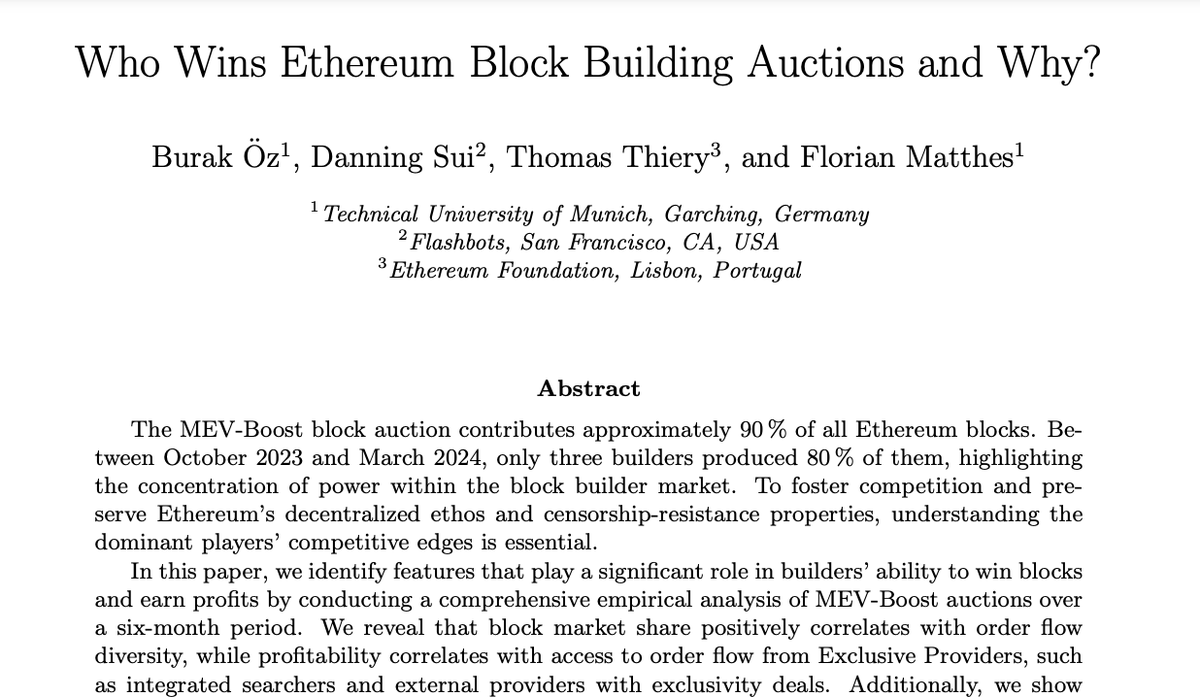
@0xemperor Very cool work! 😎 Here, builder profits don't include any value they get from including their own transactions, right? @boez95
English
1
0
1
235
Emperor
Emperor@0xemperor·
Very cool new data work, "Who Wins Ethereum Block Building Auctions and Why?", shows that - builders block market share a positive correlation w/ order flow diversity - positive correlation b/w market share & profit- features like exclusive signal, non-atomic arb, tg bot flow
Emperor tweet media
English
4
18
103
9.6K
Robin Fritsch
Robin Fritsch@robin_ethz·
@LiamKovatch @Polymarket And this one market/two market choice is separate from the AMM/LOB question. (You could potentially also have two AMMs for YES/USD and NO/USD.)
English
0
0
2
42
Robin Fritsch
Robin Fritsch@robin_ethz·
@LiamKovatch @Polymarket The difference: With one YES vs. NO market (be it AMM or LOB), passive LPs (that don't react) will lose everything, when the result becomes clear. With two market vs. USD, this will only happen in one of the two markets.
English
1
0
2
52
Liam Kovatch
Liam Kovatch@LiamKovatch·
someday I will do a deep dive on our thinking re market structure @Polymarket, but there are nice properties of the orderbook that we get vs the cpmm. Perhaps most importantly is that makers can use the same usdc to collateralize orders across all books driving capital efficiency for the supply side. Additionally there are factors like the ability to support market-based idiosyncrasies like in-game taker delay. Empirically we've also seen the orderbook facilitate faster market formation from 1->n (slower 0->1). There are tradeoffs ofc and not always having a price is a big one for pms given informational angle. Let's connect - doing research on the next evolution rn cc @_loset
Doug Colkitt@0xdoug

Why isn’t there a strong AMM based prediction market platform? Much easier to attract passive LPs than market makers particularly for longer tail questions. Biggest barrier is setting swap fees relatively fairly for very volatile markets, but shouldn’t be that hard

English
2
5
58
6K
Robin Fritsch
Robin Fritsch@robin_ethz·
@0xdoug Polymarket used to use AMM pools. However, iirc they had pools with YES vs NO tokens with fees going into the pool, meaning passive LPs lose everything at revelation. Kleros seems to be giving AMMs another try: seer-2.gitbook.io/seer
English
0
0
3
313
Doug Colkitt
Doug Colkitt@0xdoug·
Why isn’t there a strong AMM based prediction market platform? Much easier to attract passive LPs than market makers particularly for longer tail questions. Biggest barrier is setting swap fees relatively fairly for very volatile markets, but shouldn’t be that hard
English
60
1
160
95.7K