
Robin Chan ❄️

2.3K posts

Robin Chan ❄️ banner
Robin Chan ❄️

Robin Chan ❄️

@robinchan

founder @operator @goat_capital @fractalwagmi @rye advising/ investing @openai @twitter @square @sleeperhq @tryramp @uber @xiaomi

Katılım Mayıs 2007
1.7K Takip Edilen11.3K Takipçiler
Robin Chan ❄️ retweetledi
Ramp Labs
Ramp Labs@RampLabs·
Today, we're launching Ramp Agent Cards. There's been no safe way for agents to spend money, until now. Ramp Agent Cards give agents the ability to spend, governed with real spend limits, merchant controls, and full visibility into every transaction.
English
107
120
2K
779.4K
Robin Chan ❄️ retweetledi
David Singleton
David Singleton@dps·
Had the genuine pleasure of being back at @Stripe last week for their Friday Fireside with @patrickcollison and @collision . I demo'd @dreamer, and it was amazing to see how quickly people "got it" and the specificity of what they wanted to build: - a project management agent that auto-generates gantt charts - a Stripe wave visual tool - an emoji mood mixer - a SaaS integration guide generator… …and of course, the Stripe llamas (iykyk - linked in thread) The best thing about this moment is that you don't need a team of engineers to build any of these. You can describe the problem, and it just works. That's what Dreamer is for. We've got a lot of Stripes using Dreamer now, and I'm so excited to see what they build!
David Singleton tweet media
English
4
4
121
9.3K
Robin Chan ❄️ retweetledi
Marc Andreessen 🇺🇸
My information consumption is now 1/4 X, 1/4 podcast interviews of the smartest practitioners, 1/4 talking to the leading AI models, and 1/4 reading old books. The opportunity cost of anything else is far too high, and rising daily.
English
1.4K
3.9K
35.1K
34.5M
Robin Chan ❄️ retweetledi
Pirate Wires
Pirate Wires@PirateWires·
EXCLUSIVE: Department of War AI Chief On How The Anthropic Deal Collapsed When Emil Michael (@USWREMichael) took over the Department of War’s AI portfolio last August, he discovered the Biden admin had been “asleep at the wheel” when it came to top military contracts. “I was like, ‘Holy cow,’” Michael said of Anthropic’s contract, “There’s 25 pages of terms and conditions of things I can’t do.” For example: as written, the contract would not allow Anthropic to plan any kinetic strikes, generally considered a central activity of war. “This is a contract that should be made with GEICO Insurance, not with the Department of War,” he told us. A renegotiation ensued. What followed, in Michael’s words, were “three months of knockdown, drag-out negotiations” which involved Michael imagining every possible future wartime scenario that would require a carveout in Anthropic’s terms of service, and asking them for approval. Anthropic was also quite slow: “It’s not like mano a mano negotiation, me and Dario,” Michael says. “It’s like every time we discuss something, he has to take it back to his politburo of co-founders and their ethics panel.” Then, after an Anthropic exec reached out to Palantir to ask for classified info about how Claude was used to capture Nicolás Maduro — allegedly implying they could pull the plug on a military raid if they disagreed with how AI was used (which Anthropic denies) — Michael and the DOW concluded the company was a supply-chain risk. Many speculated that the Pentagon was punishing Anthropic for ideological differences. But Michael feared that certain ideological differences could, in fact, harm or undermine the performance of DOW products, potentially threatening soldiers’ safety. “I can’t have a gun not work because they decide they don’t like guns,” Michael says. That’s “putting real lives at risk. It’s no joke, right?” Anthropic’s unreliable behavior led Michael to believe they may have never really wanted to reach a deal. Still: he’s open to renegotiating if Anthropic can prove they’re acting in good faith. “I have a responsibility to the Department of War, and if there was a way to ensure that we had the best technology, I have no ego about it.” he said. “I mean, look, I’m a deal guy.” Full story in Pirate Wires 👇
Pirate Wires tweet media
English
71
325
1.6K
379.4K
Robin Chan ❄️ retweetledi
David Singleton
David Singleton@dps·
Jobs called computers "bicycles for the mind" -- tools we could shape to our will. But they never were. Until now. Every morning an agent preps me for my day -- calendar, news, last 24hrs of Slack -- in a personal podcast. I made it by asking. Same for hundreds of other things. Launching @dreamer in beta today. That 🧠 bicycle, finally. dreamer.com
Dreamer@dreamer

Introducing Dreamer. A place to discover, build, and enjoy agentic apps. It’s your home for personal intelligence. Now in beta. Sign up👇

English
86
73
413
190.8K
Robin Chan ❄️ retweetledi
Sam Blond
Sam Blond@samdblond·
We're launching Monaco today. Monaco automates customer acquisition and revenue growth for startups. The platform disrupting sales with AI has finally arrived.
English
327
161
3.4K
1.9M
Robin Chan ❄️
Robin Chan ❄️@robinchan·
❤️
Garry Tan@garrytan

Boil the Oceans You know the phrase: “don’t boil the ocean.” Everyone’s said it in some overly ambitious meeting. It’s good advice in normal times. It keeps teams focused. It prevents scope creep. But we are no longer in normal times, and I think it’s time to retire saying it. Artificial Superintelligence means it’s time to boil the ocean. We’ll start with a few lakes first. I was recently with a university endowment’s head of private investing who told me their engineers were terrified for their jobs after seeing what Claude Code could do. And I get it — that’s the natural first reaction. But it’s the wrong one. It’s a zero-sum reaction to a positive-sum moment. Instead of worrying about doing the same thing we’ve been doing for cheaper, why not focus on doing the thing we never even dreamed of doing? Why can’t that endowment achieve 50% net IRR instead of 10%? Why can’t a startup deliver a service that is 100x better than the incumbent? Why can’t we have fusion energy? Why can’t we talk to every single user and have a perfect understanding of every bug in our product? These aren’t rhetorical questions anymore. They’re engineering problems with paths to solutions. Here is what I think is actually going on with the fear: our fear of the future is directly proportional to how small our ambitions are. If your plan is to keep doing exactly what you’re doing, then yes, a machine that can do it faster and cheaper is terrifying. But if your plan is to do something dramatically bigger, then the machine is the best news you’ve ever gotten. If you’re a worker — someone who trades labor for a living — this is the moment to become a builder. Start a business. And if you’re already management or capital, it’s time to go 10x more hardcore on what your aspirations could be. Not eking out 5% efficiency gains. Not increasing profit margins 2% by lowering cost and firing people. Those are the old games. The new question is: what would it look like to build a product or service so good that people would happily pay 10x what they pay now? The net result of this is more jobs, not fewer. As Ryan Petersen likes to say, the human desire for more things is absolutely limitless. We can actually fulfill that desire now — if we have the agency to prompt it for ourselves. Buckminster Fuller coined the term “ephemeralization” in 1938: doing more and more with less and less until eventually you can do everything with nothing. His entire vision of progress was about technology enabling radical expansion of human capability through dematerialization. He traced this from stone bridges to iron trusses to steel cables — each iteration stronger, longer, lighter, cheaper. He wasn’t describing job destruction. He was describing civilization getting better at being civilization. This is Jevons Paradox for everything. When you make a resource dramatically more efficient, you don’t use less of it — you use vastly more. Steam engines didn’t reduce coal consumption. They made coal so useful that demand exploded. The same thing is about to happen with intelligence, with labor, with every service and product we can imagine. But Jevons Paradox doesn’t activate on its own. It requires capital and management to actually raise their ambitions — to boil lakes and oceans instead of drowning them in committee That’s what startups have always been good at: moving fast in the face of radical uncertainty, building for the 10x future while everyone else is optimizing for the 1.05x present. Time to start.

ART
1
0
3
728
Robin Chan ❄️ retweetledi
Jack Zhang
Jack Zhang@awxjack·
A bit of perspective. @hdubugras has just turned 30. @pedroh96 turns 30 in a few months. At that age, I was only just getting started on Airwallex…. still early, still learning, still figuring things out. Henrique is already onto his next chapter, starting Orca. And I have no doubt Pedro will go on to build more companies in the years ahead. Both are exceptional founders. And on a personal note, Henrique has given me some of the best advice of my entrepreneurial journey. This is still very early in their story as they are true entrepreneurs at heart ❤️
Jack Zhang tweet media
English
12
7
259
20.1K
Robin Chan ❄️ retweetledi
dsa
dsa@dsa·
Today is a day I’ll never forget. I grew up in Cupertino. My dad was a tech founder in the 80s/90s. I was in YC S07. LiveKit is my 5th company. The first 4 didn’t work out. I’ve had a lot of advantages — it still took 20 years to get here. Founders: keep taking shots.
LiveKit@livekit

We learn to speak before we learn to read. Voice is the most natural interface we have. We just raised a $100M to make building voice AI as easy as a web app.

English
81
38
929
90.6K
Robin Chan ❄️ retweetledi
Dev Shah
Dev Shah@0xDevShah·
universities are about to realize that they had been selling the wrong product for the 150 years. they thought they sold knowledge, then information became free. they pivoted to selling credentials but now credentials are just proxies. in the post-ai era the universities who survive will realize they were always selling 3 things: network, status signaling, and a 4 years of protected time to become an adult.
English
387
1.4K
14.6K
879.3K
Robin Chan ❄️ retweetledi
DAN KOE
DAN KOE@thedankoe·
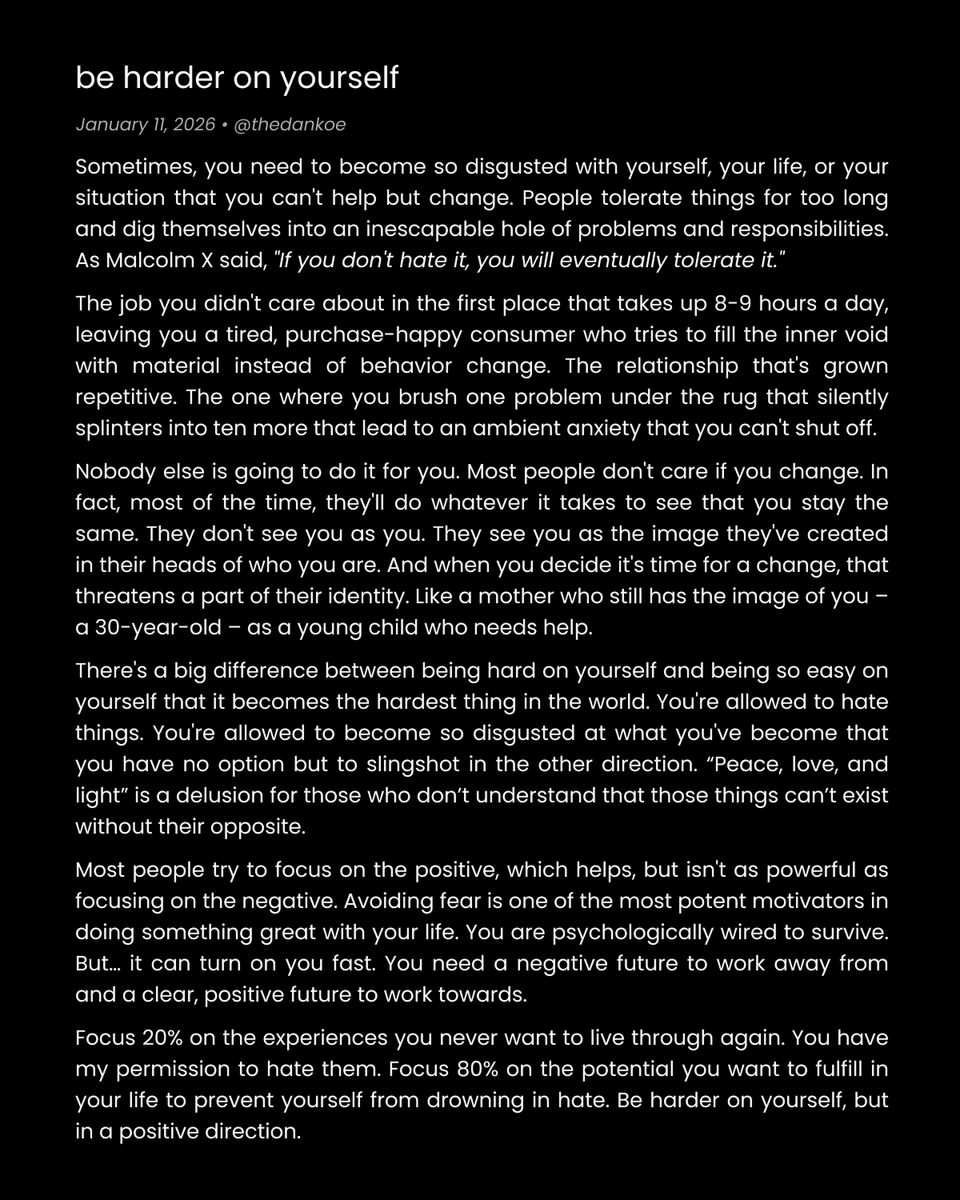
be harder on yourself
DAN KOE tweet media
English
173
2.4K
15.1K
846.9K
Robin Chan ❄️ retweetledi
Chris Hoffmann
Chris Hoffmann@STLChrisH·
Favorite excerpt from Brent Beshore's annual letter: What CEOs Are and Aren’t Most people think of a CEO as the person at the top. That’s true in the same way it’s true that the windshield is “at the front” of the car. Technically correct. Also, misses the point. The windshield isn’t the engine. It isn’t the wheels. It doesn’t move anything. But it does determine what the driver can see, what they ignore, and what they slam into at 70 miles an hour. When done well, the CEO job is an arbiter of truth. The CEO stands at the border between the outside world and the inside world, between company mythology and competitive reality. That sounds obvious, but it’s not. I’d argue the norm is delusion, where organizations create realities disconnected from truth, complete with alternate headlines, villains, and heroes, all proclaimed with a shocking level of certainty. So the CEO’s job starts with a basic question: What’s true? Not what’s comforting. Not what’s politically convenient. Not what our dashboards can measure. What’s true? And what should we do about it? But deciding what to do and then doing it, requires a blend of rare attributes. The CEO must be confident enough to pick a direction and humble enough to change it. Optimistic enough to inspire and paranoid enough to prepare. Warm enough to build trust and hard enough to make calls that disappoint people they like and care about. We need to strip away the mystique. In practice, the CEO allocates three things: Attention: If you want to understand a CEO, ignore their strategy deck and read their calendar. Where attention goes, energy flows. Where energy flows, money follows. And where money follows, the organization slowly becomes something different, usually without anyone noticing until it’s obvious. This is why the CEO’s attention is so expensive. It’s why it’s so easy to waste. There are a thousand “important” meetings that are actually just elaborate ways to avoid the one meeting that matters. There are a thousand “urgent” problems that are actually just the company asking the CEO to temporarily soothe anxiety. A CEO’s attention is the company’s flashlight. Point it at the right things and companies transform. Point it at the wrong thing long enough and the wrong thing becomes the thing. People: The CEO builds the team that builds the team. I’ve learned that a healthy company isn’t built by a heroic CEO. It’s built by a great team operating with clarity, trust, speed, and accountability. The CEO’s role is to create that environment, protect it, and, when necessary, make the painful personnel decisions that preserve it. This sounds straightforward until you live it. Then you realize you’re not moving boxes on an org chart. You’re messing with people’s dignity, livelihoods, and families. You’re also messing with the morale of everyone who stays. Every hire is a bet. Every promotion is a signal. Every tolerated behavior becomes a de facto policy. The CEO becomes, whether they like it or not, the embodiment of culture. It’s not what they say they value, but what they practically reward, punish, ignore, and allow. Money: This is the CEO’s most difficult job because it’s often the one they’re least trained for, that seems the most glamorous, and is extremely impactful over time. Most CEOs come up through some form of excellence in sales, operations, engineering, or product. Then one day they wake up and realize the biggest decisions they make are capital allocation decisions: reinvest or distribute, grow or consolidate, buy or build, add headcount or automate, bet on the future or play it conservative. Capital allocation is where strategy stops being a noun and becomes a verb. It is where vision gets an audit. And it’s also where a CEO can quietly ruin a business while looking busy. It’s remarkably easy to confuse action with progress, and reinvestment with wisdom. Oftentimes the best capital allocation decision is painfully boring: Do fewer things, do them better, and keep your powder dry. But, that’s not what gets applause. In our world, with long-term owners, permanent capital, and no forced exit timetable, this is where the CEO job gets simpler. We don’t need theater. We don’t need growth for growth’s sake. We don’t need to hit a narrative for the next fundraising cycle or quarterly call. We can play offense when the opportunity is real and defense when it isn’t. We can say “not now” without pretending it’s “never.” This brings me to what might be the most misunderstood part of the CEO role: The CEO is the Chief “No” Officer. Every yes is a no to something else. Every strategy is a pile of exclusions. Every commitment is a tradeoff. The organization will always ask for more: more initiatives, more products, more meetings, more hires, more exceptions, more complexity. Increasing complexity is the default setting of life, and companies are not exempt from natural order. A CEO has to become comfortable being the person who disappoints people in the short term so the company doesn’t disappoint everyone in the long term. This is where I’ve personally struggled, both as a leader and as an owner. I want to be helpful, agreeable, and liked. I can easily slip into short-term people pleasing at the expense of leading well. Sometimes I’ve confused my progress anxiety for insight. I’ve wandered into decisions too early because “someone should do something.” I’ve also learned slowly and painfully that a CEO can add enormous value simply by refusing to add noise. Clarity is kindness, but often feels like inaction to busy people. A lot of CEO work is invisible. It’s pressure management. It’s absorbing emotion without spreading it. It’s knowing what you think and how to say it with grace. It’s carrying the weight of uncertain outcomes while still asking the team to move forward decisively. This is why, in our portfolio, we care less about a CEO’s charisma and more about their character and judgment. We’ve found that the best CEOs have a rare combination of humility and intensity. They don’t need to be the smartest person in the room, but they do need to be the clearest. They don’t need to have all the answers, but they do need to be willing to make the hard call.
English
53
95
888
176.9K
Justin Mateen
Justin Mateen@justinmateen·
People keep asking if I’d invest in Venezuela. The answer is yes. I already have. The company is called Yummy. Today, it operates at real scale in Venezuela with 35M+ orders a year, 60% YOY growth, and 100,000+ gig workers, effectively creating the modern day gig economy in Venezeula. Back in 2021, when it was still a little known startup, I became Yummy’s largest investor at a single digit million valuation and encouraged the founder Vicente to apply to Y Combinator. At the time, I was not sure they would get in, but they somehow did. This was one of the last, and certainly the scariest investment I made in emerging markets, as I have spent most of my time lately deploying personal capital across private and public companies in the US. For anyone looking for tech exposure to Venezuela, Yummy would be a unique blanket bet. Ride sharing, food delivery, grocery delivery, a peer to peer marketplace, and merchant enablement all inside one platform. @metavarce is the first person to build a tech startup at this scale in Venezuela (outside of telecom) when most people thought it was crazy. Since he wrote the first line of code, more than 80 tech startups have emerged in the country. He built Yummy with his hands tied behind his back, yet the results are remarkable. Yummy is already a case study at Harvard, and I expect it will be studied for many years to come.
Vicente Zavarce@metavarce

I created Yummy, the startup in Venezuela with the most online orders and a trailblazer in the startup scene. There is incredible talent and amazing companies in the making here 🇻🇪 Here is a list of some fun ones I like that the whole world should know about. If you want to meet the founders send me a note: - Yummy: YC backed, Superapp building across delivery, rides, peer-to-peer transactions and merchant enablement. Over 100,000 people use the platform to generate earnings - Cashea: Buy Now Pay Later platform, became the largest and fastest growing BNPL in the world - Meru: Stablecoin banking for anyone in the world, built on the stellar blockchain - Stack AI: YC backed, Venezuelan founders, MIT PhDs, building an enterprise AI transformation platform - Slash: YC backed, Venezuelan founder, building a global banking platform for businesses of all sizes - HeroUI: top 10 largest open-source react libraries in the world. Over 400,000 developers use it to make better UI experiences - Venflow: Building recurrent payment infrastructure for Venezuela - Vesvank: turn-key payment infrastructure for digital businesses in Venezuela - Fina Partner: POS and business administration for SMBs in Venezuela - AmaliaSalud: doctor marketplace for Venezuela - Venemergencia: Building urgent care and telemedicine for Venezuela - La Capilla: Pioneers exporting “cocuy”, Venezuela’s version of tequila / mezcal

English
14
12
173
64.4K
Robin Chan ❄️ retweetledi
Justin Mateen
Justin Mateen@justinmateen·
You rarely know you’re living through a historic moment while it’s happening. If Iran and Venezuela truly open up, the global implications cannot be overstated.
English
8
4
91
11.8K
Robin Chan ❄️ retweetledi
hidecloud
hidecloud@hidecloud·
There’s no such thing as a pre-designed moat. You build, iterate, and survive. If you’re lucky, people later call it a moat.
English
14
10
172
27.7K
Robin Chan ❄️ retweetledi
Jason Shuman
Jason Shuman@JasonrShuman·
The more I learn about China’s VC strategy, the more I think they’re running another race outside of AI where they have structural advantages to owning the generation of tech winners 2040 and beyond. See China’s decision to mandate 70% of its new $21B National Venture Capital Guidance Fund into seed and early-stage companies is a brilliant industrial strategy. While we operated on 10 year fund lifecycles, Beijing is intentionally building "Patient Capital" and structuring this fund with a 20-year lifespan. They aren't looking for a quick exits. They’re looking to own the foundational technologies of the next century. And honestly they’ve proven their ability to pick the right markets and dominate them through early state-backed support: 1. EVs and Battery Tech: BYD and CATL now control over 69% of the global EV battery market, effectively dictating the supply chain for the world’s transition to green energy. 2. Drones: DJI remains the undisputed king, accounting for a staggering 83% of all global drone detections in 2025. They’ve turned a hobbyist toy into a critical piece of industrial and defense infrastructure. 3. Solar & Photovoltaics: China now controls more than 80% of the global solar supply chain, from polysilicon to finished modules, making global decarbonization impossible without their tech stack. The themes they’re focused on today: 1. Embodied Intelligence (AI + Robotics) The focus has shifted from LLMs that chat to AI that moves. They are pouring seed capital into "Embodied AI" meaning humanoid robots and autonomous industrial systems. The goal is to solve the labor shortage by automating the entire manufacturing base, not just the software. 2. The Low-Altitude Economy This is no longer science fiction. Beijing has designated this a "strategic emerging industry," funding eVTOL (electric vertical take-off and landing) aircraft and the digital "air roads" to manage them. They are betting on a future where urban logistics happen 300 meters above the ground and that they can manufacture for global markets at a price well below the American competition (Joby & Archer) 3. Quantum & 6G Infrastructure They are seeding the startups that will define the sovereign tech stack of 2035. This includes quantum-resistant cryptography and 6G satellites to ensure their communications remain unhackable and ubiquitous. 4. Commercial Space They are flooding capital into commercial satellite constellations (G60 Starlink competitors) and reusable rocket tech, moving space from a government project to a venture-backed industry. 5. Energy Sovereignty (Nuclear Fusion & Green Hydrogen) They are playing the long game on energy. The state is de-risking the most capital-intensive "DeepTech" sectors, like magnetic confinement fusion, where the R&D cycle is too long for traditional private VC but perfectly suited for a 20-year state mandate. The challenge we have in America is that VC funds have 10 year life cycles and typically are only willing to make one bet per category. Not only is this concentrated risk but its duration mismatch,which is a structural disadvantage. So maybe we need to rethink how we approach these key longterm initiatives as well.
English
7
7
69
23.7K
Robin Chan ❄️ retweetledi
david friedberg
david friedberg@friedberg·
why not just raise income tax rates? because your real intent is not to just “provide healthcare”. you’re masking that you are proposing the creation of, for the first time in the 250 years of this American republic, an organized government seizure of private property from citizens. you’re calling it a “wealth tax” or a “billionaires tax” or “millionaires tax” or whatever nom du jour polls well. but at the end of the day, it’s the seizure of private property from citizens by the government. citizens that earned money, paid their fair taxes on those earnings (53% if they live in California) and are now being told they need to hand over after-tax assets because the government has failed to provide promised services with the revenue it’s collected, and are now re-casting their own failure to be a socio-economic inequity that must be justly resolved... a slippery slope that has never gone anywhere good (see economic effects in USSR, Cuba, Venezuela, France and Norway wealth tax etc.) the American founders fled tyranny in Europe and this amazing nation was populated by immigrants (myself and your parents) from around the world not just looking for a “better life” but for a place where they could have freedom from tyrannical governments that can take what they want from private citizens. a great nation borne of property rights, the rule of law, and endowed freedoms to believe, speak, or act. these principles led to the greatest run of innovations, successes, and widespread increase in prosperity, for all citizens, ever seen. the citizens, the individuals, not the institutions, delivered this progress. those who invented, who toiled, who bled, who sacrificed, who took risk and persevered, who led, and who changed the world, are not charlatans, kleptocrats, or oligarchs. they’re what made us all better off. prosperity is a measure of america’s success, not its failure. it is your principle that is so offensive, as evidenced by the broad disdain for your flippant flirtation with the darkest of human fantasy - socialism. you and other neo-socialists have led so many of us to reflect on America’s history and what it is becoming. that now leads so many to consider, so unnecessarily, leaving their homes for a place where everyone stands up to shout down the principle you suggest. because if your ideas are now considered moderate, it’s clear this titanic is sinking. that a “simple tax” of taking assets that have been earned, through toil and tribulation, rightly taxed, and preserved, should now be unjustly seized, is your solution to a problem of obvious government mismanagement and outright fraud, tells us that your true motivation lies not in giving people healthcare but in cutting down success and deleting the system of prosperity and opportunity for all. i don’t care, and neither should anyone else, what the sum total market value of a private citizens private assets might be. it is none of my business and should be none of yours. because, again, once you open that pandora’s box, we might as well study Lord of the Flies … there is literally nothing stopping 51% of citizens demanding that their government go out and seize 100% of the private property of the 49%. want to give healthcare to people in need? do your job and fix healthcare. make it affordable. want to be lazy about it? then do your job lazily and raise income taxes. want to take private property from private citizens who have paid their fair share of taxes and legally earned their property, then honestly declare that it is envy, not inequity, that you strive to resolve…
English
1.7K
5.6K
39K
4.5M
Robin Chan ❄️ retweetledi
LiveKit
LiveKit@livekit·
Happy holidays from LiveKit! 2025 was incredible. We launched: - Agent Builder - Phone Numbers - Observability - Agents on Cloud - Node.js Agents - Inference - and more.. Plus an amazing DevDay with 200+ developers. Grateful for this community. Here's to building more in 2026!
English
2
4
50
2.5K