

Rod Roberson
552 posts
Rod Roberson
@rod_roberson
CEO, Wallboard | SMB Entrepreneur | SMB Lawyer
Dallas, Tx Katılım Ocak 2009
2.4K Takip Edilen432 Takipçiler


Hey @claudeai your Opus 4.7 table is cool and all, but...
Claude@claudeai
Introducing Claude Opus 4.7, our most capable Opus model yet. It handles long-running tasks with more rigor, follows instructions more precisely, and verifies its own outputs before reporting back. You can hand off your hardest work with less supervision.
English

Yesterday's post hit 90K+ views. The replies split into two camps.
Solo lawyers saying "finally someone said it."
And people saying "build it in a weekend is naive and dangerous."
The second group is right about one thing. If you treat AI like a magic box that produces finished legal work, you will get sanctioned. 600 lawyers have learned this the hard way. Fabricated citations. Hallucinated statutes. Motions citing cases that do not exist.
But they are wrong about what the post was actually saying.
Nobody said type your legal question into a chatbot and file what comes back. That is how you end up in front of a disciplinary committee. That is using AI as a slot machine.
What the post described is fundamentally different. And the difference matters enough that I want to spell it out clearly because people's licenses depend on getting this right.
There are two completely different ways to use AI in legal work. One will get you sanctioned. The other will not. The profession is confusing them and it is causing real damage.
Method one. You ask AI a question from its training data. "What are the elements of a breach of contract claim in California?" Or worse, "find me cases that support my argument that the statute of limitations was tolled."
The AI generates an answer from memory. It sounds confident. It might be right. It might be completely fabricated. You have no way to verify without doing the research yourself anyway. This is the method that produced Mata v. Avianca. This is the method that got a lawyer in Oregon hit with $109,000 in sanctions.
This method is a chatbot. ChatGPT, Claude, in a browser, Gemini, whatever. You type, it generates from training data, you pray.
Do not do this for anything you plan to file.
Method two. You give AI your actual documents and ask it to work with what you gave it.
Put the judge's last 30 orders in a folder. Put your draft motion in the same folder. Put the opposing brief in there. Put the relevant statutes and the cases you have already found and verified in there.
Now you are not asking the AI to find law. You are asking it to read what you already have and tell you what you might be missing.
"Based on the opposing brief in this folder, what arguments am I not addressing?"
"Based on this judge's orders, how does she typically analyze this issue?"
"Read my draft and tell me if any of my arguments are inconsistent with each other."
The AI is not generating case law. It is reading your documents. It cannot hallucinate a case that is in front of it. It can only tell you what it sees in what you gave it.
This is the difference between asking a stranger on the street for legal advice and asking your associate to review a draft you already wrote.
One of the smartest comments on yesterday's post said "learn to build gates, audit tools, checklists." She is absolutely right. The skill is not prompting. The skill is building a review process around AI the same way you would build a review process around a junior associate.
You would never let a first-year file a brief without reviewing it. You would never let them cite a case without checking it. You would never let them make a factual claim without verifying the source.
Same rules apply to AI. Not because AI is unreliable. Because no work product from any source should go out without review. That is just being a lawyer.
The other comment that stood out: "95% of solo practitioners are using the same forms over and over. PI, Family, Real estate. Only corporate litigators need true writing."
This is exactly right. And it is why the "build it yourself" claim is not naive.
If you are a family lawyer, you draft the same petition for dissolution 15 times a month. Same structure. Different names, dates, assets, children. You are not doing novel legal research. You are filling in a template.
AI is absurdly good at this. Give it your best template. Give it the intake form. Tell it to populate the draft. Then review it. Fix what it got wrong. You just turned a 90-minute task into a 15-minute review.
That is not dangerous. That is what a good paralegal does. Except it is available at midnight and it does not take PTO.
The lawyers who will get in trouble with AI are the ones who use it as a substitute for thinking. The lawyers who will thrive are the ones who use it as a tool that they supervise, correct, and verify. The same way they would supervise any other person producing work product under their name.
AI is not a lawyer. It is the most capable paralegal you have ever had. And like any paralegal, the quality of its output depends entirely on how well you supervise it.
Stop asking AI to be a lawyer.
Start treating it like one more person on your team whose work you check before it goes out the door.
That is the difference between getting sanctioned and getting an unfair advantage.
Ann Srivastava@helloparalegal
The legal tech industry spent the last 3 years telling solo lawyers and small firms that AI would level the playing field. Then they priced it so only BigLaw could afford it. CoCounsel. $900 a month per seat. For a single user. That is $10,800 a year for one attorney to use an AI research tool that hallucinates 17% of the time according to Stanford's own testing. Lexis+ AI. Integrated into plans that already cost $270 a month whether you use them or not. Locked into annual contracts you cannot pause. And their AI hallucinated more than 17% of the time in the same study. Westlaw's AI-Assisted Research. Hallucination rate above 34%. More than one in three queries returning something that is not real. At premium pricing. Harvey. Raised $300 million. Serves elite firms. If you are a solo doing PI cases in suburban Ohio, Harvey does not know you exist and does not want to. The pattern is the same one legal tech has followed for 20 years. Build for the firms that can write six-figure checks. Let everyone else figure it out. And everyone else is 75% of the profession. There are 1.3 million licensed attorneys in the United States. Roughly 49% are in solo practice. Another 15% are in firms of 2 to 5. That is nearly two thirds of all practicing lawyers in firms where $900 a month per seat is not a rounding error. It is a decision between a tool and a paralegal. These lawyers chose the paralegal. Every time. Not because they do not understand AI. Because the math does not work. If you bill 150 hours a month at $300 an hour and your utilization rate is the national average of 37%, you are collecting maybe $16,000 a month before overhead. You are not spending $900 of that on an AI tool that might make up a case and get you sanctioned. So the state of the art for most American lawyers in 2026 is the same as it was in 2019. Westlaw. Word. A yellow legal pad. Maybe Clio for billing if they are progressive. The AmLaw 100 firms have AI teams. They have prompt libraries. They have custom-trained models for their practice areas. They are running document review that used to take 200 associate hours in 3 days. The solo in Tampa is still copying and pasting from a brief template he wrote in 2017. That is the playing field legal tech "leveled." Here is what nobody in legal tech is talking about because it threatens their entire business model. A solo practitioner with a laptop can now build most of what those $900/month tools do. In a weekend. For the cost of a Claude subscription. I am not being provocative. I am being specific. Take the thing lawyers actually need most. Not a chatbot to ask legal questions to. That is what got people sanctioned. Lawyers need tools that work with their actual files. Their actual cases. Their actual documents. Claude Code runs on your machine. It reads every file in a folder you point it to. It does not go to the internet and generate case law from memory. It reads the documents you already have. Here is what a solo practitioner can build in a single weekend. Client intake processing. Right now you get an email or a phone call, you take notes, you type everything into Clio manually, you send a retainer letter, you open a file. Every step is manual. Set up a folder structure. Put your retainer template in it. Put your conflict check list in it. Tell Claude Code what your intake process looks like and have it build you a system where you paste in the client's details and it generates the retainer letter, the conflict check memo, the new matter checklist, and the initial filing deadlines. All in the format you already use. Not some vendor's format. Your format. Your letterhead. Your retainer language. Or take deadline tracking. You are paying for a calendaring system or worse you are using Outlook reminders and hoping. Pull your active case list. Feed it to Claude Code with every relevant deadline type for your practice area. Have it build a tracker that flags deadlines at 30, 14, 7, and 3 days out. Output to a spreadsheet you already know how to use. Or to your calendar. Or to a daily email. A developer would charge you $5,000 to $15,000 for this. You can build it Saturday morning. Or take the thing that actually moves the needle in litigation. Preparing for a judge you have never appeared before. Download 30 of this judge's orders from PACER. Put them in a folder with your motion and the opposing brief. Have Claude Code read all of it and tell you how this judge has ruled on the exact issues in your case. What arguments she finds persuasive. What she raises sua sponte. How she structures her analysis. Now have it draft your brief to match how this specific judge reads and reasons. Lex Machina charges thousands a year for judge analytics that give you bar charts. You just built a judge-specific brief preparation system in an afternoon using the actual orders instead of summarized data. Or document review. You have 2,000 documents in discovery. A vendor wants $15,000 to run them through their review platform. Put them in a folder. Have Claude Code read them and flag the 200 that are responsive to the RFPs. Have it draft a privilege log for the ones that are privileged. Review its work the way you would review a first-year associate's work. Correct where it gets it wrong. Run it again. This is not hypothetical. Lawyers are doing this right now. The reason the legal tech industry does not want you to know this is because their entire model depends on you believing that you cannot build these tools yourself. That AI is too complicated. That you need their proprietary wrapper around the same foundation models you can access directly. CoCounsel is a wrapper around GPT-4. Lexis+ AI is a wrapper around proprietary models. Harvey is a wrapper around Claude and GPT. You are paying $900 a month for a user interface and a brand name sitting on top of models you can access for $20 to $200 a month. I am not saying these tools are worthless. If you are a 500-lawyer firm with compliance requirements and you need enterprise deployment with audit trails and SSO, you should buy enterprise software. But if you are a solo. Or a 3-person shop. Or a legal aid lawyer who has never had access to any of this. You can build it yourself now. The foundation models are the same ones the expensive tools use. Claude Code gives you direct access. It reads your files, it understands your practice, and it does not lock you into an annual contract. The most expensive legal tech is no longer the best legal tech. The best legal tech is the one you build yourself because it does exactly what you need and nothing you do not. The playing field did not get leveled by the companies that promised to level it. It got leveled by the same AI they are reselling to you at a 40x markup.
English

🏌️⛳️ For the rest of your life you’re only able to watch ONE…
Which one are you choosing… A or B?
English

Andrew Yang is calling it "The Fuckening." That's his actual word for it. And honestly it fits.
A CEO of a publicly traded tech company told him directly: "We're firing 15% now. Another 20% in two years. Another 20% after that."
There are 70 million white collar workers in this country. Yang projects 20 to 50% of those jobs gone within a few years. The low end of that is 14 million people. The entire 2008 crisis wiped out 8.7 million.
The difference this time is the jobs don't come back. A recession ends and companies rehire. This time the work still gets done. It just gets done by software. The position itself stops existing.
Nothing expands margins like replacing a $379K employee with a $200/month subscription.
We track it all at layoffhedge.com. 58 companies. 254,000 people. And climbing.
Yang is writing about what's coming. We're counting what's already here.
Andrew Yang🧢⬆️🇺🇸@AndrewYang
The Fuckening of white-collar workers has arrived. blog.andrewyang.com/p/the-end-of-t…
English
@hillery_dan How long do you think it takes for liquidity and open interest comes into STRC put markets?
English

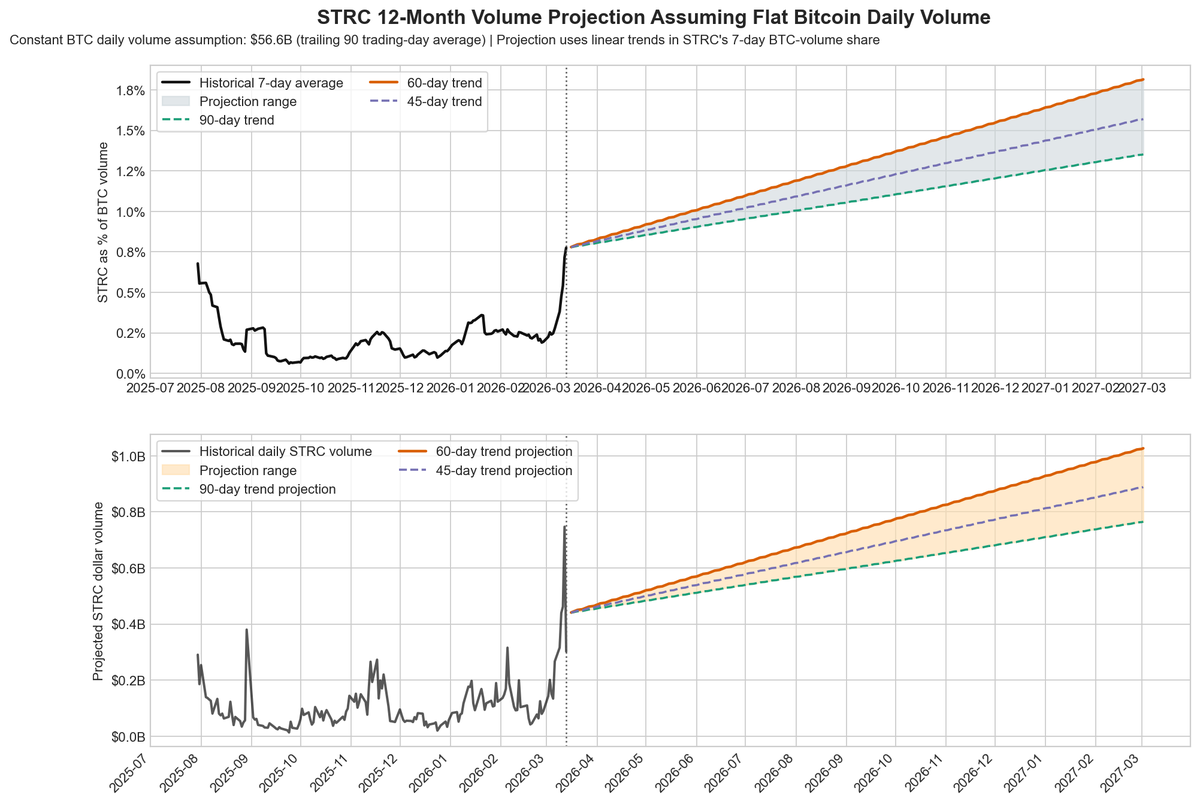
STRC will push Bitcoin into an Exponential
- STRC trading volume decouples from MSTR, IBIT, & Bitcoin.
- STRC's Shelf Registration and ATM are novel. All other variable rate prefs have been benchmarked to SOFR. Strategy's unlock was letting the market set STRC's interest rate.
- SPY Risk > STRC Risk?
- Leveraged STRC is the high performance application.
- Leveraged STRC will breed the STRC PUT market.
- Selling STRC Puts gives anyone access to institutional leverage.
English

Automation consultants charge $15K for what Claude Code now does in 2 hours.
I know because we're the ones who used to charge it.
Here's the exact process:
Step 1: Discovery (20 min)
→ Paste your org chart, tool stack, and top 3 bottlenecks
→ Claude interviews you with clarifying questions
→ Outputs a full process inventory ranked by time cost
Step 2: Workflow Mapping (15 min)
→ Describe any department's daily operations in plain English
→ Claude builds a complete process map
→ Every manual handoff, redundant step, and automation trigger flagged
Step 3: Opportunity Audit (10 min)
→ Feed it the workflow map output
→ Returns your top 10 automation opportunities
→ Ranked by ROI, complexity, and build time
Step 4: Architecture Design (20 min)
→ Claude designs the full system architecture
→ Which tools connect where, what the data flow looks like
→ Agents for complex logic, linear flows for the repetitive stuff
Step 5: Build (ongoing)
→ Claude writes the actual workflow JSON
→ Self-documents everything as it builds
Step 6: The output.
A live dashboard your whole team can work from.
→ Clickable process maps for every department
→ Automation opportunities ranked by ROI
→ Implementation progress by phase
→ KPIs updated in real time
→ One link you share with clients, freelancers, or your team to execute
This is what we hand every client at the end of discovery.
The .md file is what makes all of it possible.
Without it, Claude guesses.
With it, Claude builds like a $15K consultant.
Like this post, RT and comment "BLUEPRINT" and I'll send you the full prompt stack and the .md file we use internally. (Must be following so I can DM you)
🎁 Bonus: The first 100 people get a real Precision AI Blueprint — an actual sample audit doc from a client engagement so you can see exactly what the output looks like.

English

Most finance teams are only using 10% of Claude’s actual potential, that’s why I created this guide for you.
What’s inside?
We dive deep into the four essential Claude entry points:
• Claude Web - For high-level strategic analysis and document synthesis
• Claude in Excel - To automate formulas and data cleaning where you live.
• Claude Cowork - For seamless team collaboration on financial projects.
• Claude Code - For advanced automation and technical finance workflows.
Who is this for?
• FP&A Analysts: Streamline your reporting and variance analysis.
• Finance Managers: Speed up consolidation and team reviews.
• CFOs / VPs of Finance: Enhance strategic decision-making with rapid scenario modeling.
The Essentials:
→ 25 Detailed, Easy-to-Use Prompts: Copy-paste solutions for real-world finance tasks.
→ AI Safety for Finance Professionals: A dedicated section on maintaining data privacy and security.
→ From Analyst to CFO: Tailored workflows for every level of the finance hierarchy.
Here is what you can expect inside:
• Chapter 1: How to Use This Book
• Chapter 2: Getting Started — What You Need
• Chapter 3: AI Safety for Finance
• Chapter 4: Claude Web: Analysis & Narratives
• Chapter 5: Variance Analysis
• Chapter 6: Claude in Excel: Model Workflows
• Chapter 7: Reporting & Board Packs
• Chapter 8: Claude Cowork: Multi-File Automation
• Chapter 9: Building a CFO Agent with Claude Code
• Chapter 10: Implementing AI in Your FP&A Team
• Chapter 11: What Comes Next
The future of finance is "AI-augmented." Don't get left behind.
If you want this E-book, just drop a comment and I’ll send it to you.
(Important: follow me so I can DM you!)

English
Rod Roberson retweetledi

I think it's time I start speaking up a bit more on this platform. I lead engineering efforts for @geminicli and Gemini Code Assist at @googlecloud .
If I promise to post pithy thoughts and opinions a bit more, let's see if I can get a few followers...
Help me out @ntaylormullen , @JackWoth98 , @LyalinDotCom , @SriThreePO, @geminicli
English
After 20 years in Excel, I finally watched an AI agent build a full model for me — end-to-end.
I used Genspark and the result was insane: structure, schedules, cash flow, scenario switches… all generated, then refined with my assumptions. The biggest shift?
I’m no longer stitching 20 sheets at 2 a.m. — I’m 𝗿𝗲𝘃𝗶𝗲𝘄𝗶𝗻𝗴, 𝘀𝘁𝗿𝗲𝘀𝘀-𝘁𝗲𝘀𝘁𝗶𝗻𝗴, 𝗮𝗻𝗱 𝗶𝗺𝗽𝗿𝗼𝘃𝗶𝗻𝗴 the model instead.
If you want faster board-ready models:
Start with a clear spec (drivers, outputs, constraints)
Let AI draft the skeleton (P&L, BS, CF, links)
You do the QA: tie-outs, edge cases, sensitivities
Lock a repeatable prompt + data schema for next time
If you want this Prompt,just drop a comment and I’ll send it to you.
(Important: follow me so I can DM you!)
GIF
English
I recently audited an FP&A team that was working 70-hour weeks.
They were smart.
They were hardworking.
But their reporting was a mess.
Every month was a "fire drill."
Static spreadsheets.
Broken VLOOKUPs.
Manual variance comments that took 3 days to write.
When the CFO asked for a 12-month rolling forecast, the room went silent.
They didn’t have a model for it. They had to build it from scratch. Again.
This is the hidden cost of "manual" finance. We hire top talent, then we ask them to act like data entry clerks.
In my 15 years in finance, I’ve realized something: The difference between a "good" team and a "world-class" team isn't the software they buy.
It’s the standard of the templates they build.
You shouldn't be reinventing the wheel every Monday morning. There are 7 "Must-Have" templates that every FP&A professional needs to master.
From 3-Statement models to Driver-Based forecasting. If you have these ready, a "fire drill" becomes a 10-minute update.
Efficiency isn't about working harder. It’s about having the right infrastructure.
If you want these templates in Excel, just drop a comment and I’ll send it to you.
(Important: follow me so I can DM you!)

English

I downloaded Claude in Excel on Friday night and didn't stop until I hit my Claude Max limits. Multiple times.
My Excel skills are average at best. But I understand real estate. I understand taxes, Opportunity Zones, depreciation, compounding, waterfalls.
I know when the numbers are right and when they're wrong.
So I talked Claude through building a model that had only ever existed in my head.
The result: a 30-year Opportunity Zone fund model with capital recycling. One of the most complex financial structures you can build in a spreadsheet.
14 interconnected sheets. 360-month engine. 378 rows × 114 columns tracking 13 deals simultaneously, month by month.
Here's what makes this hard:
Dynamic deal triggering. Deals aren't hardcoded. They auto-generate when cumulative refinance proceeds hit a funding threshold. The model decides when to deploy capital based on what's actually available.
13 stacked, interdependent deals. Each has its own timeline: construction → stabilization → refi → refi 2 → exit. The timing of one deal triggers the next. Miss one link and the whole chain breaks.
Multi-phase waterfall. Pref → return of capital → GP catch-up → 80/20 split. The LP/GP economics flip mid-stream. The model tracks allocations across both phases.
OZ tax basis tracking. Original deferred gain. 10% basis step-up at Year 5. Deferred gain tax due Year 6. K-1 losses flowing through annually. Full exclusion of appreciation after Year 10. All tracked separately for LP and GP.
Depreciation allocation differently before and after the waterfall flip. The model knows the difference.
After-tax IRR. Most models stop at pre-tax returns. This one calculates true after-tax performance including K-1 loss utilization, deferred gain payments, and OZ exclusion benefits.
8 automated validation checks. All passing.
I built it in a weekend by having a conversation.
English

R.I.P lead gen agencies.
I just replaced an entire lead gen team with Claude agents.
(all working while I slept)
Most founders spend $10k-$20k/month on marketing teams that work 9-5.
Most agencies spend $30k+/mo on outreach.
Last night I built AI agents that run 24/7:
- Lead Magnet Engineer → builds viral lead magnets in minutes
- Social Media Expert → writes scroll-stopping hooks
- Creative Director → generates on-brand visuals
- Research Analyst → finds trending topics in your niche
- Performance Tracker → analyses and maps out content
The results after 24 hours:
- 32 lead magnets ready to launch
- 60 days of content mapped out
- 50+ scroll-stopping visuals created
While I was sleeping.
Follow + reply CLAUDE and I’ll send the full system + setup.
English

Super outside my comfort zone here.
Took me forever to work up the courage to post this, but hoping it encourages or helps someone out there.
I haven't "arrived" yet but I snapped the pic on the right yesterday after my workout and was astonished how much I've changed my body in the last 343 days.
Yeah I hit my 2025 goal to get under 200 by the end of the year, but HOW I did it is what I'm proud of.
I've lost a lot of weight in the past with extended fasting or extremely restrictive diets that left me a skinny-fat, saggy, depleted person that quickly regained the weight when I stopped my unsustainable methods, but this time I did it differently, changing my habits and relationship with food while lifting weights, eating plenty of protein and carbs etc. and am more muscular and fit and feel and look so much better.
It took a lot of hard work. 11 consecutive months of progress. Averaged 0.85 pounds lost per week (not crazy fast loss, but super consistently lost 3-6 pounds per month).
The details of exactly what I did this year for anyone that cares to take any lessons from what I did:
- logged every single thing I ate or drank in MyFitnessPal, tried to stay under a daily calorie limit while also hitting a protein goal, and tried to keep fat low-ish and do most of my calories available in clean carbs after I prioritized hitting the protein number first. Started off at like 2300/cals a day and as I adapted I would ratchet the calories down to maintain the weight loss pace I was wanting of about 1lb/week. Currently at about 1850/cals a day to achieve this. And my initial protein goal was 200g/day and now it's 180.
- vastly reduced drinking of alcohol to just a couple times a month and usually 1-2 drinks when I did, at business events or holidays, but really cut it out 90% from my life and also avoided drinking calories in general unless it was a protein shake
- lifted weights in my garage gym 4-5 days a week for about 45-75 mins each session. Stopped lifting like a powerlifter and stopped obsessing with strength PR's, and just tried to maintain strength and do more bodybuilder bro sessions with mid-range reps (5-8) on the big compound barbell lifts and usually 8-12 rep range on dumbbell stuff
- zone 1-3 45-90 minute cardio sessions most non-lifting days, and sometimes additional walks on lifting days too to increase step count. cardio was mainly riding my stationary BikeERG or Rucking with a 45 pound pack on my back around my neighborhood. (I logged a total of 272 days with workouts in 2025 lifting and/or cardio.)
- No steroids or anabolics. I've been on a lowish replacement level of 100mg of TRT therapy for several years and just continued that with no changes this year. TRT didn't make me get in shape by itself as I stayed fat for years while on it, but it helped me big time overcoming depression in years' past as I was very low on T, and fixing it helped my mental health more than anything physical.
- GLPs/Peptides were absolutely a secret weapon. Started on Tirzepatide in late February and switched to Retatrutide in June and am still taking it. Both were very effective at helping me stay on point with my diet, and they also were nothing short of miraculous on my bloodwork markers with drastic improvements to my insulin sensitivity, lipid profiles, ApoB scores, triglycerides, etc. Went from danger zone pre-diabetic to ideal range or elite athlete range on my bloodwork. Might have added years to my life. Did bloodwork every 90 days or so as well as full body composition scans to verify Body Fat and muscle levels and hydration etc.
- Experimented with other random peptides throughout the year with many good results. For instance, the healing ones (BPC-157, TB500, and GHK-Cu combo) helped me overcome some bad tennis elbow that was nagging me and healed me up so I could stay on track with my lifting regimen. Stuff works awesome. Also had good results with some others like L-Carnitine preworkout clean energy, MT-1 made me tan amazingly, and some other niche ones from time to time. Skin, energy levels, and healing/recovery were all on point with these additions.
Feel free to message me if you want sourcing/info details on those peptides/supps that helped.
In general I had to lock in on my nutrition, get a training regimen that I enjoyed, and get help with my body chemistry via hormones/peptides that truly made it feel like my body was cooperating with the process instead of it being at war with me or a crazy uphill battle like it usually is for me.
Make a plan.
Get help if you need it.
Don't be in a rush. It took you years to get out of shape, you can commit to 1-2 years to get back into shape in a healthy way and change your habits.
I promise I won't post shirtless pics regularly, but this felt like a major milestone and I hope someone out there takes action or benefits from hearing all this.
I'm excited to see where I'll be if I continue for another year at this level of commitment. I'm not planning on stopping. I'm enjoying the journey too much now and it feels like it's part of me and working on improving my fitness and body composition is one of my favorite hobbies now.
Will keep posting my goals and updates for public accountability.
Never want to go back to where I was again.
Thanks for reading, and God bless you on your journey.

English
Rod Roberson retweetledi

Rod Roberson retweetledi

Keonne is beginning this new year in the confines of a prison, serving a 5 year sentence for a crime he did not commit. Meanwhile, Bill is preparing to turn himself in tomorrow, facing his own 4 year sentence. This somber start casts a shadow over this upcoming year.
The number of new signatures on the petition seeking a pardon has dwindled significantly, and the focus of bitcoin and cryptocurrency news has turned to other matters.
“There may be times when we are powerless to prevent injustice, but there must never be a time when we fail to protest.” - I hope you take this sentiment to heart into 2026

English
Rod Roberson retweetledi

I’ve been writing letters to @keonne. He and I communicate daily via the jail correspondence system at FPC Morgantown. I’ll give some of my thoughts in a video soon.
I will also be doing an interview with Keonne’s wife, @leamuirleyn. Stay tuned.
You can expect to hear more from @leamuirleyn on X and other platforms. She is an extremely brave woman. She has been shoved into this uncomfortable situation, and she’s attacking it with no fear.
If you have a podcast / show and want to interview @leamuirleyn, feel free to message me or her directly.
Thank God we have good people like Lauren and Keonne in this world.
Their story of bravery in the shadow of tyranny will bring us into the new world of truth and freedom—powered by Bitcoin. They think they can stop us from building the future. They can’t.
Watch. 🟠
#pardonsamourai
English

I wrote a 20,000+ word Notion guide on every single strategy I know to pay less in taxes this year
The catch?
Most of these strategies cannot be implemented after December 31
Leave a comment below and I'll DM you the full guide (in return for candid feedback!)
English

🎁 Just published: Free Christmas Gift!
⚗️ DistillED Playbook
→ 30 page, printable A4 booklet
→ 6 high-impact teaching strategies
→ Strategy checklists
→ QR codes to planning resources
→ Built from the most-read DistillED posts this year.
If you want a copy, comment below and I’ll DM you the PDF.
⏰ Free until Boxing Day.
English