Rohan Varma

1.5K posts

Rohan Varma

Rohan Varma

@rvarm1

@reflection_ai | prev: Jump Trading, Meta Superintelligence, @PyTorch

New York, NY Katılım Haziran 2014
656 Takip Edilen1.3K Takipçiler
Sabitlenmiş Tweet
Rohan Varma
Rohan Varma@rvarm1·
It’s my last week at Meta this week after an amazing 6 years! I’m grateful for having had the opportunity to contribute to PyTorch both internally and for the community, as well as work on some interesting scaling related problems as part of Llama. Excited for what’s next!
English
16
3
369
68.5K
Rohan Varma retweetledi
Noam Brown
Noam Brown@polynoamial·
2023: LLMs struggle with 4th grade word problems 2024: LLMs can do high school math 2025: LLMs get a gold medal at the IMO Now, GPT-5.6 solves famous frontier math/stat questions. The IMO is today and 5.6 one-shotting a perfect score isn't even news. Where will we be next year?
Edgar Dobriban@EdgarDobriban

AI has helped resolve an important question in statistics. In the area of multiple hypothesis testing, the goal of controlling the false discovery rate (FDR) has been introduced in a seminal paper by Benjamini and Hochberg (1995). They also introduced a method (the Benjamini-Hochberg or BH method) and proved it controls the FDR. This method has been widely adopted in modern high-throughput science, including in genomics, astronomy, economics, etc. The paper has has garnered more than 130,000 citations to date. However Benjamini and Hochberg showed FDR control only when the data for the individual tests are *independent*. In practice, these data are often dependent; a good example is data on genetic variants due to linkage disequilibrium. Later work has focused on extending the validity of the BH procedure, e.g., to a form of positive dependence by Benjamini and Yekutieli (2001). The question of when the BH procedure controls the FDR has remained open. Over the last twenty years, many authors, including Reiner-Benaim (2007), Kim and van de Wiel (2008), Benjamini (2010), Sarkar (2023), Sarkar and Zhang (2025), have conjectured that the BH procedure controls the FDR for two-sided tests using any correlated Gaussian data. These authors have presented both theoretical and empirical evidence supporting, but not directly showing, the conjecture. With the help of AI (specifically GPT-5.6 Sol Pro), I have settled the question in the negative: The Benjamini-Hochberg procedure does *not* generally control the false discovery rate at the desired level for correlated two-sided Gaussian tests. This was done by exhibiting a Gaussian factor model for which, at a nominal level alpha=0.01, the false discovery rate is proved to be FDR>0.0104. There is a lot of interesting commentary to be made: 1. This result should be of interest to everybody in the field of statistics. Emmanuel Candes of Stanford University once called the false discovery rate and the Benjamini-Hochberg procedure "one of the two most important developments in statistics after 1950" (the other being James-Stein shrinkage). The present conjecture is probably the most central question about FDR/BH that was unresolved to date. 2. GPT-5.6 one-shot the problem after 90 minutes of reasoning, whereas with 5.5 I was not able to solve it even after iterating with multiple parallel agents for perhaps 20 hours. So the capability improvement is quite real. Exciting times to live in! 3. The argument is not especially surprising, but it does combine an asymptotic approach (standard for FDR analysis, see e.g., Genovese and Wasserman, Efron, etc) with a numerical certificate in a way that would be pretty non-standard in the field. Once we have the specific example, then straightforward simulations also support that the false discovery rate is indeed higher than the nominal value (see attached fig). 4. The current degree of violation over the nominal level is relatively small (0.104 vs 0.1). So the importance of this result is mainly conceptual. The practical implications remain to be determined. Overall, an exciting development! Preprint is available here (faculty.wharton.upenn.edu/wp-content/upl…) and will be on arxiv tonight; supporting code is here (github.com/dobriban/BH).

English
90
289
2.9K
416.8K
Rohan Varma
Rohan Varma@rvarm1·
The day when etched took over the TL
English
0
0
1
466
Rohan Varma
Rohan Varma@rvarm1·
We are in the good timeline
Dwarkesh Patel@dwarkesh_sp

New blackboard lecture w @reinerpope How do chips actually work – starting with basic logic gates, and working up to why GPUs, TPUs, FPGAs, and the human brain each look the way they do. 0:00:00 – Building a multiply-accumulate from logic gates 0:16:20 – Muxes and the cost of data movement 0:25:59 – How systolic arrays work 0:39:00 – Clock cycles and pipeline registers 0:51:40 – FPGAs vs ASICs 1:03:14 – Cache vs scratchpad 1:07:16 – Why CPU cores are much bigger than GPU cores 1:11:49 – Brains vs chips 1:15:22 – A GPU is just a bunch of tiny TPUs Look up Dwarkesh Podcast on YouTube/Spotify/etc to watch. Enjoy!

English
0
0
1
271
Rohan Varma retweetledi
Hurley
Hurley@Johnsjawn·
Or go to the Presidio, jump in the ocean, get a coffee at The Mill, watch sunset at Twin Peaks, ride a bike anywhere, see live music, eat a burrito, take a grass nap in GG Park, have beer at The Page, watch the Bay Bridge lights, wander Chinatown, wander Ferry building, run across GG Bridge, walk Fort Funston, eat the best meal of your life with friends…drive any direction for 2hrs. And be deeply grateful for the heavenscape you live in.
Deedy@deedydas

The vibes in SF feel pretty frenetic right now. The divide in outcomes is the worst I've ever seen. Over the last 5yrs, a group of ~10k people - employees at Anthropic, OpenAI, xAI, Nvidia, Meta TBD, founders - have hit retirement wealth of well above $20M (back of the envelope AI estimation). Everyone outside that group feels like they can work their well-paying (but <$500k) job for their whole life and never get there. Worse yet, layoffs are in full swing. Many software engineers feel like their life's skill is no longer useful. The day to day role of most jobs has changed overnight with AI. As a result, 1. The corporate ladder looks like the wrong building to climb. Everyone's trying to align with a new set of career "paths": should I be a founder? Is it too late to join Anthropic / OpenAI? should I get into AI? what company stock will 10x next? People are demanding higher salaries and switching jobs more and more. 2. There’s a deep malaise about work (and its future). Why even work at all for “peanuts”? Will my job even exist in a few years? Many feel helpless. You hear the “permanent underclass” conversation a lot, esp from young people. It's hard to focus on doing good work when you think "man, if I joined Anthropic 2yrs ago, I could retire" 3. The mid to late middle managers feel paralyzed. Many have families and don't feel like they have the energy or network to just "start a company". They don't particularly have any AI skills. They see the writing on the wall: middle management is being hollowed out in many companies. 4. The rich aren’t particularly happy either. No one is shedding tears for them (and rightfully so). But those who have "made it" experience a profound lack of purpose too. Some have gone from <$150k to >$50M in a few years with no ramp. It flips your life plans upside down. For some, comparison is the thief of joy. For some, they escape to NYC to "live life". For others still, they start companies "just cuz", often to win status points. They never imagined that by age 30, they'd be set. I once asked a post-economic founder friend why they didn't just sell the co and they said "and do what? right now, everyone wants to talk to me. if i sell, I will only have money." I understand that many reading this scoff at the champagne problems of the valley. Society is warped in this tech bubble. What is often well-off anywhere else in the world is bang average here. Unlike many other places, tenure, intelligence and hard work can be loosely correlated with outcomes in the Bay. Living through a societally transformative gold rush in that environment can be paralyzing. "Am I in the right place? Should I move? Is there time still left? Am I gonna make it?" It psychologically torments many who have moved here in search of "success". Ironically, a frequent side effect of this torment is to spin up the very products making everyone rich in hopes that you too can vibecode your path to economic enlightenment.

English
83
199
4.1K
289.6K
Rohan Varma
Rohan Varma@rvarm1·
@_arohan_ What’s the leg day equivalent in this domain (no one wants to do it, but have to do it anyways)?
English
1
0
0
209
rohan anil
rohan anil@_arohan_·
Don’t skip your determinism and numerics days. Interleave kernel days.
English
3
0
61
5.3K
rohan anil
rohan anil@_arohan_·
High elves did tuck their tails and leave for the comfort of Valinor. But note that Rohan did answer the call of Gondor.
English
2
1
34
8.2K
Rohan Varma retweetledi
driss guessous
driss guessous@drisspg·
I have gone from the most AI pilled person in the world to a straight up boomer in like a week. The slop keeps slopping and I feel people should have to take a test before they are allowed to use claude
English
7
1
91
9.9K
Rohan Varma retweetledi
Jump Trading
Jump Trading@jumptrading·
For 15+ years, Jump Trading has partnered with @nvidia to advance accelerated computing in financial research. Today, we’re deploying NVIDIA’s Vera Rubin NVL72 to support large-scale AI infrastructure. We build for research velocity. Learn more: jumptrading.com/signals/jump-t…
Jump Trading tweet media
English
2
6
53
42.2K
Anne Ouyang
Anne Ouyang@anneouyang·
Excited to share @Standard_Kernel's seed round and some reflections on what we’ve learned about kernel generation and what we believe is next. Grateful to our amazing team, supporters, and the broader community pushing this space forward.
Anne Ouyang tweet media
English
48
45
520
136.8K
Rohan Varma
Rohan Varma@rvarm1·
@_arohan_ Thanks! I guess choosing breath vs depth and whether to specialize over time is also tricky 🤔
English
0
0
1
166
rohan anil
rohan anil@_arohan_·
@rvarm1 Noisy aggregation from many sources, but over time I have specialized, so i am going after fewer but meaningful things (example I can talk about is going after sparsity before it was cool with ngrammer but now made cool with engram).
English
1
1
3
719
rohan anil
rohan anil@_arohan_·
I am turning 37 tonight. Technically turned 37 in IST. AMA.
English
71
2
288
44.8K
Rohan Varma retweetledi
Bryan Johnson
Bryan Johnson@bryan_johnson·
The most destructive belief in the world is that sleep deprivation produces better results.
English
391
438
8.4K
522.3K
Rohan Varma
Rohan Varma@rvarm1·
Will be at NeurIps in San Diego this week! Looking forward to catching up and fun conversations!
English
0
0
2
349
Rohan Varma
Rohan Varma@rvarm1·
@lqiao So sorry to hear, glad everyone is safe!
English
1
0
1
2.2K
Lin Qiao
Lin Qiao@lqiao·
My daughter was at Valley Fair when shooting happened. She escaped through an underground path to a shelter. The 20 mins between getting her call for help and picking her up feel like eternity. Wish all the injured victims fully recover.
English
17
4
403
56.9K
Rohan Varma retweetledi
Sundar Pichai
Sundar Pichai@sundarpichai·
Geminiii
Indonesia
854
891
19.1K
4.8M
Rohan Varma retweetledi
Yuchen Jin
Yuchen Jin@Yuchenj_UW·
This is just ridiculously wrong. PyTorch is software, so it only needs linear thinking and is not seminal work? Let me tell you, my PhD was in AI systems, and I would be so thrilled if I had created PyTorch. It was published at NeurIPS (a top AI conference), has 64K citations, and has a transformative impact on the entire AI field. Most of computer science is engineering and building software. Saying we cannot call that research or seminal work, is the real linear thinking.
Yuchen Jin tweet media
English
125
74
1.6K
228.6K
Chayenne Zhao
Chayenne Zhao@GenAI_is_real·
@codewithimanshu Thanks, to us, since Speculative decoding in small batch size sampling is always faster, I think it should always be stable.
English
1
0
3
378
Chayenne Zhao
Chayenne Zhao@GenAI_is_real·
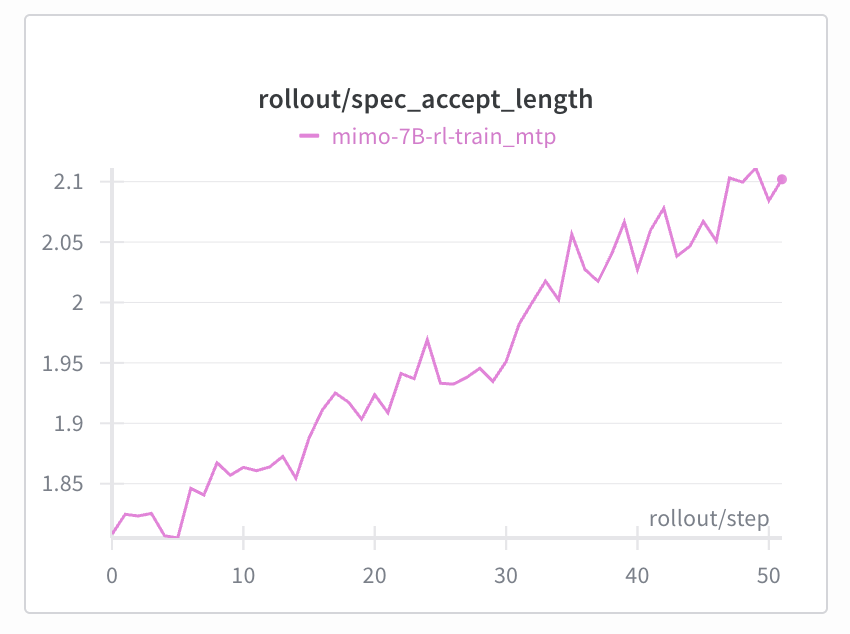
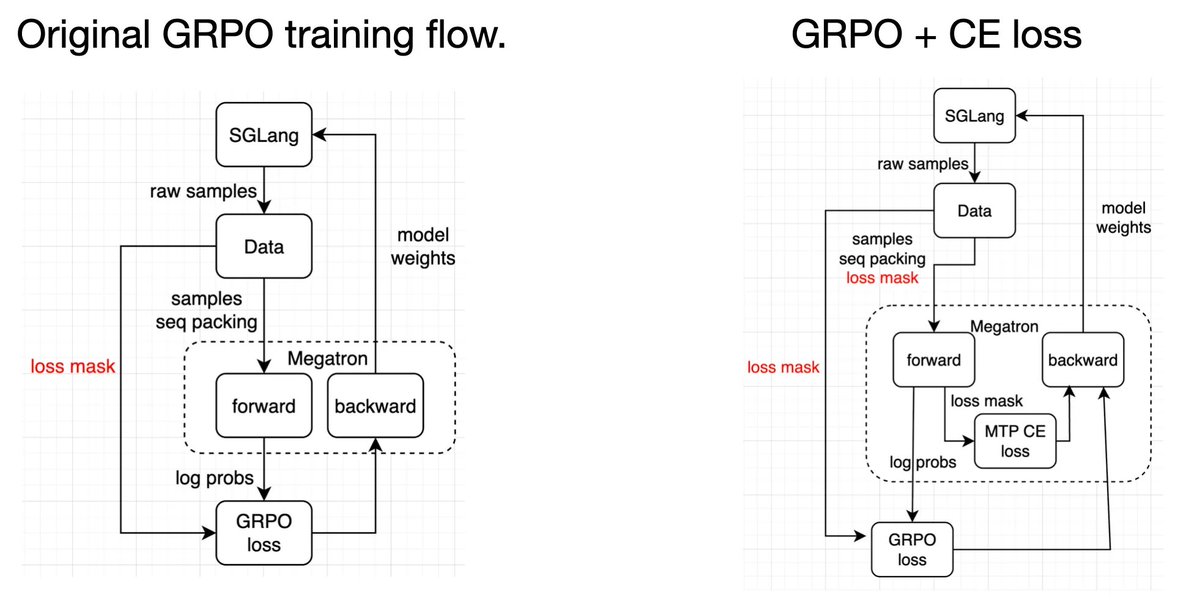
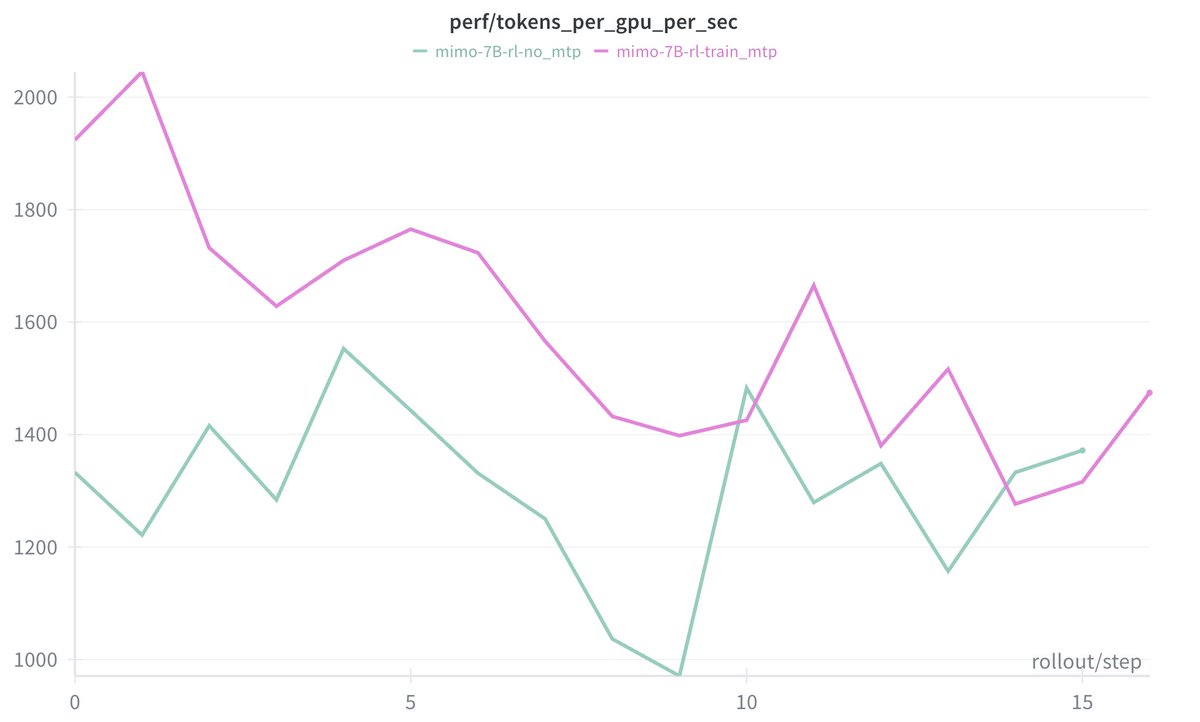
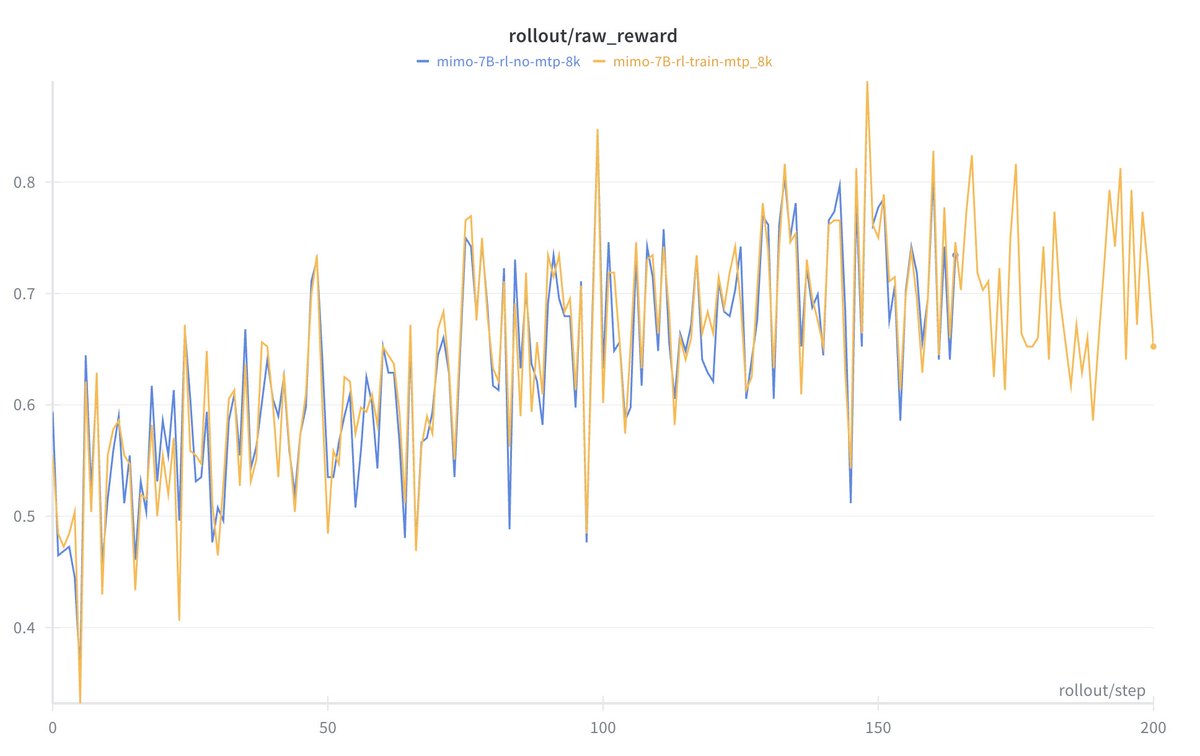
We introduce speculative decoding into the RL sampling process, achieving a significant improvement in sampling speed under appropriate batch sizes. Compared to freezing the draft model, the accepted length maintain at a high level, generating long-term stable positive gains.
Chayenne Zhao tweet mediaChayenne Zhao tweet mediaChayenne Zhao tweet mediaChayenne Zhao tweet media
English
4
29
219
24K
Rohan Varma
Rohan Varma@rvarm1·
TIL PyTorch was almost shut down 😮
Deedy@deedydas

If you feel like giving up, you must read this never-before-shared story of the creator of PyTorch and ex-VP at Meta, Soumith Chintala. > from hyderabad public school, but bad at math > goes to a "tier 2" college in India, VIT in Vellore > rejected from all 12 universities for US masters despite 1420 on the GRE > fuckit.jpg > goes to the US anyway on a J-1 visa to CMU with no plan > applies for masters (again) to 15 universities > rejected from all except USC and with late admissions, NYU in 2010 > finds this guy called Yann LeCun (before he was famous) > starts getting into open source > rejected from all jobs including DeepMind > only job is Amazon as test engineer > his PhD mentor helps him get a job at a small startup (MuseAmi) > rejected from DeepMind > couldn't get H-1B because of J-1 home return issue; gets waiver through months of approval with USCIS and US State Dept > very low on confidence > In 2011/12 builds one of the fastest AI inference engines on phones > rejected from DeepMind > emailed Yann again and joins FAIR because of Torch7 open-source work > scrapes through bootcamp at Facebook, struggling on an HBase task > L8/L9 engineers at Facebook struggle to get ImageNet working > figures out numerics / hyperparam issue as an L4 > first big win! > FAIR goes well, runs 3 person torch7 team and co-creates PyTorch > because of politics, management wants to shut down PyTorch > cries-at-bar.jpg, literally > eventually some people save PyTorch and it launches in 2017 > gets a EB-1 green card! > the rest is history... Think about that. He went to a tier 2 college. Was rejected from all Masters programs 2x. Rejected from every single job except Amazon test engineering. Rejected from DeepMind 3x. Nearly had his baby project shut down. Struggled with visa issues. After 12 years of failures (2005-17), he eventually rose to became a VP at Meta one of the most influential people in AI! Soumith's story is one of resilience and he's living proof that no matter how down in the dumps you are, there's always hope.

English
0
0
1
399
Rohan Varma retweetledi
Andrej Karpathy
Andrej Karpathy@karpathy·
I took delivery of a beautiful new shiny HW4 Tesla Model X today, so I immediately took it out for an FSD test drive, a bit like I used to do almost daily for 5 years. Basically... I'm amazed - it drives really, really well, smooth, confident, noticeably better than what I'm used to on HW3 (my previous car) and eons ahead of the version I remember driving up highway 280 on my first day at Tesla ~9 years ago, where I had to intervene every time the road mildly curved or sloped. (note this is v13, my car hasn't been offered the latest v14 yet) On the highway, I felt like a passenger in some super high tech Maglev train pod - the car is locked in the center of the lane while I'm looking out from Model X's higher vantage point and its panoramic front window, listening to the (incredible) sound system, or chatting with Grok. On city streets, the car casually handled a number of tricky scenarios that I remember losing sleep over just a few years ago. It negotiated incoming cars in tight lanes, it gracefully went around construction and temporarily in-lane stationary cars, it correctly timed tricky left turns with incoming traffic from both sides, it gracefully gave way to the car that went out of order in the 4-way stop sign, it found a way to squeeze into a bumper to bumper traffic to make its turn, it overtook the bus that was loading passengers but still stopped for the stop sign that was blocked by the bus, and at the end of the route it circled around a parking lot, found a spot and... parked. Basically a flawless drive. For context, I'm used to going out for a brief test drive around the neighborhood to return with 20 clips of things that could be improved. It's new for me to do just that and exactly like I used to, but come back with nothing. Perfect drive, no notes. I expect there's still more work for the team in the long march of 9s, but it's just so cool to see that we're beyond finding issues on any individual ~1 hour drive around the neighborhood, you actually have to go to the fleet and mine them. Back then, I processed the incredible promise of vehicle autonomy at scale (in the fully scaleable, vision only, end-to-end Tesla way) only intellectually, but now it is possible to feel it intuitively too if you just go out for a drive. Wait, of course surround video stream at 60Hz processed by a fully dedicated "driving brain" neural net will work, and it will be so much better and safer than a human driver. Did anyone else think otherwise? I also watched @aelluswamy 's new ICCV25 talk last week (x.com/aelluswamy/sta…) that hints at some of the recent under the hood technical components driving this progress. Sensor streams (videos, maps, kinematics, audio, ...) over long contexts (e.g. ~30 seconds) go into a big neural net, steering/acceleration comes out, optionally with visualization auxiliary data. This is the dream of the complete Software 1.0 -> Software 2.0 re-write that scales fully with data streaming from millions of cars in the fleet and the compute capacity of your chip, not some engineer's clever new DoubleParkedCarHandler C++ abstraction with undefined test-time characteristics of memory and runtime. There's a lot more hints in the video on where things are going with the emerging "robotics+AI at scale stack". World reconstructors, world simulators "dreaming" dynamics, RL, all of these components general, foundational, neural net based, how the car is really just one kind of robot... are people getting this yet? Huge congrats to the team - you're building magic objects of the future, you rock! And I love my car <3.
Ashok Elluswamy@aelluswamy

Full video of the ICCV '25 presentation

English
943
2.8K
27.6K
17.9M