Sabitlenmiş Tweet

we absolutely perfected the art of arbitrage but little else.
Sam Altman@sama
we look back at the period of zero percent interest rates and be astonished we didn't do more to take advantage of such an amazing opportunity
English
rvb
28.6K posts

@ryanvailbrown
This whole thing used to be a joke.
we look back at the period of zero percent interest rates and be astonished we didn't do more to take advantage of such an amazing opportunity


NEW: Billionaire Wealth Management in the Mega-Liquidity Era How to financially prepare for SpaceX IPO, Cerebras, Anthropic, OpenAI, & more.. With Marc Andreessen & Ben Horowitz's Multi-Family Office Chief Investment Officer, Michel Del Buono (@MDB_CIO) We cover: - How $50M–$1B+ personal portfolios are actually constructed & managed - Pre-liquidity planning - QSBS stacking strategies - Secondary market SPV risks - Trust & estate structuring - BDC liquidity gates - Tax loss harvesting - Real assets & depreciation Plus.. private jets? 𝐓𝐈𝐌𝐄𝐒𝐓𝐀𝐌𝐏𝐒 (00:00) Michel Del Buono, CIO at @a16z Perennial (01:05) The Billionaire office playbook (02:57) The 35% IRS trap (07:55) Multiply your QSBS benefits (11:48) Biggest Pre-liquidity mistakes (12:32) Why is diversifying a trap? (14:28) SPVs and Secondary traps (17:36) The cap table illusion (19:57) How does SPV carry actually work? (22:53) The SPV operator who fled (24:33) The private credit trap (28:38) Why endowments dump VC? (32:19) Public demand for private tech (35:08) Racing for AI equity (36:20) The data center tax loophole (39:36) The golden visa play (40:35) New York’s wealth tax (45:42) Shield your income with real assets (50:25) The Billionaire spending mindset (53:39) Buying vs Chartering jets (55:31) Dodging NGO scams

In our latest video, @dagsen scours the great city of San Francisco looking for its most confusing AI billboard. Then he gives the winner a trophy. 00:26 The rules 00:48 Telnux 01:12 The tier breakdown 01:34 Lambda, Slash, Omneky 02:15 Asking the public 02:46 Framer 03:09 Campfire 03:43 Atlassian Rovo, ChatGPT, and Codex 04:30 Asking the public about Vercel’s billboard 05:07 SF’s gold rush history and Google Gemini 05:42 Replit 06:03 Airwallex 06:22 Vanta 06:37 Apollo 07:08 Corgi 07:31 Stripe 07:58 Speakeasy 08:24 Mercury 08:40 Deel 08:57 Asking the public about Graphite 10:18 Outset.ai 10:37 Awarding our Most Confusing trophy
Are teens too scared of AI? We tried to figure that out.
Introducing: Soon. A new media company covering the machines, minds, and subcultures of tech's new frontier. Here's a preview of what's to come. Our first documentary, featuring never-before-seen access to @RainmakerCorp's weather modification tech, drops Friday.



Nobody is telling you how FUCKED New York City's infrastructure actually is right now. Everyone is watching the flood footage. The cars underwater. The subway stations turned into swimming pools. Nobody is talking about the fact that six inches of rain just paralyzed a global city. Not a hurricane. Not a once-in-a-century storm. Six inches. In a few hours. And the Long Island Expressway shut down in both directions. The F train suspended. Flash flood warnings across every borough. By rain. → Cost of fixing this: deferred for decades → Cost of not fixing it: the entire city grinds to a halt → That is not a weather problem. That is a maintenance problem. NYC's catch-basin cleaning fleet was 63% out of service during prior storms. By end of 2023 it was 77% out of service. The city had 19 functional trucks for five boroughs. Nineteen trucks. For eight million people. 💀 Here's what nobody is explaining to you: This doesn't just change THIS storm. This changes ALL storms. Forever. → NYC has 7,400 miles of combined storm and sewer pipes that back up the moment rainfall exceeds capacity → Many of those pipes are over 100 years old — built before cars existed, let alone SUVs and modern runoff volumes → Fewer than half of the city's 964 priority catch basins were inspected before recent storms hit → This exact same thing happened in 2023. And 2025. Same expressway. Same subway lines. Same excuses. → The city knows which drains are clogged. They have a data-driven priority list. → They just don't have the trucks to clean them. → So every time it rains hard, the same streets flood, the same trains stop, the same headlines run. → And then nothing changes until the next storm proves it again. The source tweet said it directly: "Six inches of rain shouldn't do this to a major city, but clogged drains and years of deferred maintenance will." That's not a weather forecast. That's a confession. New York spent decades deferring the maintenance bill. May 21, 2026 is what the invoice looks like. Bookmark this. You're watching the biggest infrastructure failure since the last time it rained. I'll keep you updated. Turn on notifications. 🚨


I talked to Versant CEO Mark Lazarus about turning a cable TV company into something else - and why he's not buying Vox Media's podcast business. (Btw Versant owns a piece of Vox)

The Ordinary is launching a free NYC bus line between Domino Park in Williamsburg and Prospect Park, cutting out the irritation of having to travel through Manhattan just to get between two parts of Brooklyn. The limited-run shuttle operates May 26 through June 9.
The number of AI companies in one building in Williamsburg is crazy. And we have the best view!


Update here: I hear Sam is joining New York Magazine
The vibes in SF feel pretty frenetic right now. The divide in outcomes is the worst I've ever seen. Over the last 5yrs, a group of ~10k people - employees at Anthropic, OpenAI, xAI, Nvidia, Meta TBD, founders - have hit retirement wealth of well above $20M (back of the envelope AI estimation). Everyone outside that group feels like they can work their well-paying (but <$500k) job for their whole life and never get there. Worse yet, layoffs are in full swing. Many software engineers feel like their life's skill is no longer useful. The day to day role of most jobs has changed overnight with AI. As a result, 1. The corporate ladder looks like the wrong building to climb. Everyone's trying to align with a new set of career "paths": should I be a founder? Is it too late to join Anthropic / OpenAI? should I get into AI? what company stock will 10x next? People are demanding higher salaries and switching jobs more and more. 2. There’s a deep malaise about work (and its future). Why even work at all for “peanuts”? Will my job even exist in a few years? Many feel helpless. You hear the “permanent underclass” conversation a lot, esp from young people. It's hard to focus on doing good work when you think "man, if I joined Anthropic 2yrs ago, I could retire" 3. The mid to late middle managers feel paralyzed. Many have families and don't feel like they have the energy or network to just "start a company". They don't particularly have any AI skills. They see the writing on the wall: middle management is being hollowed out in many companies. 4. The rich aren’t particularly happy either. No one is shedding tears for them (and rightfully so). But those who have "made it" experience a profound lack of purpose too. Some have gone from <$150k to >$50M in a few years with no ramp. It flips your life plans upside down. For some, comparison is the thief of joy. For some, they escape to NYC to "live life". For others still, they start companies "just cuz", often to win status points. They never imagined that by age 30, they'd be set. I once asked a post-economic founder friend why they didn't just sell the co and they said "and do what? right now, everyone wants to talk to me. if i sell, I will only have money." I understand that many reading this scoff at the champagne problems of the valley. Society is warped in this tech bubble. What is often well-off anywhere else in the world is bang average here. Unlike many other places, tenure, intelligence and hard work can be loosely correlated with outcomes in the Bay. Living through a societally transformative gold rush in that environment can be paralyzing. "Am I in the right place? Should I move? Is there time still left? Am I gonna make it?" It psychologically torments many who have moved here in search of "success". Ironically, a frequent side effect of this torment is to spin up the very products making everyone rich in hopes that you too can vibecode your path to economic enlightenment.

Sea Ranch on film



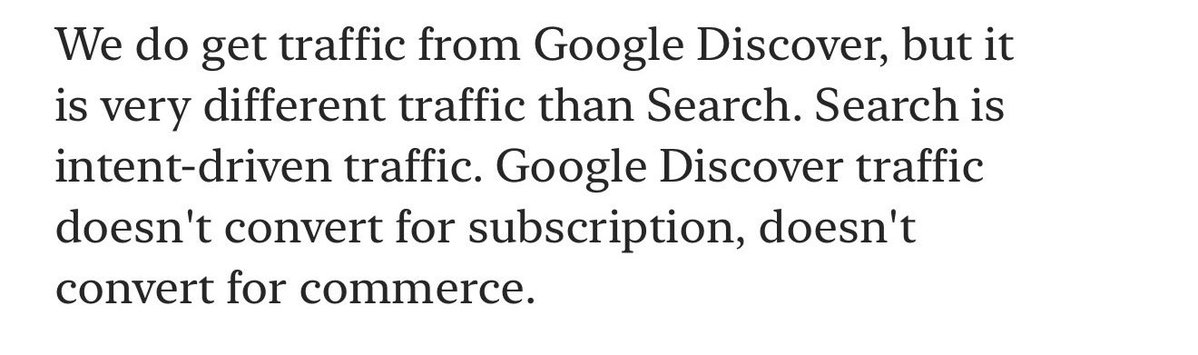
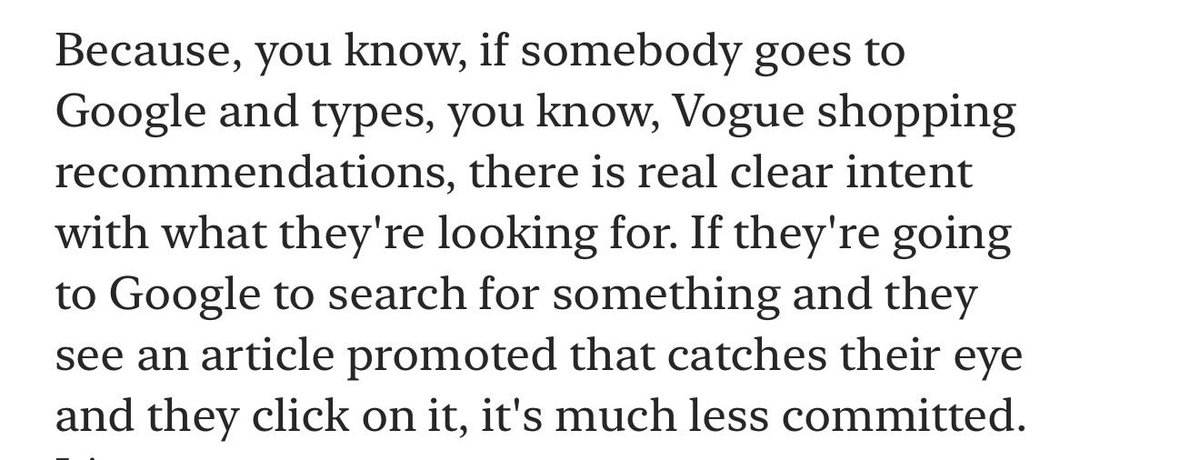
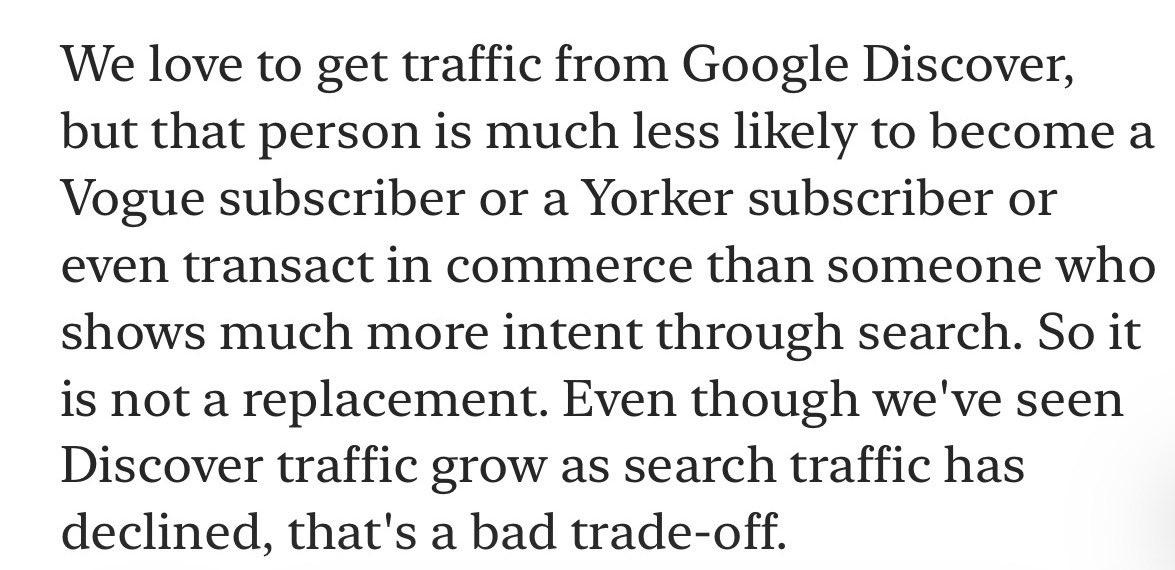
After several years of declining search traffic, Condé Nast CEO @rogerlynch has directed all the company's brands to operate as if search traffic to their properties will be zero. He says the era of turning search and social media traffic into profitable businesses is gone. And that if you run a media business that doesn't have an authoritative brand, a very strong niche, or a direct audience, you're going to be fighting hostile algo changes all the way down. He describes a recent board meeting: "We took a snapshot of search results from seven or eight years ago. And what you saw were a few sponsored links, then the ten blue links." "Do the same search today, you get an AI overview, then you get rows and rows and rows of commerce links, then you get sponsored stuff." "Each of the last three years, we would do our budgets, and we'd put forecasts in of search traffic declining. Because we'd seen the pattern of algorithm changes. And generally those algorithm changes were negative." "Every year, our search traffic was down more than we had forecast. So last year I told our teams, 'Assume there's no search.' You have to have your businesses planned as if search is zero. We don't expect it to be zero, we expect it to be a single-digit percentage of our traffic."