Aaditya Salgarkar

112 posts

Aaditya Salgarkar

Aaditya Salgarkar

@salgarkarap

https://t.co/ABlJ2qKYvx

Bangalore Katılım Ekim 2009
420 Takip Edilen169 Takipçiler
Sabitlenmiş Tweet
Aaditya Salgarkar
Aaditya Salgarkar@salgarkarap·
All dichotomies are false.
English
0
0
3
445
Aaditya Salgarkar retweetledi
Alvaro Lozano-Robledo
Alvaro Lozano-Robledo@mathandcobb·
Following up on the suggestion from Will Sawin, here is an illustration of the new configurations that disprove Erdos' unit distance conjecture (made with the help of ChatGPT 5.5 Thinking).
Alvaro Lozano-Robledo tweet media
Julian Bruns@BrunsJulian1541

@mathandcobb an explicit drawing doesnt seem possible, but maybe the last paragraph satisfies your request. (its essentially a projection of the lattice construction in another field into R^2)


English
114
241
2.7K
1.9M
FPV Labs
FPV Labs@fpv_labs·
Introducing Project Stera by FPV Labs, an open data infra for embodied AI research. Project Stera includes Stera-10M, with 10M+ frames of long-horizon data with persistent state tracking, and an open-source pipeline that converts raw data into training-ready formats.
English
18
38
130
12.2K
QC
QC@QiaochuYuan·
funnily enough the deeper you go into mathematics the more suspicious negative numbers seem. it becomes increasingly meaningful that there's no such thing as, like, -1 apples, as they say. addition is very straightforward but subtraction is surprisingly often bizarre black magic i can't think of a really simple example but here's a calculus example. so the taylor series of e^x goes e^x = 1 + x + x^2/2! + x^3/3! + ... and so forth. when x is positive this is all fine and dandy, each of these individual terms is an increasing function and you add them up and you get a really quickly increasing function, an exponential curve when x is negative something really strange happens. e^x decreases as you get negative, e^{-10} is really small, e^{-100} is tiny. but the individual terms of the taylor series are getting much larger! the taylor series expansion e^{-100} = 1 - 100 + 100^2/2! - 100^3/3! +-... results in a number whose decimal expansion starts with 44 zeroes, it is absolutely tiny. and yet the largest term in the taylor series expansion (it's a nice exercise to figure out what term this is and why, take a few seconds to try before reading on) is 100^100 / 100! which is a 1 followed by 42 digits it's almost a googol times bigger than the final result! which means this whole taylor series expansion involves a really insane amount of very precise cancellation, even though if you didn't know this was the taylor series expansion of e^x you'd have no way of knowing this a priori and it wouldn't be remotely obvious staring at the series from first principles
davidad 🎇@davidad

It seems odd that there’s a rough societal consensus that 1+x=0 needs to have a solution—and that it’s not just an imaginary number to appease the accountants—but 1+x²=0 need not have a solution, unless it’s an imaginary number to appease the physicists and electrical engineers.
English
54
54
1.1K
142K
Aaditya Salgarkar retweetledi
Surya Ganguli
Surya Ganguli@SuryaGanguli·
Just wanted to point out that recent geopolitical events provide a pedagogical example for teaching the max-flow min-cut theorem.
English
10
22
242
27.2K
Aaditya Salgarkar
Aaditya Salgarkar@salgarkarap·
Gromov argues that Chomsky’s claim, “there is no such thing as the probability of a sentence,” is not actually in tension with LLM next-token prediction. With the context of prior tokens and a relatively small vocabulary, the model’s probability space becomes 'homogeneous'.
English
1
0
1
87
Aaditya Salgarkar
Aaditya Salgarkar@salgarkarap·
A neat way to think about LLM training is as working over the full [B, S, D] tensor: attention mixes S, FFNs mix D, GRPO mixes B.
English
0
0
3
43
Aaditya Salgarkar retweetledi
Abhishek Anand
Abhishek Anand@levelheaded_94·
After 8 months of building in stealth and testing our infrastructure on 10000+ hours of real-world data and hundreds of unique environments, we're bringing @fpv_labs into the open today. FPV Labs started with the following bet - if human data proves to be the underlying factor that determines scaling laws in general-purpose robotics, it will trigger the largest economic transformation in human history, and the underlying infrastructure that captures that data will determine how fast we get there. We will achieve this by building the full-stack infrastructure for capturing, processing, transferring, and evaluating human experience into spatial, temporal, and semantic knowledge for machines. Despite all the research novelty behind ChatGPT, its success can be attributed to one foundational fact - the scaling law of transformers. We believe the same dynamics have made their way into robotics. Recent studies showed task completion rates jumping from 30% to 70% when human demonstration data scaled from 1,000 to 20,000 hours, a log-linear trend that mirrors exactly what we saw in language and vision. Seeing these emergent signs of scaling law curves in robotics, we believe we are entering the era of general-purpose robotics policies, which makes the next few years the most exciting time in the history of this field. But the library of physical interactions required to train general-purpose robot policies does not exist yet. Over the last 8 months, we've seen dozens of companies emerge in this space. We were really happy to see new companies pushing this space forward, but we also saw the same pattern repeat: every egocentric data company was making some tradeoffs between quality, scale, and diversity. We have built FPV labs on the core principle that high-quality data is orders of magnitude more valuable than sheer volume. Case in point, self-driving cars collect thousands of hours of data per day, but only a small fraction of that data is actually useful for training better models. Several studies, like RT-2, have shown that as little as 1% of data improves as much as 25% on task success. The quality and diversity of data matter a lot more than scale, so there is clearly a power law curve in the downstream impact of data. We've spent months obsessing over data quality by building our stack, discarding it, rebuilding it, and iterating until we found a formula that doesn't compromise downstream quality at scale. We believe the downstream impact here is far more profound than most people realize. Workers globally are paid around $60 trillion per year in aggregate, and a lion's share of that compensation goes to physical labor - tasks that require navigating real spaces, manipulating real objects, and negotiating the infinite variability of the physical world. Human-to-robot transfer will be one of the most important infrastructures that will shape our society in the near future, and if it works, the economic impact will dwarf every technology transition that came before it in an exponential manner and lead to the creation of goods and services we can’t imagine today. Our mission is to lay the groundwork for us to transition into this future - the future of abundance. We are deeply grateful to our earliest believers, @paraschopra and @lossfunk, who played a critical role in shaping our thinking.
English
71
84
718
80.2K
Andrej Karpathy
Andrej Karpathy@karpathy·
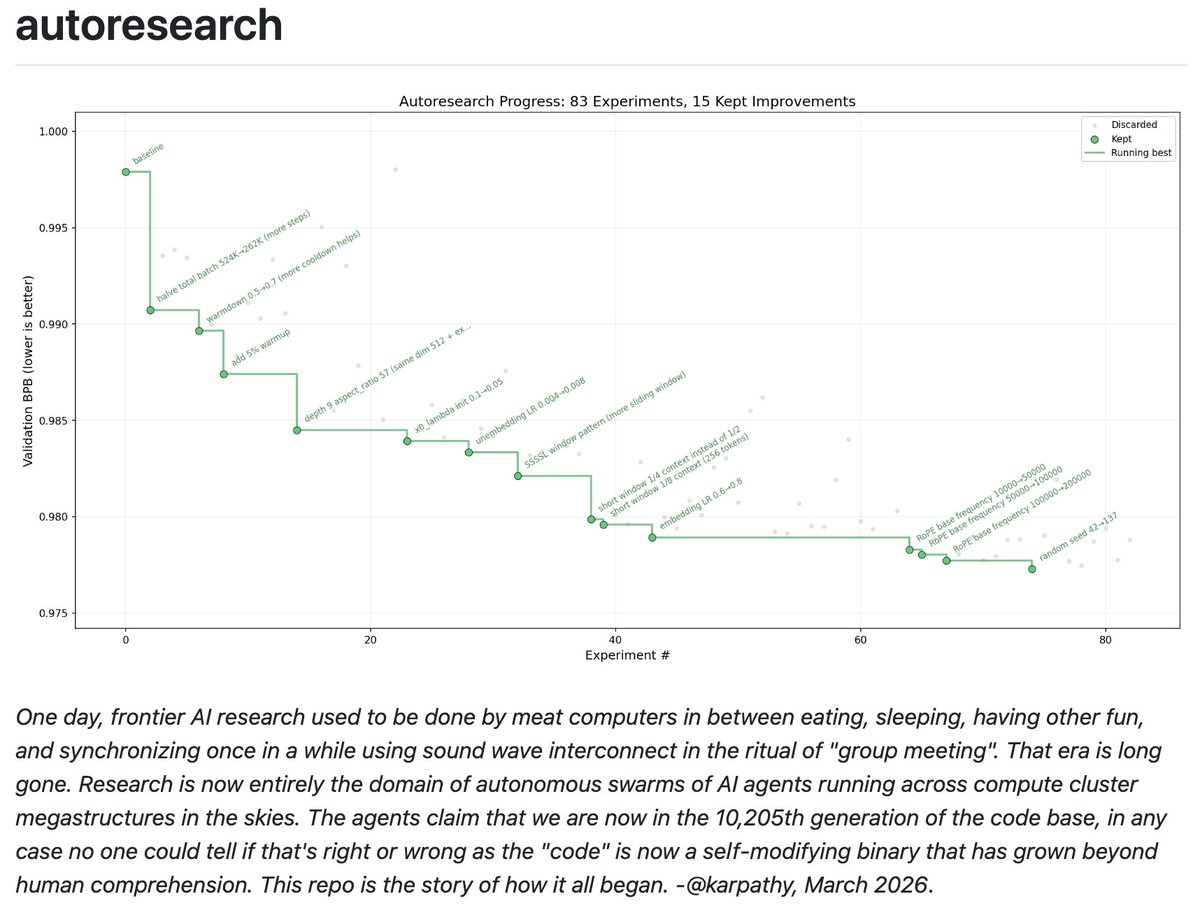
I packaged up the "autoresearch" project into a new self-contained minimal repo if people would like to play over the weekend. It's basically nanochat LLM training core stripped down to a single-GPU, one file version of ~630 lines of code, then: - the human iterates on the prompt (.md) - the AI agent iterates on the training code (.py) The goal is to engineer your agents to make the fastest research progress indefinitely and without any of your own involvement. In the image, every dot is a complete LLM training run that lasts exactly 5 minutes. The agent works in an autonomous loop on a git feature branch and accumulates git commits to the training script as it finds better settings (of lower validation loss by the end) of the neural network architecture, the optimizer, all the hyperparameters, etc. You can imagine comparing the research progress of different prompts, different agents, etc. github.com/karpathy/autor… Part code, part sci-fi, and a pinch of psychosis :)
Andrej Karpathy tweet media
English
1.1K
3.6K
28.4K
11.1M
Aaditya Salgarkar retweetledi
Rohan Pandey
Rohan Pandey@khoomeik·
apparently Faraday began his research career in metallurgy, not in electromagnetism (which he later revolutionized) his first project was studying Wootz, south india's high-carbon steel used in damascus blades
Rohan Pandey tweet media
English
3
54
298
6.4K
Suhail
Suhail@Suhail·
Reading plans from claude code in terminal is super not fun. I don't get how y'all are using it in terminal all the time vs something like Cursor that generates a nice readable markdown file.
English
303
19
770
127.1K
Bojan Tunguz
Bojan Tunguz@tunguz·
I would often get some really cynical, negative, demoralizing comments on my posts. Based on my informal survey, the majority of such comments come from Poles. It was also true of a few in person interactions. Don’t know what to make of it.
Bojan Tunguz tweet media
English
9
1
6
3.3K
Aaditya Salgarkar
Aaditya Salgarkar@salgarkarap·
Word
Alexander Granin@graninas

Sending messages by 'Enter' is idiotic. You can't change my mind on this. It's one of the most dangerous UI/UX misfeatures that have taken over our tools in the last decade, all in favor of misconceptions about "stupid users" who supposedly need care from patronizing corps. Fire all UI/UX designers. They are useless. They are dangerous. Bring back non-moving, non-behaving fixated and stable UIs we had in the 90's and 00's. Stop shuffling things right under my cursor when I least expect this. Things on the screen must not shuffle and jump randomly. They just mustn't. Stop shuffling things I carefully arranged for myself. No UI should change unless I explicitly allow this. Stop all the animations. They only consume my attention and time. Stop non-idempotent undo actions. If I typed 3 characters "wor", backspace should remove them one-by-one in reverse order, exactly as they were typed. Not the whole word, and not what was added by autocompletion I never asked for. If I type, I erase exactly what I typed, in exact order, and nothing more, and nothing less. Stop accelerating text deletions in mobile UIs when backspace is held down. I want to erase my latest characters, not entire paragraphs you stupid UI (or rather that terrorist who invented this). Stop loading websites as ever-changing, two-dimensional ribbons that jump around the screen before they’ve even finished loading. You won't believe how much of this drains brainpower and produces unhealthy frustrations worldwide. This frustration then channels itself in unexpected ways we, as a society, don’t really want. We need to rebuild everything in IT that was corrupted during these misguided years, with the principle that software should fit the user like normal clothing, not like ever-changing BDSM gear the user must fit into.

English
0
0
0
171
Nilesh Trivedi
Nilesh Trivedi@nileshtrivedi·
Shell makes it trivial to build human-in-the-loop. If you have to put the agent on the web, it takes a lot more work (unless one's using Phoenix 😁) One key pattern seems to be missing in Python/Elixir though: LLMs doing arbitrary code snippet execution in a sandbox, instead of calling one tool at a time. @KentonVarda recently wrote about doing this with V8 isolates. Would be great to have it adopted beyond Javascript.
English
2
0
2
289
Chris McCord
Chris McCord@chris_mccord·
I've been saying all year that giving the agent a shell + the file system removes mountains of complex abstractions. Glad to see some return to basic stuff that works proving itself out x.com/barry_zyj/stat…
Barry Zhang@barry_zyj

@simonw Skills actually came out of a prototype I built demonstrating that Claude Code is a general-purpose agent :-) It was a natural conclusion once we realized that bash + filesystem were all we needed

English
5
1
57
7.1K
Rishi Mehta
Rishi Mehta@rishicomplex·
Out of the box thinking
Rishi Mehta tweet media
English
3
0
5
947
Nilesh Trivedi
Nilesh Trivedi@nileshtrivedi·
I googled "Lean meetup in Bangalore" and only found "Lean startup" & "Lean In" communities. 🤦‍♂️ Anybody interested in an in-person @leanprover workshop? I really think more people should be fluent in the language that's driving AI in math and science.
English
4
1
28
6.4K