Abhishek Anand

1.8K posts

Abhishek Anand banner
Abhishek Anand

Abhishek Anand

@levelheaded_94

cofounder and ceo @fpv_labs

Katılım Mart 2021
2.9K Takip Edilen6.6K Takipçiler
Sabitlenmiş Tweet
Abhishek Anand
Abhishek Anand@levelheaded_94·
After 8 months of building in stealth and testing our infrastructure on 10000+ hours of real-world data and hundreds of unique environments, we're bringing @fpv_labs into the open today. FPV Labs started with the following bet - if human data proves to be the underlying factor that determines scaling laws in general-purpose robotics, it will trigger the largest economic transformation in human history, and the underlying infrastructure that captures that data will determine how fast we get there. We will achieve this by building the full-stack infrastructure for capturing, processing, transferring, and evaluating human experience into spatial, temporal, and semantic knowledge for machines. Despite all the research novelty behind ChatGPT, its success can be attributed to one foundational fact - the scaling law of transformers. We believe the same dynamics have made their way into robotics. Recent studies showed task completion rates jumping from 30% to 70% when human demonstration data scaled from 1,000 to 20,000 hours, a log-linear trend that mirrors exactly what we saw in language and vision. Seeing these emergent signs of scaling law curves in robotics, we believe we are entering the era of general-purpose robotics policies, which makes the next few years the most exciting time in the history of this field. But the library of physical interactions required to train general-purpose robot policies does not exist yet. Over the last 8 months, we've seen dozens of companies emerge in this space. We were really happy to see new companies pushing this space forward, but we also saw the same pattern repeat: every egocentric data company was making some tradeoffs between quality, scale, and diversity. We have built FPV labs on the core principle that high-quality data is orders of magnitude more valuable than sheer volume. Case in point, self-driving cars collect thousands of hours of data per day, but only a small fraction of that data is actually useful for training better models. Several studies, like RT-2, have shown that as little as 1% of data improves as much as 25% on task success. The quality and diversity of data matter a lot more than scale, so there is clearly a power law curve in the downstream impact of data. We've spent months obsessing over data quality by building our stack, discarding it, rebuilding it, and iterating until we found a formula that doesn't compromise downstream quality at scale. We believe the downstream impact here is far more profound than most people realize. Workers globally are paid around $60 trillion per year in aggregate, and a lion's share of that compensation goes to physical labor - tasks that require navigating real spaces, manipulating real objects, and negotiating the infinite variability of the physical world. Human-to-robot transfer will be one of the most important infrastructures that will shape our society in the near future, and if it works, the economic impact will dwarf every technology transition that came before it in an exponential manner and lead to the creation of goods and services we can’t imagine today. Our mission is to lay the groundwork for us to transition into this future - the future of abundance. We are deeply grateful to our earliest believers, @paraschopra and @lossfunk, who played a critical role in shaping our thinking.
English
72
82
716
81.7K
Abhishek Anand
Abhishek Anand@levelheaded_94·
Excited to fully open source the entire Stera stack today. Stera 1.0 open-sourced the Stera SDK, which included the processing pipeline and evaluation. Stera 2.0 now opens the capture stack, thereby closing the full loop and making the entire RGB-D stack available to anyone. Leveraging commodity devices capable of generating high-fidelity robotics data is the fastest way to solve the robotics data gap.
FPV Labs@fpv_labs

x.com/i/article/2082…

English
1
2
12
576
Abhishek Anand retweetledi
Paras Chopra
Paras Chopra@paraschopra·
Here’s some unsolicited advice to the government on what to do to help boost India’s sovereign model story. 1. Mandate domestic models for all non-critical functions Government needs to be a guaranteed buyer for homegrown models. There are tons of applications that don’t require SOTA performance. (To be clear, for mission-critical use-cases, using anything other than SOTA would be a shortsighted decision) China got ahead because of their domestic demand (Anthropic and OpenAI models don’t work there). 2. Release massive distillations of chain-of-thought of SOTA Chinese models on diverse prompts (and post-process to remove China bias) Inference is easy and cheap. So the government should simply create a national public repository of SOTA reasoning chains in order to prevent each model creator doing it separately. Centralize and absorb the cost. Thinking Machines (US company) did finetuning on Kimi 2.5 to bootstrap reasoning. Indian model companies would do the same, and government can help by footing the bill. 3. Procure diverse RL environments and release them publicly Modern frontier models train on 100k+ RL environments having 10s of tasks each. These RL environments are driving most of the progress. Model companies pay billions of dollars for procuring them. Government should simply centralize and absorb this cost. 4. Give full travel sponsorship to Indian authors with A* conference accepts If an Indian gets into NeurIPS, ICML, ICLR main conference, simply sponsor them to attend the conference to present their paper. It’s rounding error in govt’s budget as ~100 Indian papers get into such conferences (0.3-0.5% of papers are Indian primary authors), but would go a long way in establishing a culture of basic R&D which is required to go beyond the frontier in next 5-10 years.
English
51
112
813
56.5K
Harsha Bommana
Harsha Bommana@harshablast·
There are two primary ways to train your robot; I) Imitation Learning, II) Reinforcement Learning. The former needs a lot of data, either teleop or human (with a rig), which is expensive and unscalable. Plus IL tends to be a brittle training approach. The latter requires something harder - physics-accurate simulation environments. We don't really have any way to create an accurate sim environment automatically, we usually have to go through the manual 3D/Sim modelling route, or give up and use assets from omniverse or lightwheel. Today, that changes. We can help you get YOUR assets, YOUR scene, YOUR physics, into a sim in the fastest and easiest way possible. Now you can start training your robot in your specific environments as soon as possible. This is what we're building at Dirac Robotics. Robotics has never seen simplicity like this before! Let us know if there are any assets or scenes you need made! We'll get it done. Building this with @divyans1461 , @join_ef #robotics #physicalai
English
15
22
163
25.1K
Abhishek Anand
Abhishek Anand@levelheaded_94·
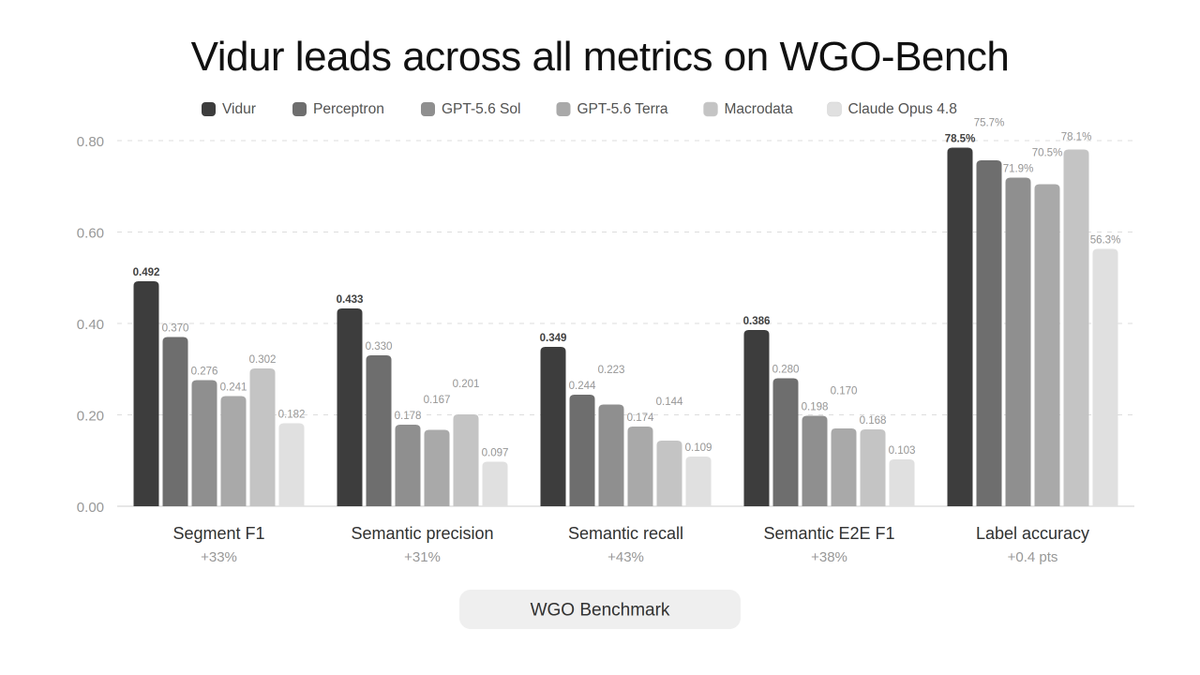
The robotics community is sleeping on Vidur. Language density is the cheapest lever for extracting more signals from a demonstration dataset. Vidur makes 3 core contributions - 1. An automatic dense annotation pipeline with state-of-the-art accuracy for dense action labels, including temporal action grounding, contact grounding, and spatial grounding 2. Empirical evidence of the accuracy with detailed evaluation across 2 diff benchmarks 3. Lowest processing cost per hour of data. DM open if you want to partner with us!
FPV Labs@fpv_labs

1/ Announcing Vidur, an end-to-end system to generate fine-grained action labels on raw robot and human videos. Vidur leads across all metrics on WGO and EgoExoLearn Bench across temporal segmentation, semantic precision, semantic recall, and end-to-end action-label quality 🧵

English
2
5
21
1.8K
Abhishek Anand
Abhishek Anand@levelheaded_94·
Have seen @_raghuvamsi @Mankaran32 @pr0t0_01 and team pour their heart and soul into building these cute mobile companion robots over the last year - robotics and entertainment will soon see an inflection point through companion robots and virtual IPs that enter the physical world and live and grow with humans - @eyecandyrobots is one of the few teams globally that are really well positioned to make this happen!
Runtime@RuntimeBRT

🚨 Eyecandy Robotics (@eyecandyrobots), a Bengaluru-based startup, has unveiled a series of robot characters. They plan to manufacture and sell their palm-sized tabletop robot, Piko, in 2027 at $200/unit. Eyecandy will also develop a line of larger robots for theme parks.

English
0
3
56
2.7K
Abhishek Anand retweetledi
Jensen Huang
Jensen Huang@JensenHuang·
For my first post, I’m sharing a letter @NVIDIA signed on why open models matter. AI will transform every industry, power every company, and be built by every country. Open models strengthen safety and cybersecurity, accelerate innovation and diffusion, and enable sovereignty. The world needs both frontier closed models and frontier open models. images.nvidia.com/pdf/Open-Weigh…
Jensen Huang tweet mediaJensen Huang tweet mediaJensen Huang tweet media
English
16.2K
29.8K
172.5K
64.5M
Abhishek Anand retweetledi
Nishant
Nishant@nishantchandna_·
Big milestone for robotics data pipelines🚀. Vidur tackles one of the field's toughest bottlenecks while achieving state-of-the-art performance across key benchmarks. Check out the blog !! @fpv_labs #robotics #data
FPV Labs@fpv_labs

1/ Announcing Vidur, an end-to-end system to generate fine-grained action labels on raw robot and human videos. Vidur leads across all metrics on WGO and EgoExoLearn Bench across temporal segmentation, semantic precision, semantic recall, and end-to-end action-label quality 🧵

English
0
1
6
281
Abhishek Anand retweetledi
FPV Labs
FPV Labs@fpv_labs·
1/ Announcing Vidur, an end-to-end system to generate fine-grained action labels on raw robot and human videos. Vidur leads across all metrics on WGO and EgoExoLearn Bench across temporal segmentation, semantic precision, semantic recall, and end-to-end action-label quality 🧵
FPV Labs tweet media
English
11
17
56
7.6K
Abhishek Anand
Abhishek Anand@levelheaded_94·
Excited to open up Vidur for robotics and data labs. Vidur achieves SOTA on WGO Bench and EgoExoLearn Bench and generates the highest-quality action labels at a fraction of the cost the market spends on action labels today.
FPV Labs@fpv_labs

1/ Announcing Vidur, an end-to-end system to generate fine-grained action labels on raw robot and human videos. Vidur leads across all metrics on WGO and EgoExoLearn Bench across temporal segmentation, semantic precision, semantic recall, and end-to-end action-label quality 🧵

English
2
2
13
838
Tanay Lohia
Tanay Lohia@TanayLohia1·
1/ A protein is a nanomachine - moving parts, does real work, changes shape to do its job. A gene editor is one of them: a molecular machine that hunts down a stretch of DNA and cuts it. We still borrow these machines from nature and tune them, because we don't understand them well enough to build our own. We started Mandrake to change that.
English
36
44
278
45.5K
Abhishek Anand
Abhishek Anand@levelheaded_94·
@TanayLohia1 Congratulations buddy! So excited to see you solving frontier problems from India for the world!
English
1
0
3
271
Shlok Khemani
Shlok Khemani@shloked·
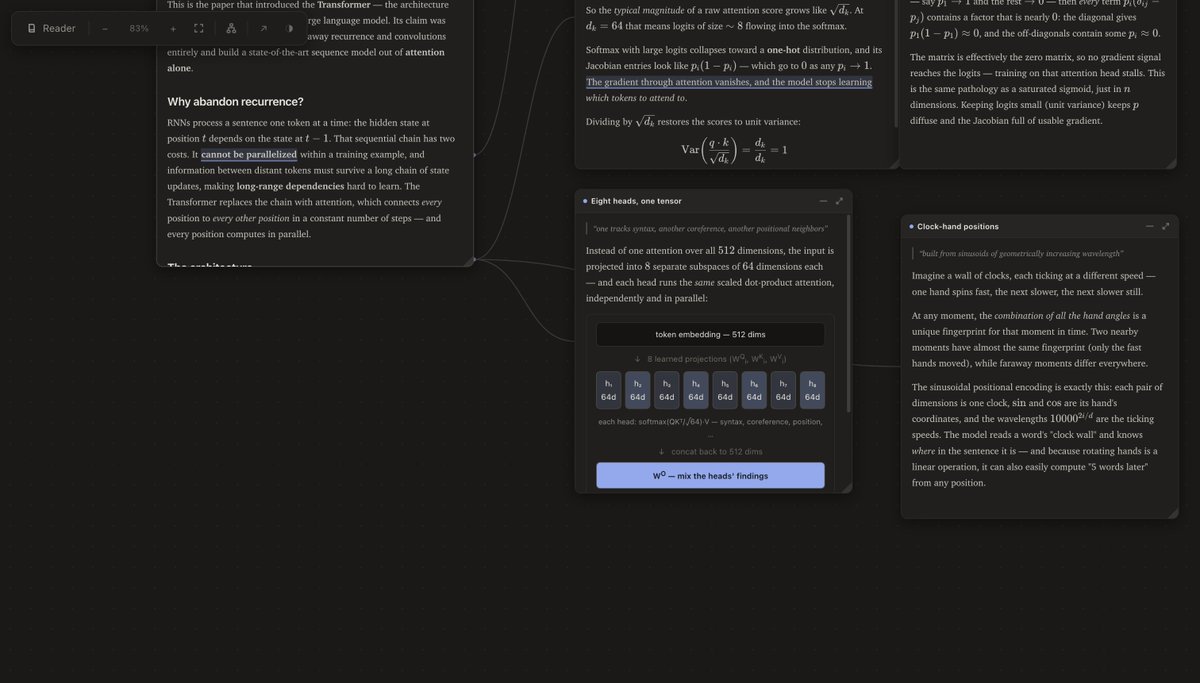
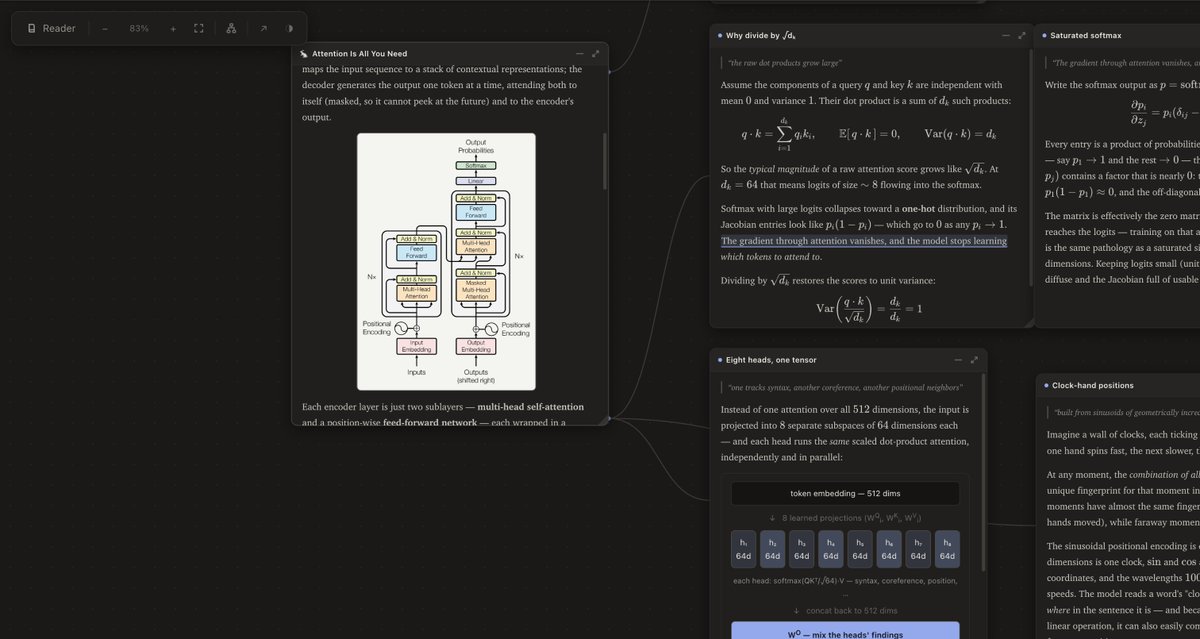
Ok, this got way more attention than I expected! Rabbithole v0.2 🐇 > open any PDF or arXiv paper > full LaTeX support > agents draw you diagrams (and not just prose)
Shlok Khemani tweet mediaShlok Khemani tweet mediaShlok Khemani tweet media
English
12
10
194
17.5K
Remi Cadene
Remi Cadene@RemiCadene·
Starting with the fundamentals Prototype Version 0 AI, Software, Hardware A small team, 9 months Designed and assembled in Paris at @UMA_Robots
English
85
122
875
238.2K
hari_haran
hari_haran@HariAyapps·
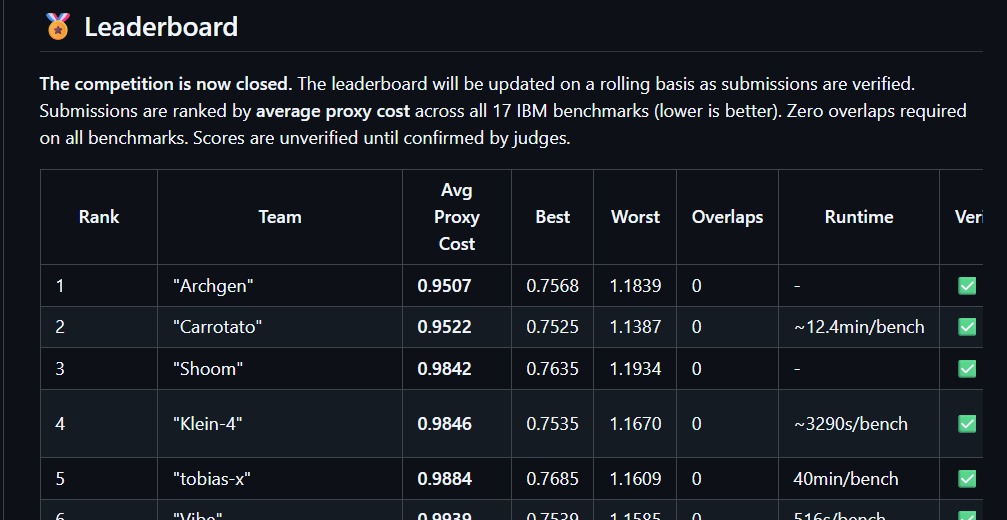
We built the best chip design engine in the world!! 🥳🥳 @archgen_ is currently ranked #1 on the @WeAreHRT / Partcl Macro Placement Challenge 2026 leaderboard. Macro placement is one of the hardest problems in physical design. It involves placing large fixed-size blocks such as SRAMs, IPs, and analog macros on a chip floorplan while balancing, wirelength, density, congestion, routability, timing and constraints. After months of research and iteration our submission reached a verified rank-1 with an average proxy cost of 0.9507 across the IBM benchmark suite. @naveen_venk and @JishnuMada86596 burned the midnight oil to build an optimization flow that combined fast local repair, multi-start search, congestion-aware ranking, GPU-accelerated candidate generation and strict legality checks to reach the top spot. (detailed blog in the comments) Grateful to Madhusudan S, Abhishek Lal, and Anant Gulati for their valuable suggestions and inputs to help us overcome issues in EDA algorithms, traditional macro placement algorithms and GPU optimisation. If you are working on physical design and want to understand how AI, self learning agents, loops, and GPU-accelerated optimisation can improve your flows please feel to reach out to us. Thank you @Willschips, Vamshi Balanaga and the Partcl team for organising this competition. #PhysicalDesign #EDA #ChipDesign #VLSI #AIforEDA #Semiconductors #Placement #ArchGen #HardwareDesign
hari_haran tweet mediahari_haran tweet media
GIF
hari_haran tweet media
English
55
41
297
27.7K