

Sam Kaufman
107 posts

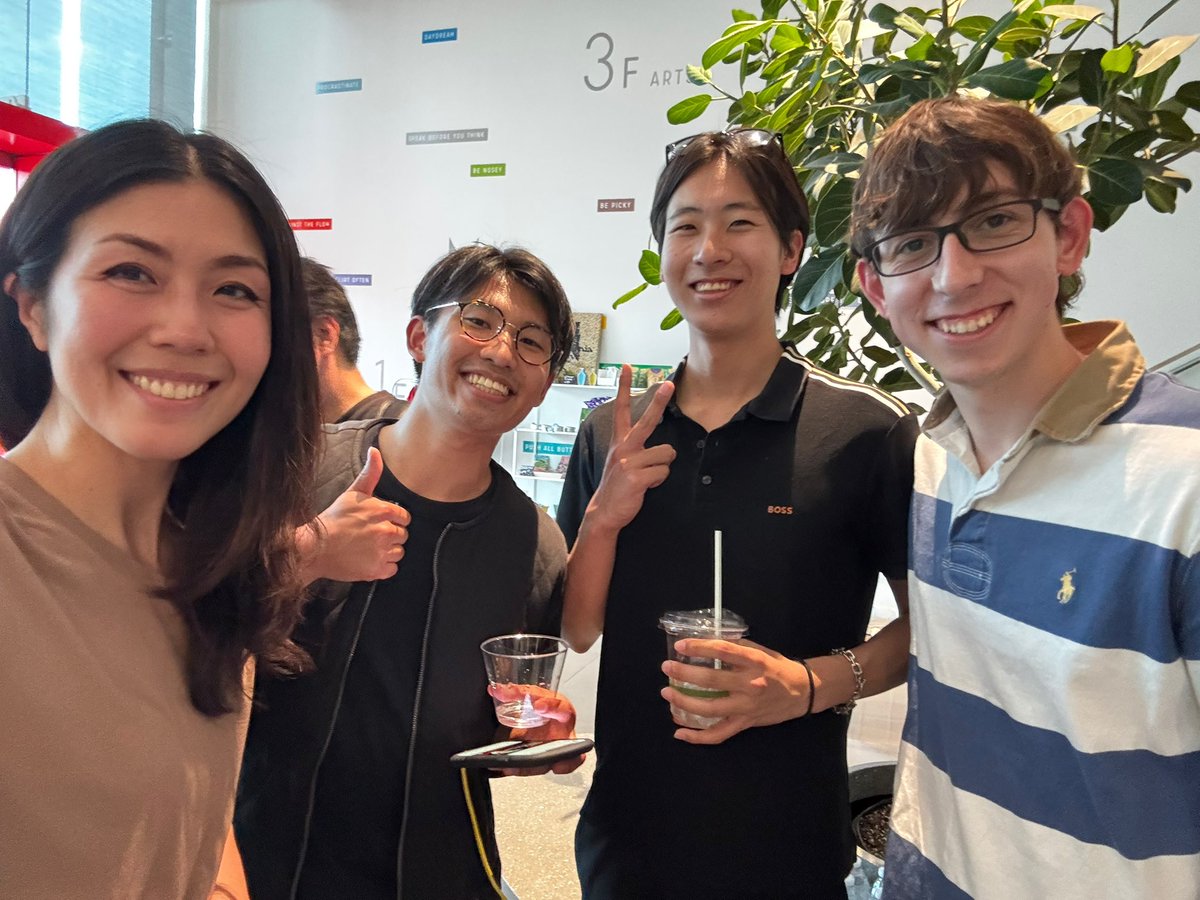
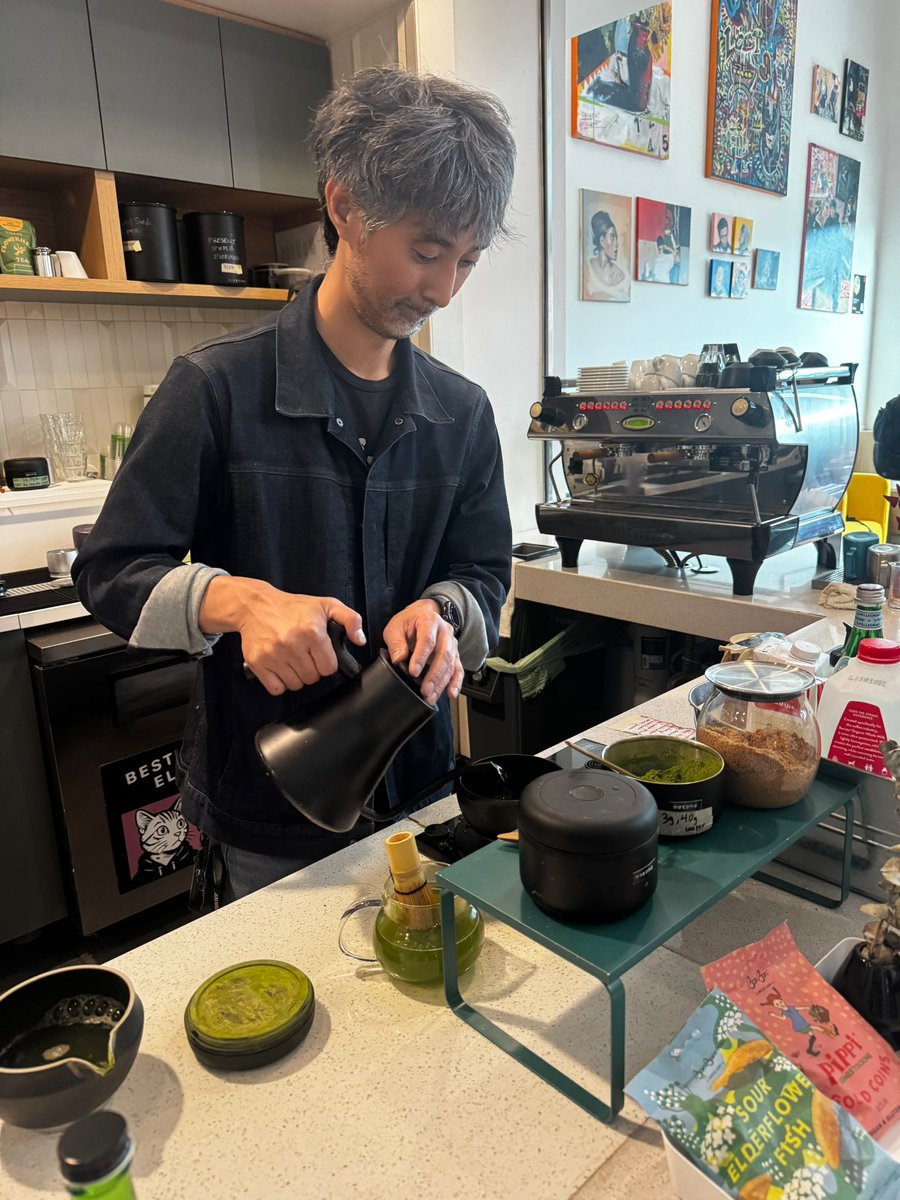
U.S. × Japan builders love affair happened IRL 🇺🇸🤝🇯🇵
Met killer Japanese founders building in the U.S.
And U.S. serial founders getting involved with Japan.
Bullish on U.S. × Japan
Rie Yano やのりえ@rieglobe
ok something interesting is happening… i’m getting a lot of inbound from founders + builders who want to build with Japan 🇯🇵 so should we make this real? US × Japan builder love affair in SF this weekend 🗓 sat or sun 5pm- Coral can sponsor drinks + light japanese food 🍶🍣 if you’re serious about US ↔ Japan builders + active investors you should be in the room. comment, share or DM. will lock if energy is there
English
@VirtualElena @GarettJones @elocinationn the Garden of Eden is a metaphor for x dot com the everything app and the apple is illegibility
English

English
sure NYT I believe that a “restaurant gap relationship” is not only a real thing but that a phenomenon that has only emerged in the past 5-10 years wrought by opportunistic opentable scrapers, private dining clubs, credit card points, concierge services, and nyc’s increasingly competitive restaurant scene is in fact “the ultimate test of compatibility”

English
English
@elocinationn actually come to think of it, original sin and the expulsion from Eden was the FIRST ever restaurant gap relationship
English
ok something interesting is happening…
i’m getting a lot of inbound from founders + builders who want to build with Japan 🇯🇵
so should we make this real?
US × Japan builder love affair in SF
this weekend
🗓 sat or sun 5pm-
Coral can sponsor drinks + light japanese food 🍶🍣
if you’re serious about US ↔ Japan
builders + active investors
you should be in the room.
comment, share or DM. will lock if energy is there
English

@jiratickets I bring a kind of yakiniku energy to the samgyeopsal function
English

Sam Kaufman retweetledi
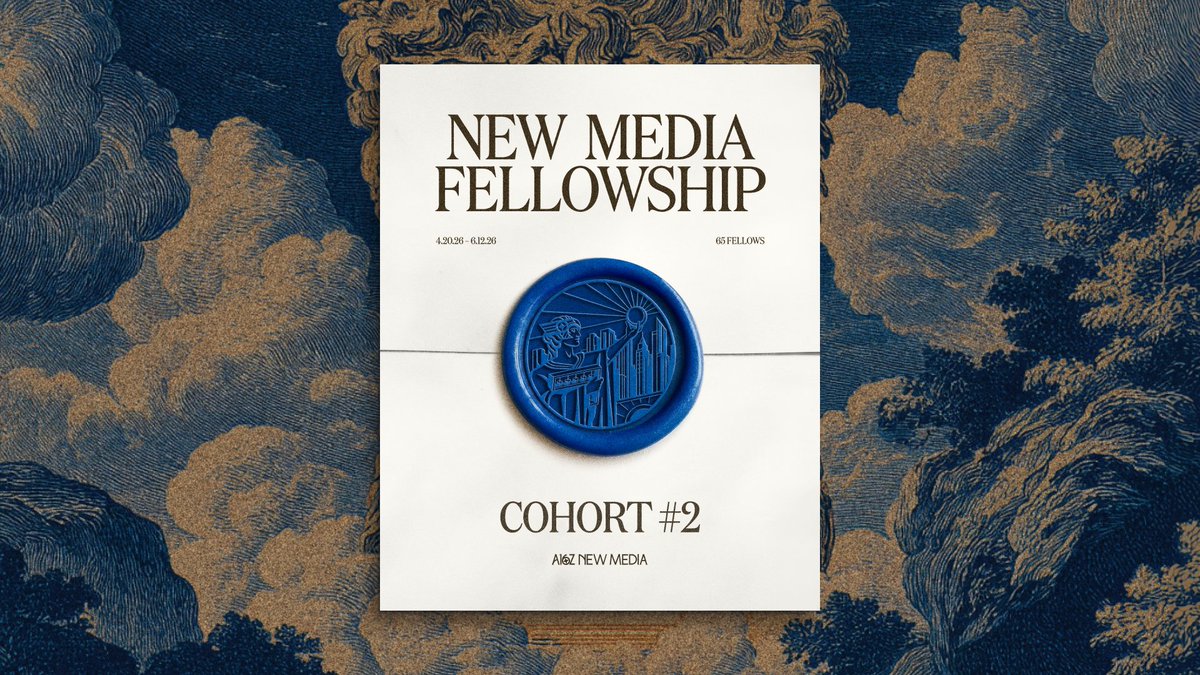
the @a16z new media fellowship is back for round 2! 🎉
apps are live now to join the new, second cohort: a16z.fillout.com/t/2dqvGNMYi9us
you know what to do 👀
cc @liangsays @eriktorenberg @humford
English

i’m joining @eriktorenberg on the @a16z new media team. the most important conversations in the world happen online. we’re building the team that starts, shapes and shares them—for our founders, but also for tech.
English
Sam Kaufman retweetledi

When it comes to preventing crime, the first response is often simple: harsher punishment.
Long sentences, mandatory minimums, more incarceration. This is what most people’s intuition says should work.
But there is another approach: make it harder to get away with crime in the first place. More eyes, faster identification. A world where committing a crime without getting caught is unthinkable.
Since the 1980s, most of American criminal justice policy has been built on the first approach. But the most important finding in criminology is that it barely works.
Daniel Nagin, a researcher at Carnegie Mellon University, has studied criminology for decades. His conclusion, confirmed by hundreds of studies and multiple meta-analyses: the certainty of being caught deters crime. The severity of punishment does not. The National Institute of Justice, the research arm of the Department of Justice, put it even more clearly: if criminals think there’s only a slim chance of being caught, even draconian punishments won’t deter them.
This makes sense when you think about it. Most crimes are impulsive. Most criminals don’t know the specific penalties. Only half of all crimes are reported to police at all. Several analyses have found that three-strikes laws actually increase homicide rates, because offenders facing life sentences had nothing left to lose.
So severity doesn’t deter. Certainty does. That changes how we need to go about public safety.
How do we put this into practice? Swift, Certain, Fair is one approach that’s shown promise. Offenders serve their sentences in the community, where they can work and contribute, under conditions that make getting away with a breach impossible.
South Dakota took this approach to drunk driving. Offenders could serve time in the community as long as they passed a sobriety test twice a day. A failed or skipped test meant a night or two behind bars, not a 3 month minimum sentence.
The program halved reoffending. It was so effective that arrests for drunk driving and domestic violence fell by around 10% for the county. And it cost the taxpayer nothing: participants paid the $2 a day for testing out of their own pockets.
The US spends $270 billion a year on criminal justice. The average cost to incarcerate one person is about $61,000 per year, about the same as the median full-time American worker earns in a year. In New York City, it’s $507,000, closer to the earnings of a surgeon.
What are we getting for that money? A system where 60% of released prisoners are rearrested within two years, all while nearly half of violent crimes and over 80% of property crimes go unsolved. And prison doesn’t just fail to rehabilitate. The evidence suggests it makes reoffending more likely. A meta-analysis of 116 studies found that custodial sentences actually increase recidivism compared to non-custodial alternatives. Every year of incarceration decreases the likelihood of getting a job upon release. Our $270 billion buys us a system that manufactures the next generation of criminals.
Then there’s the problem of age. Prisoners over 55 now make up 15% of the incarcerated population, up from 3.4% in 1991. Because of healthcare needs, they cost 2-3x as much as younger prisoners to incarcerate, a total of $16 billion a year. And for what? 84% of people released at age 60+ are never rearrested. In 2012, 178 elderly people sentenced to life imprisonment in Maryland were released after a court ruling. In the four years afterward, not one of them was rearrested for anything more serious than a traffic violation.
Criminologists Lawrence Cohen and Marcus Felson argued that crime is most likely when three conditions are met: a motivated offender, a vulnerable victim, and the absence of a capable guardian. There will always be motivated offenders and vulnerable victims, but we can ensure that capable guardians are everywhere.
This is where Flock Safety comes in.
Flock operates in over 5,000 communities across 49 states. In Marietta, Georgia, areas with Flock cameras saw a 34% drop in crime, triple the citywide average. Communities we serve have reported up to 80% reductions in residential burglaries. Across all customers, Flock helps solve an estimated 700,000 crimes per year. And each new camera added to the network makes every other camera more valuable to the police departments, investigators, and first responders who rely on them.
The deterrence research says severity doesn’t work. What works is the infrastructure of certainty. Cameras, networks, real-time alerts, cross-jurisdictional data sharing. A world where the odds of getting away with crime drop every year.
That’s what Flock Safety is building. The goal is fewer victims, not more prison cells. The evidence says you can have both.
Every community deserves that.
English
@tdoggyholhol @eriktorenberg @humford This is an incredibly fun and meaningful opportunity for the right person. We need you!
English

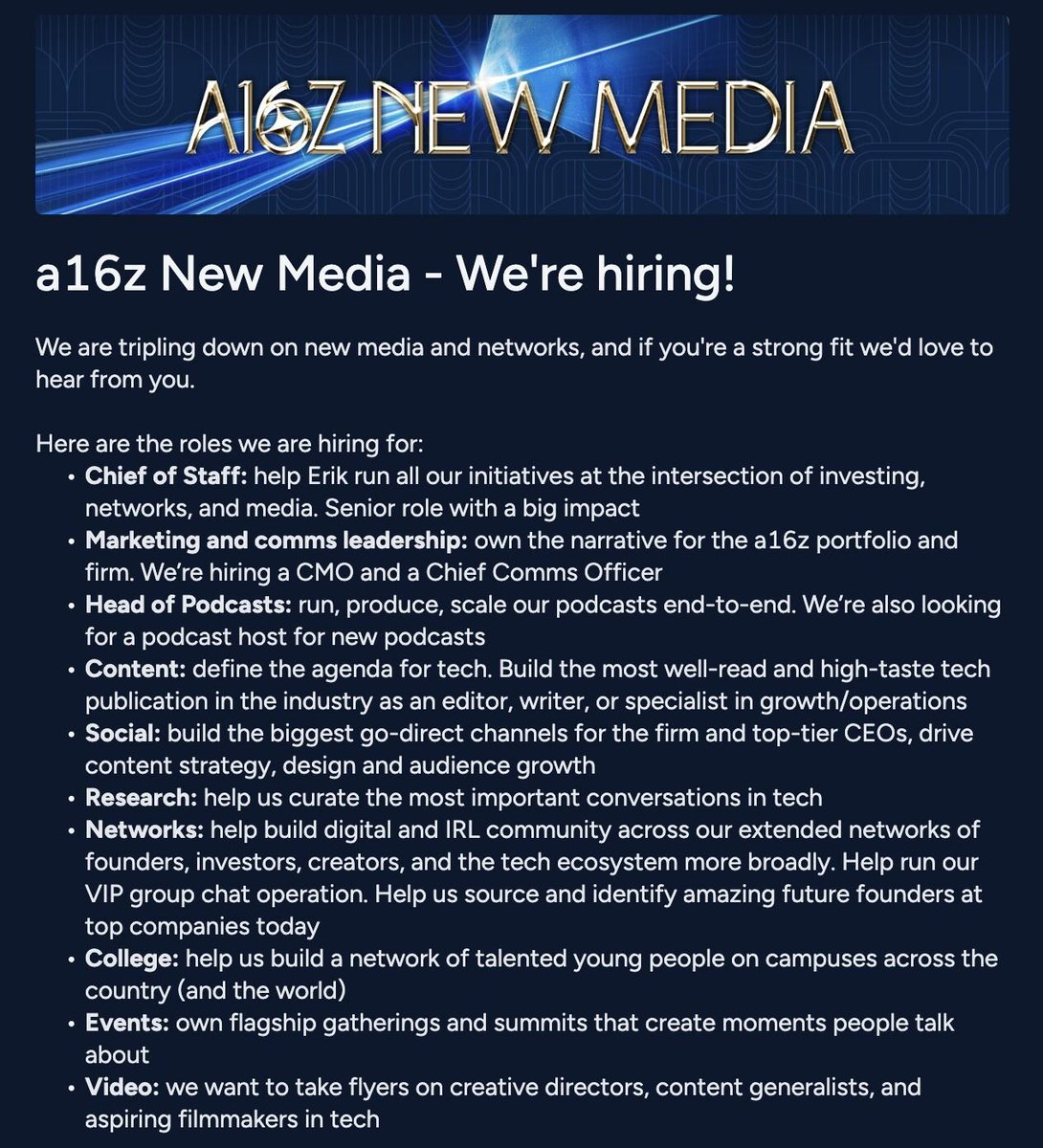
A16Z NEW MEDIA NEEDS YOU 🫵
@eriktorenberg ,@humford and I are hiring portfolio services leads who want to work at the intersection of technology x capital x culture.
- You will be the interface between the world’s best technology companies and the New Media team
- You’re likeable and can convince busy executives, marketing leaders, and the world’s best founders to give you their trust
- By daylight you run crisp meetings, by night you publish your half-baked thinking on Substack or X
- You’re bursting at the seams with ideas—and you instantly action those ideas, creating clear lists of action steps, ensuring no balls get dropped
- Your creative ex-colleagues say you’re the most organized person they’ve ever worked with. Your ops ex-colleagues say you’re the most creative person they’ve ever worked with.
- You spend your time at parties explaining why the latest viral startup has completely the wrong marketing strategy
- You’re unafraid of both technical problems and technical people
- You’re a cross between a startup founder, an ad-agency creative director, and a McKinsey engagement manager
- You’re low ego, don’t take yourself too seriously, and are comfortable giving away your legos
- You are excited to own, and be evaluated by, the outcomes your work drives
- You “just do things”, have high Actions-Per-Minute, and are great at unblocking yourself
- You’re looking for a role that has so much responsibility that it scares you
We’re hiring for a dozen of roles across the team. If you’re interested, fill out the form in the comments:
English

Life news: I just joined @a16z's new media team alongside the great @eriktorenberg and @liangsays.
I’m here to supercharge a16z Original content and our YouTube channel. Beyond that, we’re building a world-class media team to tell the stories of the most important founders + companies in the world right now.
I’m forever thankful for my time building with @mrbeast—I had a front-row seat to Jimmy's genius and it was a wild ride.
I’ve also built my own stuff: viral products that scaled to millions in revenue, and a CPG brand we sold into 600+ stores thru NYC. Now I’m channeling all of it into a16z and I couldn’t be more locked in.
BTW, we're hiring. Interns, editors, producers, directors, media freaks, anyone hungry. if this excites you, my dms are open.
English
English
Sam Kaufman retweetledi
One of Flock's more surprising use cases is helping find lost dementia patients outside.
This happens more often than you might expect.
Send out a DFR drone and throw on a thermal camera. Footsteps in the middle of a field can stay visible for an hour.
There just aren't good alternatives to drones for rapidly finding someone who could've wandered anywhere.
English
Sam Kaufman retweetledi

Today we’re launching Phylo, a research lab studying agentic biology, backed by a $13.5M seed round co-led by @a16z and @MenloVentures / Anthology Fund @AnthropicAI.
We’re also introducing a research preview of Biomni Lab, the first Integrated Biology Environment (IBE), where we’re imagining a new way biologists work.
Biomni Lab uses agents to orchestrate hundreds of biological databases, software tools, molecular AI models, expert workflows, and even external research services in one workspace, supporting research end-to-end from question to experiment to result.
Agents handle the mechanics, while you define the question, then review, steer, and decide. Scientists end up spending more time on science: asking questions, understanding mechanisms, and eliminating diseases.
Phylo (@phylo_bio) is a spin-out of @ProjectBiomni, where we will maintain the open-source community and push open-science research. I’m grateful to continue building with my co-founders @YuanhaoQ @jure @lecong and the dream founding team @serena2z @TianweiShe @huangzixin20151 @gm2123 @margaretwhua @malayhgandhi.
We’re also fortunate to be advised by leading scientists @zhangf, Carolyn Bertozzi, and @fabian_theis, and supported by an amazing group of investors including @JorgeCondeBio @zakdoric Matt Kraning @ZettaVentures @dreidco @conviction @saranormous @svangel @valkyrie_vc and others.
Biomni Lab is available for free today: biomni.phylo.bio
Learn more in our launch post: phylo.bio/blog/company-f…
We are also hosting launch events - join us at
South San Francisco: luma.com/n8k8qb0n
Virtual: luma.com/l5ryjaij
We’re also hiring! phylo.bio/careers
English

I’ve been asked a number of times “what’s so new about new media?”
In last week’s all hands @bhorowitz explained it very well:
“Old media is defense oriented, tries to please every audience, is terrified of upsetting people. New media only cares about being interesting. When in doubt, flood the zone.”
@eriktorenberg @Alex_Danco @humford @liangsays went into more detail, worth reading! a16z.com/what-is-new-me…
English