samlaf

3.1K posts

samlaf

samlaf

@samlafer

| Prev @Eigenlayer @eigen_da

Katılım Ocak 2010
1.9K Takip Edilen2.3K Takipçiler
samlaf
samlaf@samlafer·
Here's another Claude generated visualization of the tradeoff.
samlaf tweet media
English
1
0
0
63
samlaf
samlaf@samlafer·
Mommy a new consensus-bandwidth trilemma just dropped!
samlaf tweet media
Andrew Lewis-Pye@AndrewLewisPye

New paper with @_patrickogrady and @commonwarexyz: The Carnot Bound. In leader-based consensus, the leader has to get each block out to every other processor. Erasure coding helps: instead of sending a full copy to everyone, the leader sends each processor a small fragment, from which the full block can be reconstructed once enough fragments are collected. The efficiency of this encoding is captured by the data expansion rate — the ratio of total data sent to payload size. This is a key parameter for throughput: the closer it is to 1, the closer maximum throughput gets to the raw network bandwidth. We prove that protocols with 2-round finality (one round of voting) can't achieve a data expansion rate below 2.5, which is a bound matched by existing protocols. We then show that an extra round of voting breaks the barrier, allowing rates arbitrarily close to 1. Links to paper and blog below...

English
1
0
4
290
samlaf retweetledi
patrickogrady.xyz
patrickogrady.xyz@_patrickogrady·
You've heard of 3f+1 and 5f+1, but what about 4f+1? (if you want to reach a data expansion rate of ~1, look no further 👀)
Andrew Lewis-Pye@AndrewLewisPye

New paper with @_patrickogrady and @commonwarexyz: The Carnot Bound. In leader-based consensus, the leader has to get each block out to every other processor. Erasure coding helps: instead of sending a full copy to everyone, the leader sends each processor a small fragment, from which the full block can be reconstructed once enough fragments are collected. The efficiency of this encoding is captured by the data expansion rate — the ratio of total data sent to payload size. This is a key parameter for throughput: the closer it is to 1, the closer maximum throughput gets to the raw network bandwidth. We prove that protocols with 2-round finality (one round of voting) can't achieve a data expansion rate below 2.5, which is a bound matched by existing protocols. We then show that an extra round of voting breaks the barrier, allowing rates arbitrarily close to 1. Links to paper and blog below...

English
2
2
22
1.9K
samlaf
samlaf@samlafer·
Why are there no documentaries that focus on 2008 money market funds breaking the buck?
English
0
0
2
97
samlaf
samlaf@samlafer·
@RyanSAdams How did Aptos get in there and not Sui 🤔
English
0
0
0
61
RYAN SΞAN ADAMS - rsa.eth 🦄
THEY DID IT. The SEC and CFTC just dropped a landmark document that officially classifies crypto assets. They're actually telling us which crypto assets are securities and which ones aren't - by name! THIS IS SOMETHING GENSLER REFUSED TO DO (he focused on prosecuting crypto out of existence) This rule doc gives crypto many of the benefits of the clarity bill - it lifts us out of the gray market - it gives every asset a path. It's almost like the Clarity act just passed by way of regulator. (of course, the actual clarity act will harden all this into legislation and make it irreversible in the event we get another Gensler, we still want it) This rule says there's 5 categories for crypto assets: 1) Digital Commodities - assets tied to a functional, decentralized crypto system (e.g., BTC, ETH, SOL, XRP, ADA, DOGE). Not securities. (yes, they name them on page 14) 2) Digital Collectibles - NFTs, meme coins, artwork tokens, in-game items. Not securities (fractionalized collectibles may be an exception). 3) Digital Tools - membership tokens, credentials, domain names (e.g., ENS). Not securities. 4) Stablecoins - payment stablecoins under the GENIUS Act are not securities. Other stablecoins, it depends. 5) Digital Securities - tokenized versions of traditional securities. Like tokenized stocks. Always securities. Amazing! This makes so much sense I can't believe it's coming from a regulator. No more enforcement threats to Ethereum developers and crypto exchanges. How about the Howey test? More common sense! If an issuer makes specific promises of managerial efforts from which buyers expect profits, the offering is a security until those promises are fulfilled. Then it's a commodity. The asset itself was never the security, the deal around it was. (E.g. XRP was a security pre launch, became a commodity after). How about stuff like staking and mining? Mining? Not a securities transaction. Staking? Also not a securities transaction, that includes custodial and liquid staking even with LSTs! How about wrapping BTC? Not a securities transaction. Airdrops? NOT SECURITIES. NO MORE GEO BANS PROTECTING AMERICANS from free airdrops. Remember this is a joint doc from the SEC and CFTC, They're actually cooperating on this, no internal strife, this is binding to both. SEC regulates $80-100 trillion assets CFTC regulates $5-10 trillion assets Both of the world's largest capital markets are showing us that crypto assets are here to stay and they're welcome alongside traditional assets. Every country will follow. This is the biggest move toward legitimacy I've seen in all my time in crypto. Maybe bigger than the genius act since is covers all crypto assets. Well done @MichaelSelig and @SECPaulSAtkins. And especially well done to the indefatigable @HesterPeirce. Her fingerprints are all over this, couldn't have happened without her eight years of principles-based curiosity.
RYAN SΞAN ADAMS - rsa.eth 🦄 tweet mediaRYAN SΞAN ADAMS - rsa.eth 🦄 tweet media
English
200
833
4.3K
376.5K
samlaf
samlaf@samlafer·
From rollup training wheels to startup training wheels.
samlaf tweet media
English
1
0
4
212
samlaf
samlaf@samlafer·
Answer is: - Lamport/Shostak/Pease 1982 (the Byzantine Generals paper) gave the first protocol for Byzantine broadcast tolerating f < n in the synchronous model with signatures/PKI. But their protocol was expensive — exponential message complexity, because it involved recursively relaying and re-signing messages to depth f. - Dolev/Strong 1983 solved the same problem much more efficiently — polynomial message complexity. It's essentially the "better version" of the same result. - Vitalik restated it in mdoern terms.
English
0
0
1
56
samlaf
samlaf@samlafer·
Answer is -- Paper established a complete picture for Byzantine broadcast in the synchronous model: - Impossibility: f ≥ n/3 is impossible without authentication/signatures - Upper bound without PKI: f < n/3 is solvable — the "Oral Messages" algorithm (OM(m)), which uses recursive majority voting - Upper bound with PKI: f < n is solvable — the "Signed Messages" algorithm (SM(m)), which uses recursive relaying with signatures
English
0
0
0
44
samlaf
samlaf@samlafer·
And finally the broadcast cheat sheet tying everything together. Will need a few more posts to fully expand on this.
samlaf tweet media
English
0
0
1
59
samlaf
samlaf@samlafer·
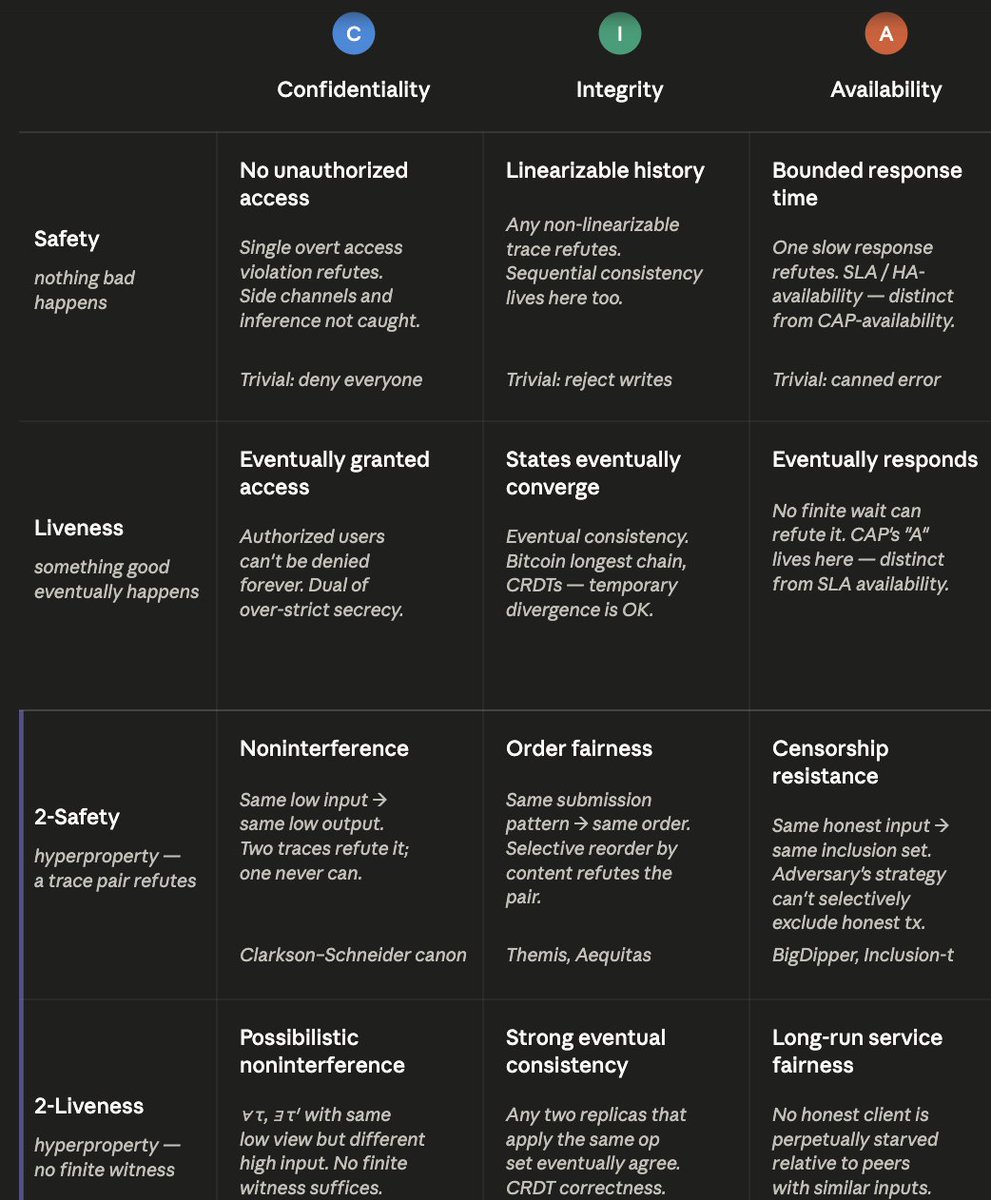
Provability hierarchy
samlaf tweet media
Čeština
1
0
1
68
samlaf
samlaf@samlafer·
Wrote new post in preparation for today's FTF consensus ep4 session, going over: - terminating broadcast vs binary consensus equivalence - broadcast liveness hierarchy - easy PKI-based solns for consistent/reliable broadcast - PKI and provable broadcast - view change triggers
samlaf tweet media
English
1
2
6
521
samlaf
samlaf@samlafer·
@kartik1507 @ittaia Nice hadn’t thought of post-quantum. Although lean-vm might solve that issue soon enough :)
English
0
0
1
68
samlaf retweetledi
Kartik Nayak
Kartik Nayak@kartik1507·
@samlafer @ittaia If we want to be signature-free/post-quantum secure, Bracha is still the best protocol tolerating t < n/3 faults. So, from that standpoint, I think it is very relevant.
English
1
1
2
134