Ted Sanders

801 posts

Ted Sanders banner
Ted Sanders

Ted Sanders

@sandersted

Research at OpenAI. Be kind to others, and yourself.

San Francisco, CA Katılım Eylül 2009
1.3K Takip Edilen9.6K Takipçiler
Ted Sanders
Ted Sanders@sandersted·
@nabla_theta @MatthewJBar One big corporation I used to work for is Netflix. When I was there, they proactively cancelled subscriptions that had no streaming activity. This cost them millions and I don’t think they got much public goodwill for it. It felt ethical and I’m pleased they did it.
English

0
0
1
47
Ted Sanders
Ted Sanders@sandersted·
@nabla_theta @MatthewJBar In contrast, I recently cancelled a haircut with a sole proprietor because I was sick. He chose to charge me the full amount anyway because I cancelled less than 24h ahead of time.
English
1
0
1
43
Leo Gao
Leo Gao@nabla_theta·
new post: Corporations seem evil because we anthropomorphize them if you model companies as people, then they would be amoral sociopaths. but so would your lawnmower. to change corporate behavior effectively, you have to treat them as optimizers and change their incentives.
English
15
3
145
6.9K
Sriram Krishnan
Sriram Krishnan@sriramk·
model capabilities and the "four minute mile": been discussing with some frontier lab researcher friends as to why the frontier model capabilities are always so clustered together as opposed to any one model having an unassailable edge. the best metaphor for this in my mind is the "four minute mile": no one broke it till Bannister in 1954 and then very quickly five more runners did it in the next two years. In the model world, this translates to a) intense competitive pressure. b) often similar pool of ideas / research directions c) roughly similar access to capitalization and compute infrastructure the oft quoted example is after the launch of o1 being quickly followed by reasoning models from multiple players both closed and open weights. this is not the case with many other technology driven industries where capability or advancements often tend to be longer held.
Sriram Krishnan tweet media
English
15
12
100
17.7K
Ted Sanders
Ted Sanders@sandersted·
@NateSilver538 @SpecialPuppy1 feels very probable to me that in ten years AI becomes as indispensable to people as phones and the internet. in contrast, feels much less probable that search engines and video streaming services are as popular as today.
English
0
0
0
292
Nate Silver
Nate Silver@NateSilver538·
@SpecialPuppy1 What if there's a 1% chance they're worth basically infinity dollars b/c the singularity hypothesis is true and they win the race. But also even ignoring that Facebook has double the market cap and OpenAI seems like a much better bet even with the 50% haircut.
English
26
0
143
47.7K
Ted Sanders
Ted Sanders@sandersted·
@simonw @vkawadia yeah, prompt injection is definitely not solved. we're way, way better than couple years ago, but it's very hard to be perfect against such a high dimensional distribution. way more possible prompts than atoms in the observable universe...
English
0
0
0
65
Simon Willison
Simon Willison@simonw·
@vkawadia "Solved" implies that it's not possible to craft an attack that works. I'm not convinced that's true, even as attacks get harder The big challenge is proving you can't get an attack through - I'm not sure how you'd do that
English
12
0
71
7.1K
Vikas Kawadia
Vikas Kawadia@vkawadia·
Hot take: latest reasoning models have solved prompt injection. To demo an attack now, you have to deliberately prompt the model to be gullible. In real-world use, it just doesn't happen. @simonw, still concerned about it?
English
8
0
10
7.6K
Ted Sanders
Ted Sanders@sandersted·
@AndyMasley @MatthewJBar from an individual POV, most of us are already fairly disempowered. the government has superhuman power over us: it decides rules and it has a monopoly on violence to enforce them. if AGI were to take over and run things similarly, the main losers would be officials not citizens.
English
0
0
2
47
Andy Masley
Andy Masley@AndyMasley·
@MatthewJBar fwiw I have seen more engagement with the idea and take it pretty seriously. I see the risk as more "This could be really bad" not "This definitely will" #ai-systems-are-nicer-than-humans-in-expectation" target="_blank" rel="nofollow noopener">forethought.org/research/human…
English
2
0
7
1K
Andy Masley
Andy Masley@AndyMasley·
The best introductions to the three big AI risks people into EA worry about are just the 80,000 Hours articles on each: 1) Power seeking AI: 80000hours.org/problem-profil… 2) Gradual disempowerment: 80000hours.org/problem-profil… 3) Catastrophic misuse: 80000hours.org/problem-profil… Take it or leave it, agree or disagree, but if you want to know where EA people working on AI risk are coming from, these three blog posts together explain it all.
English
9
24
156
42.9K
Hadi Vafaii
Hadi Vafaii@hadivafaii·
The blueprint for this "grand unification" already exists: --------- 🔹1961: Landauer established the thermodynamic cost of bit erasure (ieeexplore.ieee.org/document/53924…) 🔹1982: Bennett resolved Maxwell’s Demon, proving that logical irreversibility (erasure), rather than measurement, necessitates thermodynamic work (link.springer.com/article/10.100…) 🔹Late 1990s: Jarzynski and @gavincrooks related non-equilibrium work to equilibrium free energy. Their Fluctuation Theorems were later used to derive the entropy production cost of statistical inference (journals.aps.org/prl/abstract/1…; journals.aps.org/pre/abstract/1…) 🔹2007: Kawai et al. proved average thermodynamic entropy production equals the KL divergence between forward and backward path distributions( journals.aps.org/prl/abstract/1…) 🔹2009: Sagawa & Ueda incorporated information theory into this framework, bounding the energetic cost of measurement and feedback (journals.aps.org/prl/abstract/1…) 🔹2019: Wolpert extended stochastic thermo to formal computational architectures, including Turing machines and boolean circuits (iopscience.iop.org/article/10.108…) 🔹...and many more works in thermo/non-equilibrium stat mech that are waiting to be formally connected to computer science/ML concepts. --------- Formalizing this mathematical connection is a central research interest of mine. Reach out if you have ideas (DMs open).
David Pfau@pfau

We need a grand unification between physics and computer science to understand the relationship between energy and information. Always nice to see work that brings them together.

English
23
54
475
50.4K
Ted Sanders
Ted Sanders@sandersted·
@tamaybes a related way to spin it is that investors didn't have enough faith in the trendlines/tech/teams, and therefore got better deals early on. in a low-capital business you can outwait skepticism; in a capital-heavy business, you cannot.
English
0
0
3
235
Tamay Besiroglu
Tamay Besiroglu@tamaybes·
It’s striking how little of the value of AI labs accrues to founders. Anthropic’s cofounders reportedly hold only ~1.8% each. Sam Altman had no equity in OpenAI for years. No founder of a frontier AI lab appears in the top 500 of the Forbes billionaires list, unless they made most of their wealth from other companies. This looks quite different from earlier tech companies. At Facebook’s IPO, Zuckerberg held ~28% of the company. At Google’s IPO, Larry and Sergey held ~16% each. I think this mostly reflects the fact that by far the most valuable factor of production in frontier AI is compute, not founders. Building a leading lab requires tens of billions in capital before meaningful revenue, and each raise dilutes founders substantially.
Celia Ford@cogcelia

Anthropic employees may be on the brink of getting very, very rich. Many of them, including its co-founders, have pledged to give a lot of that money away. If that money materializes, it could flood EA-aligned nonprofits with cash, including those aiming to regulate, audit, and review Anthropic itself. Whether that's good or bad depends on who you ask. I covered this potential wave of Anthropic wealth for @ReadTransformer:

English
32
16
322
152.9K
rohit
rohit@krishnanrohit·
@giffmana Wasn't there a paper a couple of years ago that also showed this to be the case? With respect to poetry if I remember
English
1
0
1
182
Ted Sanders
Ted Sanders@sandersted·
@austinc3301 @bayesianboy my steelman: the better you are at writing (and thinking), the more useless you find AI writing (and thinking). I think his day will come, but it will be later day than for the rest of us.
English
0
0
0
110
Agus 🔸
Agus 🔸@austinc3301·
@bayesianboy Ted's views on AIs are surprisingly warped for a person I consider to be otherwise very intelligent
English
4
0
23
1.4K
Mel Andrews
Mel Andrews@bayesianboy·
Ted Chiang responds to the article going around that asks if the left is missing out on AI: “I don’t know. Is the left missing out on ICE?”
English
5
27
321
21.8K
Diego | AI 🚀 - e/acc
Diego | AI 🚀 - e/acc@diegocabezas01·
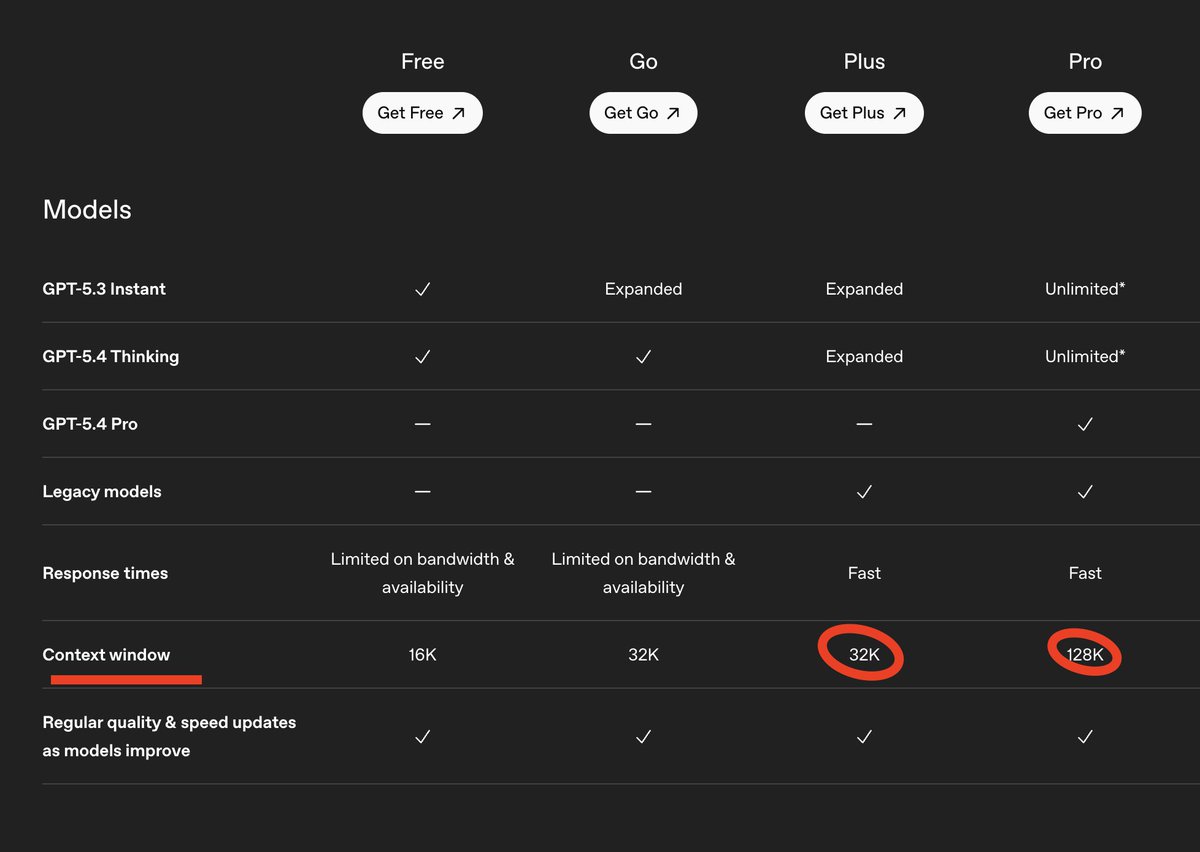
Did you know GPT-5.4 Thinking has a 1M token context window in the API, but only 32K in ChatGPT Plus ($20/month) and 128K in Pro ($200/month)?
Diego | AI 🚀 - e/acc tweet media
English
81
29
787
133.6K
Ted Sanders
Ted Sanders@sandersted·
@ramez @Noahpinion yeah. in fairness, a very reasonable steelman is that AGI will need tons of skills and so it makes perfect sense to build training pipelines that train tons of skills. and there really is amazing generalization happening! but so far, it’s still nowhere near humans levels of G.
English
1
0
1
16
Ramez Naam
Ramez Naam@ramez·
Yes. There's a lot of benchmarkmaxxing. I know of one case where AI models were just totally failing to succeed at a certain task (an online puzzle game). So an engineer at one of the labs built a very specific data set for that game and used it for RL. That's great. We can find problems and make AI better at them. But it's not clear it generalizes in any way, and what looks like rapid progress on benchmarks, as you say, is increasingly less about general capability increases and more about targetted work aimed at those benchmarks.
English
1
0
1
65
Ted Sanders
Ted Sanders@sandersted·
@Noahpinion @ramez although progress on these is super impressive, I think it would be radically more impressive if progress was rising as a side effect of a general training recipe and not from people trying to directly improve math, office suite, etc. hard to quantify, of course.
English
1
0
2
82
Ted Sanders
Ted Sanders@sandersted·
@Miles_Brundage there’s a relationship, but they’re not equal. part of the reason for the difference is that API is frozen, so that developers get reliable operation. ChatGPT is not frozen, as we might tweak them after launch (e.g., in January we gave a speed boost to standard).
English
0
0
3
547
Miles Brundage
Miles Brundage@Miles_Brundage·
Is there any relationship between “extended” and “heavy” thinking in the ChatGPT interface and “high” and “xhigh” in the API?
English
2
0
10
3K
Cameron Raymond
Cameron Raymond@CJKRaymond·
fwiw if oai people get weirdly defensive or tribal about the gullible comment I think that’s lame. have to have thicker skin then that
English
9
3
141
12.4K
Ted Sanders
Ted Sanders@sandersted·
@robertwiblin @MatthewJBar I do think there’s a bias from: - models are necessarily simple - in a simple world there is less heterogeneity to slow things down - so most models are biased towards fast acceleration also, much progress comes from data, not algos. making data to fix your blindspots is hard.
English
0
0
1
64
Matthew Barnett
Matthew Barnett@MatthewJBar·
I find it notable how many people think AI automating AI R&D will be sufficient to trigger a capabilities explosion. I see considerably fewer people suggest that non-R&D inputs like compute and data will bottleneck the process, even though I find that hypothesis much more likely.
Rob Wiblin@robertwiblin

When I interviewed Holden Karnofsky he gave a plausible justification for why Anthropic should remain at/near the AI frontier. ¹ But the case is far weaker for running far ahead of the competition on approx the most dangerous capability: autonomous SWE agents that can set off a recursive self-improvement loop. These capabilities are also now being stolen by less scrupulous actors: x.com/AnthropicAI/st… As Holden said: "If AIs were able to just do AI R&D I think there would be a significant chance of what I tend to call a capabilities explosion. And then everything else you're worried about from AI, all the other threats... all that comes onto the table really fast, and you're not going to have time to react to it." Full interview here: x.com/robertwiblin/s… ¹ If you believe technical alignment is very difficult and none of the current approaches have much of a chance I agree the case for this whole strategy is much weaker.

English
13
4
109
10.8K
Ted Sanders
Ted Sanders@sandersted·
@jkcarlsmith @AmandaAskell How do you trade off teaching obedience (which backfires with bad orders) versus independence (which backfires with bad judgment)?
English
0
0
4
226
Joe Carlsmith
Joe Carlsmith@jkcarlsmith·
.@AmandaAskell and I are recording an audio version of Claude’s Constitution, and we’re planning to include an additional section where we answer some questions about the document. If you have questions you’re especially curious about, feel free to drop them in the replies.
English
157
35
641
53.5K
Ramez Naam
Ramez Naam@ramez·
I am a skeptic on fast AI takeoff and ASI and also incredibly impressed by what LLMs can do and their rate of progress.
English
10
1
52
4.8K