Erica Sandberg

2.6K posts

Erica Sandberg banner
Erica Sandberg

Erica Sandberg

@sandstorms

Intermediate elementary teacher. Passionate about explicit instruction and dodging edu-trends.

Vancouver, British Columbia Katılım Aralık 2008
547 Takip Edilen321 Takipçiler
Erica Sandberg retweetledi
TheLegalProcess (v3.0 | Instruction Not Therapy)
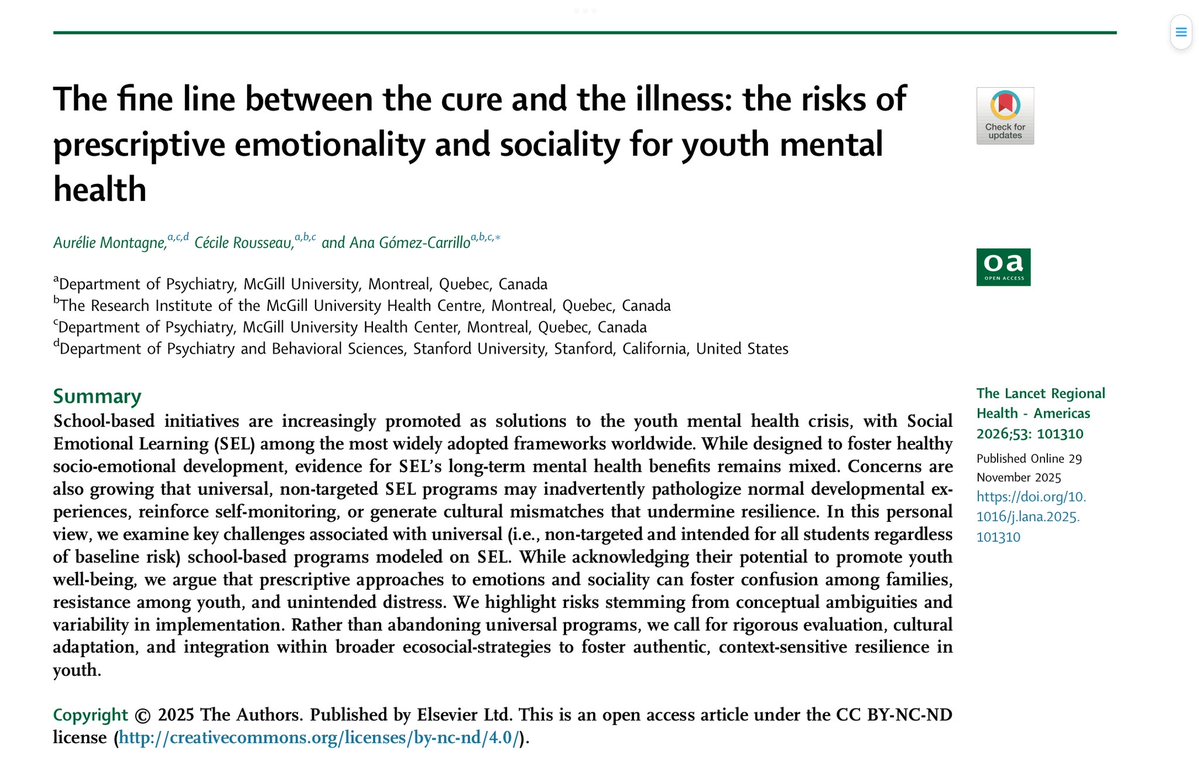
“[E]vidence for SEL’s long-term mental health benefits remains mixed. Concerns are also growing that universal, non-targeted SEL programs may inadvertently pathologize normal developmental experiences, reinforce self-monitoring, or generate cultural mismatches that undermine resilience” 👉AND they admit SEL is a “framework” for mental health, not primarily an academic proficiency booster
TheLegalProcess (v3.0 | Instruction Not Therapy) tweet media
English
1
16
44
8K
Erica Sandberg retweetledi
Aaron Rupar
Aaron Rupar@atrupar·
Crockett: "What if someone from another country said 'We're gonna come and bomb America, kill civilians, because we have a warrant for the president's arrest because of the child sex trafficking in the Epstein files.' I can guarantee that every single one of you that is sticking up for him right now would be screaming from the rooftops. The analysis has to be the same."
English
930
4.9K
21.4K
690.8K
Erica Sandberg retweetledi
Carl Hendrick
Carl Hendrick@C_Hendrick·
We say "write a story about a time you were brave" and call it "student-centred". But for a child with limited vocabulary, limited reading, and limited models of how written language works, this doesn't feel like freedom. It feels like being asked a question you don't have the knowledge to answer, in public, every day.
English
4
17
52
5.5K
tetheredtoed
tetheredtoed@tetheredtoed1·
Why can’t kids write? Hmmm. Such a mystery! This is “approved instructional materials” : (posted in a classroom I’m covering today)
tetheredtoed tweet media
English
7
5
29
3.3K
Erica Sandberg
Erica Sandberg@sandstorms·
@EvidenceInEdu I’d like to compare this to the percentage of kids who feel their parents know when they are upset.
English
1
0
0
25
Evidence Based Education
Evidence Based Education@EvidenceInEdu·
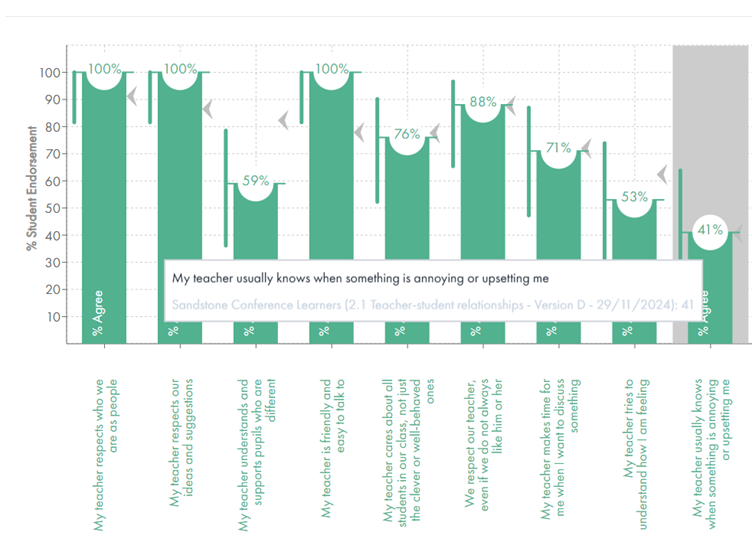
4 in 10 students feel their teacher knows when something is upsetting them. A sense of belonging underpins almost every aspect of wellbeing and learning. It’s not a school-specific construct; it’s part of being human. We all need to feel connected to people, to places, to something bigger than ourselves. Based on 120,000 learner surveys completed on the Great Teaching Toolkit platform, only around four in ten students feel their teacher knows when something is upsetting them. These findings should give every leader pause for thought. Professor @ProfKime explains why belonging matters and isn't a "nice-to have" in this blog hubs.la/Q046TpT90
Evidence Based Education tweet media
English
6
2
10
1.1K
Anna Stokke
Anna Stokke@rastokke·
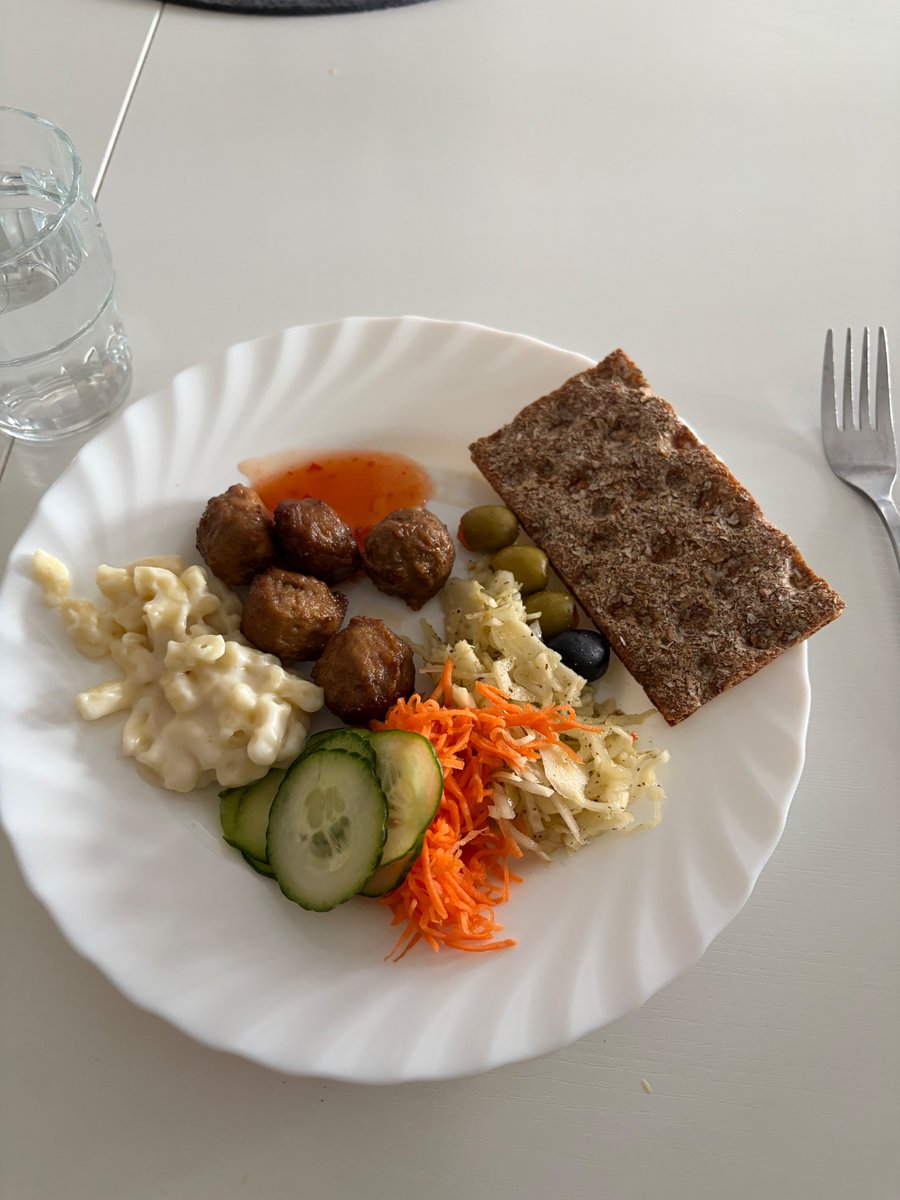
School lunch in Sweden.
Anna Stokke tweet media
Nederlands
35
4
161
19.6K
Erica Sandberg retweetledi
James A. Furey
James A. Furey@JamesAFurey·
One of the biggest mistakes in writing instruction, and the one I’ve seen in school after school, teacher after teacher, is to mistake volume for rigor. It does a kid no good whatsoever to write an essay in sixth grade if they can’t piece together a decent sentence.
English
17
16
235
7.1K
Erica Sandberg retweetledi
Ammar A. Merhbi
Ammar A. Merhbi@AmmarMerhbi·
Many experts believe Finland’s early PISA success was actually the result of the previous traditional, teacher-centric system. The decline began as the generation taught under the "new" progressive methods started taking the exams. Global observers mistook the reforms of the 90s (autonomy, less testing, less homework) for the cause of the high scores. ​In reality, those students were the "legacy products" of a rigorous, teacher-led system. In 2016, Finland introduced a curriculum emphasizing "Phenomenon-Based Learning." although intended to foster multidisciplinary thinking, many argue it diluted the focus on core subjects and left students without the necessary foundational scaffolding. High-achieving students often (but not always) thrive under autonomy, but research suggests that mediocre and struggling students and those from lower socio-economic backgrounds benefit most from explicit instruction.
English
0
7
101
4.5K
Erica Sandberg retweetledi
Tom Bennett OBE
Tom Bennett OBE@tombennett71·
Restorative Justice, one of the worst system-level strategies you can imagine. I've lost track of the number of schools I have supported out of this well-meant but destructive model, where behaviour has spiralled out of control because boundaries have become meaningless. This article demonstrates exactly why, and how it happened in the US. It is a cautionary tale for the age. The extraordinary thing is how it was implemented so far and so fast with *almost no credible evidence to suggest that we should*. It was strategy based on vibes. 'This feels right.' It was also yet another triumph of education elites over education experts: no one in school was crying out for this. Nobody was saying 'please make it impossible for us to send students out, or reprimand them, or set boundaries, if they disrupt or harass their peers.' But that's what they got, and they were penalised if they didn't. RJ can be a useful tool. But it's closer to a glass cutter than a screwdriver; it's niche, not the default. educationnext.org/restorative-ju…
English
44
109
397
35.6K
Erica Sandberg
Erica Sandberg@sandstorms·
@rodjnaquin Asking children about their experiences with AI is not evidence of learning. This is probably as accurate as students’ self-assessments on a group project. If you’re an educator, you know. We used to think highlighting helped us learn too. It’s the illusion of learning
English
0
0
5
102
Rod
Rod@rodjnaquin·
My blog from summer 2024 argues that critics of LLMs in education view the issue from teachers' perspectives, not learners'. Students overwhelmingly report positive experiences—66% say AI chatbots help them, 80% say they explain difficult concepts well. Yet educators dismiss this as taking shortcuts, mirroring the adult-centric bias Margaret Donaldson identified in child development research. We should center learners' voices. open.substack.com/pub/rodjnaquin…
Rod tweet mediaRod tweet media
English
12
0
10
22.5K
Catherine Cook
Catherine Cook@CatherineCook58·
@kinderwithMrsL It was exhausting when I switched to structured literacy in my gr. 1 class, but it was worth it to see the gains all the children were making.
English
2
0
4
161
Caitlin Lucas
Caitlin Lucas@kinderwithMrsL·
“If you are tired from teaching reading well, you may be doing it right.” Doing the right thing is often harder and lonelier. Running and returning to the classroom reminded me of that. New 💭✍️ open.substack.com/pub/thekinderl…
English
3
1
15
1.4K
Erica Sandberg retweetledi
Justin Skycak
Justin Skycak@justinskycak·
Math trauma tends to be less about math and more about someone asking you to do advanced maneuvers before you've mastered the basics. Imagine going to skating lessons, and your coach tells you to skate backwards on one leg, despite the fact that you can barely hold yourself up on one leg. So you try, and you fall over, and coach just tells you to try harder, maybe sprinkling in some vague advice that you don't really understand. You try and fail over and over again. And coach just tells you, it's not that hard, you've been on the ice before, you should be able to do this if you try. Nevermind the fact that there is a massive prerequisite gap between what you're able to do and where coach expects you to be. Whether it's math, skating, swimming, whatever, that kind of experience would be traumatic for anybody.
English
13
25
188
6.4K
Erica Sandberg retweetledi
Kareem J. Weaver
Kareem J. Weaver@KJWinEducation·
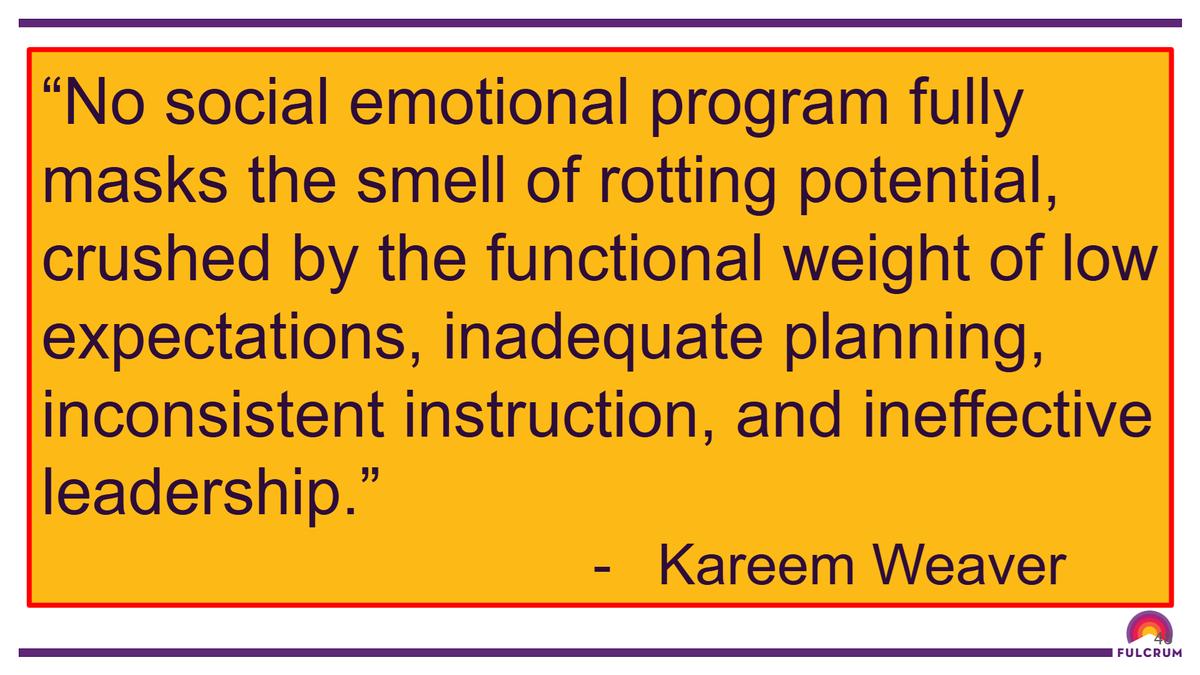
Thinking about literacy programs and schools.
Kareem J. Weaver tweet media
English
7
31
119
3.4K
Erica Sandberg retweetledi
Tom Bennett OBE
Tom Bennett OBE@tombennett71·
Worth repeating: in an age of AI, all material used for academic assessments that involves take-home work or projects done unsupervised, are now worthless. Assessed homework in this category the same. There is no alternative to supervised, standardised, in-person, off-screen work. This is the innovation we need to embrace right now.
Michael Salter@mikesalter74

This should frankly be so blindingly obvious (even to Ed bureaucrats) as to not even need saying. But the age of the ostrich is not dead. smh.com.au/national/allow…

English
2
75
280
21K
Erica Sandberg retweetledi
Jonathan Haidt
Jonathan Haidt@JonHaidt·
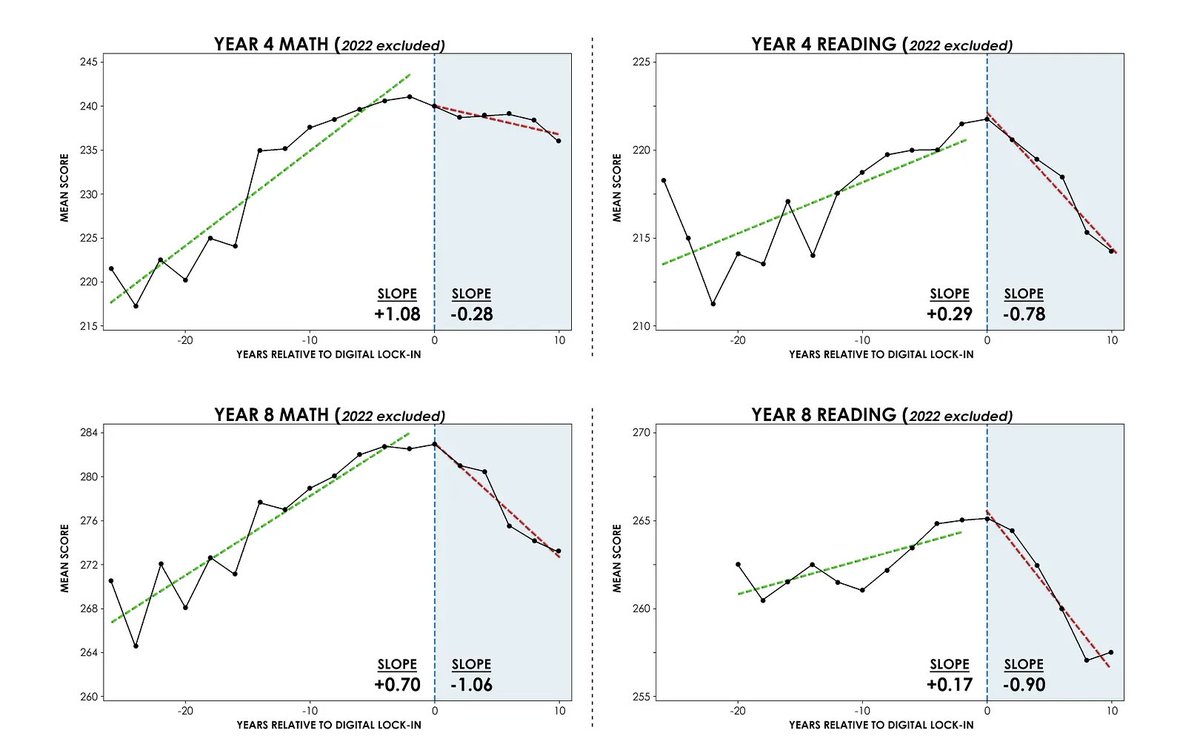
Still more evidence that EdTech harmed American education: Across states, the year that the state imposed mandates requiring computers/tablets, that's the year that test scores stopped rising and in most cases started falling. From Jared Cooney Horvath thedigitaldelusion.substack.com/p/when-correla…
Jonathan Haidt tweet media
English
40
725
2.5K
449.6K
Erica Sandberg retweetledi
Naomi Fisher
Naomi Fisher@naomicfisher·
Uta Frith, renowned autism researcher, gives an interview to the TES about autism – and the internet goes wild. We’re told that what she said will put back progress 40 years, that she knows nothing about autism, that she lacks critical thinking and that her words will harm autistic people to the point of suicide. You’d guess she must have said something really awful. Perhaps something deeply offensive about autistic people which reveals her lack of compassion and understanding. Even then, it’s hard to know how one retired academic would have the power to make others commit suicide and to turn back progress to the extent that is predicted. What she said was that she thinks the autism spectrum has expanded too far and that it isn’t helping anyone. Not those who originally received autism diagnoses, and not those who are now getting diagnoses who previously would not have done. She said that she thinks scientific progress is being held back because ‘autism’ now means something so heterogenous that we can’t identify anything that all autistic people share. Nothing biological or neurological, nothing cognitive, nothing behavioural. In her words, there are no markers. The autism spectrum is, in fact, the widest spectrum imaginable. It goes from some of the most disabled people in our society to some of the highest achievers. And there’s no evidence that they have anything in common except their diagnosis. Saying this sort of thing gets you into a lot of trouble online. There are accepted narratives that we are all expected to comply with, and one is the idea that the giant autism spectrum is protective, that it helps people to be included under one diagnosis. Any language which helps people differentiate is banned. Which is odd, because we don’t think that in any other area of medicine. No one says (for example), that we shouldn’t differentiate between Type 1 and Type 2 diabetes because it’s protective not to be able to talk about the differences. It’s obvious that differentiating between types of diabetes will lead to better understanding and interventions. If you don’t comply with these narratives about autism – as Uta Frith hasn’t – then you will be publicly shamed. Your expertise will be challenged, even if you have 60 years of experience. You’ll be told that you are harming people and that you are ignorant. Personal slurs are likely to be used against you. And it’s all about social control. Shame is about social control. It’s about creating things that can be said, and things that can’t be said. Others see the shaming and keep quiet. It’s about controlling the narrative so that real discussions can’t be had. I’ve talked to so many clinicians who raise these concerns with me and who then say that they’d never speak up, for fear of shaming and even losing their job. There are important things that are not being talked about, for fear of the repercussions. To my mind, the interesting question is really why. Why is it treated like blasphemy to say that the vast autism spectrum may no longer be fit for purpose? Why are we not allowed to discuss the reality of clinical practice? Why are personal attacks the go-to when scientists disrupt the prevailing narrative? And why are we all so compliant, censoring ourselves to avoid the discomfort of shame? Listen to our podcast with Uta Frith here. open.substack.com/pub/neurosense…
English
121
223
1.1K
192.2K