

Sandy Slipper
92 posts

@valueymercado $ASPI Paul Mann & Stefano Marani have a very similar grifting style, always saying profits are just around the corner, yet somehow perpetually delayed.
In 2016, Renergen announced a supply deal with Afrox. Commercial helium sales were set to start in 2018.
We're in 2026 now...
English

$ASPI cada vez mejor pinta.
Además el ceo a comunicado que para el q3 se espera que esté produciendo helio.
Catalizadores muy importantes para este año 2026
Finance Major@FinanceMajor_23
Read Engineering News article on $ASPI and had a few thoughts this afternoon. 1. The piece really underlines how $QLE is trying to straddle two fronts at once: South African enrichment with Necsa on one side and a potential U.S. HALEU/LEU+ footprint backed by a nuclear operator on the other. 2. The MOU is still non‑binding, but getting a U.S. utility to evaluate financial support and offtake is a meaningful step away from “interesting tech” and toward a credible domestic fuel‑supply option for advanced reactors. 3. Big picture, this is another data point that Western policymakers and utilities are willing to nurture alternative enrichment paths to reduce Russian dependence, and $ASPI/ $QLE has carved out a small but leveraged position in that transition if they can execute. I think execution its imminent, and the market is beginning to realize that as well. Good read overall.
Alameda, España 🇪🇸 Español
@broheim777 @TulipoJM @CDe_Gasperis Agreed. Could be July, although I am still hoping for a finish of commissioning in June. What do you think of the radio silence on Bioleum?
English

@TulipoJM @sandy_slipper $LODE @CDe_Gasperis Corrado is a serial over promissor and under-deliverer. Nobody can argue otherwise. He instills very little confidence as CEO. I am long despite him not because of him. That said, I do believe the risk/reward here is meaningful.
English
@broheim777 You believe he is much behind? I think initially they had some margin of safety in the planning, and from the CEO we only hear positive statements. Understood they will still finish commissioning in Q2, also based on this recent update:
Corrado DeGasperis@CDe_Gasperis
Comstock Metals commissioning is advancing very well with equipment arrival, assemblies and power connectivity all in progress. The last scheduled equipment arrival was the scrubber (arrived Monday) and the Ovens (10 massive truck loads) that started arriving yesterday. $LODE
English
@sandy_slipper I’m in Italy a little far from the action! But I doubt it. I understand the consternation and it has nothing to do with an earthquake. I’m going to write up a deep dive on $LODE this weekend. Just relax. He is behind schedule but its not of world.
English

English

@piterloskot82 $FRMI $ASPI $QLE
My next Strategy!
⬇️Show more.
English
@variance_swap Agreed - this was all very bullish for $LODE. Well done Corrado and team 👏
English

A lot has been cleared up since I last wrote this. I’m long.
$LODE
Monolith Investments@variance_swap
Good explanation. But I would like to hear this from the management's mouth. They need a shareholder call so that we are not left guessing / trying to connect the dots on our own. Going radio silent after doing a 30%+ dilution is not acceptable. $LODE.
English
English

@madcap_cap @WalterScottFund Corrado indeed has questionable ethics and alignment when it comes to LODE shareholders.
And yet, the Metals thesis is very promising decreasingly risky, and proximal. Bioleum is increasingly distant and possibly a capital liability for LODE. SSOF is a lottery ticket. Weird times
English

I generally always give people the benefit of the doubt so first thought was maybe he just thinks the stock is overvalued so better to raise when you can than when you have to but the chart ruled that out
Then checked his feed and it’s red flags the whole way
$LODE of crap
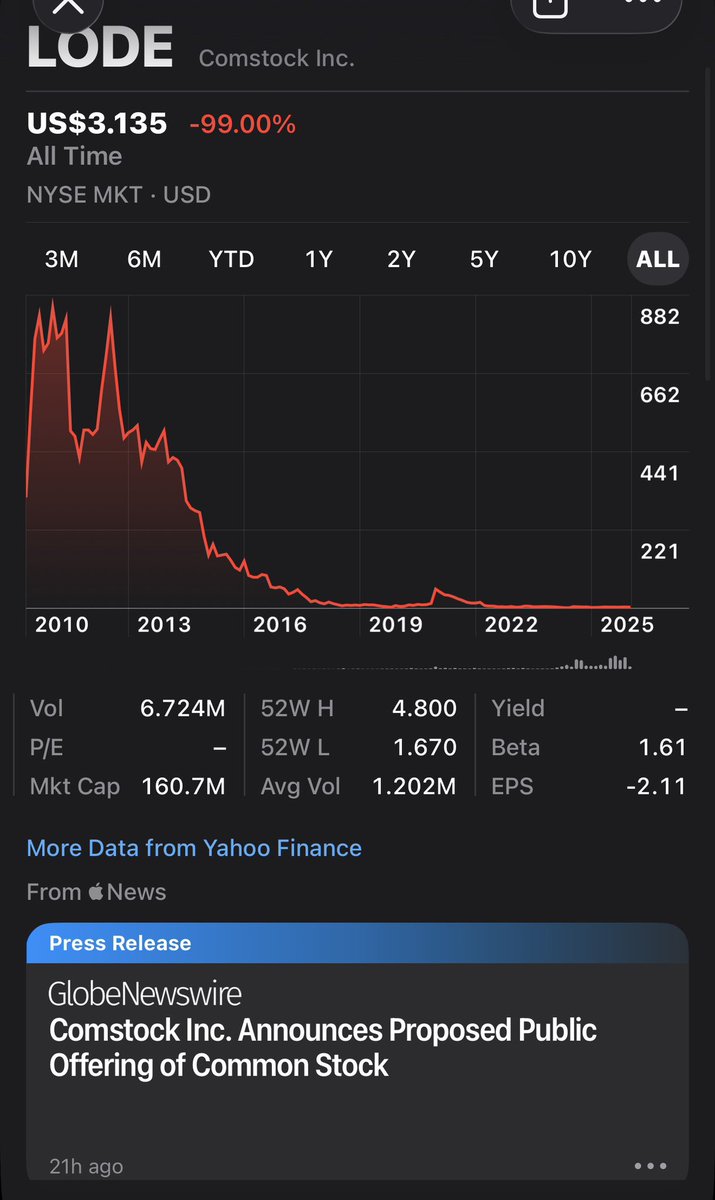
Corrado DeGasperis@CDe_Gasperis
$LODE Production coming on line / funded #urbanmining #silver #comstock
English
@ShadySci @broheim777 @valueventurez @Meditate_Run @CDe_Gasperis From memory: he was initially suggesting that the deal could be closed Feb, en later suggested around the 10K. I get that he was intentionally vague, but still, was expecting more than only SSOF ownership updates, as Robert expects.
English
@sandy_slipper @broheim777 @valueventurez @Meditate_Run @CDe_Gasperis What exactly do you believe Corrado "stated"? Check his exact words from transcripts
English
@CDe_Gasperis $LODE at the IAlpha investor conference, CEO reiterated that we will see an update to LODE’s equity stake in SSOF. I want to see at least 30% given the transfers. A deal should bring in ~ $500mm, or net $150mm to $LODE- good for $3 pop imho
English
@broheim777 @ShadySci @valueventurez @Meditate_Run @CDe_Gasperis Thanks both. I understand your skepticism. For me, this is a real test, one that will help determine whether Corrado can be trusted and whether we continue to hold our long $LODE position.
English
@ShadySci @valueventurez @sandy_slipper @Meditate_Run @CDe_Gasperis $LODE no doubt Corrado is vague but most likely constrained by NDA. Regardless, I think this 10K will have to be very transparent as related party transfers trigger disclosure. My base case is we now control 30-33% of SSOF
English
@broheim777 @ShadySci @valueventurez @Meditate_Run @CDe_Gasperis I understood that a specific deal would be disclosed on Tuesday, at least based on what Corrado stated. I hope there are no more delays. Why would you expect that the deal would not be expressly mentioned?
English
@ShadySci @valueventurez @sandy_slipper @Meditate_Run @CDe_Gasperis $LODE I think they will detail where the money went i.e., Line Extension Agreement post Nighthawk CUP that increases the value of SSOF as power is secured. A definitive deal I suspect is not expressly mentioned but very close. Lets see.
English
@AndreasSteno @chrisbackus5 @MaxNordau @beardedmiguel I guess some people just desperately want to believe some one dimensional secret...
English

English

@ShadySci @Meditate_Run @broheim777 @CDe_Gasperis Agree the previous loans were unethical, but now is the time for Corrado to make amends. Since he appears to take the allegations seriously, at the very least he should ‘buy’ $LODE shares with the personal gains he made at shareholders’ expense. Hope we won’t be disappointed.
English
@Meditate_Run @sandy_slipper @broheim777 @CDe_Gasperis Assuming @CDe_Gasperis as SSOF's CEO gives LODE equity in return is a big ask. He's shown he'd rather do interest free loans against LODE's interests (and the LODE board who own SSOF too deem it OK), to SSOF's advantage. Be prepared to be disappointed. I hope to be wrong.
English
@UDiamondBalls Haha I was also thinking like this 😂. Valuation is crazy low. But not sure how to balance valuation and management trust
English
@SunvMikey Yes interesting. Isn’t the difficulty that timelines of Renergen phase 2 are not fully certain yet and probably require more dilution as per the latest call? Difficult to predict how long helium prices will stay raised, and how much $ASPI will benefit
English

$ASPI great post. ASPI need to lock in. Losing early mover advantage would be disastrous (especially for $QLE... we already see this with competitors landing massive government grants / contracts yet none for ASPI)
Also a question that should be asked is is the helium already locked into contracts at a set price? Price increase worldwide won't matter if contracts are already locked in 👍
IU C🅰️T@shihchiehlee
$ASPI Completely agree! Helium is almost irreplaceable in semiconductor cooling and fabrication. The Middle East (especially Qatar) has been a major source (~30–33% global supply), and the Iran conflict has created a real ~30% global deficit — definitely not minor. However, the US has multiple new helium developments from natural gas fields ramping up (e.g., Wyoming Dry Piney, Minnesota Topaz projects). Korea, Japan, and Taiwan have strong US ties, so allies will shift to secure American/North American supply — ultimately benefiting US-linked producers. But it's not all rosy for $ASPI alone; other players like ExxonMobil, Linde, and emerging pure-helium companies are also expanding — we can't be fully optimistic. Dispersed alternatives (Canada, Utah new projects) can help mitigate demand. For $ASPI, the swift execution of Phase One (targeting 58 MCF/day), committing ~170 million in capital to unlock Phase Two additional financing (500 to 750 million) are the real milestones and stock growth drivers. Ultimately, what drives the stock price and valuation is whether the company can actually deliver and land these projects — not repeated delays. Everything depends on actual execution and delivery, not just macro talk or war headlines. At least, we see how Paul has been setting a milestone for investors to follow, to ensure if he can do execution. Bullish on execution, but staying cautious!
English
@CryptoOwly @BeenThereCap Did you think any of the biotech or mining deals made much sense? Maybe Renergen did. In any case, the explanations seemed vague to me. It felt like he didn’t even try to justify spending millions of shareholders’ money on new areas
English


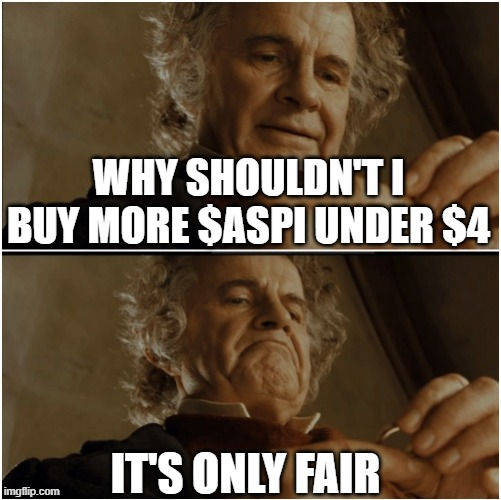
The $ASPI sentiment and chatter has swung entirely from "look at all the potential ways to win big!" to "Paul Next-Quarter Mann will botch every shot on goal."
The truth is in the middle. The current $4 price is just as dumb as $14 was in October.
English
@BeenThereCap … has even spent money in a related-party deal that has ‘unethical’ written all over it while acting as CEO of another company. None of these issues are openly addressed, as Paul actively discourages open dialogue by scripting investor calls. This is why $ASPI is not at 14
English
@BeenThereCap Well, I guess this swing is not really about valuation. It's about finding out that the $ASPI CEO has repeatedly lied about timelines, randomly buys unrelated mining and biotech assets to divert attention from the core, and ...
English
@SunvMikey Haha, fully agree to your post. Few too many red flags for me.
English
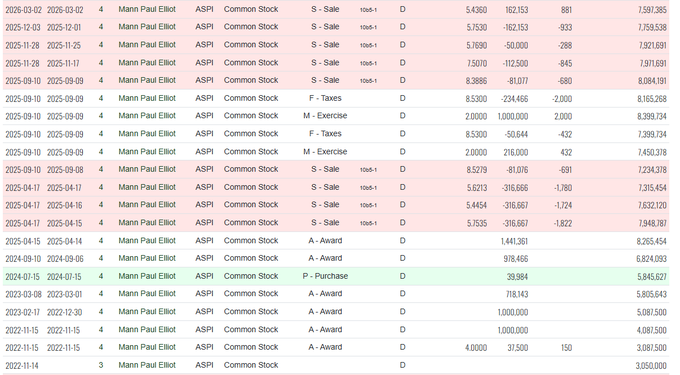
$ASPI $SKBL shareholders deserve better. Paul Mann has destroyed shareholder value and needs to be replaced. The track record of broken promises, moving goalposts and self enrichment is undeniable at this point. Here is the reality of ASPI under current management
The endless delays and pivots
Silicon-28 and O-Rings: Claimed commercialization was imminent, then abruptly paused operations to replace compressor O-rings. Still no firm restart date?
Ytterbium-176: Touted as complete 9 months early, only to later admit to a "catastrophic laser failure" pushing commercial scale out to late 2026
SKBL Asian Mining Asset: Promised a definitive announcement "in the coming weeks" back in Dec 2025 (meant to be EOY announcement) Almost 4 months later no announcement yet. 3 months ago it was "coming in a few weeks"
Carbon-14 Feedstock: Blamed an 18-month delay on supply chains. Pushed revenue generation from early 2026 to vaguely "expected to arrive."
Molybdenum-100: Hyped $27M/year BRICEM contract from 2022. Deliveries were supposed to start in 2023. FY24 total company revenue was a miserable $4.1M. The contract never materialized (yet they tweeted about it semi recently)
Free Cash Flow: Management projected substantial FCF in 2024 to fund expansion. The reality? A massive cash burn of -$26M to -$28M
While shareholders hold the bag on constant dilution to keep the lights on, management is burning capital instead of fixing their core enrichment operations (think the Opengo deal recently wtf was that?) ASPI just dumped $10 million into an Israeli biotech company working on fibrosis and cancer therapeutics. Why is a cash-burning isotope enrichment company taking venture capital bets on early-stage biotech? Because CEO Paul Mann and director Todd Wider personally held interests in the firm lol!!! They are using shareholder funds to boost their own private investments while ASPI's core operations stall out.
Paul Mann in the last two years alone has sold 9.6M worth of stock (more if you count what he sold for tax) Why is he being awarded millions in shares for missing every single deadline? Paul Mann is treating this company to fund his lifestyle (DYOR on what a lifestyle stock is they exist) and is not focused on meeting deadlines (why would you be when you are happily enjoying your millions at the expense of retail)
To top it off Mann is acting as the CEO/Executive Chairman of completely unrelated companies instead of fixing the operational disasters here and restoring trust in ASPI shareholders.
The market is tired of the dilution, the delays, the self-dealing, and the lies. It's time for accountability and new leadership.
I have no doubt this will piss some people off. Unfortunately for them this account is NOT an echo chamber. Paul Mann needs to go. There is no defending him anymore. Did I miss a lie? Add it below
English