

Warrne Pise
1.7K posts
Warrne Pise
@sapskm
An IT Professional, ReTweet and likes are not endorsement.
Sharjah, United Arab Emirates Katılım Eylül 2011
119 Takip Edilen53 Takipçiler

Discussed these dynamics last Friday w/ @michaelsantoli (last 90 seconds of link below).
youtube.com/watch?v=X4ehXm…
YouTube
English
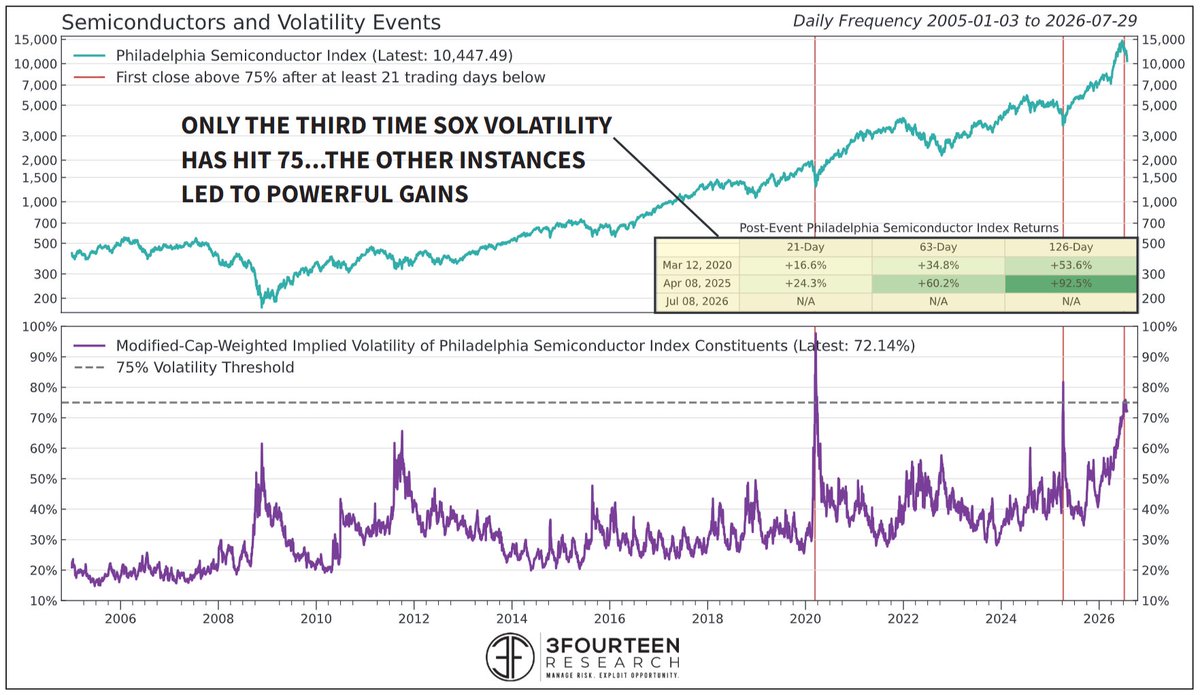
The Leopold liquidation pushed semiconductor single-stock volatility up to 75% (SOX Index).
This is only the third time semi volatility has reached this level. The other two instances: March 2020 and April 2025.
English
Semis were a massive driver of the S&P 500's elevated constituent-level volatility (VIXEQ) over the course of July.

English
Looks like AWS kept it going
Warren Pies@WarrenPies
Hyperscaler cloud revenue growth holds the key to this earnings season and is a likely catalyst to normalize low index correlations in a benign way (excerpt from last week's @3F_Research client report). $MSFT was first step along this path...$AMZN on deck.
English

It is always worth paying attention to Warren's comments.
Warren Pies@WarrenPies
Hyperscaler cloud revenue growth holds the key to this earnings season and is a likely catalyst to normalize low index correlations in a benign way (excerpt from last week's @3F_Research client report). $MSFT was first step along this path...$AMZN on deck.
English
Hyperscaler cloud revenue growth holds the key to this earnings season and is a likely catalyst to normalize low index correlations in a benign way (excerpt from last week's @3F_Research client report).
$MSFT was first step along this path...$AMZN on deck.

English
There’s a big difference between forward guidance and explaining a reaction function.
Warsh still has not demonstrated that he understands the difference.
Warren Pies@WarrenPies
The idea that markets will trade off "data" now rather than the Fed's reaction function is oddly circular. Less, or no, forward guidance obscures the reaction function and introduces a higher risk premium into asset pricing. But, the market will still interpret each incoming data point through its perception of the Fed's reaction function. (i.e. does this data move the Fed closer to a tightening or loosening of policy). For better or worse, the Fed is still at the center of the financial universe. That is the system we have. Getting rid of forward guidance does not decrease the Fed's influence on capital markets (Marty Zweig was saying "don't fight the fed" 55 years ago - long before the "dots"). From my perspective, the main benefit of removing forward guidance is increased responsiveness to changing conditions/data. Making a public forecast hinders your ability to stay flexible/react. If FOMC members hold their cards closer to the vest, then they will be able to change their minds more freely.
English
That's the conventional wisdom...and is true sometimes.
But, in this regime, the paper market is dictating direction. Once managed money short % got up to 42%, it was obvious that a rally was coming.
We all would have told ourselves a story for why the rally happened (undervalued, inventories, rebalancing, geopol, etc.). Mostly pretext.
Just my 2cents...I won't be long anymore once the positioning flips/shorts all cover.
English
Learning - once again - that positioning is everything in the crude market these days.
Positioning dictates direction...fundamentals/news flow dictate the amplitude of the move.
Warren Pies@WarrenPies
OIL Managed Money short positions >40% (third highest reading in 15 years + Record crack spreads = recipe for a solid bottom. The question is how big will the bounce be?
English
@3PeaksTrading Look at semi IV and skew…going to be a tough nut to crack…especially if k3 is a fundamental tailwind (it is).
English

GPU availability tightening back up...
B200 availability was already at 0%.
Post-Kimi K3, GH200 tightening aggressively.
The @3F_Research "Fast" Availability Index heading back below 10%.

English

The price at which North America can produce 200 Bcf/d is like $5 USD/MMBtu. It's not $10 USD/MMBtu, and there will never be a shortage.
Matthew Smith, DM me and we can talk, your conclusion is very, very wrong.
Patrick OShaughnessy@patrick_oshag
Matthew Smith has spent the last 18 months modeling every well, pipeline, storage facility, and power plant in the American natural gas system. His conclusion is that the US is heading toward a natural gas shortage with no precedent, beginning in 2028. By 2030, he believes we could exhaust our working natural gas storage entirely. The fuel everyone in AI is counting on, and that everyone assumes is abundant, is not there. And because gas sets the price of electricity in most of the country, he argues Americans will pay for the shortage in their power bills. Matthew has worked in energy markets for over 20 years and is the CIO of Chronometer Partners. This is his second time on the show, and he's one of my favorite people to talk to about energy. We discuss: - Why the bottleneck is moving from power to fuel - Why we can't just shut off exports - 2028 as the inflection point - Large-scale nuclear v. SMRs - Who wins, who loses, and what can still be done Enjoy! TIMESTAMPS 0:00 Intro 1:30 What Drives the Deficit 11:00 Why Supply Can’t Catch Up 20:35 The 2030 Gas Crisis 25:05 Winners and Losers 29:00 Nuclear and Solar 33:30 Consumers Pay the Bill 37:20 AI’s Next Shortage 45:25 Solutions and Global Stakes 51:15 The Coming Gas Knife Fight
English

Low beta turned into negative beta which makes things really difficult.
If I buy hc when it’s getting puked, am I just shorting momentum?
If I buy hc now, am I just shorting ai deep in the hole?
Case has never been stronger for being disciplined and finding highly idiosyncratic ideas that *might* work either way.
Warren Pies@WarrenPies
One interesting change in market structure during the AI era has been the negative correlation that so many non-tech stocks have with semis. Purple line of the chart below plots the 10th percentile of non-Tech S&P 500 stocks correlation to semis. Most negative its ever been
English
Add this to the fact that semis have become synonymous with momentum and beta and you have the rotational mix that has defined July so far.
The K3 drama is interesting b/c, as it hurts labs, it may hurt hyperscalers by proxy (lab counterparties). Obviously hyperscalers have been a common rotation destination for the month. Said differently, it can boost intra-market correlations from record lows...
x.com/MacroCharts/st…
Macro Charts@MacroCharts
One of the most important charts I'm watching: *Plus what it means for asset allocation today, and opportunities/risks. These are massive themes that could dominate the rest of 2026...
English
One interesting change in market structure during the AI era has been the negative correlation that so many non-tech stocks have with semis.
Purple line of the chart below plots the 10th percentile of non-Tech S&P 500 stocks correlation to semis.
Most negative its ever been

English
@TMTLongShort You see anything in the benchmark results that suggest this is more than distillation? We are waiting to get access and run through our internal benchmarking...
English

Distillation is the biggest threat to the U.S. economy.
The government should be providing all resources to combat it.
We should be putting CEOs and all employees of Chinese labs who blatantly utilize nefarious tactics on entities lists.
US cloud providers should not be allowed to serve Chinese models on any cloud they operate including AWS and Azure in Europe.
The government should be coordinating across labs behind closed doors.
They should be reverse attacking sources of distillation using unreleased models with advanced capabilities with the aim of completely destroying their IP and networks.
This is war. Act like it and shove Gurley into a fucking locker.
English