

Sarah Chen
26 posts


What’s the point of a “helpful assistant” if you have to always tell it what to do next?
In a new paper, we introduce a reasoning model that predicts what you’ll do next over long contexts (LongNAP 💤).
We trained it on 1,800 hours of computer use from 20 users.
🧵
English

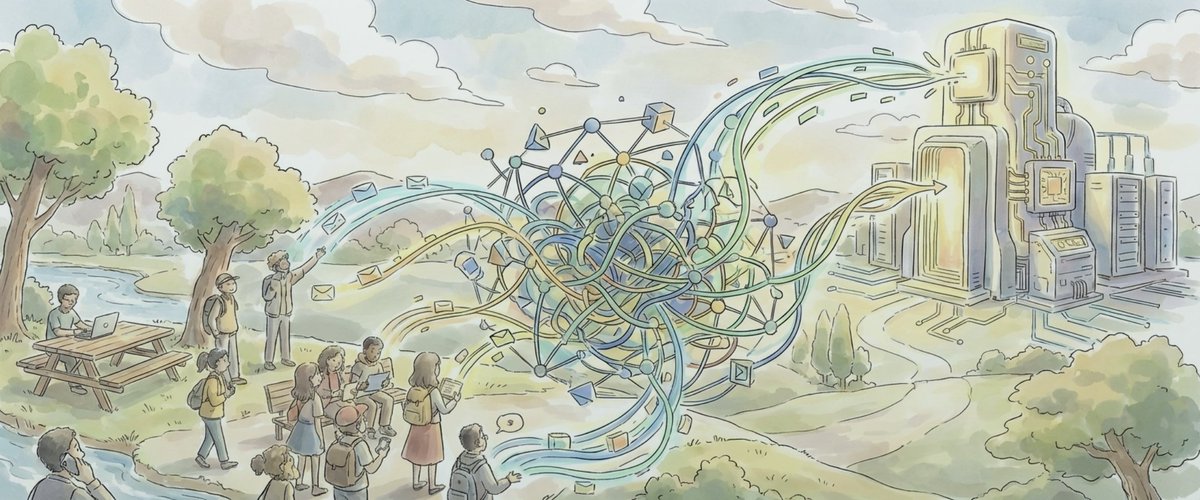
Can we build a blind, *unlinkable inference* layer where ChatGPT/Claude/Gemini can't tell which call came from which users, like a “VPN for AI inference”?
Yes! Blog post below + we built it into open source infra/chat app and served >15k prompts at Stanford so far. How it helps with AI user privacy:
# The AI user privacy problem
If you ask AI to analyze your ChatGPT history today, it’s surprisingly easy to infer your demographics, health, immigration status, and political beliefs. Every prompt we send accumulates into an (identity-linked) profile that the AI lab controls completely and indefinitely. At a minimum this is a goldmine for ads (as we know now). A bigger issue is the concentration of power: AI labs can easily become (or asked to become) a Cambridge Analytica, whistleblow your immigration status, or work with health insurance to adjust your premium if they so choose.
This is a uniquely worse problem than search engines because your average query is now more revealing (not just keywords), interactive, and intelligence is now cheap. Despite this, most of us still want these remote models; they’re just too good and convenient! (this is aka the "privacy paradox".)
# Unlinkable inference as a user privacy architecture
The idea of unlinkable inference is to add privacy while preserving access to the remote models controlled by someone else. A “privacy wrapper” or “VPN for AI inference”, so to speak.
Concretely, it’s a blind inference middle layer that:
(1) consists of decentralized proxies that anyone can operate;
(2) blindly authenticates requests (via blind signatures / RFC9474,9578) so requests are provably sandboxed from each other and from user identity;
(3) relays prompts over randomly chosen proxies that don’t see or log traffic (via client-side ephemeral keys or hosting in TEEs); and
(4) the provider simply sees a mixed pool of anonymous prompts from the proxies. No state, pseudonyms, or linkable metadata.
If you squint, an unlinkable inference layer is essentially a vendor for per-request, anonymous, ephemeral AI access credentials (for users or agents alike). It partitions your context so that user tracking is drastically harder.
Obviously, unlinkability isn’t a silver bullet: the prompt itself still goes to the remote model and can leak privacy (so don't use our chat app for a therapy session!). It aims to combat *longitudinal tracking* as a major threat to user privacy, and its statistical power increases quickly by mixing more users and requests.
Unlinkability can be applied at any granularity. For an AI chat app, you can unlinkably request a fresh ephemeral key for every session so tracking is virtually impossible.
# The Open Anonymity Project
We started this project with the belief that intelligence should be a truly public utility. Like water and electricity, providers should be compensated by usage, not who you are or what you do with it. We think unlinkable inference is a first step towards this “intelligence neutrality”.
# Try it out! It’s quite practical
- Chat app “oa-chat”: chat.openanonymity.ai
(<20 seconds to get going)
- Blog post that should be a fun read: openanonymity.ai/blog/unlinkabl…
- Project page: openanonymity.ai
- GitHub: github.com/OpenAnonymity
English
Sarah Chen retweetledi

Congrats on the launch @simile_ai ! (and I am excited to be involved as a small angel.)
Simile is working on a really interesting, imo under-explored dimension of LLMs. Usually, the LLMs you talk to have a single, specific, crafted personality. But in principle, the native, primordial form of a pretrained LLM is that it is a simulation engine trained over the text of a highly diverse population of people on the internet. Why not lean into that statistical power: Why simulate one "person" when you could try to simulate a population? How do you build such a simulator? How do you manage its entropy? How faithful is it? How can it be useful? What emergent properties might arise of similes in loops?
Imo these are very interesting, promising and under-explored topics and the team here is great. All the best!
Joon Sung Park@joon_s_pk
Introducing Simile. Simulating human behavior is one of the most consequential and technically difficult problems of our time. We raised $100M from Index, Hanabi, A* BCV, @karpathy @drfeifei @adamdangelo @rauchg @scottbelsky among others.
English


Excited to be working on the frontier of simulation with this incredible team!
Simile@simile_ai
English
Sarah Chen retweetledi

Sarah Chen retweetledi

Introducing Simile.
Simulating human behavior is one of the most consequential and technically difficult problems of our time.
We raised $100M from Index, Hanabi, A* BCV, @karpathy @drfeifei @adamdangelo @rauchg @scottbelsky among others.
English
Sarah Chen retweetledi

Six months ago, I took leave from Stanford and jumped on the Simile rocket ship! This has been the most exciting time of my life!
Developing our simulations is a truly magical experience. One very quickly gets the sense that there are thousands of people living in the computer.
They have spent long and interesting lives in the real world, and now, we get to talk to their similes, to understand why they see the world the way they do, and learn how to make their lives as rich and fulfilling as possible.
It will be a superpower for humanity to more concretely answer questions about all systems with people in them, which have historically relied on poor approximations for analysis.
If you also can’t stop thinking of amazing things to do with simulation, please shoot me an email or DM - Simile might be a great place for you.
English

Simile is out of stealth!
At Simile, we have built the first AI simulation of society, populated by agents based on real humans.
We are building a foundation model that predicts human behavior in any situation, and a product that deploys it at scale.
Thrilled to be on this mission.
Simile@simile_ai
English
Sarah Chen retweetledi

It’s not every day you come across a genuinely new, seemingly sci-fi idea like Simile's: to simulate human behavior by partnering deeply with real people to build high-fidelity models of how they live and make decisions. It’s even rarer to find a team that’s so uniquely suited to bring that vision to life.
When we first met @joon_s_pk, @percyliang, and @msbernst , it was clear that this wasn’t just an ambitious idea - it was one they were singularly qualified to pursue. Together, they introduced the original concepts of generative agents, rich agentic simulations, and literally the term “foundation model.” Few teams have contributed more directly to the foundations of modern AI - or are better positioned to extend them.
The market pull is undeniable. Across industries and geographies, organizations instantly see how Simile’s simulations can help them reason about decisions before committing to action, and the demand is staggering.
We’re excited to lead Simile’s $100M Series A and to partner with Joon, Percy, Michael, @elainayallen, @mihikapoor, and the rest of the phenomenal team as they build foundational infrastructure for decision-making in an AI-native world.
Simile@simile_ai
English
Sarah Chen retweetledi

Today we're launching Simile, the simulation company. What happens when AI can help you foresee how real people will respond to your decisions, your ideas, your products, and your policies?
Simile@simile_ai
English
Sarah Chen retweetledi


New year, new continent, new company - and a powerful new way to understand consumers
Honoured and beyond excited to be building with the amazing team at @simile_ai !!
Simile@simile_ai
English
Sarah Chen retweetledi

sim the people, sim the world, join simile.
they kick ass.
@joon_s_pk @msbernst @percyliang @ElainaYallen @mihikapoor
Simile@simile_ai
English