sagar

812 posts

sagar banner
sagar

sagar

@schopsss

Co-founder @empower_sleep | Personalized sleep care, online | Prev @uber @dormroomfund @wharton @lauderinstitute


Los Angeles, CA Katılım Ekim 2014
368 Takip Edilen288 Takipçiler
joshua
joshua@4xiom_·
@schopsss @FarzaTV we really put effort in the onboarding, glad u liked it. healthcare/research is a big winner here. will work on it this week 🫡 any suggestions DMs are open
English
1
0
1
25
Farza 🇵🇰🇺🇸
Here's the new Clicky. It's the simplest interface in the world to talk to AI + spawn agents. It builds Mac apps. It does research to help you find IG micro-influencers. It interacts with native Apple Notes, Calendar, Reminders. Built for consumers, 0 setup. Try today, free.

English
447
323
6K
1.1M
Stuart Blitz
Stuart Blitz@StuartBlitz·
It’s so dumb that physicians need to get a medical license in every state. They all have different processes and takes forever. Why doesn’t a startup create a national medical license? Physicians just pay an annual fee and can practice anywhere. Is anyone building this?
English
327
37
739
92.1K
sagar
sagar@schopsss·
@paulcerro Not really. Success in sleep medicine comes down to candidate selection for the right therapy. We’ve treated thousands of people with sleep apnea. CPAP is not always the best treatment. We have objective data to measure this.
English
0
0
1
31
Paul Cerro
Paul Cerro@paulcerro·
@schopsss Literally the best treatment for sleep apnea is CPAP. That's not an opinion, it's a fact
English
1
0
0
59
Paul Cerro
Paul Cerro@paulcerro·
Funny enough, I also looked at the sleep category while at Ro, and spoiler, it wasn't worth it. You largely have to do insurance because most insurance plans cover CPAP machines for patients since it's an actual health problem. $HIMS doesn't do insurance. Cash pay doesn't make any sense because you're shipping expensive products (which eats into cash to hold inventory) that weigh a lot more than pills or vials. The market just isn't big enough for a cash pay player to make much money on it. The margins are low, and additionally, when you think about weight loss, many instances people breathe better at night BECAUSE they are able to lose weight. This isn't a reasonable assessment from this guy, and to say it's another billion-dollar opportunity is just lunacy. Barriers to entry and hurdles to even getting access to this are immense AND you're going against insurance coverage for this. Good luck with that.
Hims House@himshouse

.@davidmaris says sleep is a billion-dollar opportunity for $HIMS and nobody on Wall Street has priced it in: "I haven't seen any sell-side report talk about the sleep opportunity. And to me that's another billion-dollar opportunity for them. I think it's just a home run for them." "[Medical supply companies and sleep centers] argue that you need to have the mask fitted, and they will say, oh, well this machine might be better for you than this other machine. And to me it's all BS. 98% of it's BS." "Because they're getting another fee for this. You don't know what payments they're getting on the backend for saying this machine's better than that machine. There's no transparency." "If $HIMS is interested in helping patients and making this transparent, they would say, look, we have these two machines, these three machines, five machines, whatever. We're gonna sell it to you at cost plus, we're gonna deliver it to your house." "You don't have to go anywhere. So you've taken away all this friction and you're also getting an older patient. It's another great patient pool. So I think this is a great way to revolutionize the sleep area."

English
3
1
13
8.8K
sagar
sagar@schopsss·
Sleep is massive. A few things are happening: - aging customer segment into osa that’s cognizant of sleep health - more screening via better sensors and wearables (this is huge) - alternative therapies, other than cpap The challenge with most sleep companies in the past is that they’ve indexed on cpap as the endpoint. The key is that cpap is just one of many therapies, and often not the one that works. Also, humans always need long-term monitoring and care (because so much of sleep is behavioral and physiology always evolves)
Andy Salamon@AndySalamon

This is 100% correct. The right customer segment just needs to age into the OSA disease category, and we’re getting pretty close. 3-5 years this will explode. @BreatheNSleepMD @schopsss are building that size company is my bet. @AndrewDudum knows all about this area btw🤣

English
0
0
0
44
sagar
sagar@schopsss·
Sleep is massive. A few things are happening: - aging customer segment into osa that’s cognizant of sleep health - more screening via better sensors and wearables (this is huge) - alternative therapies, other than cpap. With longitudinal testing, we see that cpap can often destroy sleep and create fragmentation
English
0
0
1
19
Andy Salamon
Andy Salamon@AndySalamon·
This is 100% correct. The right customer segment just needs to age into the OSA disease category, and we’re getting pretty close. 3-5 years this will explode. @BreatheNSleepMD @schopsss are building that size company is my bet. @AndrewDudum knows all about this area btw🤣
Hims House@himshouse

.@davidmaris says sleep is a billion-dollar opportunity for $HIMS and nobody on Wall Street has priced it in: "I haven't seen any sell-side report talk about the sleep opportunity. And to me that's another billion-dollar opportunity for them. I think it's just a home run for them." "[Medical supply companies and sleep centers] argue that you need to have the mask fitted, and they will say, oh, well this machine might be better for you than this other machine. And to me it's all BS. 98% of it's BS." "Because they're getting another fee for this. You don't know what payments they're getting on the backend for saying this machine's better than that machine. There's no transparency." "If $HIMS is interested in helping patients and making this transparent, they would say, look, we have these two machines, these three machines, five machines, whatever. We're gonna sell it to you at cost plus, we're gonna deliver it to your house." "You don't have to go anywhere. So you've taken away all this friction and you're also getting an older patient. It's another great patient pool. So I think this is a great way to revolutionize the sleep area."

English
1
0
3
188
sagar
sagar@schopsss·
False. You can do home sleep tests now, which get you most of the way there in 90-95% of cases. Plus it’s better because it’s more reflective of your own sleep (in your bed) and you can also do it longitudinally. It just doesn’t make sense for complex cases (eg. Complex osa). In that case, you can use a device like Onera (also home based). Most sleep testing will eventually move into the home. More wearables will also get fda approval for screening.
English
0
0
3
55
Adam May
Adam May@A_May_MD·
@himshouse @davidmaris Not a chance. This is a primarily insurance based market, and you DO actually have to have physical tests done in person to make these diagnoses…what’s the point of HIMS in this process? Another low margin non-opportunity. It will go nowhere.
English
1
0
12
2.1K
Hims House
Hims House@himshouse·
.@davidmaris says sleep is a billion-dollar opportunity for $HIMS and nobody on Wall Street has priced it in: "I haven't seen any sell-side report talk about the sleep opportunity. And to me that's another billion-dollar opportunity for them. I think it's just a home run for them." "[Medical supply companies and sleep centers] argue that you need to have the mask fitted, and they will say, oh, well this machine might be better for you than this other machine. And to me it's all BS. 98% of it's BS." "Because they're getting another fee for this. You don't know what payments they're getting on the backend for saying this machine's better than that machine. There's no transparency." "If $HIMS is interested in helping patients and making this transparent, they would say, look, we have these two machines, these three machines, five machines, whatever. We're gonna sell it to you at cost plus, we're gonna deliver it to your house." "You don't have to go anywhere. So you've taken away all this friction and you're also getting an older patient. It's another great patient pool. So I think this is a great way to revolutionize the sleep area."
Hims House@himshouse

🚨 THE BILLION-DOLLAR OPPORTUNITY FOR $HIMS THAT WALL STREET IS "SLEEPING" ON @davidmaris - six-time #1 ranked pharma analyst, founder of Phalanx Investment Partners 02:56 - Compounded semaglutide pill saga 05:49 - The "steelman" for why Hims launched the pill 07:29 - Novo deal economics 14:29 - MEDVi scandal and wild west of GLP-1s 18:19 - Peptides going mainstream 25:57 - July FDA meeting 31:27 - TRT = billion-dollar opportunity 35:31 - Sleep Sleep Sleep Sleep 37:26 - Friction in getting diagnosed 38:04 - The CPAP supply chain problem 39:17 - How Hims could revolutionize sleep 43:04 - Eucalyptus and going global 46:16 - Cruise engineers (wtf are they building?!) 50:25 - Short interest still out of control 55:05 - Voting control and insider selling 59:46 - Valuation and Q1 warning signs 01:03:48 - Should Hims buy a teletherapy? 01:07:12 - Why Maris is long Hims 🔥 Not financial, legal, or medical advice

English
5
4
130
44.2K
Farza 🇵🇰🇺🇸
Farza 🇵🇰🇺🇸@FarzaTV·
This is Farzapedia. I had an LLM take 2,500 entries from my diary, Apple Notes, and some iMessage convos to create a personal Wikipedia for me. It made 400 detailed articles for my friends, my startups, research areas, and even my favorite animes and their impact on me complete with backlinks. But, this Wiki was not built for me! I built it for my agent! The structure of the wiki files and how it's all backlinked is very easily crawlable by any agent + makes it a truly useful knowledge base. I can spin up Claude Code on the wiki and starting at index.md (a catalog of all my articles) the agent does a really good job at drilling into the specific pages on my wiki it needs context on when I have a query. For example, when trying to cook up a new landing page I may ask: "I'm trying to design this landing page for a new idea I have. Please look into the images and films that inspired me recently and give me ideas for new copy and aesthetics". In my diary I kept track of everything from: learnings, people, inspo, interesting links, images. So the agent reads my wiki and pulls up my "Philosophy" articles from notes on a Studio Ghibli documentary, "Competitor" articles with YC companies whose landing pages I screenshotted, and pics of 1970s Beatles merch I saved years ago. And it delivers a great answer. I built a similar system to this a year ago with RAG but it was ass. A knowledge base that lets an agent find what it needs via a file system it actually understands just works better. The most magical thing now is as I add new things to my wiki (articles, images of inspo, meeting notes) the system will likely update 2-3 different articles where it feels that context belongs, or, just creates a new article. It's like this super genius librarian for your brain that's always filing stuff for your perfectly and also let's you easily query the knowledge for tasks useful to you (ex. design, product, writing, etc) and it never gets tired. I might spend next week productizing this, if that's of interest to you DM me + tell me your usecase!
Andrej Karpathy@karpathy

Wow, this tweet went very viral! I wanted share a possibly slightly improved version of the tweet in an "idea file". The idea of the idea file is that in this era of LLM agents, there is less of a point/need of sharing the specific code/app, you just share the idea, then the other person's agent customizes & builds it for your specific needs. So here's the idea in a gist format: gist.github.com/karpathy/442a6… You can give this to your agent and it can build you your own LLM wiki and guide you on how to use it etc. It's intentionally kept a little bit abstract/vague because there are so many directions to take this in. And ofc, people can adjust the idea or contribute their own in the Discussion which is cool.

English
236
378
4.8K
1.9M
sagar retweetledi
roon
roon@tszzl·
[explaining the baghavad gita to a16z] so it’s kind of like a podcast, but they’re on a chariot
English
136
381
5.5K
193.5K
sagar
sagar@schopsss·
Start with a sleep test before anything else. Use longitudinal sleep testing data to rule out underlying disorders, and also build a personalized protocol. It’ll save you a lot of time so you’re not guessing. You can do sleep testing from the comfort of your home now…the sensors have come a long way.
English
0
0
0
19
JoeWo
JoeWo@AverageJoeWo·
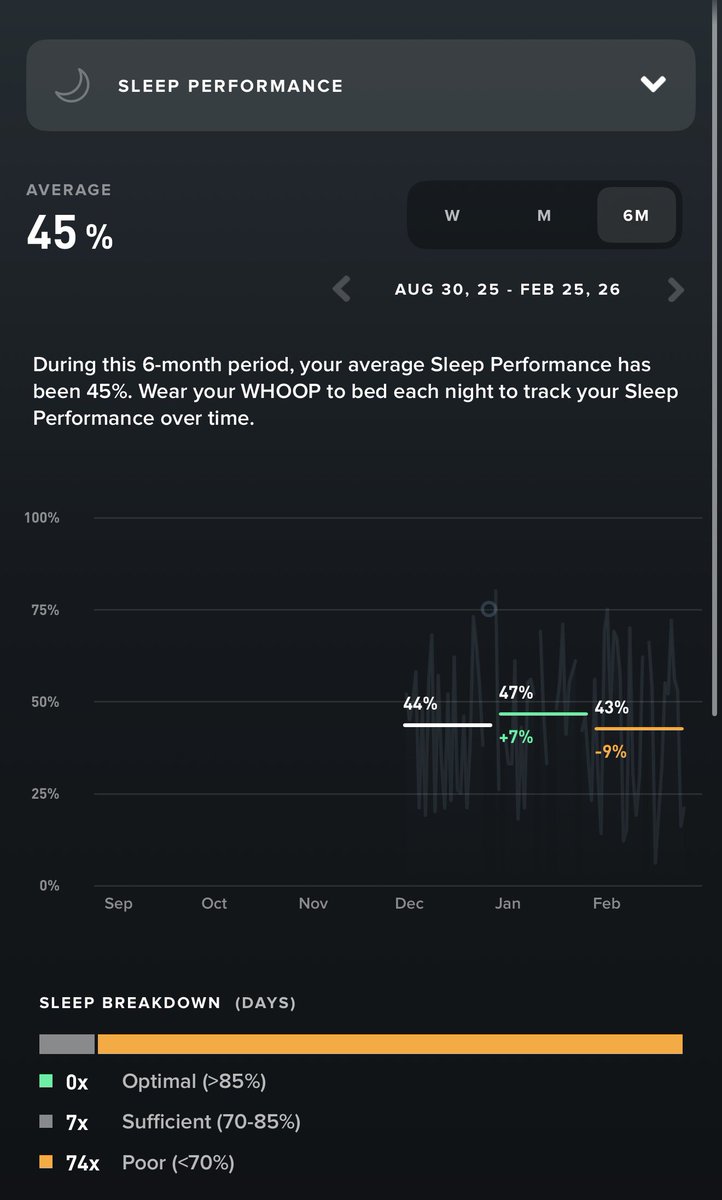
Can any sleep experts give me some pointers? Hands down this is the worst area in my fitness journey/life. I take magnesium glycinate every night and wake up around 6:30 everyday but can’t fall or stay asleep longer than 3 hours.
JoeWo tweet media
English
174
3
148
132.1K
sagar
sagar@schopsss·
@m_franceschetti Do we understand why the process of thermoregulation breaks down with aging?
English
0
0
0
31
Matteo Franceschetti
Matteo Franceschetti@m_franceschetti·
What disrupts the circadian rhythm of core body temperature during sleep is aging, not menopause alone. In a new study with postmenopausal women and age-matched men, we found: ➡️ Aging flattens the circadian rhythm of core temperature ➡️That flattening is linked to worse recovery ➡️Restoring temperature dynamics during sleep lowers HR by ~3% and increases HRV by ~11% overnight ➡️This restoration of the core temperature rhythm may also improve metabolic and cognitive function Sleep quality declines for biological reasons, but those reasons are measurable and addressable.
English
2
1
17
2.3K
Ben South
Ben South@bnj·
Introducing @variantui Enter an idea and get endless (beautiful) designs as you scroll No canvas, no skills or MCP, no constant prompting Reply if you'd like 200 free designs to give it try
English
2.2K
271
4.2K
1.1M
sagar
sagar@schopsss·
@AndrewSohrabi @thekaransinghal @IlyaAbyzov Really neat! Which wearables are you using to track? Just be cautious of using absolute values for sleep staging and architecture with consumer devices…will likely be off. But looking at it directionally wrt lifestyle correlations definitely helpful
English
1
0
0
33
Andrew Sohrabi
Andrew Sohrabi@AndrewSohrabi·
The AGI moment feels close especially when I can get ChatGPT Health to build and run ML models on my historical sleep data. Still hitting memory and timeout constraints but it kinda works on subsets of data with lightweight models cc @thekaransinghal @IlyaAbyzov
English
3
0
5
694
sagar retweetledi
Deepinder Goyal
Deepinder Goyal@deepigoyal·
Last one on this topic, and I have been holding this in myself for a while. For centuries, class divides kept the labor of the poor invisible to the rich. Factory workers toiled behind walls, farmers in distant fields, domestic help in backrooms. The wealthy consumed the fruits of that labor without ever seeing the faces or the fatigue behind it. No direct encounter, no personal guilt. The gig economy shattered that invisibility, at unprecedented scale. Suddenly, the poor aren't hidden away. They're at your doorstep: the delivery partner handing over your ₹1000+ biryani, late-night groceries, or quick-commerce essentials. You see them in the rain, heat, traffic, often on borrowed bikes, working 8–10 hours for earnings that give them sustenance. You see their exhaustion, their polite smile masking frustration with life in general. This is the first time in history at this scale that the working class and consuming class interact face-to-face, transaction after transaction. And that discomfort with our own selves is why we are uncomfortable about the gig economy. We want these people to look our part, so that the guilt we feel while taking orders from them feels less. We aren't just debating economics. We are confronting guilt. That ₹800 order might equal their entire day's earnings after fuel, bike rent, and app cuts. We tip awkwardly, or avoid eye contact, because the inequality is no longer abstract. It's personal. Pre-gig era, the rich could enjoy luxury without moral discomfort. Labor was out of sight. Now, every doorbell ring is a reminder of systemic inequality. That's why debates explode. It's not just policy. It's emotional reckoning. Some defend the system (“they choose it”), others demand change (“this isn't progress, its exploitation”). And here’s the uncomfortable twist: the unsaid ask of clumsy ‘solutions’ isn’t dignity. It is about returning to invisibility. Ban gig work and you don’t solve inequality. You remove livelihoods. These jobs don’t magically reappear as formal, protected employment the next day. They disappear, or they get pushed back into the informal economy where there are even fewer protections and even less accountability. Over-regulate it until the model breaks, and you achieve the same outcome through paperwork instead of slogans: the work evaporates, prices rise, demand collapses, and the people we claim to protect are the first to lose income. And then what happens? The rich get their old comfort back. Convenience returns without faces. Guilt dissolves. We go back to clean abstractions and moral posturing from a distance. The poor don’t become safer, they become invisible again: back in cash economies, back in backrooms, back in shadows where regulation rarely reaches and dignity isn’t even debated. The gig economy just exposed the reality of inequality to the people who previously had the luxury of not seeing it. The doorbell is not the problem. The question is what we do after opening the door. Visibility is the price of progress. We can either use this discomfort to build something better (which we keep doing continuously as delivery partners are our backbone), or we can ban and over-regulate our way back into ignorance. One of those choices improves lives. The other simply helps the consuming class feel virtuous in the dark.
English
2K
5.2K
25.5K
3.7M