

Scott Lowe
404 posts

@scottclowe
Postdoctoral Research Fellow in Machine Learning at Vector Institute. PhD in Computational Neuroscience. British.


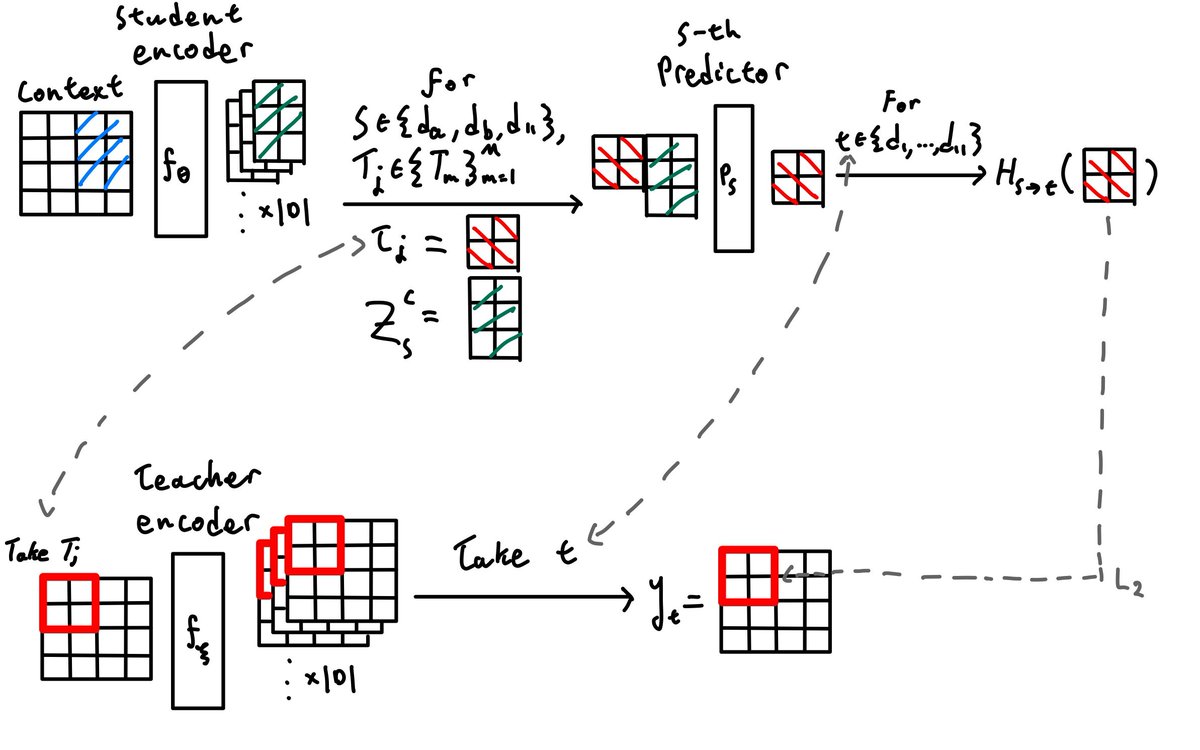
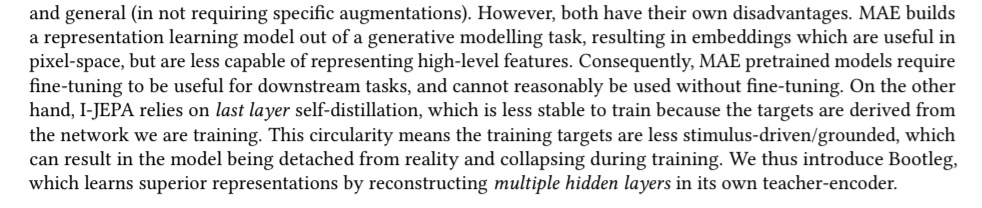
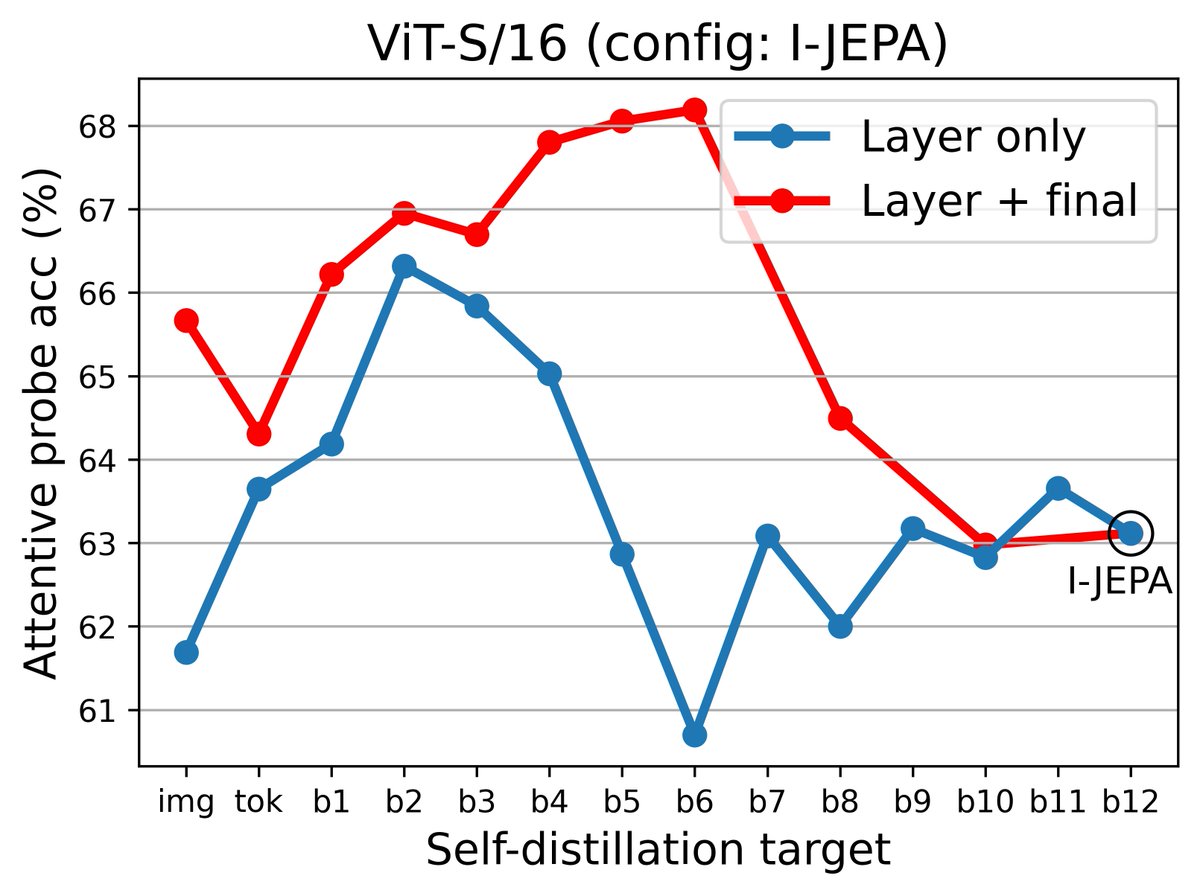
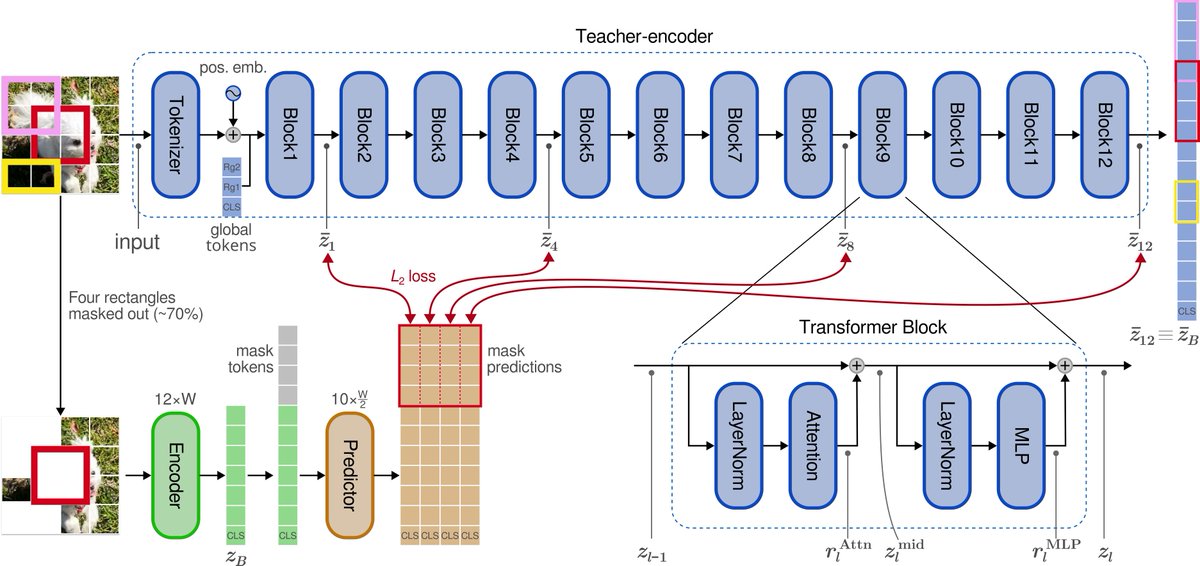
New paper: "Self-Distillation of Hidden Layers for Self-Supervised Representation Learning" We introduce Bootleg — a simple twist on I-JEPA/MAE that dramatically improves self-supervised representations. The idea: MAE predicts pixels (stable but low-level). I-JEPA predicts final-layer embeddings (high-level but unstable). Bootleg bridges the two by predicting representations from multiple hidden layers of the teacher network — early, middle, and late — simultaneously. Why it works: early layers provide stimulus-driven grounding that prevents collapse; deep layers provide semantic targets; and the information bottleneck of compressing all abstraction levels through masked patches forces the encoder to build richer representations. The method is quite simple on top of I-JEPA: extract targets from evenly-spaced blocks, z-score and concatenate, widen the predictor's final layer. That's it. Frozen probe results (no fine-tuning): ImageNet-1K: 76.7% with ViT-B (+10pp over both I-JEPA and MAE) iNaturalist-21: 58.3% with ViT-B (+17pp over I-JEPA, +15pp over MAE) ADE20K segmentation: 30.9% mIoU with ViT-B (+11pp over I-JEPA, +6pp over MAE) Cityscapes segmentation: 35.9% mIoU with ViT-B (+11pp over I-JEPA, +5pp over MAE) Gains hold across ViT-S, ViT-B, and ViT-L. Single-view, batch-size independent — no augmentation stack, no multi-crop, no contrastive loss, no large compute requirements. Our study is just on images, but this change can be readily deployed to MAE and JEPA models across all domains. arxiv.org/abs/2603.15553

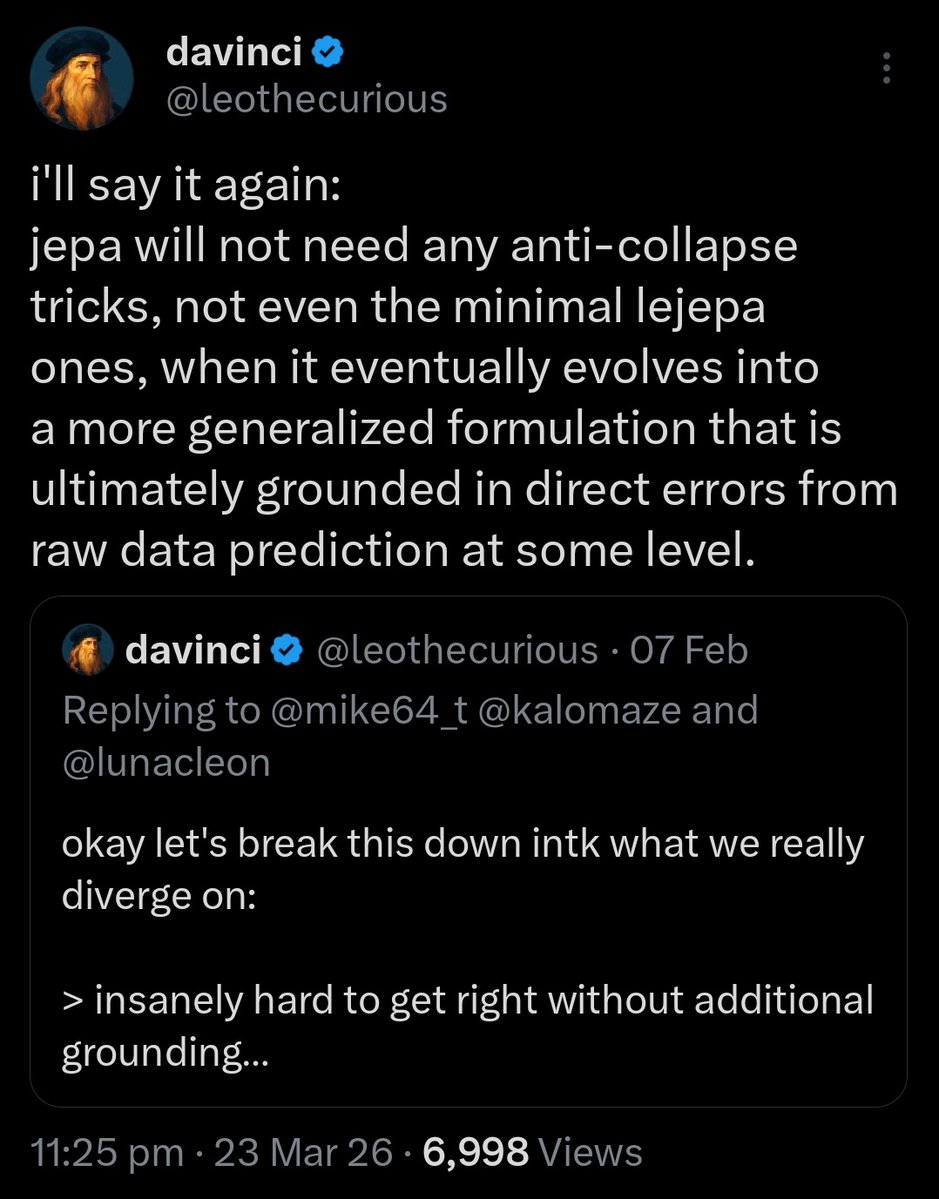
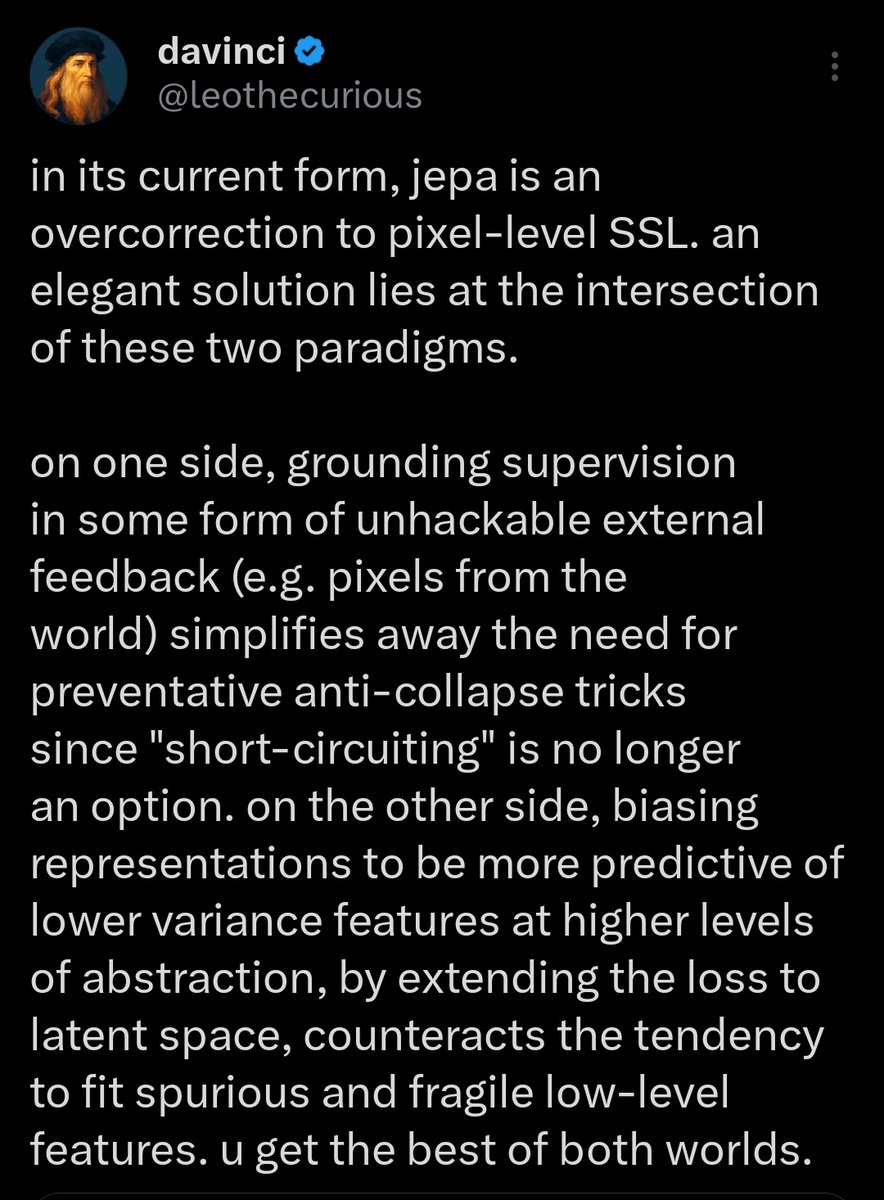
note: there's admittedly (and expectedly) more nuance to it than my previous posts implied and it seems like representation collapse can still be possible even with pixel grounding if the masked and seen patches are too visually close and can be trivially predicted


New paper: "Self-Distillation of Hidden Layers for Self-Supervised Representation Learning" We introduce Bootleg — a simple twist on I-JEPA/MAE that dramatically improves self-supervised representations. The idea: MAE predicts pixels (stable but low-level). I-JEPA predicts final-layer embeddings (high-level but unstable). Bootleg bridges the two by predicting representations from multiple hidden layers of the teacher network — early, middle, and late — simultaneously. Why it works: early layers provide stimulus-driven grounding that prevents collapse; deep layers provide semantic targets; and the information bottleneck of compressing all abstraction levels through masked patches forces the encoder to build richer representations. The method is quite simple on top of I-JEPA: extract targets from evenly-spaced blocks, z-score and concatenate, widen the predictor's final layer. That's it. Frozen probe results (no fine-tuning): ImageNet-1K: 76.7% with ViT-B (+10pp over both I-JEPA and MAE) iNaturalist-21: 58.3% with ViT-B (+17pp over I-JEPA, +15pp over MAE) ADE20K segmentation: 30.9% mIoU with ViT-B (+11pp over I-JEPA, +6pp over MAE) Cityscapes segmentation: 35.9% mIoU with ViT-B (+11pp over I-JEPA, +5pp over MAE) Gains hold across ViT-S, ViT-B, and ViT-L. Single-view, batch-size independent — no augmentation stack, no multi-crop, no contrastive loss, no large compute requirements. Our study is just on images, but this change can be readily deployed to MAE and JEPA models across all domains. arxiv.org/abs/2603.15553