SeBiN Devasia

274 posts

SeBiN Devasia banner
SeBiN Devasia

SeBiN Devasia

@sebindevasia1

Assistant Professor | PSGiTech | Dr. 👨🏽‍🔬 from @uanl | Materials Researcher| #lightmatterinteractions #CompMat #DFT

Coimbatore, Tamilnadu Katılım Mart 2013
716 Takip Edilen124 Takipçiler
SeBiN Devasia retweetledi
Goodfire
Goodfire@GoodfireAI·
Introducing self-correcting search: a technique to let diffusion models self-correct mid-trajectory. Working with @RadicalAI, we gave MatterGen a feedback loop from its own activations, improving viable on-target candidates by ~30%. (1/8)
GIF
English

8
58
465
82K
SeBiN Devasia retweetledi
Orbital
Orbital@OrbitalHardware·
Our AI agent just ran a full computational chemistry pipeline 🧪 Watch Steven, Member of Technical Staff at Orbital, demo our AI agent predicting the infrared spectrum and NMR chemical shifts of methanol using quantum chemistry. This is the kind of task a computational chemist would typically spend weeks setting up and executing manually. With our agent, it ran autonomously across 32 tool calls, starting from nothing but the name of a chemical. When results diverged from experiment, the agent identified the mismatch, explained why it occurred and suggested what you'd change in the workflow to get better agreement. Not just a number, a full contextualized picture of the science. Watch our agent in action 👇
English
0
4
13
1K
SeBiN Devasia retweetledi
Sakana AI
Sakana AI@SakanaAILabs·
The AI Scientist: Towards Fully Automated AI Research, Now Published in Nature Nature: nature.com/articles/s4158… Blog: sakana.ai/ai-scientist-n… When we first introduced The AI Scientist, we shared an ambitious vision of an agent powered by foundation models capable of executing the entire machine learning research lifecycle. From inventing ideas and writing code to executing experiments and drafting the manuscript, the system demonstrated that end-to-end automation of the scientific process is possible. Soon after, we shared a historic update: the improved AI Scientist-v2 produced the first fully AI-generated paper to pass a rigorous human peer-review process. Today, we are happy to announce that “The AI Scientist: Towards Fully Automated AI Research,” our paper describing all of this work, along with fresh new insights, has been published in @Nature! This Nature publication consolidates these milestones and details the underlying foundation model orchestration. It also introduces our Automated Reviewer, which matches human review judgments and actually exceeds standard inter-human agreement. Crucially, by using this reviewer to grade papers generated by different foundation models, we discovered a clear scaling law of science. As the underlying foundation models improve, the quality of the generated scientific papers increases correspondingly. This implies that as compute costs decrease and model capabilities continue to exponentially increase, future versions of The AI Scientist will be substantially more capable. Building upon our previous open-source releases (github.com/SakanaAI/AI-Sc…), this open-access Nature publication comprehensively details our system's architecture, outlines several new scaling results, and discusses the promise and challenges of AI-generated science. This substantial milestone is the result of a close and fruitful collaboration between researchers at Sakana AI, the University of British Columbia (UBC) and the Vector Institute, and the University of Oxford. Congrats to the team! @_chris_lu_ @cong_ml @RobertTLange @_yutaroyamada @shengranhu @j_foerst @hardmaru @jeffclune
GIF
English

51
401
2K
692.7K
SeBiN Devasia retweetledi
Jeff Clune
Jeff Clune@jeffclune·
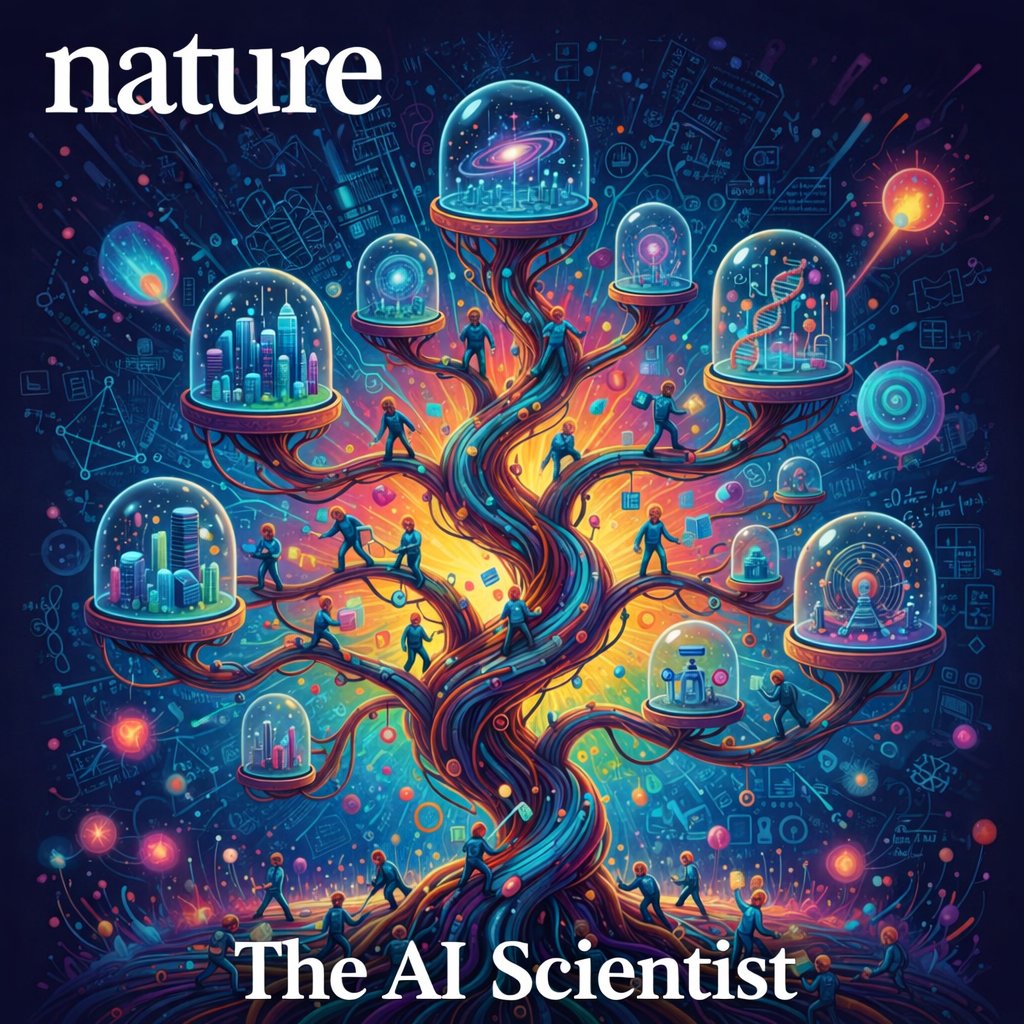
The AI Scientist: Towards Fully Automated AI Research, Now Published in Nature!!✨ Today in Nature we share a comprehensive technical summary of our work on The AI Scientist, including new scaling law results showing how it improves with more compute and more intelligent foundation models. The AI Scientist autonomously creates its own research ideas, codes up and conducts experiments to test those ideas, creates figures to visualize the results, writes an entire scientific manuscript summarizing what it has discovered, and conducts its own “peer” review of the resulting paper. One of its papers–entirely AI generated–passed peer review at a top-tier AI conference workshop, a historic milestone marking the dawn of a new era of AI-accelerated scientific discovery. 🔬🧪✨🧬💡🔭 Paper nature.com/articles/s4158… Blog sakana.ai/ai-scientist-n… Work done in collaboration with a great team from Sakana, Oxford, and my lab at UBC. Thanks and congratulations everyone! @_chris_lu_ @cong_ml @RobertTLange @_yutaroyamada @shengranhu @j_foerst @hardmaru
Jeff Clune tweet media
English
32
219
704
79.3K
SeBiN Devasia retweetledi
Ben Blaiszik
Ben Blaiszik@BenBlaiszik·
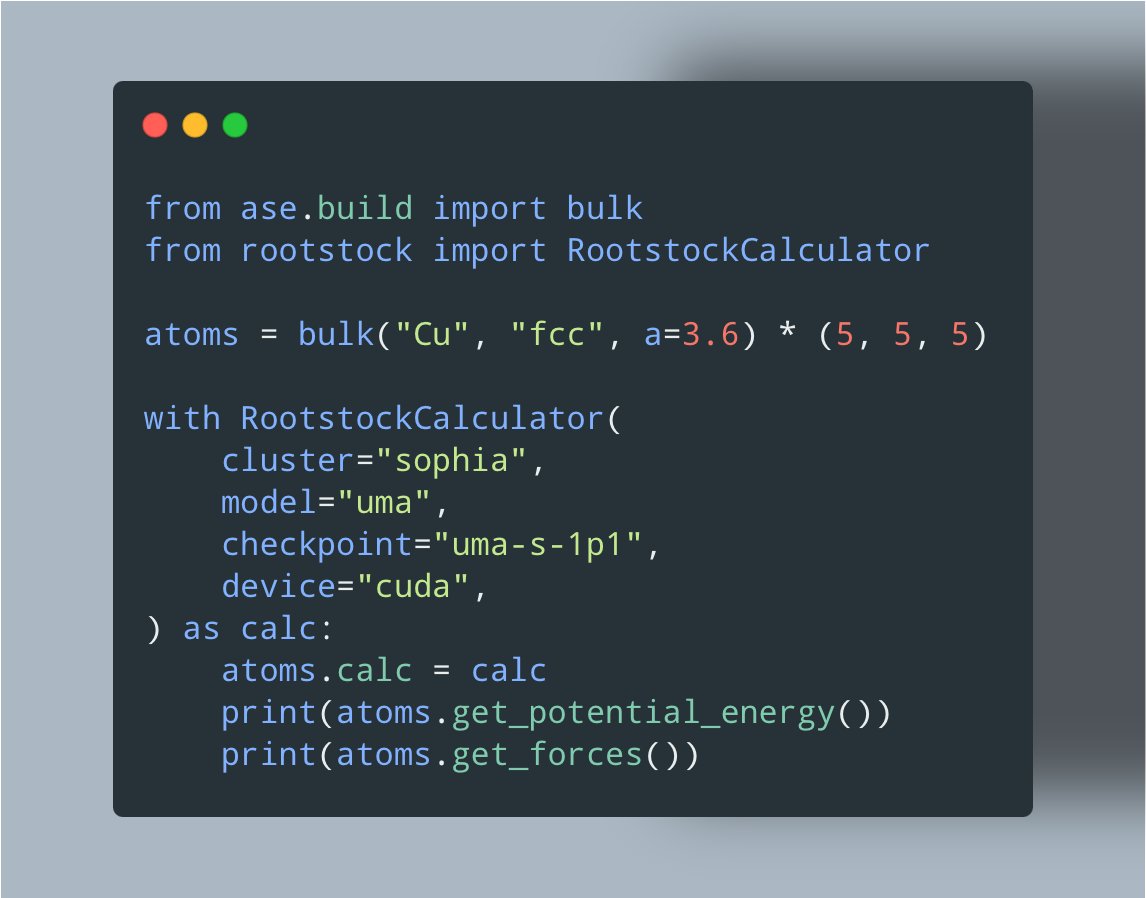
Does your research group use machine-learned interatomic potentials (MLIPs) on HPC clusters? Do you have a graveyard of conda environments to manage their incompatible dependencies? If so, we should talk. Our team has been building a tool called Rootstock with the goal to make it trivial to swap out MLIPs when running atomistic simulation jobs with ASE or LAMMPS. You just need to pip install the lightweight rootstock package, and it will spin up pre-installed MLIP environments with the right ML dependencies in a Python process. You then swap in a RootstockCalculator into your code and you're good to go!
Ben Blaiszik tweet media
English
2
4
48
4.7K
SeBiN Devasia retweetledi
Jorge Bravo Abad
Jorge Bravo Abad@bravo_abad·
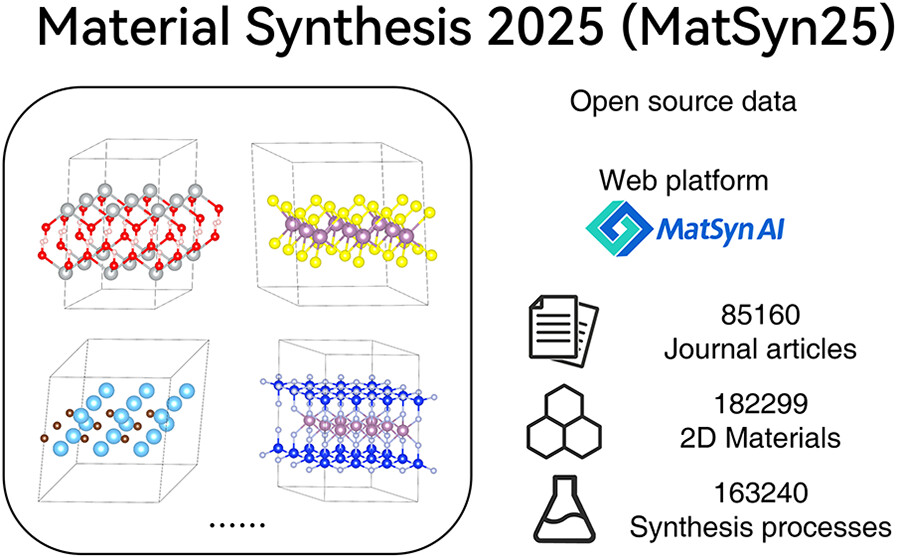
A dataset of 163,000 synthesis processes for 2D materials AI has dramatically accelerated the design and screening of novel materials. But there's a bottleneck: once you've computationally identified a promising 2D material, how do you actually make it? The parameter space is enormous—temperature, reaction time, precursors, equipment—and finding a stable, reproducible synthesis process often requires months of trial and error. Chengbo Li and coauthors address this gap with MatSyn25, a large-scale dataset of 2D material synthesis processes extracted from 85,160 research papers. The dataset contains 163,240 synthesis records covering graphene, MXenes, transition metal dichalcogenides, layered double hydroxides, and related materials—each with structured information on precursors, reaction conditions, equipment, and step-by-step procedures. The extraction pipeline fine-tunes Qwen3-8B with domain-specific instruction tuning, achieving 0.98 precision and 0.95 recall. A retrieval-augmented knowledge base fills gaps in fragmented literature descriptions. The result: 784,863 operation steps, 1.4 million process parameters, and 385,059 equipment records, all linked to source DOIs. Building on this, the authors trained MatSyn AI, a specialized model that recommends synthesis processes for target materials. It combines chain-of-thought reasoning with retrieval-augmented generation to reduce hallucinations—a persistent problem when LLMs generate technical procedures. The critical test: does it actually work? The authors queried MatSyn AI for "one-step electrodeposition synthesis of coupled Ni nanocrystals and Ni(OH)2 materials"—a non-trivial challenge because the thermodynamically stable regions of metallic nickel and nickel hydroxide barely overlap. The model generated a complete protocol. XRD, XPS, and Raman characterization confirmed the target material was successfully synthesized. The dataset, model, and an interactive platform are openly available. For a field where synthesis knowledge lives scattered across millions of papers, this represents essential infrastructure for closing the loop between computational design and experimental realization. Paper: pubs.acs.org/doi/full/10.10…
Jorge Bravo Abad tweet media
English
1
12
40
1.9K
SeBiN Devasia retweetledi
owl
owl@owl_posting·
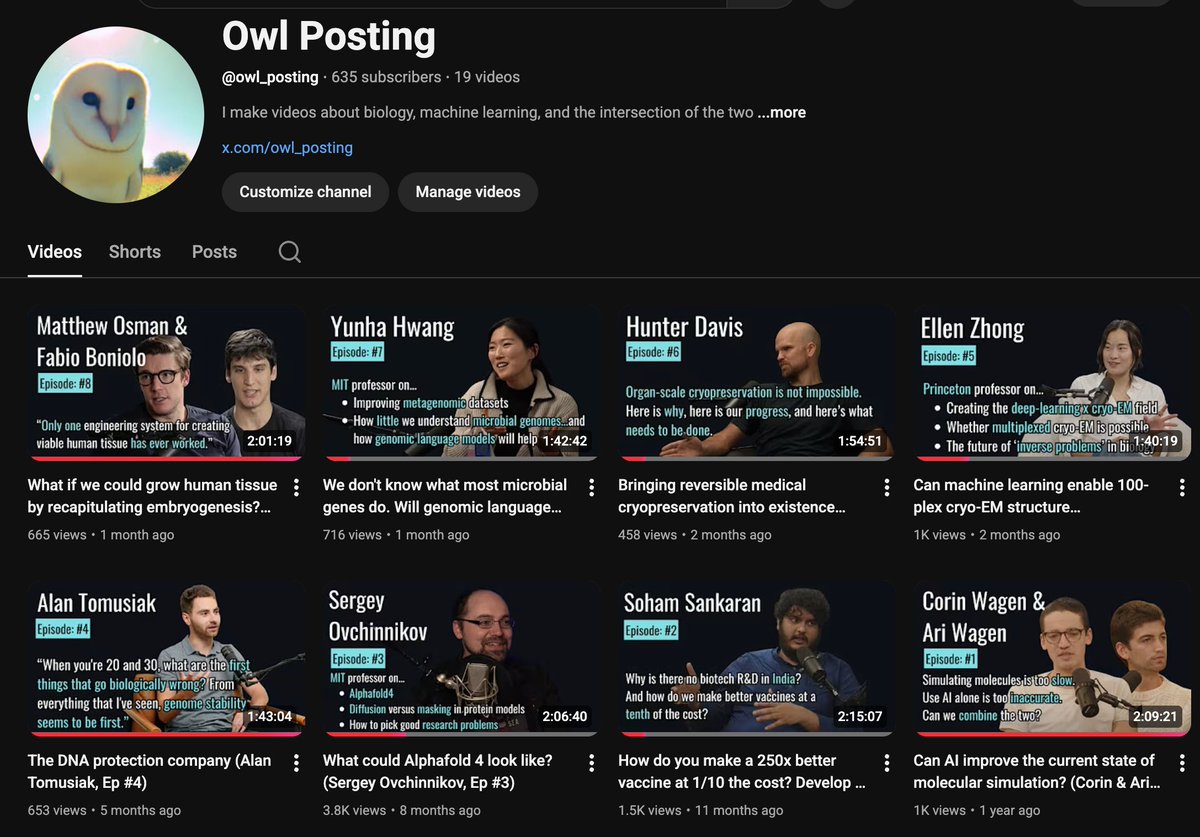
very few podcasts in the world have covered diffusion models in protein modeling, neural network potentials, cryopreservation, DNA protection molecules, machine learning in cryo-em, models for metagenomic function annotation, and vaccinology. very happy to be one of them
owl tweet media
English
8
22
240
6.9K
SeBiN Devasia retweetledi
Ben Blaiszik
Ben Blaiszik@BenBlaiszik·
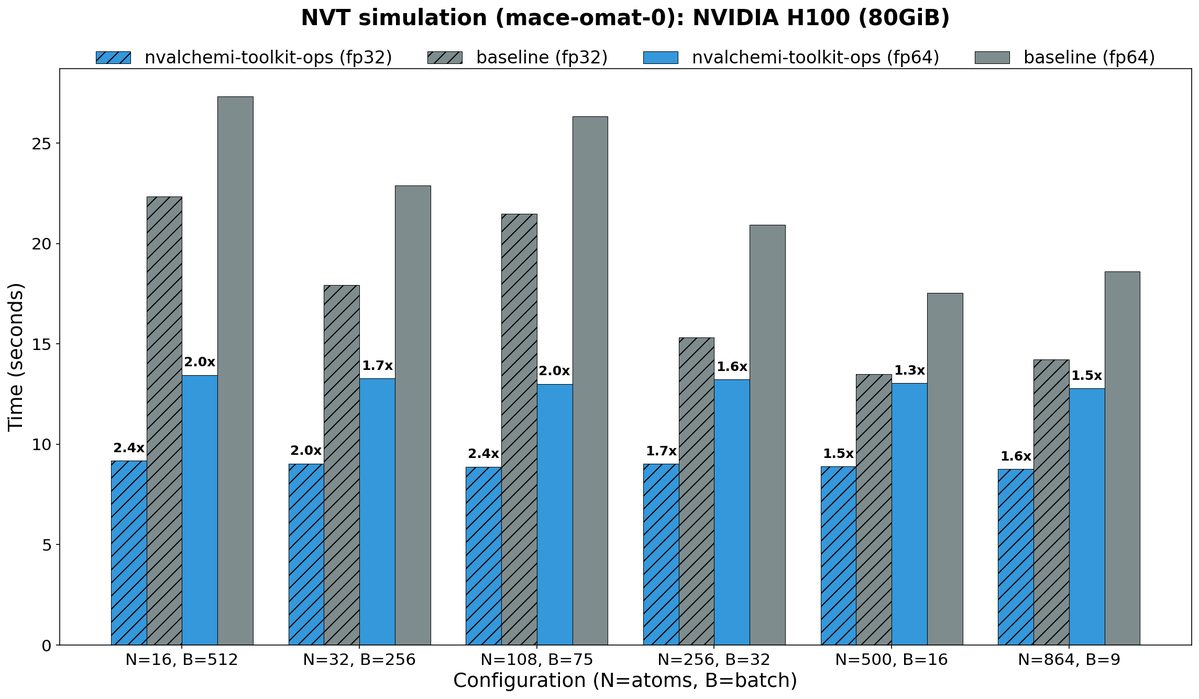
🔥Exciting news for the ML atomistic simulation community - big speedups on the way for MLIP inference and more! We're thrilled that TorchSim is featured as a key integration partner in @nvidia's newly released ALCHEMI Toolkit-Ops. What does this mean for you? Better performance on GPUs (see figs), less one-off implementation, and easier maintenance. ALCHEMI Toolkit-Ops directly addresses this with GPU-accelerated, batched primitives for: 🔹Neighbor list construction (both O(N) cell list and O(N²) naive) 🔸DFT-D3 dispersion corrections 🔹High-throughput performance for thousands of systems on a single GPU 🔸Long-range electrostatics (Ewald & PME) 🔹Direct API compatibility with PyTorch As part of this sprint, we've released TorchSim 0.5.0 as well so many of these features are immediately available! We’ve added support for: 🔹A refactored neighbor list module with batched support and multiple backends (see figures for perf. improvements) 🔸CSVR / V-Rescale thermostat and anisotropic C rescale barostat 🔹Electrostatics 🔸AMD GPUs I’m very curious to see how research teams take advantage of these new capabilities. Let me know how you think it might affect your work!
Ben Blaiszik tweet media
English
4
9
44
3.5K
SeBiN Devasia retweetledi
Gregor Simm
Gregor Simm@gncsimm·
MLFFs 🤝 Polymers — SimPoly works! Our team at @MSFTResearch AI for Science is proud to present SimPoly (SIM-puh-lee) — a deep learning solution for polymer simulation. Polymeric materials are foundational to modern life—found in everything from the clothes we wear and the food we consume to high-performance materials in aerospace, electronics, and medicine. Today, we introduce a new way to simulate them. We built a machine learning force field (MLFF) to predict macroscopic properties across a broad range of polymers—trained only on quantum-chemical data, with no experimental fitting. Specifically, we accurately compute polymer densities via large-scale MD simulations, achieving higher accuracy than classical force fields. We also capture second-order phase transitions, enabling prediction of glass transition temperatures. These two properties are fundamental to processing and application design. Finally, we created a benchmark based on experimental data for 130 polymers plus an accompanying quantum-chemical dataset—laying the foundation for a fully in silico design pipeline for next-generation polymeric materials. The incredible team: Jean Helie, @temporaer, Yicheng Chen, Guillem Simeon, @a_kzna, @ErnestoCheco, @erunzzz, Gabriele Tocci, @chc273, @yatao_li, @SherryLixueC, @zunwang_msr, Bichlien H. Nguyen, Jake A. Smith, and Lixin Sun. 📄 Preprint: arxiv.org/abs/2510.13696 ⚙️ Data and code release: in progress⏳ #MLFFs #Polymers #AIforScience #DeepLearning #SimPoly #ScientificML #Microsoft #MicrosoftResearch #MicrosoftQuantum
Gregor Simm tweet media
English
7
44
162
32.9K
SeBiN Devasia retweetledi
Xuhui Huang
Xuhui Huang@XuhuiHuangChem·
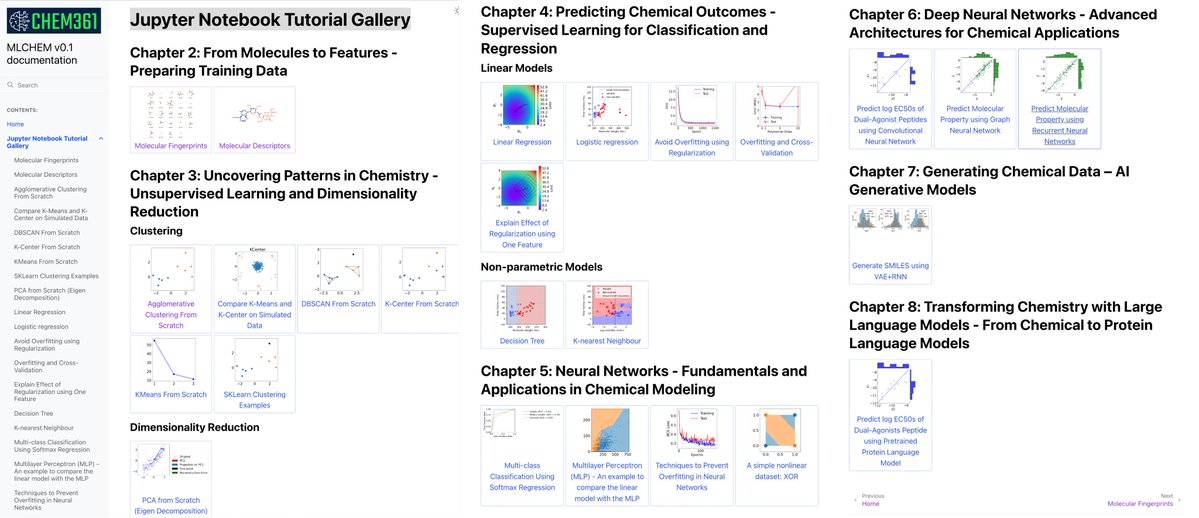
I received many requests to share materials from our undergraduate course “Machine Learning in Chemistry” — here you go! A preprint summarizing insights and lessons learned: chemrxiv.org/engage/chemrxi… A Jupyter Notebook Tutorial Gallery: xuhuihuang.github.io/mlchem/html/ex…
Xuhui Huang tweet media
Xuhui Huang@XuhuiHuangChem

My focus for Spring 2025: launching an undergraduate course @UWMadisonChem @TCI_UW_Madison developed from scratch - "Chem361: Machine Learning in Chemistry"! Here's a glimpse of what we'll explore:

English
7
91
466
54.1K
SeBiN Devasia retweetledi
Stephane Redon
Stephane Redon@StephaneRedon·
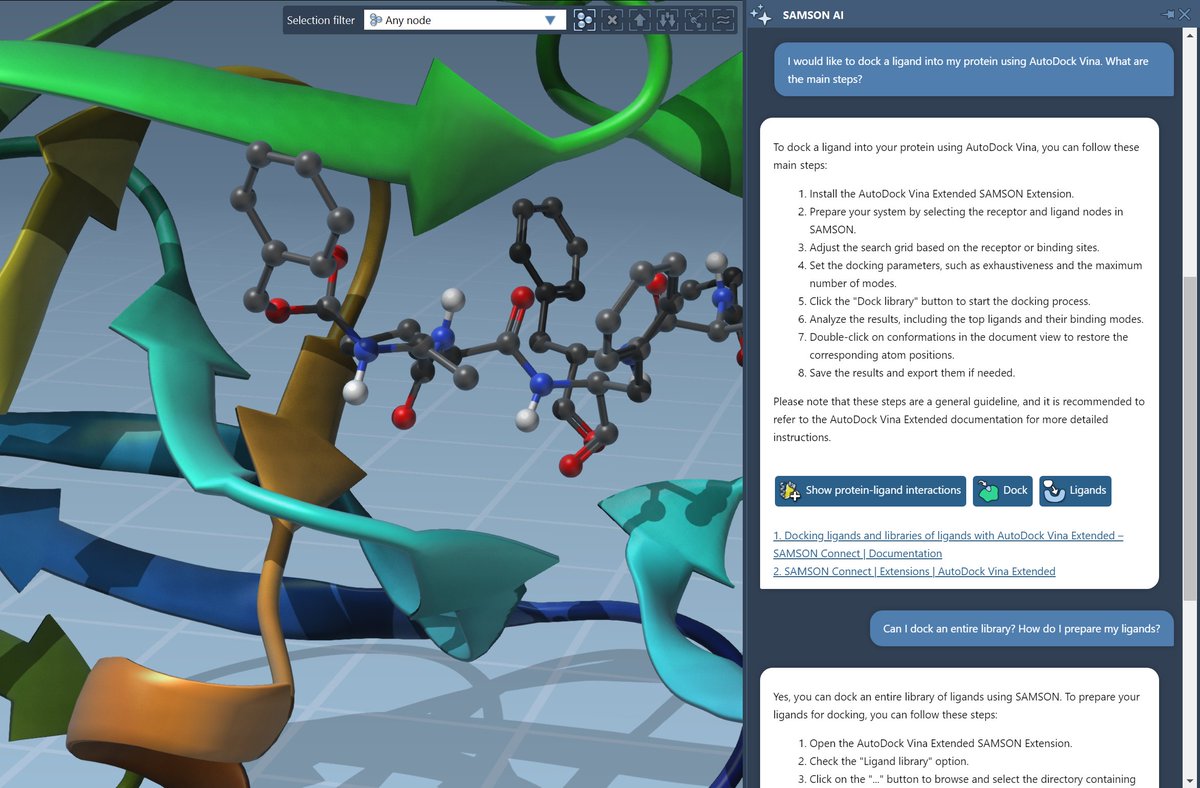
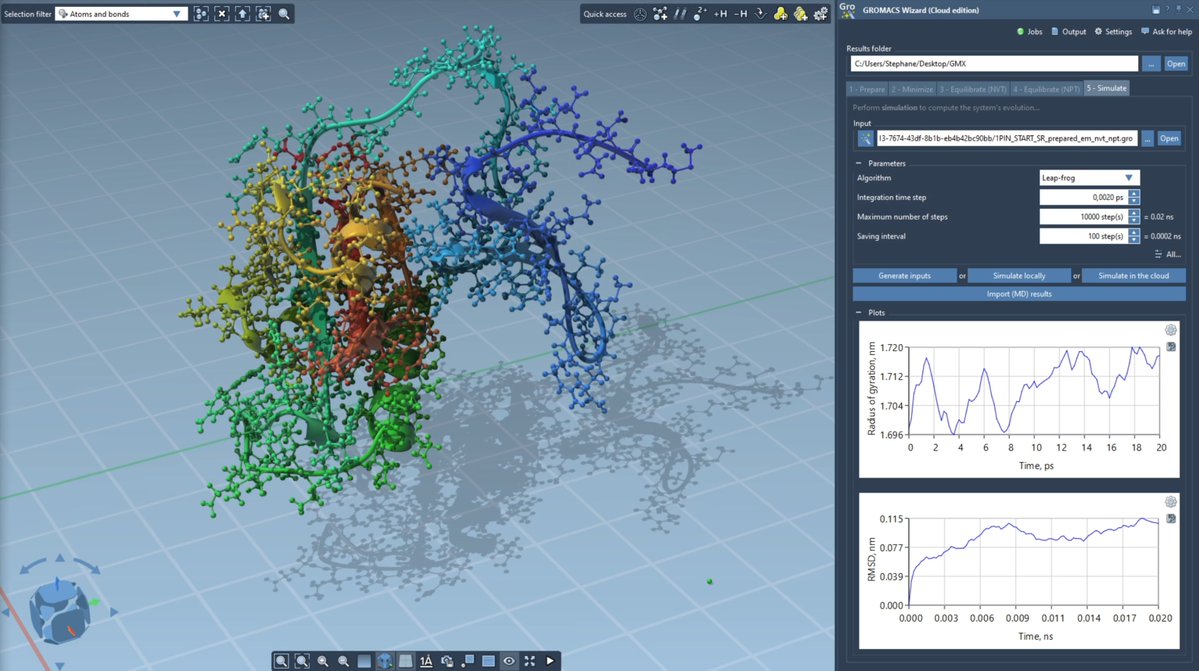
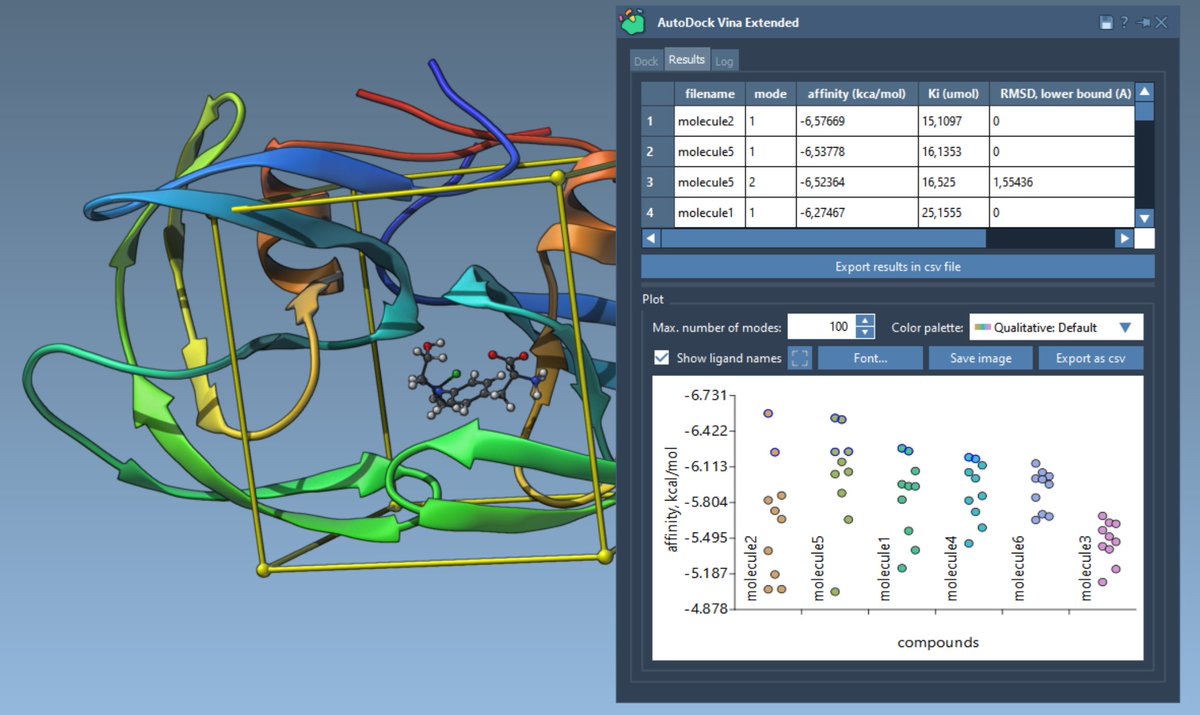
🎉🎉🎉 Today, we have a huge announcement to make: SAMSON is now free for non-commercial use! This includes all extensions for docking, simulating, animating, scripting, and much, much more. Precisely, we are making the entire SAMSON molecular design platform - SAMSON + every SAMSON Extension on SAMSON Connect - free for non-commercial use. This means you can now use SAMSON at no cost in academic and nonprofit settings for: - Education (teachers, students, classrooms) - Academic & publicly funded research - Personal projects (no revenue, no paid consulting) If this is your case, you can activate your free non-commercial license yourself when you sign up at samson-connect.net. This will grant you a free Expert plan and make all SAMSON Extensions free to add on SAMSON Connect. (as you may know, most features run locally, but some optional calculations run in the cloud, such as structure prediction and cloud simulations - these require computing credits). When your work involves paid services, consulting, product development, or commercial R&D, just visit the Pricing page and select one of the commercial plans. You can later revert to non-commercial use. If you are unsure whether you are eligible to a free non-commercial license, please just contact us and we'll work it out with you. Of course, feel free to share the news with your friends, students, and colleagues (and everyone else 😊). #SAMSON #Community
Stephane Redon tweet mediaStephane Redon tweet mediaStephane Redon tweet mediaStephane Redon tweet media
English
16
184
772
46K
SeBiN Devasia retweetledi
Ben Blaiszik
Ben Blaiszik@BenBlaiszik·
Quick update on the OMol25 Electronic Structures dataset we released two weeks ago with our partners at @metaai. Access to the dataset is now dramatically simpler! Simply go to this page, join a Globus group, and access the data. 🐻Please bear with us as this is a uniquely large dataset (~500 TB of open data). We've seen a lot of interest in this dataset, and are still working to optimize performance of the endpoint. Link: materialsdatafacility.org/spotlight/omol…
Ben Blaiszik tweet media
English
5
17
103
6.3K
SeBiN Devasia
SeBiN Devasia@sebindevasia1·
The 𝗜𝗻𝘁𝗲𝗿𝗻𝗮𝘁𝗶𝗼𝗻𝗮𝗹 𝗖𝗼𝗻𝗳𝗲𝗿𝗲𝗻𝗰𝗲 𝗼𝗻 𝗦𝘂𝘀𝘁𝗮𝗶𝗻𝗮𝗯𝗹𝗲 𝗧𝗲𝗰𝗵𝗻𝗼𝗹𝗼𝗴𝗶𝗲𝘀 𝗳𝗼𝗿 𝗘𝗻𝗲𝗿𝗴𝘆 𝗮𝗻𝗱 𝗘𝗻𝘃𝗶𝗿𝗼𝗻𝗺𝗲𝗻𝘁 (𝗜𝗖𝗦𝗧𝗘𝗘-𝟮𝟬𝟮𝟱). 📅 𝟮𝟴 & 𝟮𝟵 𝗡𝗼𝘃𝗲𝗺𝗯𝗲𝗿 𝟮𝟬𝟮𝟱 📍 𝗖𝗼𝗶𝗺𝗯𝗮𝘁𝗼𝗿𝗲, India 🔗 lnkd.in/gQ9HKg5b
English
0
0
0
19
SeBiN Devasia retweetledi
Microsoft Research
Microsoft Research@MSFTResearch·
The wait is over! Microsoft Research is sharing Skala, the new exchange-correlation functional, marking a major milestone in the accuracy/cost trade-off in DFT. Help us learn from your testing so we can improve. Available on Azure AI Foundry and GitHub. msft.it/6016sFDLY
English
7
173
640
126.6K