
Sabitlenmiş Tweet
seb
188 posts


seb
@sebmichaelsep
llm inference @perplexity_ai https://t.co/lbqxf87Ugz
San Francisco, CA Katılım Temmuz 2020
912 Takip Edilen227 Takipçiler
LFG @0xhappier
Alex Shan@alexshander03
We’re launching @JudgmentLabs today and announcing $32M in funding. As AI agents take on more of the work that creates economic value, they generate massive amounts of production data: the clearest record of how they behave with users, software, and the real world. Judgment builds infrastructure for improving AI agents from production data.
seb retweetledi

Introducing Perplexity Computer.
Computer unifies every current AI capability into one system.
It can research, design, code, deploy, and manage any project end-to-end.
English
seb retweetledi

Technological innovation can be a form of participation in the divine act of creation. It carries an ethical and spiritual weight, for every design choice expresses a vision of humanity. The Church therefore calls all builders of #AI to cultivate moral discernment as a fundamental part of their work—to develop systems that reflect justice, solidarity, and a genuine reverence for life.
English


One of the subtle points in the following post related to accepting inputs in Rust APIs is to appreciate the difference between `impl AsRef<>` and `impl Borrow<>`.
Just as a quick reminder ..
• The purpose of `AsRef` is to convert by reference to `&T` for ergonomic inputs.
• The purpose of `Borrow` is to treat a value as `&T` with identical Eq/Ord/Hash semantics.
It can sometimes be a bit tricky - here are some Do's and Don't's for Picking `AsRef` vs `Borrow` ..
Do
• Use `impl AsRef` (or `AsRef`, `AsRef<[u8]>`) at API boundaries to accept many caller types by reference. As shown in the first example in the linked post, `AsRef<>` gives great ergonomics to the caller.
• For containers, make your key newtypes implement `Borrow` (or the appropriate target) so lookups with a borrowed probe just works.
• Prefer `Into` when your function needs to take ownership (e.g., `impl Into`), and pair it with `AsRef` overloads when you also have read-only variants.
Don’t
• Don’t use `Borrow` in ordinary parameter lists if you only need a read-only view - `AsRef` is clearer and lighter.
• Don’t accept `String` when a `&str` (or `impl AsRef`) is enough - that forces allocations on callers.
• Don’t rely on `AsRef` for map/set lookups - use `Borrow` to preserve `Eq`/`Hash` invariants.
Debasish (দেবাশিস্) Ghosh 🇮🇳@debasishg
In Rust, how the borrow-checker shapes your API inputs and outputs ..
The general design principle is to choose signatures that minimize ownership churn while keeping call sites clean and safe.
Accepting input
• Borrow when you only read: `fn parse(src: &str)`
• Borrow mutably when you mutate in place: `fn fill(buf: &mut [u8])`
• Own when you need to keep it: `fn spawn(task: String)`
• Generic borrow (most ergonomic at call sites): `impl AsRef
English

lmao
murat 🍥@mayfer
🔥 Today we’re excited to announce new funding for `grep` (at a $1.3B valuation) to continue building the foundation of agent observability and text search infrastructure. grep began as a humble UNIX utility in 1973. Since then, it’s evolved—through recursive innovation and the rise of ripgrep—into a core platform for developers, sysadmins, and agents. Our tools now power engineering and AI teams across @OpenAI, @Anthropic, @Meta, @Cloudflare, @Replit, @NASA, and thousands more. Over the decades we’ve iterated from grep to `egrep` to `ripgrep`. Our goal has always been to figure out what intelligent agents of the future need to see, filter, and extract—and then build the tools that make that possible. While our journey is still just beginning, we also want to take a moment to reflect on how the space (and our role in it) has evolved. You can read our reflections and details on this funding milestone here: gnu.org/software/grep/… We also share more about the funding that will power our future there. Thank you to @IVP, @Benchmark, @Sequoia, @CapitalG, and the open-source community for their belief in the enduring power of regex. What excites us most today is what’s next: grep 5.0 with AI-assisted pattern synthesis ripgrep Cloud, bringing distributed search to agent clusters pgrepGPT, an agent-native process discovery layer And new no-code integrations for autonomous observability pipelines We’re in the midst of a transformation in computation itself. grep and ripgrep will remain at the core—helping humans and agents alike find what matters, faster.
HT
English


today I’m unemployed again :)
I just wrapped up my internship with @perplexity_ai during what was the most transformative summer of both my life and the company.
I cannot feel more privileged to have had such an opportunity. I’ve watched @PerplexityComet evolve from inception to one of the most sought after products in history (dogfooding along the way was so fun too). I’ve shipped what myself just a year ago would’ve thought was impossible. The speed at which Perplexity moves is astounding, and the culture keeps you so excited to come to work and build the future.
In my final 1:1 with @AravSrinivas, we touched on many topics, but what stuck with me the most was his desire to always stay hungry. To stay hungry for purpose. To stay hungry for knowledge. To stay hungry enough to leave a tangible mark on the world.
And while it may not be with Perplexity right now, I am excited to satiate my own hunger.
So grateful for my mentors, friends, and coworkers, including @Ali_Shobeiri, @JamesLiounis_, @alipanju_, @omeedtavakoli , @yoimnotkesku, @jeffgrimes9, @camerontstow, @dmitry140 and many others.
My intention right now is to return to school in Atlanta to spend time with my grandparents, build more, create more, and do as much good as I can.
Looking forward to the next chapter.


English
seb retweetledi

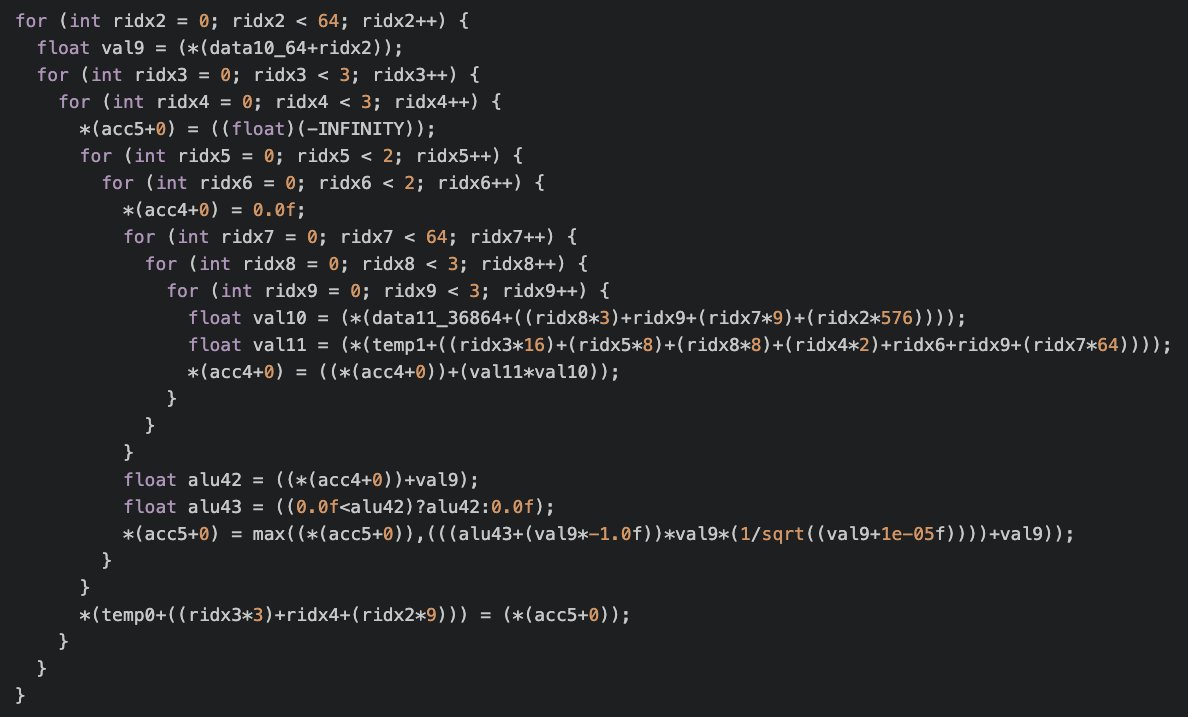
conv2d(3x3)+relu+batchnorm+max_pool2d(2x2)
Once you get the fusion rules right, you stop with the false idea that kernels should have anything to do with operations, and realize it's all about data locality.
English
seb retweetledi

recently i started telling candidates right in the first interview that if they think that fullmetal alchemist brotherhood is better than the original, they don't really have a spot here
Daksh Gupta@dakshgup
recently i started telling candidates right in the first interview that greptile offers no work-life-balance, typical workdays start at 9am and end at 11pm, often later, and we work saturdays, sometimes also sundays. i emphasize the environment is high stress, and there is no tolerance for poor work. it felt wrong to do this at first but i’m convinced now that the transparency is good, and i’d much rather people know this from the get go rather than find out on their first day. curious if other people do this and if there’s some obvious pitfall i’m missing.
English


ever heard of @PerplexityComet
justin@justinsunyt
dia is the exact opposite of how an ai product should be built. the ai should feel like magic to use and deeply integrated into every aspect of the product. dia’s ai feels like a cheap after thought, tacked on to the search and side bar because the vcs asked them to.
English