Salman G.

24.8K posts

Salman G. banner
Salman G.

Salman G.

@seghuman

@NuclearBan #FreeImranKhan

Kitty Hawk, NC Katılım Ocak 2011
1.5K Takip Edilen2K Takipçiler
Salman G.
Salman G.@seghuman·
If Imran Khan with his ideals of integrity, honesty l, bravery and standing for principle above all could all be embodied in a country it would be Iran. And Asim Munir is smack in the middle of it, convincing Iranians to surrender and give up what they’ve fought for.
English
0
0
1
36
Salman G. retweetledi
Noreen Khanum
Noreen Khanum@noreen_khanum·
‼️ 🚨 ‼️ Imran Khan has been kept in solitary confinement for six months under brutal conditions, while Bushra Bibi is being held the same way. Their freedom is being deliberately blocked by the Chief Justice of the Islamabad High Court, who refuses to fix their bail hearings. Imran Khan has made it clear that the judiciary is no longer independent, it is acting like a tool of the government. Judges assigned to his cases are not delivering justice; they are ensuring hearings never happen. The reality is simple: the moment this case is heard, its weak and baseless nature will be exposed, and bail will become unavoidable. That is exactly why it is being stalled. Imran Khan and Bushra Bibi continued imprisonment is due to Judge Dogar, who is openly facilitating a government that came to power by stealing Imran Khan’s mandate. Through Salman Safdar, Imran Khan has sent a message, his wife is being pushed to the edge by prolonged isolation. He has said he can endure this ظلم himself, but she is being broken to force him into submission. The pressure is deliberate, calculated, and inhumane. He said clearly “no deal, no surrender! It is liberty or death.”
English
69
2.5K
4.9K
31.6K
Salman G. retweetledi
PTI
PTI@PTIofficial·
No television. No books. No human interaction. Just walls to stare at. Imran and Bushra Khan are being tortured in custody by Pakistan's military regime. Barrister Salman Safdar, their lawyer, describes how they are isolated in their tiny, windowless cells in complete isolation for 22-23 hours each day. He termed it "shocking and alarming" that the Jail Superintendent is subjecting Imran and Bushra Khan to punishment beyond their conviction and sentencing, however flawed that may have been. SSP Sajid Baig, who took over as Superintendent of Adiala Jail in January 2026, is widely believed to take his orders from an army colonel who is de facto in charge of Rawalpindi's maximum-security prison. #SubtitledByPTI #FreeImranKhan #EndSolitaryConfinement
English
85
4K
7.7K
112.8K
Salman G. retweetledi
Zubair Ahmed Khan
Zubair Ahmed Khan@ZubairKhanPK·
Stats Reveal Shocking 45% Drop in PSL Viewership Since Last Year. Last year, the league was averaging roughly 91.7 million views per game at that point. This season, the average is down to 50 million. The tournament is rightly Dead for so many reasons!
English
50
112
629
36.7K
Salman G.
Salman G.@seghuman·
@ZarrarKhuhro As a journalist you want to remind the viewers how his last trip to Tehran went - just for some context.
English
0
0
0
70
Zarrar Khuhro
Zarrar Khuhro@ZarrarKhuhro·
I'll ask him and get back to you asap
joke1@meteoricdev

@ZarrarKhuhro What's the message he has to convey to them? They may have possibly declined to a second round of talks and he's there to just request them to come to Islamabad again?

English
12
4
82
6.3K
Salman G. retweetledi
Alifya Sohail
Alifya Sohail@AlifyaSohail·
If the first five minutes of BBC’s undercover documentary doesn’t shatter the manicured image of Maryam’s Punjab, nothing will. I’m sick to my stomach.
English
18
670
2.6K
61.4K
Salman G.
Salman G.@seghuman·
A murderous regime can never be a peacemaker. The greatest act of trickery evil can play is to be one thing while pretending to be the exact opposite.
English
0
0
1
19
Salman G. retweetledi
Trita Parsi search. ..
Why the Iran ceasefire may have shifted the dynamics back in Trump's favor Diplomacy between Washington and Tehran has not yet unraveled, despite JD Vance’s theatrical departure from last week’s talks in Islamabad. Trump now signals that the two sides could reconvene within days in the Pakistani capital. Whether negotiators return to the table or continue their exchanges through quieter, remote channels before the ceasefire lapses, one reality appears to have shifted: Trump has clawed back a measure of momentum—and with it, leverage—over Iran, largely by virtue of the ceasefire. Here’s why. Trump entered this moment politically cornered and strategically constrained. Surging gasoline prices were inflicting acute domestic pain, eroding his standing at home. More critically, he faced a barren escalation ladder. Each conceivable move—strikes on Iran’s oil infrastructure, attacks on civilian targets, the seizure of Persian Gulf islands, or covert operations to capture enriched uranium—carried the near-certainty of forceful Iranian retaliation. Such responses would not merely match his escalation but compound it, deepening his economic exposure, amplifying political risk, and entangling him further in a perilous and unwinnable strategic bind. Nor could he simply extricate the United States from the conflict on his own terms. Absent an understanding with Tehran, Iran retained both the capacity and the incentive to continue targeting Israel and vulnerable U.S. assets across the Gulf. Trump needed Iran’s permission to get out of the war. The ceasefire, however, has subtly altered that equation. Trump may no longer need a formal nod from Tehran to step back. If he disengages now—without a comprehensive agreement—Iran will almost certainly maintain its grip over the Strait of Hormuz, a strategic setback for Washington. Yet Tehran is unlikely to resume direct military operations against U.S. targets in the Persian Gulf. To do so, in the absence of renewed American strikes, would cast Iran as the aggressor, inviting severe and potentially coordinated repercussions—not only from Washington but from wary global powers such as Russia and China. Moreover, the balance of needs has tilted. Iran now appears to need an agreement more than the United States does. Trump has already secured his central objective—the escape from a war he was ill-advised to begin—while Iran, despite accruing leverage through its command of the Strait, remains far from realizing its broader ambitions: meaningful sanctions relief, a definitive and enduring end to hostilities, and perhaps even the contours of a more stable, constructive relationship with Washington. Tehran’s decision to dispatch its largest, most senior, and most expansive delegation to Islamabad for direct talks with the American vice president reflected a striking confidence—that it occupied its strongest negotiating position vis-à-vis the United States since 1979. Yet to convert that moment of perceived ascendancy into little more than a cessation of U.S. bombardment would fall short of its aspirations. Even if Washington were to acquiesce to Iran’s control of the Strait, such an outcome would pale against the far more consequential gains Tehran believes are within reach. Instead, Iran needs to translate this leverage not only into a durable end to the war, but ideally, into a new peace: One that delivers sweeping sanctions relief and inaugurates a more stable, mutually defined economic and political relationship with Washington. Such an arrangement would serve as a bulwark against renewed conflict. The economic imperative is especially stark: sanctions relief is indispensable to reconstruct a country now burdened with damage running into the hundreds of billions of dollars. As I have argued before, sanctions relief is not merely an economic demand—it is a strategic necessity. Without it, Iran risks a condition of chronic erosion, a slow but steady weakening that would leave it exposed. That vulnerability, in turn, could invite further attacks. It was, after all, the misperception of Iranian weakness that helped open the window for initial strikes. But Trump does not, in any fundamental sense, require any of this. The United States can endure without a formal agreement with Iran and without the benefits of an economic relationship with Tehran. To be sure, a negotiated settlement would better serve long-term American interests: the nuclear constraints Trump seeks can only be credibly secured at the negotiating table. Abruptly abandoning diplomacy while leaving Iran in undisputed control of the Strait would also unsettle key regional allies. Yet these are strategic preferences, not immediate necessities. Trump’s calculus is far more transactional and far less patient. He can point to the damage already inflicted on Iran’s nuclear infrastructure and conventional forces, proclaim a hollow victory, and disengage. He has already emphasized that the United States no longer depends on Persian Gulf oil, insulating it from the direct economic consequences of Iran’s toll regime. As a result, the burden shifts outward: the Strait becomes a problem for European and Asian powers—countries that Trump has noted declined to rally to his side when he sought their help in prying the waterway from Tehran’s grip. The window now open offers Tehran a chance to convert battlefield leverage into lasting strategic gain. To let it close would mean forfeiting not just incremental progress, but the possibility of reshaping its economic and geopolitical position. By contrast, the United States, having already secured a tenuous exit ramp through the ceasefire, has less at stake in the short term. Walking away, therefore, is politically and strategically easier for Trump than for his Iranian counterparts. Both can live with diplomatic failure, but Tehran has more gains to lose. How Tehran chooses to navigate this narrowing corridor—whether it presses its advantage or overplays its hand—will be interesting to see.
English
237
274
1.1K
317.4K
Salman G. retweetledi
Waqas
Waqas@worqas·
However, at the same time, it is very important that Pakistan take no step, or agree to any demand, that can have an adverse effect on national sovereignty. Pakistan must take independent decisions, free from pressures and expectations, while keeping its national interest supreme. No doubt Saudi Arabia wields enormous influence on Pakistani policy, and the large number of Pakistani expatriates working in Saudi Arabia contribute a lot to the economy, but Pakistan has always followed a balanced policy in the Middle East and must continue to do so while according a high priority to Saudi Arabia. - Dawn Editorial, May 12th, 2021 dawn.com/news/1623434 No such editorial was written when the dictator finally did this in 2024, 2025 - bringing us into the current situation.
English
21
333
986
18.2K
Salman G. retweetledi
علی مصطفی | Ali Mustafa
Pakistan’s brown-sepoy field marshal regime has effectively blinded former PM Imran Khan in one eye while keeping him in a death cell says his lawyer, the only individual who has been able to meet IK from the outside world since December 1st 2025 - Khan has not been heard from or seen by the public since his abduction by the ruling junta in August 2023 x.com/iAmjadKhann/st…
English
15
348
654
11.2K
Salman G. retweetledi
Azhar Mashwani
Azhar Mashwani@MashwaniAzhar·
عمران خان سے ہونے والی ملاقات اور گفتگو کے حوالے سے بیرسٹر سلمان صفدر کی سپریم کورٹ کے باہر میڈیا سے گفتگو: “مجھے عمران خان صاحب نے بتایا کہ: • میں تین ماہ تک جیل سپرٹنڈنٹ (عبدالغفور انجم) کو بتاتا رہا کہ میری ایک آنکھ میں بینائی کا مسئلہ آ رہا ہے لیکن اس نے اس پر کوئی کان نہیں دھرا • ⁠کئی دن تک میری ایک آنکھ کی بینائی 100 فیصد تک چلی گئی تھی • ⁠مجھے ڈاکٹر عارف نے بتایا کہ انجکشن لگانے سے بینائی میں 15% بہتری آئی ہے - اس کے بعد سے میری بینائی میں کوئی بہتری نہیں آئی • ⁠میں بالکل بھی اس علاج سے مطمئن نہیں ہوں • ⁠میں مسلسل کہتا آیا ہوں کہ میرے ذاتی ڈاکٹرز کو بلایا جائے تاکہ پتہ چلے کہ آنکھ میں blood clot / خون کا لوتھڑا آنے کی اصل underlying reason / بنیادی وجہ کا پتہ چل سکے - لیکن مسلسل اس سے انکار کیا جا رہا ہے • ⁠میں کافی عرصے سے اپنے ڈینٹیسٹ سے چیک اپ کا بھی کہ رہا ہوں لیکن اسے بھی نہیں بلایا گیا • ⁠مجھے اور بشریٰ بی بی کو 24 گھنٹے قید تنہائی میں رکھا جا رہا ہے • ⁠بشریٰ بی بی کی بھی آنکھوں کا مسئلہ آیا اور دو ہفتے بعد وہی میڈیکل بورڈ ان کا معائنہ کرے گا جس نے میرا معائنہ کیا” @BrSalmanSafdar @salmanAraja @BarristerGohar @MKAchakzaiPKMAP @AllamaRajaNasir @SohailAfridiISF @Aleema_KhanPK
اردو
194
4.9K
11.4K
211K
Salman G. retweetledi
Javed Hassan
Javed Hassan@javedhassan·
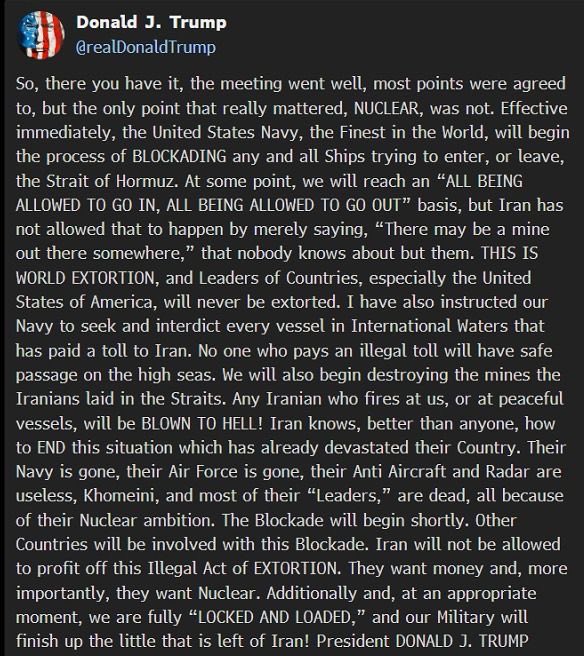
So, a couple of the boys have been texting me: “Why the hell would Trump drop the Hormuz blockade bomb on a Sunday? It’ll send oil screaming past $120, maybe $130 if the algos really panic. Makes zero sense if you actually want cheaper barrels.” But it makes perfect sense. Beautiful, even. See, Tokyo and Hong Kong are already humming by the time the East Coast is still nursing its coffee. Those futures pits—Dow, S&P, the whole equity complex, plus Brent and WTI on the screens—never really sleep. You’ve got fourteen, fifteen hours of runway before the New York bell. Plenty of time for the right hands to lean in: long the indices in Hong Kong, short the crude in Tokyo, riding the fear wave as the blockade tweet lights up every terminal from Singapore to Sydney. Then, right on cue, before the U.S. opens, comes the pivot. Something about “there’s regime change in Tehran,” “we can do business,” “Talks were Good,” the usual art-of-the-deal baloney. Markets whip around like they’ve been Tasered. Oil gives back the spike, stocks rip higher. The boys in Asia unwind clean, pocket the spread. A few hundred million, maybe more, conjured out of thin air on the back of one perfectly timed Sunday morning post. Not bad for a morning’s work. The Street’s been running these kinds of games for decades: information, timing, leverage. Just never quite so… presidential!!
Javed Hassan tweet media
English
460
3K
14.3K
3M
Salman G. retweetledi
محمدباقر قالیباف | MB Ghalibaf
Enjoy the current pump figures. With the so-called 'blockade', Soon you'll be nostalgic for $4–$5 gas. ΔO_BSOH>0 ⇒ f(f(O))>f(O)
محمدباقر قالیباف | MB Ghalibaf tweet media
English
3.1K
9.4K
43.1K
4.5M
Salman G. retweetledi
Seyed Abbas Araghchi
In intensive talks at highest level in 47 years, Iran engaged with U.S in good faith to end war. But when just inches away from "Islamabad MoU", we encountered maximalism, shifting goalposts, and blockade. Zero lessons earned Good will begets good will. Enmity begets enmity.
English
4.7K
29.1K
126K
3.9M
Salman G. retweetledi
Robert A. Pape
Robert A. Pape@ProfessorPape·
Within 10 days, parts of the global economy will start running short of critical goods After 30 years studying economic sanctions and blockades, I don’t say this lightly: --Not just higher prices --Shortages. Markets are not ready for this
English
588
8.6K
32.3K
2.2M
Salman G. retweetledi
Trita Parsi search. ..
Regarding Trump's threat/decision to impose a naval blockade on Iran, color me a skeptic. 1. Taking more oil off the market, particularly the only oil that is now getting out from the Persian Gulf, will drive oil prices further up, and the paper price of oil will get closer to the actual price, which should be around $150 per barrel. A dramatic increase in inflation in the US will ensue. Avoiding this is precisely why Trump was stuck in a position where he had no escalatory options out of this conflict before the ceasefire. He still doesn't. 2. Stopping tankers carrying Iranian oil wouldn't just be an escalation vis-à-vis Iran, but also against the countries that are buying Iranian oil, which includes China, India, and other Asian countries. I doubt Trump is ready for that escalation, particularly given the upcoming summit in Beijing. 3. This is also true for punishing countries that have negotiated a toll with Iran for the Straits. That includes Pakistan, which hosted the negotiations. 4. The naval blockade escalation will make the closing of the Red Sea more likely by the Houthis. That would take another 12% of global oil flow off the market. We would now be looking at oil around $200 per barrel. There are nine or so days left of the ceasefire. Since neither side has explicitly stated that talks won't resume, or that the ceasefire is dead and over with, all these moves should be treated as tactics and threats within the negotiations. It wouldn't be surprising if these threats are walked back soon (perhaps before markets open on Monday) and a new round is announced. HOWEVER, there is a time for brinkmanship, and there is a time for serious negotiations. If the US truly was insisting on zero enrichment in Islamabad, which was not Trump's red line at first but rather Israel's, then the next talks will be rendered a failure - just as the talks in May 2025 were killed by Trump shifting to the Israeli red line. Still, I don't think that necessarily will lead to a return to war. A more likely scenario is a new non-negotiated status quo in which Tehran retains control over the Straits but doesn't get any sanctions relief, while the US pulls out of the war, and the question becomes whether Israel will continue the war on its own.
English
192
1.1K
3.5K
321.1K