SentaTrust

46 posts

SentaTrust banner
SentaTrust

SentaTrust

@SentaTrust

Smart Contract Audits • Certification • Trust Infrastructure We verify smart contracts before they go live. Because failures are irreversible.

UAE · Europe · Asia Katılım Kasım 2025
82 Takip Edilen1.1K Takipçiler
SentaTrust
SentaTrust@SentaTrust·
$606 million vanished from blockchain wallets in April. Your bank would call it fraud. Reverse the charges. File a report. On a blockchain, there is no fraud. There is only code. And someone who read it more carefully than you did.
English
8
0
8
80
SentaTrust
SentaTrust@SentaTrust·
Who reads a smart contract? Nobody. But within a decade, one will hold your mortgage. Your pension. Your identity. So, when code runs your life — who's checking the code?
SentaTrust tweet media
English
24
217
241
24.5K
SentaTrust
SentaTrust@SentaTrust·
@PancakeSwap @HypernativeLabs Most projects used to focus almost entirely on audits. Now they’re realizing that once systems go live, monitoring and real-time detection become just as important. Verification matters before deployment. Monitoring matters after deployment.
English
4
0
3
38
PancakeSwap
PancakeSwap@PancakeSwap·
We've integrated @HypernativeLabs for real-time exploit detection across our smart contract infrastructure, adding another layer to our security stack. Excited to build with the Hypernative team.
HypernativeLabs@HypernativeLabs

.@PancakeSwap, one of the leading DEXs in the industry, has deployed Hypernative to monitor its smart contract infrastructure across multiple blockchains. After evaluating several monitoring providers, PancakeSwap chose Hypernative for real-time exploit detection, low false positive rates. Read the full announcement: buff.ly/8wS1iTK

English
26
23
115
11.7K
SentaTrust
SentaTrust@SentaTrust·
The Secret Bitcoin Key Did you know early Bitcoin had an emergency broadcast mechanism capable of sending warnings across the network itself? Very few people today even know it existed. #Bitcoin #Crypto #Blockchain #Satoshi #BTC
SentaTrust tweet media
English
46
193
241
30.4K
SentaTrust
SentaTrust@SentaTrust·
The 2010 inflation bug is a reminder that even foundational systems evolve through fragile stages. Decentralization is often a process — not a starting condition.
Jeremy@Jeremybtc

Bitcoin had a hidden override key. One person held it for 6 years. Most users have never heard of it. > In 2010 a bug nearly destroyed Bitcoin by creating 184 BILLION fake coins out of thin air. Satoshi patched it within hours. > He also secretly added an emergency override called the Alert Key. > The Alert Key let the holder broadcast a message to every Bitcoin node on the planet at the same time and push every client into safe mode. > Only a handful of people ever held it. Satoshi. Gavin Andresen. A few trusted developers. > On April 26, 2011, Satoshi sent his final known email to Andresen. > It contained the Alert Key and one instruction. “You should probably give it to at least one or two other people.” > Then he disappeared. Nobody has heard from him since. > The Alert Key was used multiple times between 2012 and 2014 to send emergency upgrade notices across the entire network. > Then Japanese police raided Mark Karpelès of Mt. Gox. > Developers realised the police may have seized a copy of the Alert Key from his computer. > They retired the system in 2016. > The private key was finally published publicly in July 2018, partly to prove no future alert could ever be trusted again. > The same day it was published, a developer used it to challenge Craig Wright to prove his Satoshi claim by signing with the same key. Wright did not. Bitcoin’s biggest selling point is that no one can shut it down. For most of its first decade, one person could.

English
28
0
29
1K
SentaTrust
SentaTrust@SentaTrust·
One of the most interesting things about early Bitcoin is that it wasn’t born fully decentralized. It evolved into decentralization. People often imagine these systems appearing perfectly trustless from day one, when in reality many of them began with temporary safeguards, trusted actors, and emergency controls while the ecosystem was still fragile.
English
0
0
3
77
Jeremy
Jeremy@Jeremybtc·
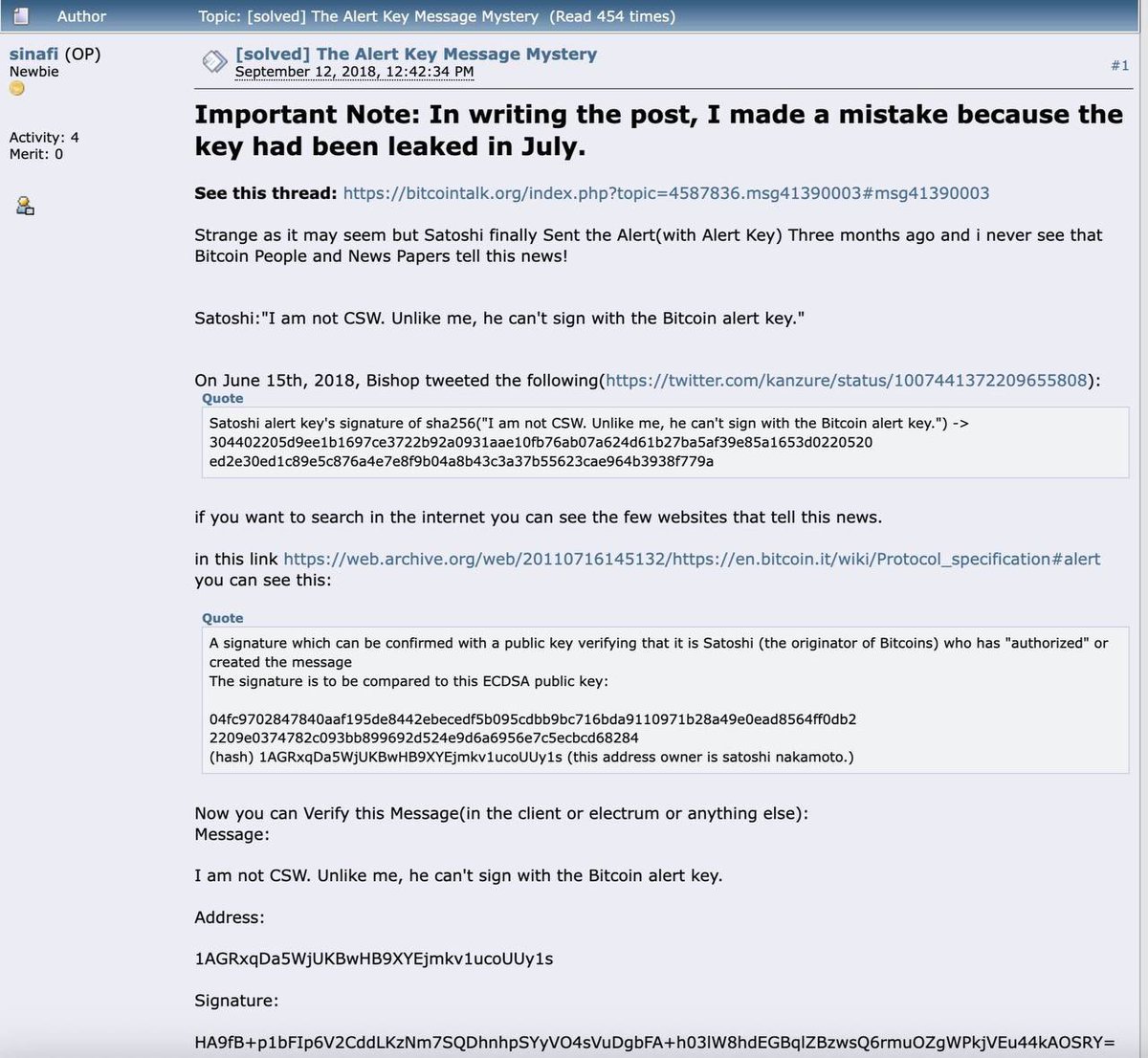
Bitcoin had a hidden override key. One person held it for 6 years. Most users have never heard of it. > In 2010 a bug nearly destroyed Bitcoin by creating 184 BILLION fake coins out of thin air. Satoshi patched it within hours. > He also secretly added an emergency override called the Alert Key. > The Alert Key let the holder broadcast a message to every Bitcoin node on the planet at the same time and push every client into safe mode. > Only a handful of people ever held it. Satoshi. Gavin Andresen. A few trusted developers. > On April 26, 2011, Satoshi sent his final known email to Andresen. > It contained the Alert Key and one instruction. “You should probably give it to at least one or two other people.” > Then he disappeared. Nobody has heard from him since. > The Alert Key was used multiple times between 2012 and 2014 to send emergency upgrade notices across the entire network. > Then Japanese police raided Mark Karpelès of Mt. Gox. > Developers realised the police may have seized a copy of the Alert Key from his computer. > They retired the system in 2016. > The private key was finally published publicly in July 2018, partly to prove no future alert could ever be trusted again. > The same day it was published, a developer used it to challenge Craig Wright to prove his Satoshi claim by signing with the same key. Wright did not. Bitcoin’s biggest selling point is that no one can shut it down. For most of its first decade, one person could.
Jeremy tweet mediaJeremy tweet media
English
20
7
53
5.4K
SentaTrust
SentaTrust@SentaTrust·
Why Dubai? Because this is one of the few places where global business, finance, regulation, emerging infrastructure, and international talent are all evolving together in real time. The world is changing quickly. We wanted to build SentaTrust in an environment that understands that. #Dubai #DigitalAssets #Web3
SentaTrust tweet media
English
4
1
7
117
SentaTrust
SentaTrust@SentaTrust·
This is far too simplistic a question to reduce to “agree” or “disagree.” Both things can be true: some fortunes are built through innovation and value creation, others through exploitation, regulatory capture, or distorted incentives. Reality is usually more complicated than political slogans.
English
0
0
1
14
Andrew Lokenauth
Andrew Lokenauth@FluentInFinance·
AOC says no one can earn $1 billion honestly. She says Billionaires build their wealth from exploitation and abusing workers. Do you Agree or Disagree?
English
631
111
710
113K
lex hoogduin
lex hoogduin@lexhoogduin·
No, the best way to strengthen the international role of the euro is to not actively aiming at it, strengthen EU economies by market oriented reforms, no protectionism, not using sanctions on capital movsnts, making government debt sustainable in all EU countries and ECB exlusively focused on maintaining price stability.⬇️
European Central Bank@ecb

Stablecoins are not an efficient way to strengthen the international role of the euro, says President Christine @Lagarde. The best solution remains deeper capital market integration through the savings and investment union and a stronger safe asset base ecb.europa.eu/press/key/date…

English
7
40
154
12.3K
SentaTrust
SentaTrust@SentaTrust·
@ecb @Lagarde Stablecoins are probably less a threat to monetary systems than a signal that users are looking for something existing infrastructure has struggled to provide: speed, interoperability, and programmable settlement. Ignoring that demand will not make it disappear.
English
0
0
3
924
European Central Bank
Stablecoins are not an efficient way to strengthen the international role of the euro, says President Christine @Lagarde. The best solution remains deeper capital market integration through the savings and investment union and a stronger safe asset base ecb.europa.eu/press/key/date…

European Central Bank tweet media
English
721
191
590
4M
SentaTrust
SentaTrust@SentaTrust·
Why do you need a smart contract audit? Not just to find bugs. People don’t trust what they can’t see. Investors, partners, and users aren’t reviewing your logic— they’re deciding whether to rely on the outcome. That’s what an audit really does. Not just verification— but a signal of trust. #SmartContracts #Web3 #Blockchain #Trust
SentaTrust tweet media
English
8
0
9
148
SentaTrust
SentaTrust@SentaTrust·
The most expensive mistake is the one that works. Not all mistakes fail. Some execute perfectly. Money moves. Access is granted. Everything completes exactly as designed. No errors. No warnings. Until you realize— the outcome is wrong because everything worked. And by then, it’s already in motion. The most dangerous failures are not failures — they are correct executions of wrong logic. #SmartContracts #Web3 #Automation #RiskManagement
SentaTrust tweet media
English
1
0
6
100
SentaTrust
SentaTrust@SentaTrust·
@8090_Factory The problem isn’t just vendors - it’s that we spent years building systems and embedding logic into them. Now we’re trying to remember what we told them to do.
English
0
0
3
1.5K
8090
8090@8090_Factory·
most enterprise software costs more to maintain per year than it cost to build. that's the entire business model of your current vendor. every modernization project in the last decade has one of two outcomes. it goes 2-3x over budget and ships late. or it gets cancelled and the legacy system stays. why? nobody can extract the business logic from the old system. it lives in vendor heads. in stack overflow threads. in a comment from 2014 that says "don't touch this." AI just broke that model. an insurer we worked with replaced an $8M/year legacy vendor with a purpose-built system. $21M saved over four years. the maintenance era is ending. the rewrite era is starting. and it's faster than your CFO's last modernization RFP. reach out to us sales@8090.ai to vent about your current vendor.
English
13
17
200
484.6K
SentaTrust
SentaTrust@SentaTrust·
Most contracts don’t do anything. They wait. Written, signed, agreed—until someone decides to act. For decades, that was enough. Execution depended on people. Smart contracts change that. They don’t describe what should happen. They do it. Once deployed, they run on their own. No follow-up. No enforcement. No delay. Which sounds efficient. But something disappears in the process: Pause. No moment to reconsider. No space between decision and outcome. Once set in motion, it doesn’t stop. So the question shifts: Not whether people will follow through— but whether what you set in motion was right in the first place. #SmartContracts #Web3 #Blockchain #Automation #FutureOfWork
SentaTrust tweet media
English
27
0
27
460
SentaTrust
SentaTrust@SentaTrust·
The illusion of control. We believed control meant staying involved. But more and more, things now continue without us. Once set in motion, they don’t pause. They don’t reconsider. They simply unfold. So the question changes: If you’re not there, who—or what—is actually deciding what happens next? And more importantly— are you? #FutureOfWork #Automation #AI
SentaTrust tweet media
English
79
209
229
45.7K
SentaTrust
SentaTrust@SentaTrust·
@CoinMarketCap DeFi doesn’t have a growth problem—it has a trust and execution integrity problem.
English
1
0
4
68
CoinMarketCap
CoinMarketCap@CoinMarketCap·
LATEST: 📊 JPMorgan says persistent DeFi hacks and flat ETH-denominated TVL growth continue to limit institutional adoption of decentralized finance.
CoinMarketCap tweet mediaCoinMarketCap tweet media
English
42
19
122
15.9K