Shaun Cooley

5.1K posts

Shaun Cooley banner
Shaun Cooley

Shaun Cooley

@shauncooley

Data for the real world @Mapped

Gundo Katılım Eylül 2008
1.6K Takip Edilen2.4K Takipçiler
Molly Jong-Fast
Molly Jong-Fast@MollyJongFast·
Checking back on this
Elon Musk@elonmusk

@DylanSheaMusic Please consider this a commitment that I will fund fixing the water in any house in Flint that has water contamination above FDA levels. No kidding.

English
97
896
6.5K
230K
Shaun Cooley
Shaun Cooley@shauncooley·
@BowTiedKong Weird, wonder why 🤔 "Voters in their 60s and older often have a clear preference for the Republican Party, with one report showing 53% identifying as Republicans compared to 43% as Democrats."
English
1
0
38
4.1K
Shaun Cooley
Shaun Cooley@shauncooley·
@adamscochran @lisamurkowski Weird, wonder why 🤔 "Voters in their 60s and older often have a clear preference for the Republican Party, with one report showing 53% identifying as Republicans compared to 43% as Democrats."
English
0
1
44
1K
Adam Cochran (adamscochran.eth)
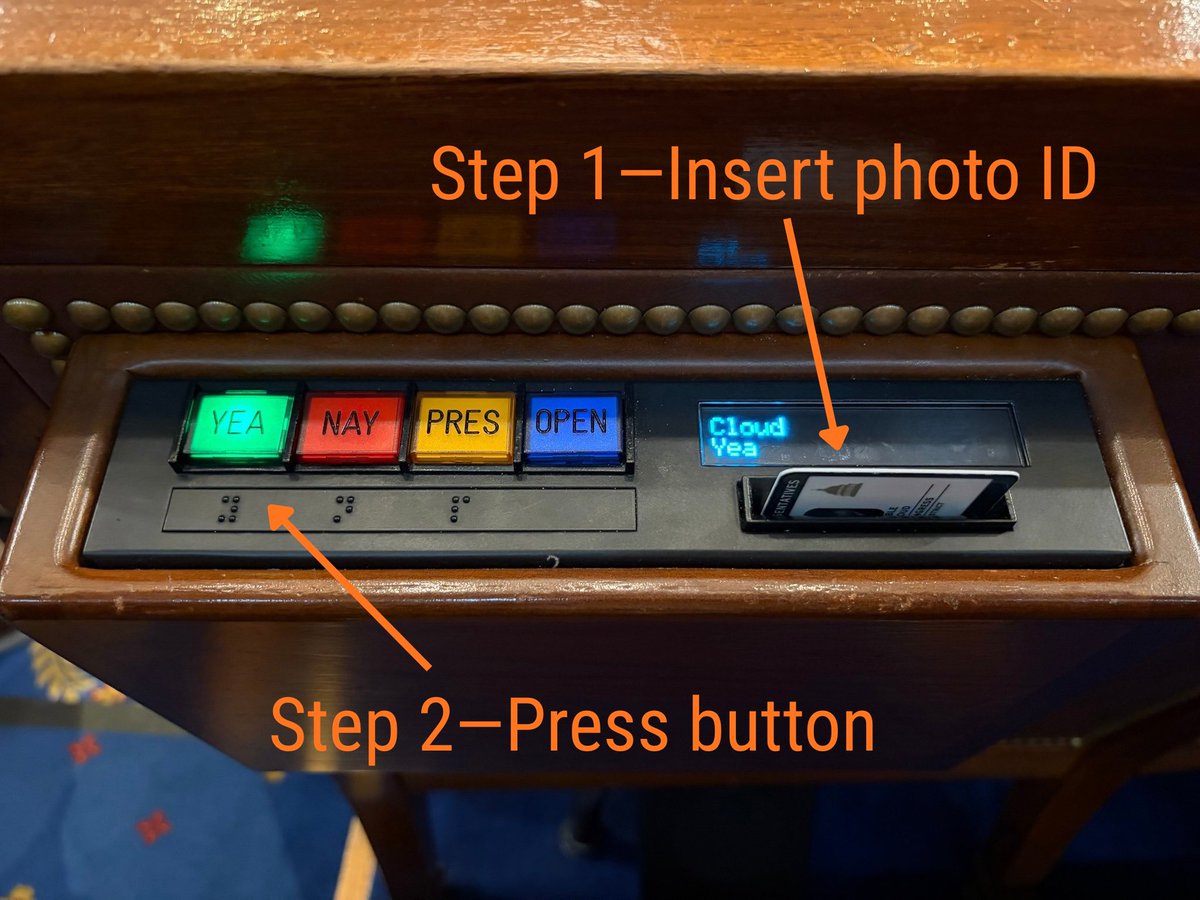
Murkowski said the structure of the ID requirements were too cumbersome and would restrict voting access - which is true. Rather than dig in and fight for a fair bill, she’s happy to have those requirements if you exempt voters 65+ Hey @lisamurkowski if you know something is wrong, then it’s absolute cowardice to carve out your base and screw over all other American’s. Try actually standing for something for once!
Jamie Dupree@jamiedupree

Sen. Lisa Murkowski R-AK has submitted 15 amendments to the SAVE America Act. One of them would exempt people born before 12/31/1960 from having to prove their citizenship in order to register to vote (they are all age 65+)

English
100
592
1.9K
68.3K
Shaun Cooley
Shaun Cooley@shauncooley·
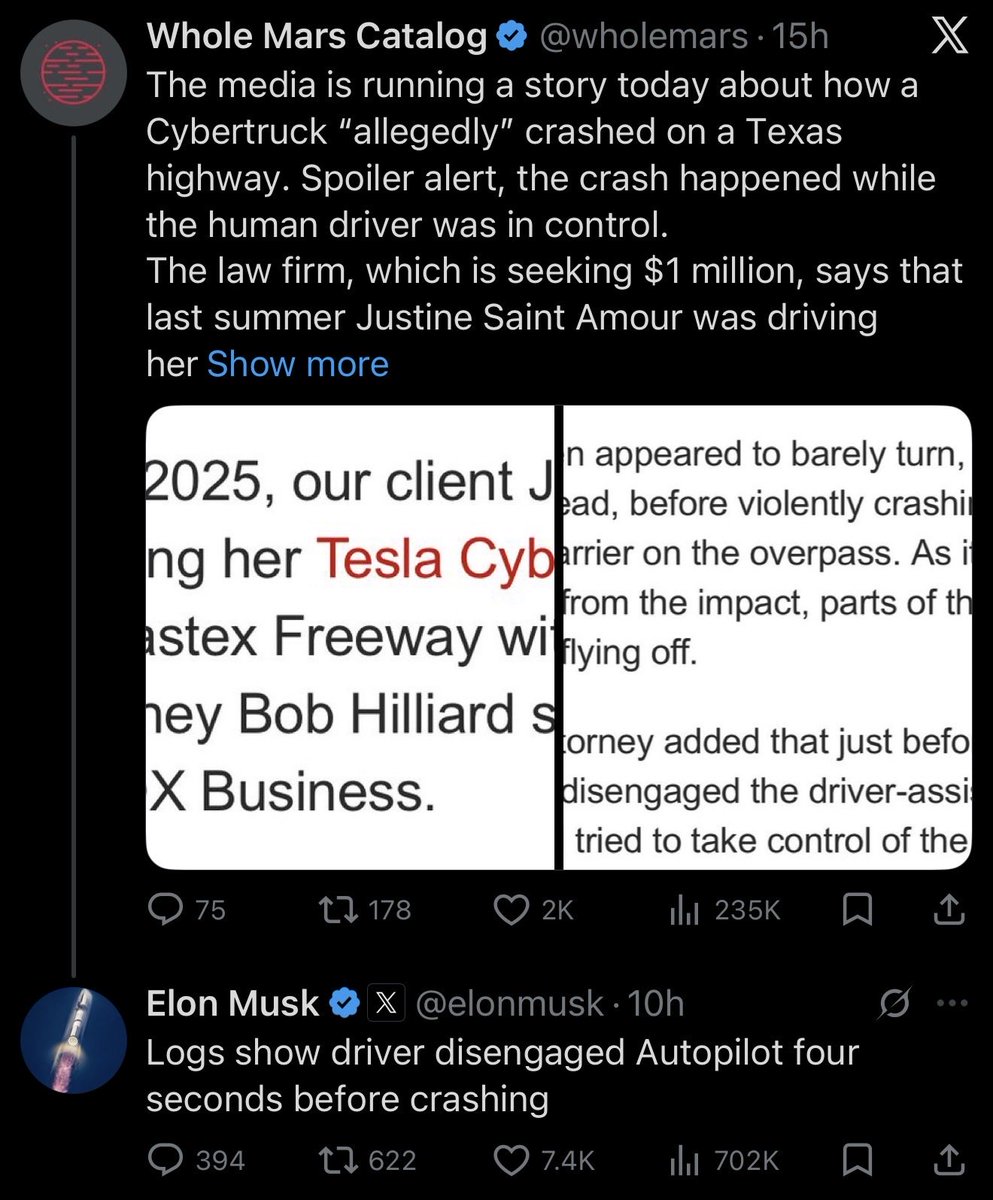
@esjesjesj I mean, best answer to the trolley problem for AI is "turn off autopilot and make the conductor at fault"
English
0
4
699
11.1K
evan loves worf
evan loves worf@esjesjesj·
Btw what happens is drivers see that autopilot is about to cause a crash and disengage it to try to stop the crash and it’s too late. Then tesla gets to say that autopilot wasn’t engaged
evan loves worf tweet media
English
396
3.7K
43.8K
846.5K
Shaun Cooley
Shaun Cooley@shauncooley·
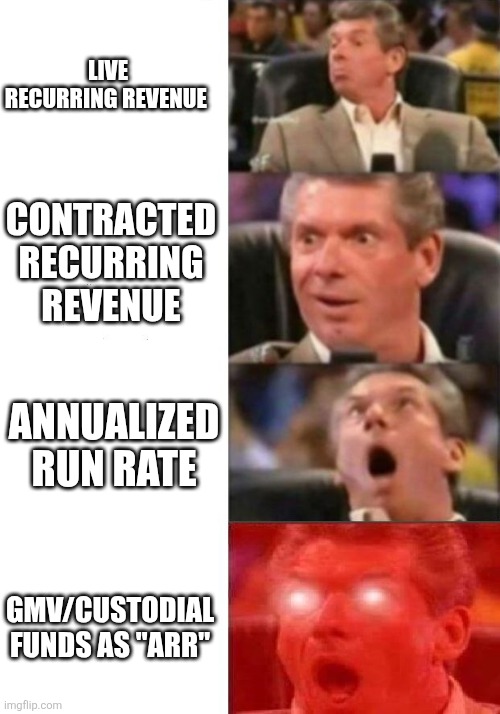
@anshublog Selling dollars for dimes and playing games with the definition of "ARR"…
Shaun Cooley tweet media
English
0
0
0
39
Anshu Sharma 🌶
Anshu Sharma 🌶@anshublog·
Cluely is not the only ai company that's lying about ARR. You really think all these companies went to $100M in real fucking ARR overnight? Easy come, easy go.
English
37
28
848
85.2K
Chandler Ward
Chandler Ward@chandlerjward·
@tenobrus hate webflow, and clay is too expensive. very deserved
English
1
0
4
271
Tenobrus
Tenobrus@tenobrus·
gigafucked: - grammarly - calendly - miro - retool - webflow - langchain - writer - harvey - glean - expedia - monday fucked: - accenture - intuit - notion - jasper - canva - alphasense - postman - airtable - talkdesk - sierra - zapier - replit - solace probably fucked: - cursor - pilot - clay - mercor naively seems fucked but so competent / plugged in they seem to be figuring it out on the fly anyway: - linear
English
582
397
8.8K
1.9M
Shaun Cooley
Shaun Cooley@shauncooley·
@t_blom Because we seem incapable of building HVDC lines to transmit the power vast distances... Maybe "unwilling" is the right term. Either way, insanity.
English
1
0
1
188
Tom Blomfield
Tom Blomfield@t_blom·
So much of the Western United States looks like this. Why aren't we carpeting it with solar farms and colocating data centers & grid-scale batteries?
Tom Blomfield tweet mediaTom Blomfield tweet mediaTom Blomfield tweet mediaTom Blomfield tweet media
English
2.1K
126
2.5K
588.1K
Shaun Cooley
Shaun Cooley@shauncooley·
@swerdlin @TheGregYang Using creatinine without accounting for muscle mass, recent resistance training, or supplemental creatine (which holds longer than the 48hr break from supplements before a test) really throws off this type of phenotypic age model. Always found it strange FH doesn't ask these Qs.
English
0
0
2
44
Jonathan Swerdlin
Jonathan Swerdlin@swerdlin·
Long live Greg. It’s calculated from objective biomarkers reflecting system functioning: • Albumin (liver + protein) • Creatinine (kidney) • Glucose (metabolic health / insulin resistance) • hs-CRP (inflammation) • Lymphocyte % (immunity) • MCV + RDW (red blood cells) • ALP (liver/bone/biliary) It’s like a systems performance score. You can have Lyme and still have strong organ function and metabolic markers. I have friends living in upstate NY with a similar profile. Curious if you did Function’s Lyme antibody testing.
English
2
0
10
779
Greg Yang
Greg Yang@TheGregYang·
function health tells me I'm 22 seems pretty off seeing i have lyme
Greg Yang tweet media
English
33
0
192
17.8K
Shaun Cooley
Shaun Cooley@shauncooley·
@bgurley Dollars for $0.85 doesn't sound too bad. My guess is that it is closer to dollars for $0.25 or less.
GIF
English
0
0
0
31
Bill Gurley
Bill Gurley@bgurley·
This type of analysis should be done with gross profit vs revenues. We all agree it’s a “token” economy. These companies both buy and sell tokens. In 1999 we talked about selling dollars for $0.85. Reselling NVIDIA tokens below cost is an easy way to grow revs. Complicated.
Aakash Gupta@aakashgupta

Anthropic hit $14 billion in annualized revenue this month. OpenAI ended 2025 at $20 billion. That gap is closing fast. But zoom out and the math gets wild. Anthropic grew from $1B to $14B in 14 months. OpenAI grew from $2B to $20B in 24 months. Anthropic is doing it with roughly 1,500 employees. OpenAI has over 3,000. Revenue per employee at Anthropic is approaching $9 million. That’s venture capital efficiency at enterprise scale. The chart assumes both companies sustain their current growth multipliers. They won’t. Both companies’ own projections show deceleration. Here’s what each company actually forecasts: OpenAI: $20B in 2025 → ~$30B in 2026 → $100B by 2029. That’s 3.3x growth over 2025, then 1.5x, then diminishing from there. Anthropic: $9B in 2025 → $18-26B in 2026 → $55B in 2027 → $70B in 2028. That’s 2-3x in 2026, then 2-3x again, then slowing to 1.3x. Even with deceleration baked in, the lines still converge by 2027. Anthropic’s own projections show $55B in 2027 revenue. OpenAI needs to hit $60-70B that same year to stay ahead, and its growth multiplier is already lower. Here’s what the chart doesn’t show: profitability trajectory. Anthropic expects to break even by 2028. OpenAI is projecting $14 billion in losses for 2026 alone, $74 billion in operating losses by 2028, and $115 billion in cumulative cash burn through 2029. Anthropic forecasts its burn rate dropping to 9% of revenue by 2027. OpenAI’s stays at 57%. OpenAI spends $1.69 for every dollar of revenue it generates. It has committed $1.4 trillion in compute deals over the next eight years. Anthropic is building its own data centers. Claude Code alone hit $2.5 billion in annualized revenue this month, more than doubling since January. A single product generating more ARR than most public SaaS companies. Revenue lines crossing on a chart makes for a good graphic. The company that gets to profitability first wins the decade. And on that metric, the gap between these two companies is already enormous.

English
58
39
899
267.9K
Shaun Cooley
Shaun Cooley@shauncooley·
@pmarca I hate taxes as much as anyone, but adding "his companies" doesn't change the equation at all… and that's not even counting subsidies and grants. 0.4% tax rate for Tesla over the last 3 years. itep.org/tesla-reported…
English
14
1
7
11.4K
Lee Edwards
Lee Edwards@terronk·
There actually is a trans furry cybersecurity mafia but none of y’all are ready for that one yet.
English
25
15
466
17.4K
Shaun Cooley
Shaun Cooley@shauncooley·
@typesfast Where is the tool for Apple, Nvidia, HP, Dell, Tesla, Google, Meta, and Amazon to calculate refunds on bribes? 👀
English
0
0
0
490
Ryan Petersen
Ryan Petersen@typesfast·
Supreme Court strikes down Trump’s sweeping global tariffs. Flexport built the world’s simplest refund calculator brands can use to see what they’re owed back. Use it for free right here: tariffs.flexport.com/refunds
English
65
120
863
480.7K
Shaun Cooley
Shaun Cooley@shauncooley·
@maxmarchione This is great! When can it order highly specific blood/MRI/CT tests that are not part of your current bundled catalog and the AI needs to eliminate or confirm conditions that the bundled annual tests signal?
English
0
0
1
1.7K
Max Marchione
Max Marchione@maxmarchione·
Today, we share our AI doctor for the first time The future is an AI that knows more about your body than any human ever could. 247 commits. 140,000 lines of code. Months of engineering. Here it is:
English
438
556
5.1K
2.8M
Shaun Cooley
Shaun Cooley@shauncooley·
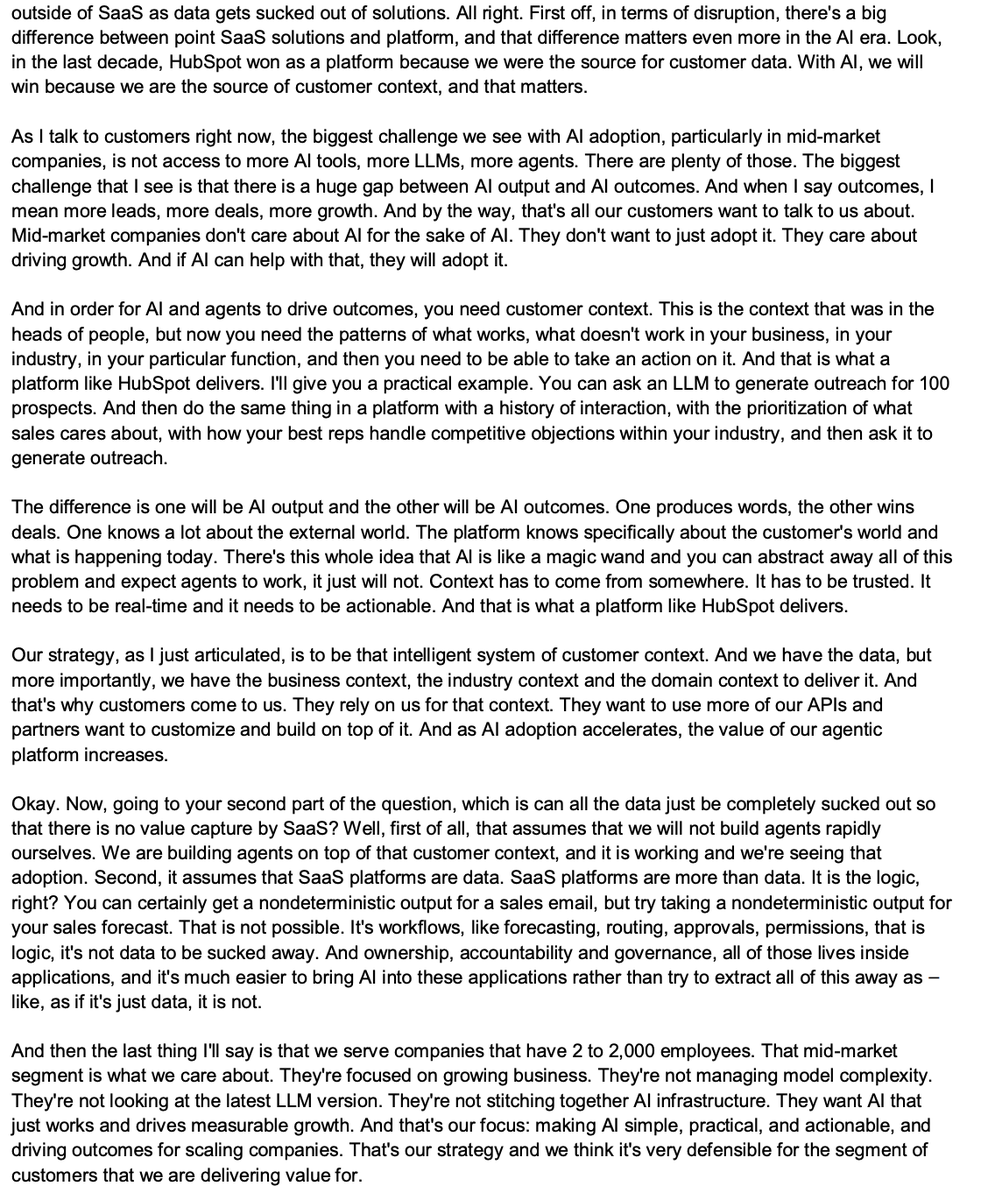
Clay, Apollo, Clearbit, Trigify, Warmly → 11x, AiSDR, Ava, Regie, Mosaic → Vector, HockeyStack, RB2B, Crossbeam → Gong, Attention, Avoma, Fireflies, MeetRecord, Granola → Clari, AgilePitch, … … If HubSpot was actually leveraging their "platform", all this would be built-in.
English
1
0
1
93
Tanay Jaipuria
Tanay Jaipuria@tanayj·
HubSpot’s response to the threat of AI disruption to them: • They’re a platform, not a point solution. • They own end-to-end customer context across marketing, sales, and service which allows for better AI outcomes • They're more than data: they have workflow, permissions, routing, forecasting, governance. • Easier to bring the AI to that system then bring all that to the AI • Mid-market companies want growth, not to stitch together LLMs and infra and build their own
Tanay Jaipuria tweet media
English
16
20
239
32.2K
Shaun Cooley
Shaun Cooley@shauncooley·
This looks awesome, but when is Ramp going to fix BASIC stuff like letting me fix completely incorrect vendor names and categories instead of just "reporting it" to some Ramp blackhole? Or when will Ramp automatically pull a receipt from the Bill Pay section when the bill is paid with a credit card, match it, and mark the bill as paid in Bill Pay? It is like every section of Ramp was built by a totally different company and none of them talk to each other.
English
1
0
3
937
Eric Glyman
Eric Glyman@eglyman·
There are two non-negotiables in accounting: the books must be correct, and they must be ready on time. For decades, companies have satisfied those constraints through an extraordinary amount of manual effort. Highly trained professionals code transactions, re-approve familiar expenses, reconcile mismatches after the fact, and compress all of it into the ritual of month-end close. It works. But it is fundamentally retrospective. Today, @tryramp is introducing an Accounting Agent designed around a different premise: what if bookkeeping happened as the business operated, rather than after it? The agent captures, codes, reviews, validates, accrues, and reconciles spend continuously. It learns directly from the people who understand the nuances best, the accounting team itself, and applies that context in real time. At @perplexity_ai, where velocity is part of the company’s identity, this has allowed their team to stop choosing between speed and accuracy. The majority of transactions are now coded automatically while remaining audit-ready, enabling close to start on day one instead of day thirty. What’s been most striking is how the system learns the subtle, company-specific logic that historically lived only in human judgment. As Jim Romano, CFO at @statesidevodka, described it, the agent is already identifying patterns like when spend belongs in samples rather than travel and entertainment — the kinds of decisions that typically require institutional memory. As he put it, the goal is simple: finance teams should focus on exceptions, not the easy stuff. We’re also seeing the second-order effects emerge quickly. Teams report spending dramatically less time reviewing transactions and substantially more time on planning, analysis, and growth. As one CFO told us, “What used to take hours of manual review now happens automatically. I’m spending nearly all of my time thinking about where the business should go, not retracing where it’s already been.” There is a broader shift underway in accounting. The central question is moving from “what parts of close can be automated?” to “should close even be a discrete event at all?” One belief that increasingly guides our work at Ramp is that information latency inside companies is an invisible tax. When financial truth lags behind operational reality, organizations make slower and often worse decisions. As transaction data becomes inherently digital and systems become capable of learning institutional context, continuous close stops being aspirational and starts becoming inevitable. One thing that surprised us while building this: accounting isn’t constrained by a lack of rules — it’s constrained by how many of those rules are unwritten. Much of financial operations lives in patterns that experienced teams simply know. Seeing software begin to absorb and apply that tacit knowledge has been one of the clearest signals that accounting is entering a new phase. Accounting has always been the record for business reality. Our goal is to help it become something closer to real-time truth. Proud of the team, and grateful to the customers building this alongside us.
English
12
24
433
129.1K