

Siddique Ahmad
1.9K posts

Siddique Ahmad
@siddiqueESL
On a mission to help many by sharing knowledge.
Wah, Pakistan Katılım Şubat 2013
102 Takip Edilen126 Takipçiler

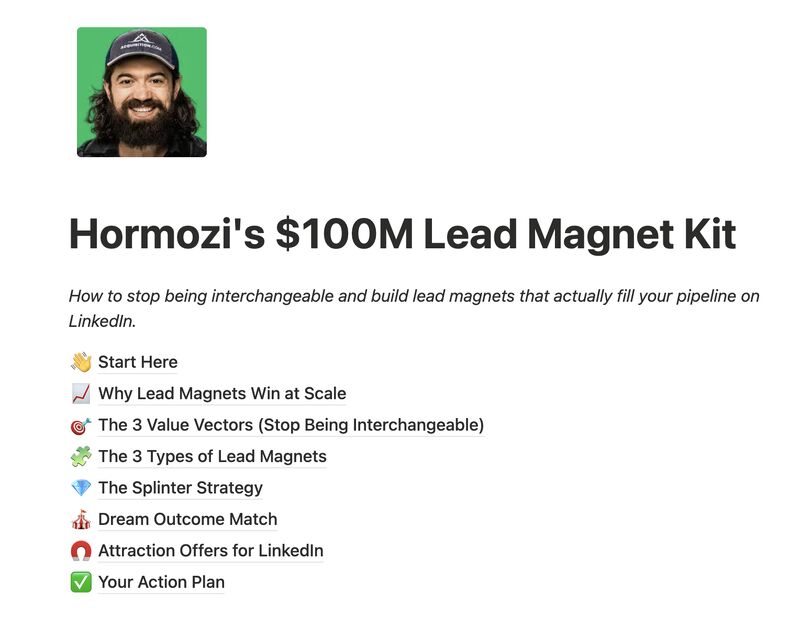
In Feb, I applied Alex Hormozi's lead magnet framework to LinkedIn.
In a few weeks, I went from:
- 1.5k -> 3.9k followers
- Booking 0-1 calls/mo -> 5-15/mo
- Getting ~1k -> ~15-30k impressions/mo
Before, I didn't realize how saturated the feed was with content.
Because nowadays...
LinkedIn is a WALL of "Comment X and I'll DM you" posts (and 'thought leadership' content in general).
Everyone has figured out that lead magnets are the method.
Yet, it's becoming harder and harder to stand out with it.
If you're posting "free PDFs" on LinkedIn and nobody is commenting for them, you already know what I'm talking about.
→ Your ICP used to comment on every giveaway post. Now they scroll past yours without blinking.
→ Your lead magnet sounds like the same "Ultimate Guide" as the 8 other people in your niche
→ You're giving away a google doc that took you 20 minutes to make and wondering why nobody cares
→ The leads that DO come in are garbage because your magnet attracted everyone instead of your actual buyer
Hormozi's framework is what separates the top performing lead magnets that go viral + book calls from the ones getting buried.
His data shows lead magnets beat direct offers on overall ROAS AND scale better.
But ONLY when yours has real value and real differentiation.
That said...
I just put his ENTIRE system into a free Notion kit.
Inside:
1) Hormozi's real ROAS data on lead magnets vs direct offers
2) The 3 Value Vectors: Speed, Risk, Ease (so your offer stops being interchangeable)
3) The Splinter Strategy: how to give away something that actually costs you to deliver
4) My naming formula for lead magnets that cut through a saturated feed
5) Plug-and-play giveaway post template
Want me to send it?
1. Comment "HORMOZI"
2. Follow @aidanb2b
And I'll DM it to you.
PS: Everyone's posting lead magnets now. The question is whether yours stands out or gets buried. This kit is how you make sure it stands out.
English

a vision language model too fast for human eyes! kudos @xenovacom 🐐
Ramin@ramin_m_h
model’s so fast, Josh had to slow down the video capture to show case this demo! @liquidai
English
@xenovacom @liquidai this is so great, so real time so responsive
English

Massive thanks to @LiquidAI for their amazing LFM2 models! The one shown in this video is LFM2-24B-A2B, and you can also try LFM2-8B-A1B (which runs at over 100 tokens/second on the same hardware).
Try out the demo yourself (if you dare)! 👇
huggingface.co/spaces/LiquidA…
English

During a job interview, if they ask: "How do you handle it when everything is a priority?"
USE THE GOLDEN RESPONSE:
English
I have to recheck multiple times that it replied a complex complex problem in a blink
Taalas Inc.@taalas_inc
24 dedicated people. $30M spent on development. Extreme specialization, speed, and power efficiency. Today we launch Taalas’ first product. Check it out: Details: taalas.com/the-path-to-ub… Demo chatbot: chatjimmy.ai API: taalas.com/api-request-fo…
English

YC just announced their looking for AI-Native agencies.
The agency model is about to split into two completely different businesses:
A) Agencies that sell labor
B) Agencies that sell leverage
Only one survives long term.
AI-native agencies don’t scale by hiring more people.
They scale by building systems that replace people.
The playbook looks like this:
→ Find a workflow clients already overpay for
→ Build an AI tool that does it 10x faster
→ Use services to fund development
→ Turn repeated work into proprietary IP
→ Eventually sell the tool, not the time
The real shift:
Agencies used to be talent businesses.
Now they’re becoming software companies with cash flow.
Most people will miss this window because they’re still optimizing delivery instead of building leverage.
That’s the opportunity.
I'm launching a community of like-minded builders trying to build their own AI-native agency.
I'm going to share everything I know having built my own 7-figure AI agency.
Looking for motivated people ready to learn & build.
Drop a comment, I'll personally reach out.

English
@RaulJuncoV Like micro services, each can be scaled individually
English

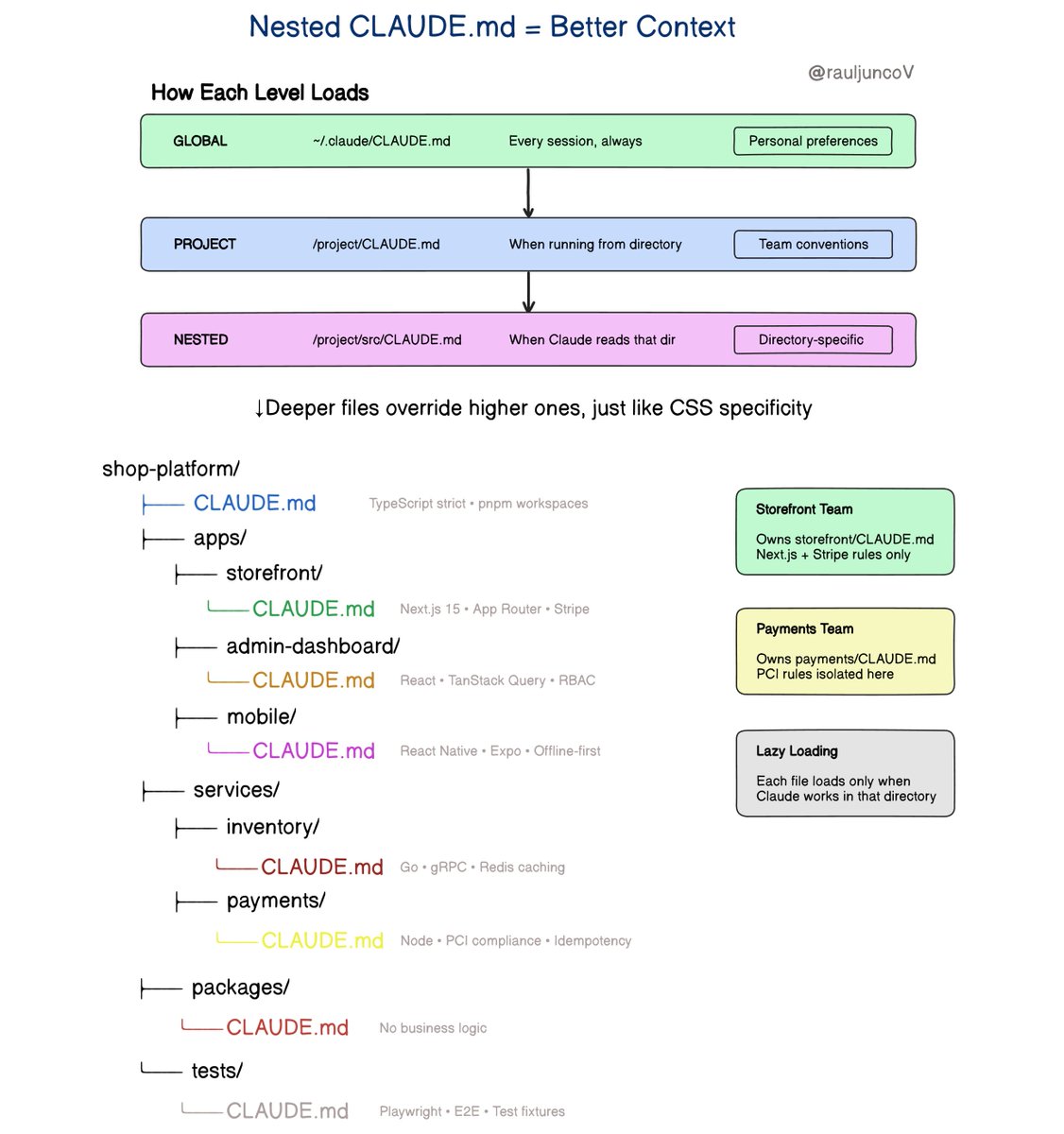
Stop dumping everything into one CLAUDE[.]md file.
Nested files are criminally underrated.
Most teams think AI fails because models aren’t smart enough.
That’s rarely the problem.
AI fails because it has zero sense of boundaries.
When you shove every rule, convention, and architecture decision into one giant CLAUDE file…
You create:
• Context noise
• Conflicting instructions
• Lower accuracy
• Slower AI collaboration
It’s the equivalent of putting your entire system into one class and calling it “modular.”
Nested CLAUDE files fix this. They introduce context boundaries.
Exactly like good software architecture.
Global rules at the top.
More specific rules as AI moves closer to the code.
Deeper files override higher ones.
Nested files only load when Claude works in that directory.
This gets ridiculously powerful in monorepos. It means:
1. Token efficiency
Every token in your context window costs performance. Why load React rules when you're writing a Python worker?
2. Team scalability
Frontend team owns apps/web/CLAUDE[.]md.
Backend team owns apps/api/CLAUDE[.]md.
No merge conflicts. No stepping on toes. Clear ownership.
3. Higher AI accuracy
Claude loads only relevant rules.
Fewer conflicting instructions.
Way more consistent output.
Here’s the bigger lesson I have learned while coding with AI:
AI coding isn’t a prompt engineering problem.
It’s a context architecture problem.
If you had to define ONE non-negotiable rule in your CLAUDE[.]md, what would it be?
English

I built an entire content team in 21 minutes.
It writes LinkedIn posts, YouTube scripts, Newsletters, and Tweets. All in my voice.
Content used to be the bottleneck. Writing for multiple platforms meant either spending hours on it or hiring someone who never quite sounded like me.
I spent weeks refining this system so I could show you exactly how to set it up.
What's in the guide:
- Setting up your personal AI writer from scratch
- The folder structure that makes AI writing actually work
- Using successful examples to train your AI's voice
- Building and refining custom writing skills
- Advanced techniques for scaling across platforms
This is for creators, founders, and marketers who want to produce more content, faster, without losing their voice or hiring a team.
I recorded the full walkthrough. Every step. Live.
Comment "WRITER" and I'll DM you the free GitHub repo with the complete folder structure and skills.
(Make sure we're connected so I can DM you)
English

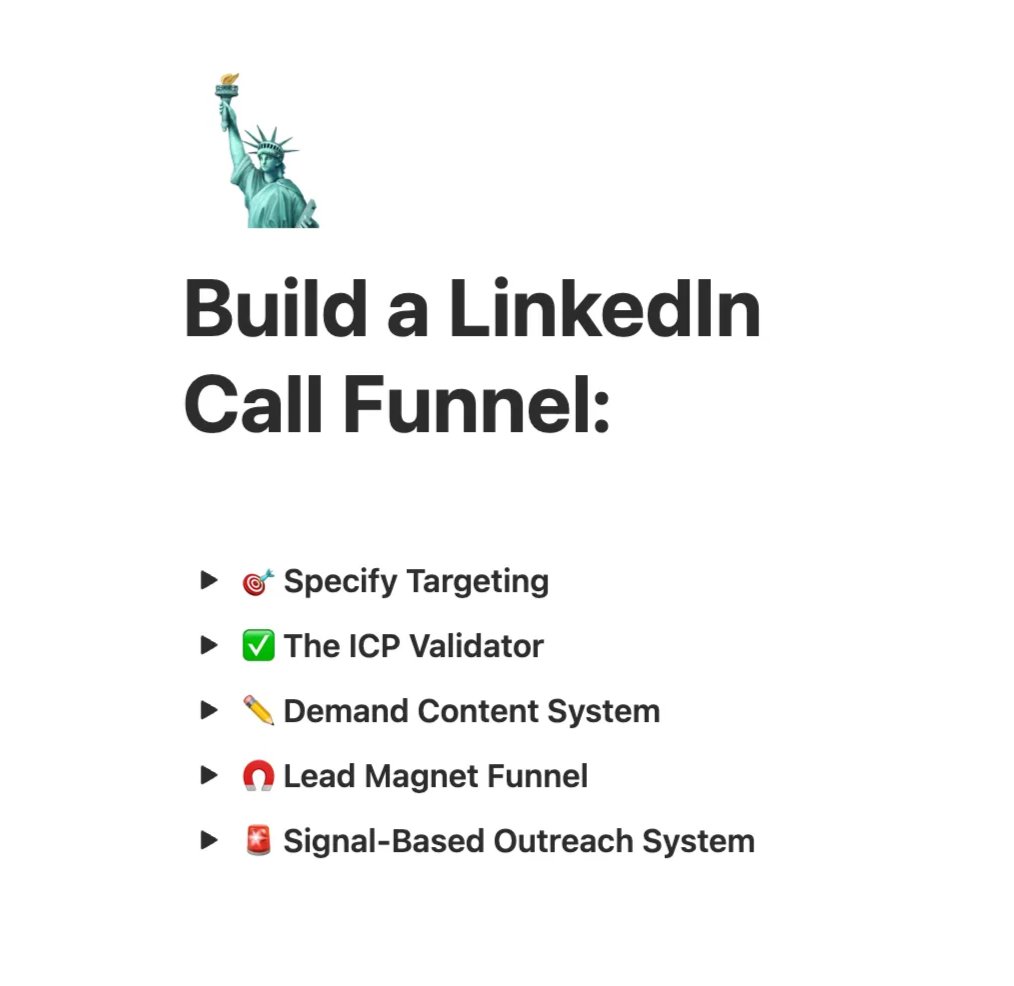
I automated my LinkedIn client acquisition.
Now I close qualified calls every month on autopilot.
Most B2B founders struggle with LinkedIn because they're missing the system.
They post randomly. Their DMs get ignored. Their lead magnets flop.
I spent 18+ months perfecting a framework that solves this:
→ Targeting filters that identify decision-makers with budget
→ A system to extract exact pain points your ICP faces
→ Content creation using their language
→ Lead magnet strategy to identify leads
→ DM sequences with follow-ups that actually close deals
→ Lead list building that generates 100+ qualified connections weekly
This is the exact system I use to book calls without cold calling, paid ads, or spammy outreach.
One client used this to generate 100+ leads in 30 days.
I've packaged the entire framework into a complete training.
1- Follow me
2- Comment "SYSTEM" and I'll send it over.
(Must be following for me to DM you)
English

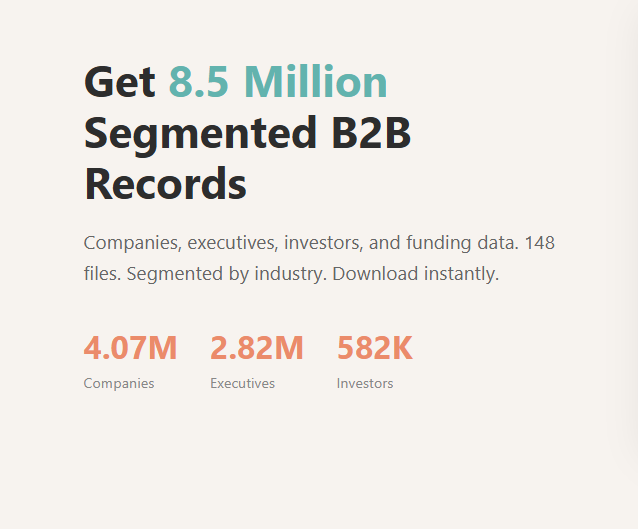
4,073,000+ companies and 2.8m founders and execs organized into targetable lead lists.
No scraping. No cleaning. Just plug and play.
I took 2 massive company database and segmented it into 13 industry-specific lists.
Here's what's inside:
→ 817K Software & Technology companies
→ 746K Diversified/Other industries
→ 551K Manufacturing & Industrial
→ 352K Healthcare & Life Sciences
→ 294K Media & Entertainment
→ 292K Real Estate companies
→ 270K Financial Services
→ 189K Professional Services
→ 189K Retail & E-commerce
→ 128K Education companies
→ 101K Food & Beverage
→ 75K Transportation & Logistics
→ 64K Energy & Utilities
BONUS data included:
→ 2.8M Executives & Founders (C-suite, directors)
→ 765K Funding Rounds (seed to IPO)
→ 582K Investors (VCs, PEs, angels)
→ 6,500 Strategy Consulting firms (McKinsey-types)
8.5M+ total records across 151 files.
Each list includes: Company name, description, website, location, employee count, LinkedIn, industry, ownership status, funding data.
Perfect for cold outreach, market research, or building your ICP.
Like + Comment "LISTS" and I'll send you the drive link.
Gotta be following to receive DM.
English
@embeddingshapes @EdouardGodfrey Yes I read for same, even though it's great work
English

@EdouardGodfrey I'm guessing more than half of the readers will get tripped up by this though and think you actually mean "Local AI agents" since the title still says that.
English


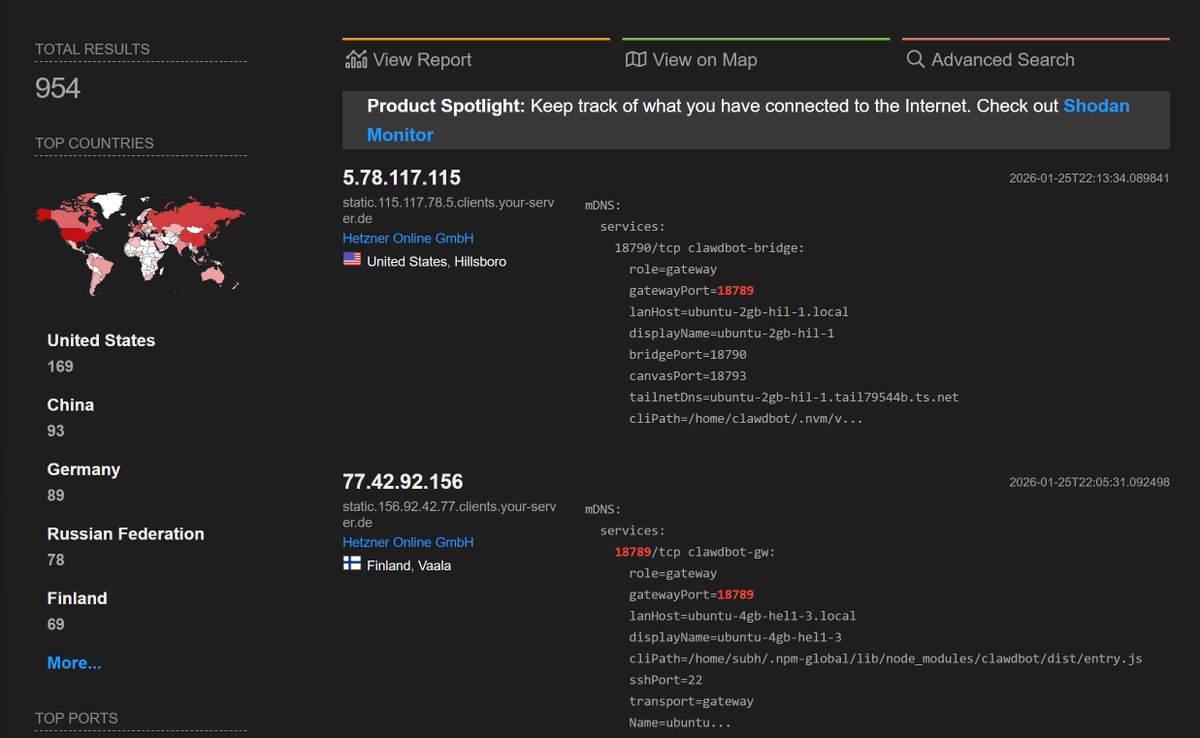
Clawd disaster incoming
if this trend of hosting ClawdBot on VPS instances keeps up, along with people not reading the docs and opening ports with zero auth...
I'm scared we're gonna have a massive credentials breach soon and it can be huge
This is just a basic scan of instances hosting clawdbot with open gateway ports and a lot of them have 0 auth
English



@nicbstme Very well written explained and linked with current needs, gem
English

@tinybird 404: NOT_FOUND
Code: DEPLOYMENT_NOT_FOUND
ID: dxb1::qn6br-1769184360853-3c0927eefd58
English

Complete case study with:
• Full schema design
• Materialized view definitions
• Pagination logic
• Source code
Learn the pattern → learnclickhouse.com/watch/log-anal…
English
Read “How ClickHouse Materialized Views Supercharge Analytics“ by Siddique Ahmad on Medium: siddique-ahmad.medium.com/how-clickhouse…
English


RIP JSON.
AI just got a data format that doesn’t waste tokens, doesn’t confuse models, and doesn’t bury structure under a pile of punctuation and it’s called TOON.
If you work with LLMs, this is the part where everything you thought was “good enough” starts looking ancient.
JSON was built for humans.
TOON is built for machines.
And the difference shows instantly:
• 40–60% fewer tokens
• Cleaner reasoning
• Higher retrieval accuracy
• Zero syntactic clutter
• Perfect round-trip back to JSON
Here’s what structured data looks like in 2025:
users[2]{id,name,role}:
1,Alice,admin
2,Bob,user
LLMs understand it faster. Your context budget lasts longer. Agents stop hallucinating field names. And Pipelines get cheaper overnight.
JSON won the web era.
TOON is about to win the AI era.
And this is 100% open source (link below)

English
Siddique Ahmad retweetledi
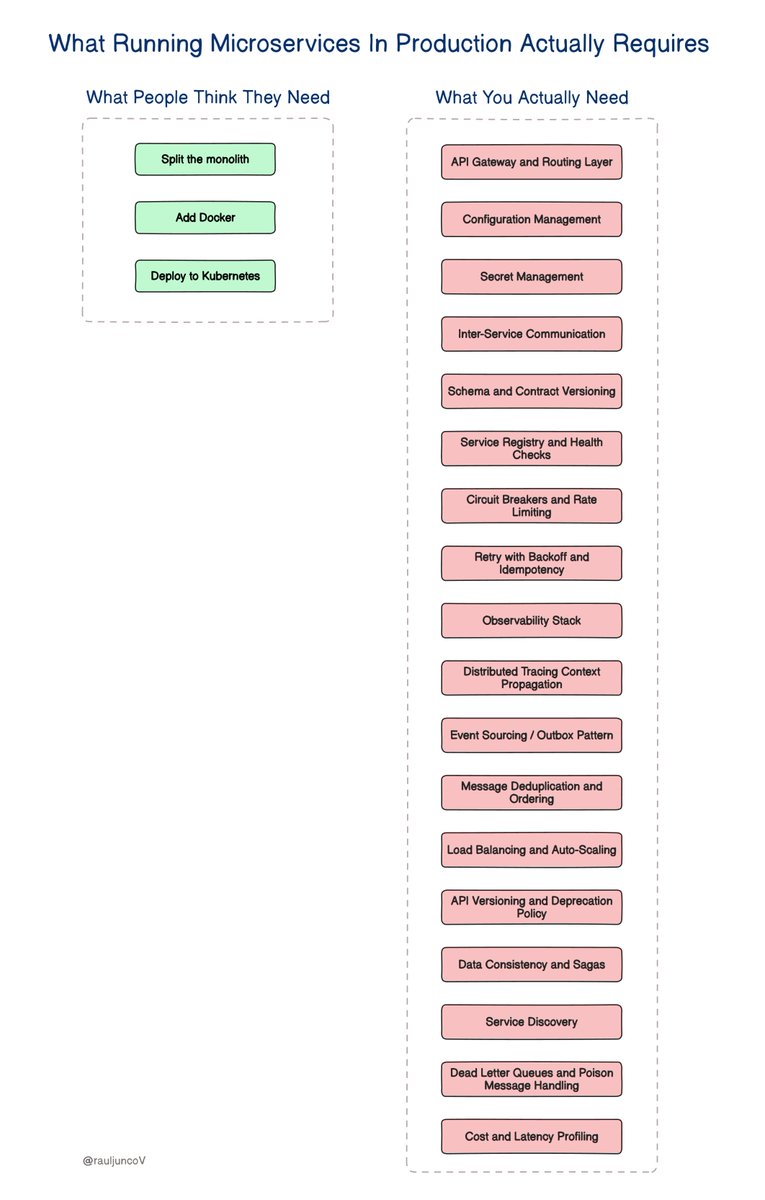
Everyone wants microservices.
Few understand what it takes to run them.
It’s not the code that kills you.
It’s the coordination.
Breaking the monolith is easy.
Running distributed complexity isn’t.
English