Simon D. Halliday

1.7K posts

Simon D. Halliday banner
Simon D. Halliday

Simon D. Halliday

@simondhalliday

Assoc Prof at CES @SNFAgoraJHU Affiliate @CASBSStanford; member @coreeconteam. Previously @BristolUni @smithcollege, @RHULEcon & UCT. My views 💗💜💙

Baltimore, MD Katılım Kasım 2009
1.2K Takip Edilen1.2K Takipçiler
Sabitlenmiş Tweet
Simon D. Halliday
Simon D. Halliday@simondhalliday·
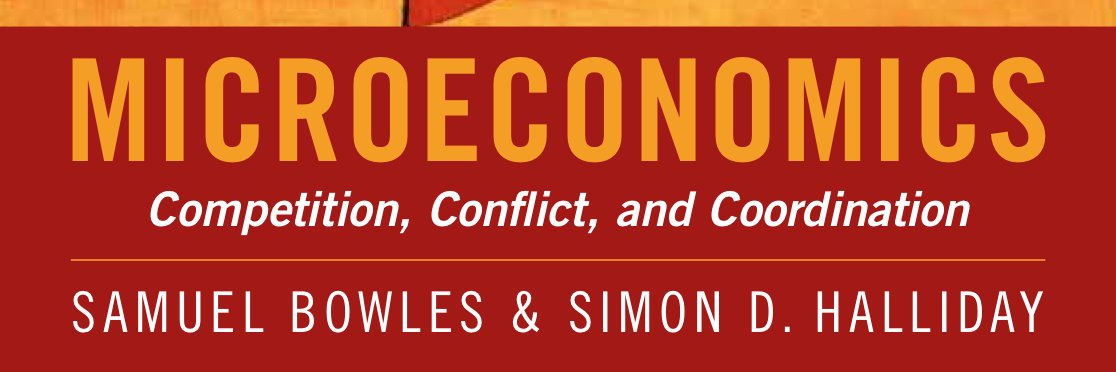
Great to see this write-up of my microeconomics textbook w/ Sam Bowles. It was published in July by @OxUniPress You can see details & free pdf at my website here: simondhalliday.com/microeconomics or at OUP here: global.oup.com/academic/produ… Some Endorsements quoted below. 🧵 (1/8)
Santa Fe Institute@sfiscience

A new #economics textbook by SFI Prof Samuel Bowles and Simon Halliday (@BristolUni) upends convention and offers a new, more engaging way of teaching the subject — one that actually acknowledges #inequality, #climatechange, #sustainability, and #poverty: santafe.edu/news-center/ne…

English
2
8
39
0
Simon D. Halliday
Simon D. Halliday@simondhalliday·
@Afinetheorem Totally agree. I’ve been doing this a lot with Claude with very specific guidelines for the textbook and it helps find things I can improve all over the place. Especially if I was writing a first draft while tired 😂
English
0
0
0
13
Kevin A. Bryan
Kevin A. Bryan@Afinetheorem·
I would not have said this was true a year ago, to be clear.
English
1
0
2
358
Kevin A. Bryan
Kevin A. Bryan@Afinetheorem·
Good writing is tough but I will say: I took a few recently published research papers, a .md file with very specific style notes (think New Yorker Editor), and Sonnet 4.6 + 5.4 Thinking, and asked for the introduction to be rewritten. They were *much* better. Try it yourself!
Noah Smith 🐇🇺🇸🇺🇦🇹🇼@Noahpinion

The reason AI still can't write well is that it writes what IT wants to say, not what YOU want to say. Writing is thinking. I expect this to be fixable, but not via typical "scale to AGI" approaches.

English
6
2
32
2.8K
Simon D. Halliday
Simon D. Halliday@simondhalliday·
@Afinetheorem Relatedly, I think this is an underrated paper from two UCLA folks (Makowski and Ostroy) whose work I only came to know after reading this paper: aeaweb.org/articles?id=10…. Both did good work and I learned important ideas from them.
English
0
0
8
3.7K
Kevin A. Bryan
Kevin A. Bryan@Afinetheorem·
Peter is right - the UCLA school is the most underrated school of economics among the general public. So many great ideas in every other 70s UCLA paper. And of course a huge influence on Rumelt, who you will know from Good Strategy, Bad Strategy (read this one also!)
Kevin A. Bryan tweet media
English
5
3
76
10.2K
tumacius
tumacius@tumacius·
@joshgans Will play around with it trying to embed it
English
1
0
0
10
Joshua Gans
Joshua Gans@joshgans·
Not sure if Claude diagrams are ready for prime time. This one is right off.
Joshua Gans tweet media
English
3
1
37
7.2K
Simon D. Halliday
Simon D. Halliday@simondhalliday·
@arindube I’ve been incorporating Claude into work at CORE. For “Understanding Our Economy” I’ve set up different skills to write memos to review inconsistent use of terms, to check exercises, to review MCQs and provide feedback, to cross-check chapters & more.
English
1
0
4
693
Arin Dube
Arin Dube@arindube·
I have read a ton from economists in my TL about use of AI in their research workflow. Much less about teaching. Would love to hear what folks' experience has been on that front. (Not problems of students using AI: I mean use of AI in teaching workflow, the good and the bad.)
English
18
9
110
79K
Simon D. Halliday
Simon D. Halliday@simondhalliday·
@Afinetheorem I’d be very happy to get (or rent?) such a robot when needed for a baby/infant up to around 12/14 months. I suspect the harder challenge is for a toddler—toddlers have a death wish infants don’t have, can the robot run and pick up the toddler to stop it charging into traffic?
English
0
0
1
43
Kevin A. Bryan
Kevin A. Bryan@Afinetheorem·
A thought experiment based on a convo today: AI -> robotics -> there is a robot a household could buy which can safely watch a baby at the level of a 14 year old babysitter. How many people use it? What does this do to labor supply? Curious for the variance in what folks think...
English
5
0
8
3K
Simon D. Halliday
Simon D. Halliday@simondhalliday·
@mslater_johnson I think it’s still feasible up to about that. I tend to have a set of compulsory questions and then a set of questions I’ll draw from and ask about depending on what they say. Less grading overall. I write each student an email report about their performance.
English
1
0
1
14
Matt Johnson
Matt Johnson@mslater_johnson·
@simondhalliday you have had good experience w/ oral exams? Was debating if I could do this for a class of ~30 students next semester.
English
1
0
0
34
Simon D. Halliday
Simon D. Halliday@simondhalliday·
File under “yet another reason my courses include oral exams” (yes I know I’m privileged to have classes small enough to manage this). Also that’s not the only thing I do but I do think they should be more widely adopted.
Kevin A. Bryan@Afinetheorem

As @alexolegimas noted in the comments, if your class is set up such that this is a problem, you haven't been paying attention. We're in year 4 of "stop giving take-home assignments that matter". But also: AI can let you run a much *better* course than pre-AI! 1/2

English
1
0
2
216
Simon D. Halliday retweetledi
Derek Thompson
Derek Thompson@DKThomp·
I have to hand it to anti-medicine influencers. They are very, very, very clever about bullshitting their audience. Statins are a popular drug, with a low side-effect profile for most patients, which have been repeatedly shown to reduce the risk of cardiovascular disease, the most common cause of death in most developed countries. So, how the hell do you argue against statins? By creating a highly specific scenario and reporting the benefit in extremely tendentious terms. More than 90 percent of people who have a heart attack don't die of a heart attack within the next 5 years. So if you ask "how much extra life will a statin give you in those 5 years?" the answer will be small. You can make it seem like statins don't do anything by analyzing their life-saving effect within a population group that mostly isn't going to die, anyway! The below is like saying, "if you wear a bike helmet for a year after being in a bicycle accident, it only increases your life expectancy by 19 minutes." Well ... haha, yeah! You have framed the scenario in a perfect way to make bike helmets look worthless! Very clever!
Joe Rogan Podcast News@joeroganhq

Dr. Aseem Malhotra: "If you take a statin for 5 years after a heart attack... in that 5 year period, how much would you think or hope it would add to your life expectancy?" Joe Rogan: "25%? 30%?" Malhotra: "Just over 4 days."

English
128
352
3.3K
357.8K
Simon D. Halliday
Simon D. Halliday@simondhalliday·
This summer program is where I met Kevin (and a bunch of fantastic people I’ve remained in touch with subsequently). It’s an excellent program. I still refer to papers and books I read during the program in 2011. Highly recommend it.
Kevin A. Bryan@Afinetheorem

PhD students interested in the history of thought: you must apply to Duke's HOPE summer program. I went twice as a grad student! You can't be a scholar without knowing the history and historiography of your field, and this is the best place to get the basics.

English
0
0
2
315
Ross Barkan
Ross Barkan@RossBarkan·
AI is still the only tech in modern human history where people have to talk you into it. No one had to make a hard sell on indoor plumbing, electricity, air travel, or even the smartphone. Humans happily bought in. How many Americans *want* to pay hundreds a month for AI tools?
English
280
71
801
309.9K
Simon D. Halliday
Simon D. Halliday@simondhalliday·
@RebelEconProf I’m trying to ensure I understand what you’re saying as this looks like an ad hom attack on Bowles (“people undisciplined”). Given your interests you may want to take a look at his JEP paper on Hayek. aeaweb.org/articles?id=10…
English
0
0
1
29
Simon D. Halliday
Simon D. Halliday@simondhalliday·
@D_Langenmayr Like I said on the original post (and elsewhere) Sam would agree with you that it’s standard in research. But how many UG students take Pub Econ as % of all majors? What about in Econ 1? In the US, ~12% of students take 1 Econ class. 2% are majors.
English
1
0
0
36
Simon D. Halliday
Simon D. Halliday@simondhalliday·
@johnjhorton @UCStoneCenter @sndurlauf @ethanbdm Sam is talking about the *teaching* of Econ in many UG economics curricula. He knows the difference between this and modern Econ and has written about what Econs do vs what we teach. (I say this as a co-author who has written with him on related topics).
English
2
0
6
245
Simon D. Halliday
Simon D. Halliday@simondhalliday·
@joshrauh I worry you’re mischaracterizing a brief quote from a longer public-facing event. He’s making an argument about what UG students are taught, which is not Mirrlees, not Saez. In published papers he’s made the point of the difference between what Econs do and what we teach UGs.
English
2
1
13
613
Joshua Rauh
Joshua Rauh@joshrauh·
This is a blatant straw-man mischaracterization of Economics. From Nobelist Mirrlees (1971) who derived an optimal top marginal tax rate of zero to Saez (2002) who suggests much higher rates, public finance economists use Social Welfare Functions (SWFs): a formalization that goes back to Bergson in the 1930s but that has deep roots in Bentham’s 19th century utilitarian political economy. My personal view is that social welfare functions combined with diminishing marginal utility of consumption practically bake in tons of optimal redistribution without considering distortions. We can debate that. But please: the idea that public finance doesn’t handle the possibility that caviar for the rich might have less social benefit than bread for the poor is just arguing with a cartoon version of economics.
UChicago | Stone Center on Inequality & Mobility@UCStoneCenter

We rarely think of economics as scandalous, but maybe we should. Sam Bowles, in conversation with @sndurlauf & @ethanbdm, argues that a core assumption in the field impedes moral reasoning about wealth redistribution. Watch the full panel → bit.ly/3Yj4F3B

English
28
62
456
70.3K
Christopher Clarke
Christopher Clarke@EconChrisClarke·
Pareto was wrong. Utility can be cardinal, not just ordinal. I've always thought the problem of incomensurability was silly. We all do it every day. Ok, is that enough fancy words for one tweet?
UChicago | Stone Center on Inequality & Mobility@UCStoneCenter

We rarely think of economics as scandalous, but maybe we should. Sam Bowles, in conversation with @sndurlauf & @ethanbdm, argues that a core assumption in the field impedes moral reasoning about wealth redistribution. Watch the full panel → bit.ly/3Yj4F3B

English
23
3
106
33.4K
Simon D. Halliday retweetledi
Kevin A. Bryan
Kevin A. Bryan@Afinetheorem·
PS - Folks in CA or NY ought care that your states have net migration numbers similar to Bulgaria to EU? You have booming economies & because nothing gets built, it's all wasted. Rule of thumb: you're in charge in a state shedding population, you don't get to run for natl office.
English
0
1
12
873
Simon D. Halliday retweetledi
The American Housing Corporation
The American Housing Corporation@americanhousing·
For a half-century, America has critically under-built family-sized housing in our most dynamic cities and neighborhoods, rendering them childless and unaffordable. It's time to save the American Dream. Introducing The American Housing Corporation.
The American Housing Corporation tweet media
English
176
315
4.4K
1.8M
Simon D. Halliday
Simon D. Halliday@simondhalliday·
@mslater_johnson Don’t think I’m representative but I saw a bunch of posts about this. I think it may be getting drowned out by ICE, Elizabeth Warren’s electability, Claude Code posting, and (other) Matt wars.
English
1
0
1
75
Simon D. Halliday retweetledi
Jason Furman
Jason Furman@jasonfurman·
Some countries that have prosecuted or threatened to prosecute central bankers for the purpose of political intimidation or punishment for monetary policy decisions: Argentina, Russia, Turkey, Venezuela and Zimbabwe.
English
148
1.9K
7.9K
989.3K