Simply Rooted
1K posts

Simply Rooted
@simplyr00ted
Member of the laptop class fighting against the forces of blue light and unhealthy environments | 🌞 Solarpunk 🌞 | Healthy home builder
Katılım Temmuz 2022
258 Takip Edilen714 Takipçiler


most teams are watching the wrong signals.
job change: everyone sees it. everyone emails at the same time.
funding round: same. 50 cold emails hit the new VP's inbox in 48 hours.
intent data: the most expensive way to fight over the same 3%.
the signals that actually predict a buying window are less obvious.
they're the ones nobody's automating yet.
i mapped 11 buying signals that consistently precede a decision, most of which are public but underused.
-> headcount growth above 15% in 90 days
-> shift from one job function to another in hiring patterns
-> new c-suite hire outside the core business (often means restructure is coming)
-> plus 8 more, each with the outreach trigger that goes with it
like + comment 'SIGNALS' and i'll DM you. (must be following)
English

I built the ultimate GTM Engineer AI Toolkit that handles prospect research, outreach writing, meeting prep, and more in minutes.
This is a beginner-friendly walkthrough that shows you exactly how to set it up, use it at work, and personalize it to your business.
It can:
- Research real prospects and companies
- Score accounts against your ICP
- Write personalized cold outreach sequences
- Generate meeting prep briefs before calls
- Help you build a repeatable prospecting pipeline
- All using a free toolkit + Claude Code / Codex.
This is for SDRs, founders, marketers, and GTM operators who want to use AI to do more at work without buying another expensive tool.
I break down the full workflow step by step in the video.
👇 Comment "GTM GUIDE" and I’ll send you the full toolkit.
(make sure you're following me so I can DM you)
English
Love your stuff, this is great. Just making dials and sending emails will run laps around all the overkill on AI automation. What are your thoughts on Attio or some of the other AI-native CRMs?
Any thoughts on the cold start populating ICP contacts into a fresh CRM? I'm using Apollo > LeadMagic > ZeroBounce right now and pushing to Attio. This is all for enterprise ICP, almost all outbound focused.
English

A friend at a nine-person startup just asked me what tools he needs to build out his GTM stack.
He rattled off RB2B, Clay, Apollo, Instantly, HeyReach, Nooks.
My answer was basically: slow down.
If you're a nine-person company, you need a CRM. That's your foundation. Everything else is optional until you've proven your sales motion actually works.
I recommend Salesforce. I've built Salesforce orgs from scratch and HubSpot orgs from scratch, and I have a strong preference. DM me or argue in the comments.
You can hook up the Salesforce CLI to Claude Code and brain dump about how you want your CRM to work. Deal stages, fields, object relationships. It builds it. You can upload CSVs, have Leadmagic enrich them, and push data back into Salesforce through the CLI and Apex code. Plain English in, production-grade CRM infrastructure out.
You can't do that with HubSpot. They don't have that programmatic layer. People complain about Salesforce being clunky, but in the AI era, that underlying architecture is actually an advantage. The complexity that made it annoying to configure manually makes it incredibly powerful when you can just talk to it. Sorry Hubspot fanbois ¯\_(ツ)_/¯
Stack for a small team: Salesforce, Leadmagic, Claude Code. That gets you surprisingly far. You could use just that to get to 1m ARR tbh
RB2B and website de-anonymization tools are only useful if you already have meaningful traffic. Even then, you need to layer multiple providers, same as an email waterfall. The problem is most of these providers license data from the same handful of upstream sources. You're paying five vendors to validate the same email from the same dataset. It's basically a Ponzi scheme for email data providers. I'm being hyperbolic, but if you don't understand how these systems work under the hood, you're subsidizing everyone who does.
LinkedIn automation: I use Lemlist. The specific tool doesn't matter. What matters is you cannot treat LinkedIn like an email campaign. LinkedIn monitors everything. I send maybe 5-6 highly relevant messages a day, only to people I'm fairly confident will respond. Your LinkedIn profile is one of the most valuable things you own professionally. Don't blow it up trying to scale before you know what works.
On dialers: don't. If you're a ten-person company, have people dial off their cell phones. Why does a founding AE need recorded calls? Who's reviewing them? Tools like Nooks and Gong exist so managers can verify reps are actually working. They're built for the professional managerial class, not for the person actually selling.
Don't go buy Nooks and all this other shit. Most of us would be better off with a notepad, a pen, and a cell phone. Get your CRM right. Hook it up to Claude Code. Add a basic enrichment layer. Go talk to people.
Don't make sales rocket surgery before you even close any deals. That's just MBA level procrastination.
English
@codyschneider why the step to use Instantly for sending? why not run the whole campaign in Apollo after the emails have been validated?
English

so you can scrape the attendees of a LinkedIn webinar and then cold email them here's how
search for LinkedIn webinars in your niche
join the webinar
you'll be able to see all the attendees linkedin profiles
phantom Buster API to scrape profile URLs
Apollo API to Enrich
million verifier API to validate
instantly API to a campaign sending to them
English
Regarding B - it’s been said Ancient Greece had the highest intellectual output of any society in history. Adjacent Levantine societies also had clustering of intellectual and religious output. It’s as if this area had off the charts SQ, or Spiritual Quotient.
This could due to be genetic, regional, or temporal reasons. Think of the Axial Age: Socrates, Plato, Lao Tzu, the Buddha, Zoroaster, Confucius all living within that period.
Perhaps Jesus’ time was a time of enchantment in the world. Perhaps our world fluctuates with periods of disenchantment and reenchantment
English

Believers often see Jesus's documented miracles as the prime evidence of his divinity. But I'm learning that in Jesus's era, it was quite common to mythologize venerated individuals, attributing miracles to them - eg:
Divine conception: Alexander was conceived by Zeus. Augustus & Plato by Apollo
Miraculous attributes: Pythagoras had a golden thigh, could appear in multiple places at once & many other abilities
Jewish holy men: Hanina ben Dosa was a Jewish contemporary of Jesus who also lived in lower Galilee (within <1day walking distance in fact). He could heal at a distance, banish demons, prompt vinegar to burn like oil (for a lamp), and turn on and off the rain
(Hanina ben Dosa was just one of several Jewish charismatics living in the region during the period: healers, exorcists, prophetic leaders, etc)
This can be narrated a few ways:
A. Only the miracles of Jesus were real*; the others were fake (this would preserve the uniqueness of Jesus's divine status)
B. All the miracles of the time were real. We've either forgotten how to perform them or somehow the conditions for miracles no longer exist
C. None of the miracles of the time were real. Historical ppl were gullible, hallucinating a lot, and/or had some different relationship to the concept of miracles that moderns struggle to fathom
* definition of "real" here = something like "physical reality was altered by divine agency"
Personally, I put ~5-10% probability on B & the rest on C. (Although I'll clarify that I also believe in the exciting possibility that some apparent "miracles" were actually advanced psychosomatic techniques – I've witnessed some of these)
I suspect that many Christians would want to deny the ideas that either Jesus was not uniquely miraculous (B) or that miracles did not exist (C)
I'll end this post with a few quotes from Jesus that feel relevant here:
Matthew 12:38-39
Pharisees: "Teacher, we want to see a sign from you."
Jesus: "A wicked and adulterous generation asks for a sign!" (this line is repeated later in Matthew)
Luke 23:8-9
Herod wants to see Jesus "perform a sign of some sort." Jesus declines.
John 4:48
"'Unless you people see signs and wonders...you will never believe."
I can almost imagine Jesus showing up again and saying to us, "O ye of little faith. I showed you the way to create heaven on earth and you demand miracles for proof"
English
@CyberPunkCortes The hunt scene in War & Peace is my favorite part of the book. The rapid chase with the borzoi concluding at the uncle’s country home is one of the richest scenes in all of Tolstoy’s work.
English

People think of the borzoi as a delicate elongated greyhound, but that is far from the case. This is a wolfhound bred by the Tsars of Russia to hunt wolves. Working in pairs, the borzoi would run down and immobilize the wolf with their long jaws until the hunter arrived.


English
@TylerAlterman A Hidden Life
The Agony and the Ecstasy
Man of God
Calvary
The Apostle (stop motion animated film - very trippy!)
English
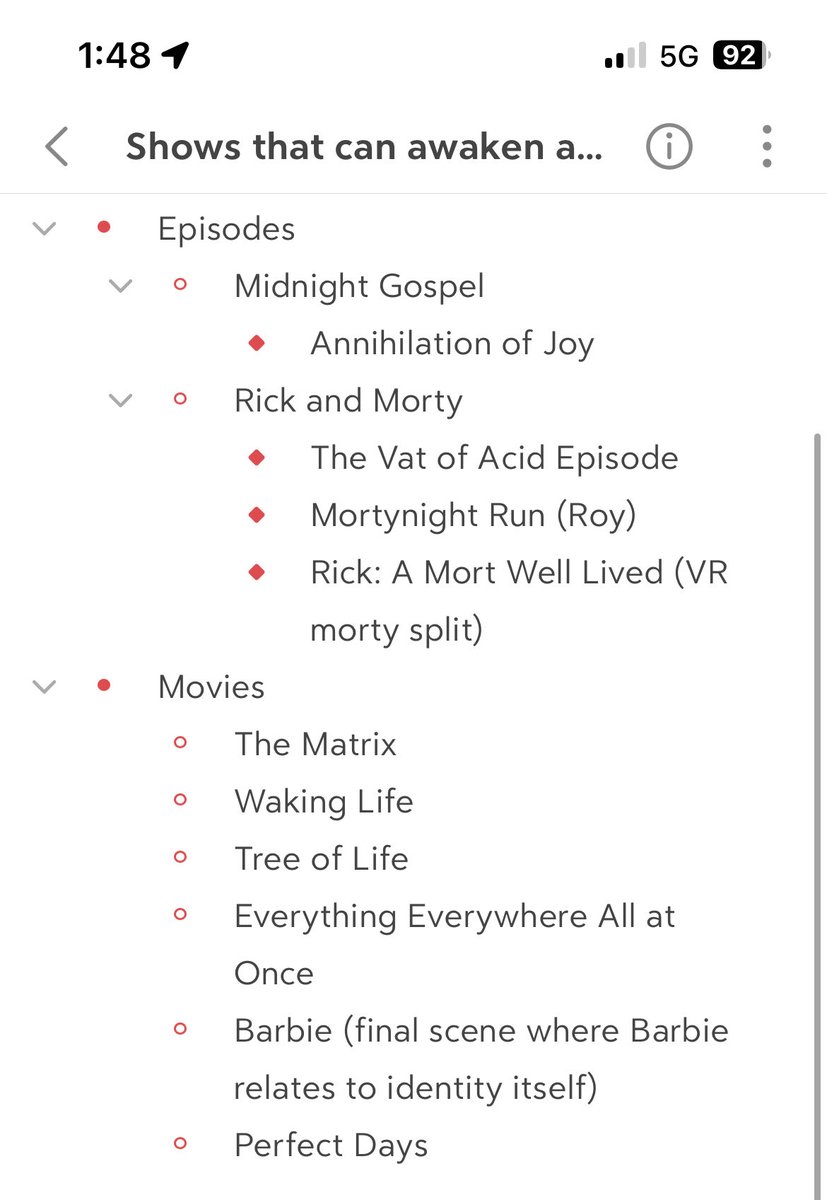
What are some episodes & movies that potentially have the power to induce awakening?
Here’s my little list:
English
@metabolicwave I tried this for a few months.
I got fat.
Maybe will try again.
English


@DrJackKruse Sun your mushrooms for some extra vit D in the winter!
x.com/simplyr00ted/s…
Simply Rooted@simplyr00ted
Vitamin D deficiency is an ignored epidemic, affecting more than 42% of the adult population in the United States. Tanning is one of the best ways to get vitamin D, but another great source is mushrooms. Here are the best ways to maximize vitamin D from fantastic fungi: 🧵 1/9
English
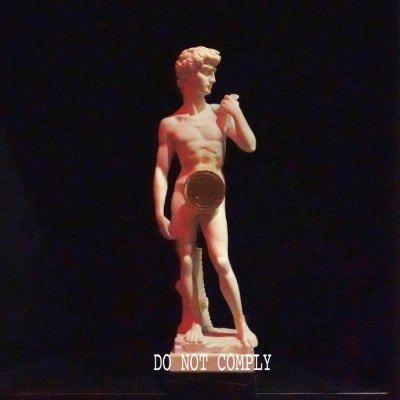
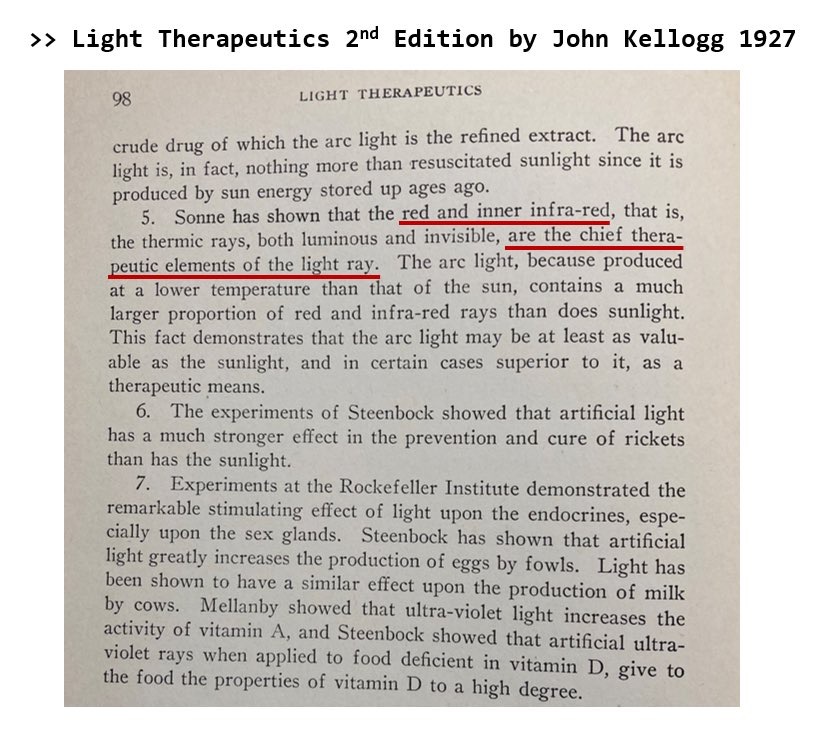
My tribe will be told something different. Learn how to properly irradiate your food to increase its Vitamin D levels when the sun leaves you. See the last two lines below from 1927. Be careful who packs your parachute folks
Paul Saladino, MD@paulsaladinomd
If you live in the Northern Hemisphere NOW is the time to soak up the last days of sunlight full of valuable ultraviolet and infrared light. Winter is coming. In the next 2-3 weeks spend as much time outside in the sun as you possibly can. You’ll thank me in December.
English
I’m 2 for 2 with babies that I got to sleep through the night by 2 months old. I’ll write a longer post on this but here’s my secret:
Light environment: as simple as a Himalayan salt lamp or red light. No bright lights after 8pm or during night feedings. Morning feeding happens by the window or outside for natural sunlight.
Always do a heavy night feeding at 10pm (as much as they’ll eat)
As their nightly sleep windows increase, rub a little mg chloride spray (I make my own) on the bottom of their feet before they go down for the night. I did this at about the 6 week mark.
Swaddle + sound machine
Blackout curtains in the room are essential.
English

You really want to solve fertility via encouraging families to have more than 1 or 2 kids again, solve infant sleeping.
Solve this and you win the century

Ryan Moulton@moultano
Figure this out and you solve fertility.
English
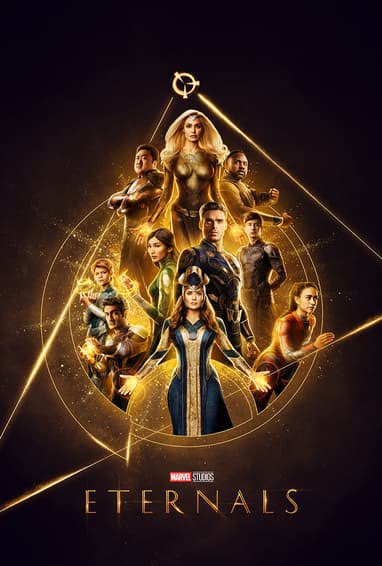
The era of blue light futurism is over. The era of golden light futurism has begun


English
Simply Rooted retweetledi

Red light (sunshine, campfire) penetrates skin, but most artificial lighting (LED, CF) doesn’t. So for 99.99% of human history our organs were bathed in light, but now unless we make a special effort most of our cells sit in darkness
A really simple hack here is to switch (back) to incandescent lightbulbs. Incandescent bulbs basically work by getting a metal filament really hot then letting it radiate; some of what gets released is visible but most is invisible red light. Which is a big part of what we’re missing
Most artificial lighting also has high-frequency flicker (some of the ‘power savings’ of LED come from rapidly switching the light on & off) which seems to increase stress whether we notice it or not; incandescent avoids this too
Something I still need to remind myself of is that windows block UV (& often infrared), and UV is also important for e.g. circadian cues & vitamin D production. So the light environment of sitting on a shaded porch is actually much different than sitting next to a window, even if it feels similar
Fwiw & as far as I can tell, the peaters seem correct about how reducing PUFA makes one less prone to sunburn. I used to get pretty bad sunburns; now (after switching to coconut oil & counting PUFA) I don’t. Benefits here probably start after a few months
Anyway, I think the broad story here is that we think of food as the primary source of energy for the body (& by the numbers it is), but light, heat, & motion are also viable pathways for getting energy into cells, and energy packaged in these forms is extremely efficient for doing certain cellular tasks compared to using calories+nutrients. In particular I think light/heat/motion are very high leverage for reducing vascular microspasms, and that microspasms are a much larger part of our daily hedonic/cognitive challenges than we realize

Abud Bakri MD@AbudBakri
Just like you can too little or too much of certain macros (carbs, protein, fats), you can get too little or too much of certain wavelengths of light (visible, infrared, UV) - Infrared is like protein, most don’t get enough - Visible (blue) is like carbs, most get too much and the low quality - UV is like fats, often demonized, but it is the wrong fat in the wrong context that is bad, just like UV Not perfect metaphor but you get the point
English
@DrNadolsky Your medical license could be revoked for such nonsense in this administration Sir
English

Changing Coke from high fructose corn syrup to cane sugar is just like rearranging the chairs on the titanic.
Good work y’all 😂😂😂
English
Ray Peat continues to work his magic from beyond the grave. MOMGA! Make Our Mitochondria Great Again!


English
How I create circadian friendly aesthetics in my home:
Huge windows and ample light (sun rooms)
Antique furniture made from all natural materials
Grouping air filtering plants in clusters
Tasteful antiques and historic tomes scattered throughout the house

English
@Jessica__Jay @pbprot Yes their wedding invitation said:
Hear ye! Hear ye!
In a most joyous union of pen and parchment, Jonathan Scriptwright and Angela DeScribbler have pledged their quills to one another in matrimony.
English

@simplyr00ted @pbprot This sounds like a story people would tell when sir names were still largely based around profession lol
English

When I was hanging out with my comedy friends in college, who were and still are all really funny, it was sometimes not even fun because every conversation was some kind of extended bit
English