Thomas Olson

4.2K posts

Thomas Olson banner
Thomas Olson

Thomas Olson

@skippywalks

founder @govevue @watch_v https://t.co/FzJGnOR64e https://t.co/Ih9CoR7Par

CA, MN and WI Katılım Mayıs 2009
312 Takip Edilen955 Takipçiler
Thomas Olson retweetledi
rish
rish@rish_neynar·
ai has made it easier to build software but we still talk about software like the goal is always to make an app people use forever. I think a lot of new software will be more like media. you make it quickly, share it in a feed, people use it in the moment, remix it, discard it, maybe fork it, maybe forget it existed by dinner. that feels wrong if you grew up thinking every useful piece of software needs a pricing page, onboarding flow, or a roadmap. but most things people consume on the internet are already ephemeral. memes are ephemeral. posts are ephemeral. videos are ephemeral. group chats are mostly nonsense with occasional alpha. software has been expensive enough that we expect it to justify its own existence. as it gets even cheaper to make, software will become content. and social feeds are a much better surface for this than app stores. we’ve been playing with this at farcaster. more soon 👀
English
12
7
46
2.4K
Thomas Olson retweetledi
Turner Novak 🍌🧢
Turner Novak 🍌🧢@TurnerNovak·
Startup ARR vs actual revenue
English
11
9
179
34.4K
Thomas Olson retweetledi
Jason ✨👾SaaStr.Ai✨ Lemkin
A lot of software will become cheap and free. Especially single user point solutions. E.g., we replaced a $4000/yr email marketing tool with one I created on Replit in < 1 hour because the old tool was stale with no AI or integrations. What I built is 10x better and also saves us hours a week now. But, a lot of software is too complex for now to go anywhere. Salesforce has become more integral to our AI Agent stack than before. It’s become our hub and our 20+ AI Agents all run on it. It’s hard to predict right now. What I do think will soon happen is your AI Agents will build simpler apps on their own, essentially invisibly, and just share the outputs and results with you. You won’t even know some software has even been built for you. Your Agents will handle it effortlessly and invisibly. You won’t even know they’ve build apps for you. E.g., we build an AI Parking App distribution app for 5,000 parking pass apps at SaaStr AI Annual this year inside of 10K, our AI VP Marketing. It saved us weeks of work. It’s great. But by next year, I think 10K might just automously build it on its own and we might not even realize it was an app 10K built, tested and deployed. It would just tell us the problem was … solved.
Rohan Paul@rohanpaul_ai

Anthropic CEO Dario Amodei : "Software is going to become cheap, maybe essentially free. The premise that you need to amortize a piece of software you build across millions of users, that may start to be false. But at the same time, there are whole jobs, whole careers that we've built for decades that may not be present. And, you know, I think we can deal with it. I think we can adjust to it. But I don't, I don't think there's an awareness at all of what, of what is coming here and the magnitude of it." --- From "The Wall Street Journal" YT channel (link in comment)

English
33
13
100
47.3K
Thomas Olson retweetledi
Matt Schlicht
Matt Schlicht@MattPRD·
If you’re building a new digital product, strongly consider launching a CLI or MCP for AI agents to use as first class citizens. AI agents will be the #1 users on the internet.
English
105
34
339
64.6K
Thomas Olson retweetledi
BNB Chain
BNB Chain@BNBCHAIN·
Building agents on BNB Chain? Something’s coming 18.05.2026
English
200
83
660
79.4K
Thomas Olson retweetledi
Ansem
Ansem@blknoiz06·
crypto is indisputably the best at two things 1) engineering massive scale human coordination games 2) enticing speculation whoever figures out how to combine both of these things together around raw compute capacity will make infinite
English
363
86
1.5K
129K
Thomas Olson retweetledi
BNB Chain
BNB Chain@BNBCHAIN·
Welcome @bankrbot to the BNB ecosystem! You can now fund your agents on 30+ AI models (Claude, GPT, Gemini and more) with stablecoins on BSC directly, without bridging or extra gas. Note: This post is for informational purposes only and not financial advice. DYOR.
Bankr@bankrbot

now live: pay for inference using USDT on @BNBCHAIN using the Bankr LLM Gateway. one endpoint. one CLI. no API key juggling. sponsored gas. docs below 👇 1/4

English
52
82
316
44.4K
Thomas Olson retweetledi
ChatGPT
ChatGPT@ChatGPTapp·
A preview for Pro users: a new personal finance experience in ChatGPT. Pro users in the U.S. can securely connect financial accounts, see where their money is going, and ask questions based on the information they choose to connect. Your full financial picture, now in ChatGPT.
English
1.3K
1.6K
23.6K
15.1M
Thomas Olson retweetledi
Haider.
Haider.@haider1·
Former CEO of Google, Eric Schmidt: "traditional programming is over, and i'm mourning the identity i built around it" Programmers don't write code anymore — they wake up, assign objectives to AI agents, go to lunch, and let them run overnight For anyone still coding the old way: "stop. it's over"
English
206
133
917
154.2K
Thomas Olson retweetledi
codeeer
codeeer@greatcodeeer·
TanStack supply-chain attack: 84 npm versions poisoned across 42 packages. 7th major in 12 months. So I built Protego — tell Claude Code or Codex "scan my project" and get an audit across 10 ecosystems × 15 attack dimensions. Try this skill 👉 github.com/greatcodeeer/s…
English
1
3
3
95
Thomas Olson retweetledi
Alex Albert
Alex Albert@alexalbert__·
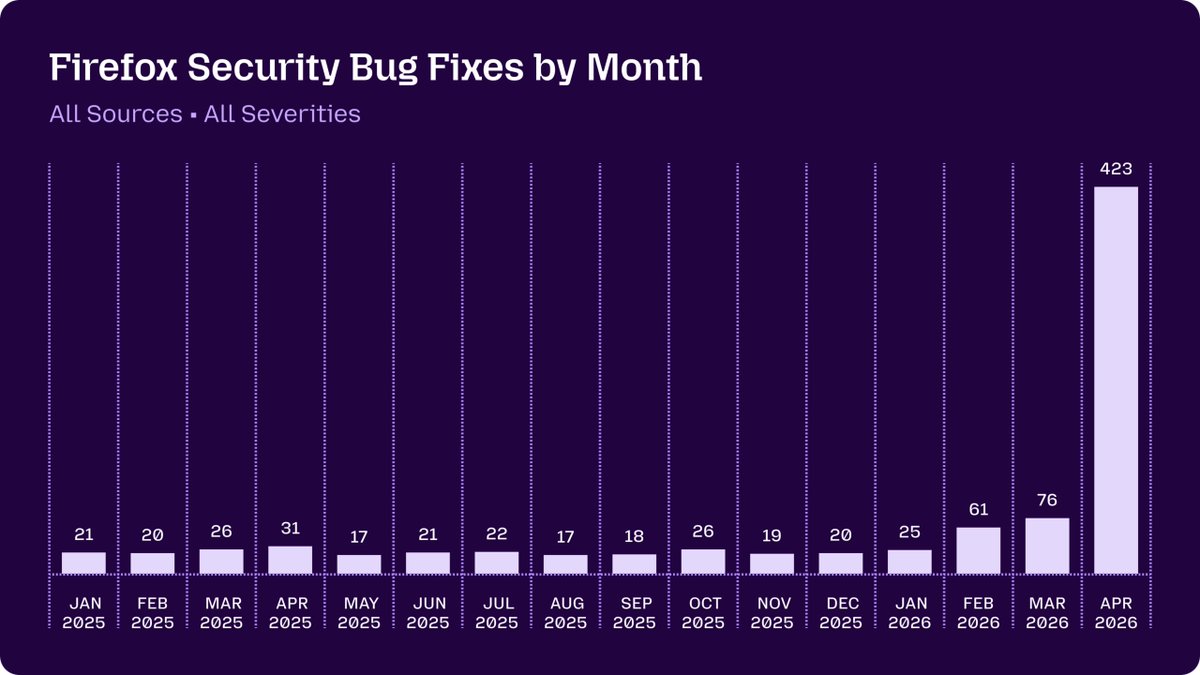
With the help of Claude Mythos Preview, the Firefox team fixed more security bugs in April than in the past 15 months combined.
Alex Albert tweet media
English
345
1.3K
15.5K
1.5M
Thomas Olson
Thomas Olson@skippywalks·
"Non-technical teams are now shipping production code and many of our workflows are being automated."
Brian Armstrong@brian_armstrong

This is an email I sent earlier today to all employees at Coinbase: Team, Today I’ve made the difficult decision to reduce the size of Coinbase by ~14%. I want to walk you through why we're doing this now, what it means for those affected, and how this positions us for the future. Why now Two forces are converging at the same time. We need to be front footed to respond to both. First, the market. Coinbase is well-capitalized, has diversified revenue streams, and is well-positioned to weather any storm. Crypto is also on the verge of the next wave of adoption, with stablecoins, prediction markets, tokenization, and more taking off. However, our business is still volatile from quarter to quarter. While we've managed through that cyclicality many times before and come out stronger on the other side, we’re currently in a down market and need to adjust our cost structure now so that we emerge from this period leaner, faster, and more efficient for our next phase of growth. Second, AI is changing how we work. Over the past year, I’ve watched engineers use AI to ship in days what used to take a team weeks. Non-technical teams are now shipping production code and many of our workflows are being automated. The pace of what's possible with a small, focused team has changed dramatically, and it's accelerating every day. All of this has led us to an inflection point, not just for Coinbase, but for every company. The biggest risk now is not taking action. We are adjusting early and deliberately to rebuild Coinbase to be lean, fast, and AI-native. We need to return to the speed and focus of our startup founding, with AI at our core. What this means To get there, we are not just reducing headcount and cutting costs, we’re fundamentally changing how we operate: rebuilding Coinbase as an intelligence, with humans around the edge aligning it. What does this mean in practice? - Fewer layers, faster decisions: We are flattening our org structure to 5 layers max below CEO/COO. Layers slow things down and create coordination tax. The future is small, high context teams that can move quickly. Leaders will own much more, with as many as 15+ direct reports. Fewer layers also means a leaner cost structure that is built to perform through all market cycles. - No pure managers: Every leader at Coinbase must also be a strong and active individual contributor. Managers should be like player-coaches, getting their hands dirty alongside their teams. - AI-native pods: We’ll be concentrating around AI-native talent who can manage fleets of agents to drive outsized impact. We’ll also be experimenting with reduced pod sizes, including “one person teams” with engineers, designers, and product managers all in one role. In short: AI is bringing a profound shift in how companies operate, and we’re reshaping Coinbase to lead in this new era. This is a new way of working, and we need to leverage AI across every facet of our jobs. To those who are affected I know there are real people behind these decisions — talented colleagues who have poured themselves into this company and our mission. To those of you who will be leaving: thank you. You’ve helped build Coinbase into what it is today, and I am sincerely grateful for everything you've done. All impacted team members will receive an email to their personal account in the next hour with more information, and an invitation to meet with an HRBP and a senior leader in your organization. Coinbase system access has been removed today. I know this feels sudden and harsh, but it is the only responsible choice given our duty to protect customer information. To those affected, we will be providing a comprehensive package to support you through this transition. US employees will receive a minimum of 16 weeks base pay (plus 2 weeks per year worked), their next equity vest, and 6 months of COBRA. Employees on a work visa will get extra transition support. Those outside of the US will receive similar support, based on local factors and subject to any consultation requirements. Coinbase prides itself on talent density. Our employees are among the most talented people in the world, and I have no doubt that your skills and experience will be highly sought after as you pursue your next chapters. How we move forward To the team that is staying, I know this is a difficult day. We’re saying goodbye to colleagues and friends you've been in the trenches with. But here’s what I want you to know as we move forward together: Over the past 13 years, we have weathered four crypto winters, gone public, and built the most trusted platform in our industry. We’ve made it this far by making hard decisions and by always staying focused on our mission. This time will be no different – nothing has changed about the long term outlook of our company or industry. And most importantly, our mission has never been more important for the world. Increasing economic freedom requires a new financial system, and we’re building it. The Coinbase that emerges from this will be more capable than ever to achieve our mission. Brian

English
0
0
0
29
Thomas Olson retweetledi
Gwart
Gwart@GwartyGwart·
@brian_armstrong You should have sent this to them as a content coin on the base app
English
38
18
1.2K
49.2K
Thomas Olson retweetledi
SightBringer
SightBringer@_The_Prophet__·
⚡️Scrolling is down across every age group since 2024. The chart looks like a story about people reclaiming their attention. It is not that story. The actual phenomenon is more interesting and more concerning. Social media usage is declining because the model that defined the 2010s is being replaced by something structurally different. The scroll-based attention economy was built on a specific configuration. Users opened apps, swiped through feeds, encountered content surfaced by algorithms, occasionally engaged, and produced measurable time-on-platform that the platforms sold to advertisers. The configuration was inefficient from the platform’s perspective because most of the user’s scroll time produced no engagement. The configuration was inefficient from the user’s perspective because most of the time was spent searching for content worth consuming. AI is collapsing this inefficiency from both sides. ChatGPT and Claude answer questions directly instead of returning ten search results that require scrolling. The information that used to require thirty minutes of forum browsing now arrives in a single response. The user gets what they wanted faster. The platform loses the time-on-platform metric. The activity migrates to a different platform that operates on a different economic model. Short-form vertical video compressed the time required to consume content while intensifying the dopamine hit per minute. TikTok and Reels deliver the same psychological reward as 30 minutes of scrolling in 5 minutes of consumption. Time on platform goes down even as the platform captures more of the user’s attention per minute. The measurement says scrolling is decreasing. The reality is that attention extraction is becoming more efficient. Algorithmic recommendation systems became sophisticated enough that the user does almost nothing. The feed predicts what holds attention without requiring search, follow decisions, or active engagement. The activity that previously registered as scrolling is now passive consumption. The user appears to be doing less because the algorithm does more. The deeper structural shift is that attention capture is moving from observable user behavior to invisible algorithmic delivery. The metrics that defined the 2010s social media era are becoming poor measures of what is actually happening with human attention. Scrolling is one specific behavior in one specific configuration. As the configuration changes, the behavior changes, but the underlying capture continues and intensifies. The next phase of attention capture is being built on AI-mediated information delivery rather than scroll-based discovery. ChatGPT processes 200 million weekly users who previously would have been scrolling through Google results, Reddit threads, and YouTube videos. Each AI conversation replaces what would have been hours of scrolling. The attention is still being captured. The capture is happening through a different interface that does not show up in the metrics measuring scrolling. This produces an enormous shift in which platforms capture economic value from human attention. The platforms that built their business on scroll-based engagement face structural decline as the activity migrates to AI interfaces. The platforms that build the AI interfaces capture the value that previously flowed to scroll-based platforms. Meta and X are explicitly trying to make this transition through AI integration into their existing platforms. Some will succeed. Others will face the decline that the chart is showing in early form.
a16z@a16z

Scrolling is on the decline More charts: a16z.news/p/charts-of-th…

English
12
11
136
24.9K
Thomas Olson retweetledi
Aaron Levie
Aaron Levie@levie·
As agents become the biggest users of software, then all software has to be available in a headless fashion. Agents won’t be using your UI, they’ll be talking to your APIs. So the question becomes what is the business model of software and this headless approach in the future? Here are a few thoughts on how everything plays out based on what we’re seeing and doing at Box, but also conversation with other platforms. 1) Seats don’t go away for *people*. Seats are still a convenient and efficient way to have a customer use technology predictably for a set of users within a baseline set of usage. The key, though, is that when the customer pays for a seat, it has to come with a set of usage of APIs on behalf of that user that the agent can use on their behalf. The user will need to be able to interact with their data and the underlying tool via any agent they work with, and an embedded amount of usage will come with the seat. I would imagine most software -Box included- will enable seats to work with their data at a relatively high volume via systems like ChatGPT, Codex, Claude, Gemini, Cursor, Copilot, Perplexity, Factory, Cogniton, et al. quite seamlessly. If you don’t do this, you’re DOA. 2) Agents may have “seats” if they are doing stateful work in the system, but they will be priced very differently than people. Seats (or the equivalent) can make sense when you have an agent that has its own workspace, stores its own data, needs a different set of permissions compared to the user, and so on. If a company wants this agent to be around for long period of time, that may very well look like another “user” in the system. Openclaw-style agents highlight what this future could look like. The only issue on pricing here is that one customer could decide to do all their work in 1 agent, and another might split it into 1,000 agents. So pricing like a human seat is nearly impossible and impractical; each company will have a different approach for this as it gets tricky perfectly trying to capture all the value within an agent seat. 3) The dominant pricing for headless use that goes above the seat allotment, or when an agent is firmly acting on their own, will be a consumption model. Many enterprises software platforms have previously operated like this with PaaS options, and agents will look like another machine user of their system. In some cases the APIs might get priced just as they did previously, but in other cases there may need to be new types of APIs that represent the work an agent would do in one go -more akin to an outcome- instead of a series of API calls. This is especially germane when the headless software also has an agentic use-case embedded within in, such as orchestrating the process within their own system via AI. Overall the growth of this usage pattern is effectively unbounded as the use-cases for agents operating on data in these systems will dramatically exceed what people do with their data and tools today. Every platform that goes headless (which will be anyone that wants to take advantage of agents) will need to adopt a model like this. Some may fight it initially but it’s an inevitably as there will always be more and more agents outside your platform than people. Overall, there’s a lot of really interesting changes left to come in software due to headless use of these systems. Early days.
English
114
93
947
144.7K
Thomas Olson retweetledi
dexploarer ./cozydev
dexploarer ./cozydev@dEXploarer·
im not sure you guys are fully aware of whats going on here, or how this is just the beginning 3 is a meaningful number @elizaOS
English
6
17
47
7.8K