

sparkc 🪆
1.1K posts


@goodalexander that's why they all acknowledged the existential risk over a decade go?
English




@TMTLongShort Do you follow anyone else that is writing from this perspective? It's surprisingly hard to find people looking at this through a decoupling lens. Everyone is focused on headlines and the most obvious outcomes.
English

Once you see decoupling you can’t unsee it.
But it’s such a wild concept that if you haven’t seen it yet you can have an incredibly high IQ and still not appreciate what is being attempted.
It’s just the geopol equivalent of defaulting to linear thinking in a world that suddenly shifted towards exponentials and game theory.
Just Another Pod Guy@TMTLongShort
I think the world of Balaji intellectually and if you were to ask me which four humans do i look up to aspirationally from an intellect standpoint it would be Balaji, Thiel, Andreessen and Ilya. That said I completely disagree with Balaji here because while he (as usual) comes armed with lots of relevant datapoints he is missing the forest from the trees. If you start with the premise that the ask from Canada is to lock out China then you’ll see why the current adversarial approach was the only viable approach. And when you see what the admin is trying to accomplish vs China you can understand why the death of the dollar is far from certain and entirely contingent on how successful the admin is at securing hegemony at the end of all this. (Medium to long term obviously, re the dollar, before @SantiagoAuFund comes for my scalp)
English

A long post from Kyle but well worth the read. Excellent analysis & retort to Kollmann of the #Ravens roster management from a non fan btw (Chargers).
He talks about how EDC approaches comp picks. He calls them dividends. Perfect analogy.
I basically said the same. (1/2)
Kyle De@TheKyleDe
@BrettKollmann does fantastic work - one of the best NFL content producers out here. I'm not a Ravens fan, but the argument he makes on their roster building doesn't hold up. Brett's thesis: Baltimore prioritizes comp picks over retention. "Draft players, develop them, let them walk and get paid elsewhere, and then you get comp picks back and then ideally a more manageable cap situation." That isn't true. The Ravens don't value comp picks over retention. They value spending resources on retention over chasing free agents, and they avoid backfilling their roster with Compensatory Free Agents that would cancel out potential comp picks. They've created a flow of compensatory picks because they regularly draft well enough that they can't afford to retain ALL of their homegrown talent - so they let teams pick up players they've decided not to build around, and receive small dividend returns that they use to build out depth and reserve pieces on their roster. Let's start with retention. Baltimore ranked #1 in the NFL in homegrown talent rate in the 2025 Hard Rock Bet study at 77% - 20 points above the league average of 57%. Over The Cap had them at nearly 80% in 2021 when the league average was 58.4%, and 4th in 2023 when they were at 71.7%. This is not a team that lets its players walk. It's one of the most homegrown rosters in football. Brett suggests 2023 was the year Baltimore bucked their usual trends by prioritizing retention and getting aggressive. Baltimore extended three players that offseason: Roquan Smith, Broderick Washington, and Michael Pierce. Smith was a trade-test-and-sign - they spent a 2nd and a 5th to upgrade their LB room for half a season and take him on a test drive before committing to a $100M extension. Washington and Pierce were modest depth deals at $5.25M and $3.75M APY. Their biggest free agent signing was Odell Beckham Jr., and he was cut by the Dolphins so he didn't cancel a comp pick. They also let Oliver and Powers walk that offseason to add to the departure side of the cancellation chart. That was actually one of their lighter offseasons over the past five years, not an aggressive outlier. They were more aggressive with extensions in 2020, 2021, and 2024. And they just came off one of the most retention-heavy offseasons in recent memory - 2025, when they extended Hamilton, Stanley, Travis Jones, Bateman, Henry, and Andrews. Six extensions to foundational players in one offseason. That's not a team that values comp picks over retention. Now the EDGE position. Brett's absolutely correct that Baltimore has chosen to let EDGEs walk in free agency. That's real. Young EDGEs who hit the market are among the most likely players to generate 3rd-round comp picks for their former team. He's right to notice the pattern. But here's the missing context: if the Ravens weren't spending their cash and cap - if they were pocketing the savings like a small-market baseball team - this would be the strongest argument for Brett's case. They aren't. Baltimore ranks 19th in total cash spending over the last 10 years at $2.49B. And that ranking is almost meaningless, because the middle 20 teams (7th through 26th) are separated by just ~$26M per year. The average gap between adjacent teams in that range is $1.4M/yr. Kansas City, Miami, and Baltimore are within $4M of each other over the entire decade. Where the real separation exists is at the bottom - the Chargers, Steelers, and Rams, who are spending $130M-$275M less than the pack over 10 years (though the Chargers have picked it up lately!). Those are the franchises pocketing money. Baltimore isn't close to that group. This isn't a matter of the Ravens valuing comp picks over EDGEs. It's them viewing the cost-benefit of how they allocate resources across the whole roster - spending on Hamilton, Madubuike, Stanley, Henry, Andrews, Smith - and benefiting from prioritizing other position groups while collecting 3rd-round comp picks from EDGE departures. The comp picks aren't the strategy. They're the dividend.
English
@stoicsavage coordinate with based who is leading bearish rt procurement
English
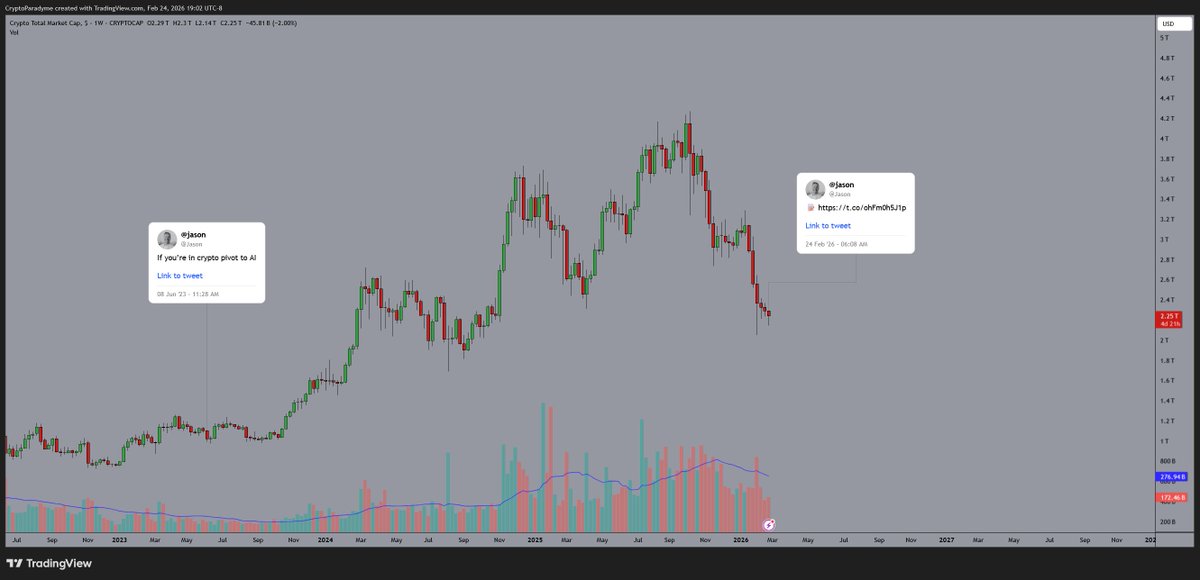
btw, how did this go for anyone that kept grinding crypto last summer?
darran@darran0x
Alt Season? Can one of our financial physicists explain how we pull this one off?
English
@matthew_sigel @drjasper_eth @mert Yes no chilling effects from these threats by the president at all
English

@drjasper_eth @mert Threats are threats. If there is an indictment, will evaluate that on its merits.
English
After what we learned about effective altruism last cycle, I'm pretty surprised to see all the crypto bros rushing to defend Anthropic.
English
@BowTiedLobster @lBattleRhino I understand the common understanding of helping traders succeed is not via spoon feeding them calls but at a certain point if someone spoon feeds enough correct calls...
I'll leave it here as i'm not looking to do tricks on it, will just say that the sample size is large
English

@sparkcalt @lBattleRhino There are a few people I know, for an absolute fact, that they are good traders, which takes a track record as there’s a lot of luck in this. It usually means their faces are known.
They NEVER say things like this. You can take that however you want.
English

@BowTiedLobster @lBattleRhino In rhino's case you don't need to try and decipher his ability to trade via heuristics, you can simply just look back over all the explicit calls he's made over the years
English
@lBattleRhino The market is always net 100% long. Phrases like this are a clever way not to put one’s own credibility on the line with a call, while encouraging one’s readers, who are almost all long only, to buy. I never see good traders say things like this.
English
@CryptoParadyme CT continually clowning Jason on the only thing he's been write about this decade
English



Right not market is pricing near zero margin expansion at Salesforce between 2026 and 2027. That means AI results in virtually zero efficiency gain (or headcount reduction) at a company that’s all hands on deck applying AI tools
So either 1) everyone will vibe code their own CRMs 2) Anthropic and OpenAI will outright start launching CRMs or 3) the market is smoking crack
I’m high confidence #1 is wrong - code maintainability drops a lot w huge code bases. That’s why you aren’t using vibe coded software every day right now
I used to think #2 and it was a great schizo meme - but it was more believable when AI coding wasn’t demonstrably extremely useful. And token usage seemed set to go off a cliff - necessitating a “big rug”.
But now I’m in camp 3. Anthropic isn’t incentivized to murder its largest enterprise customers. The flip side is that they keep doing Pr about how “non technical industries benefit a lot from Claude” - see their hackathon winners being doctors
More big picture - in October November we were in a very bad spot. Model upgrades seemed to be slowing at totally insane valuations. We are at insane valuations and we have an acceleration. Plus you’re going to have Elon on roadshow for spacex IPO pumping this stuff to Valhalla “robotic mars takeover with neuralink implants”
You don’t want to be a pessimist in this type of situation. And “software being cannibalized by research labs bc it’s all kind of a scam” is a pessimist trade
English