Timo Springer

1.9K posts

Timo Springer

Timo Springer

@springertimo

Amsterdam Katılım Eylül 2013
2.3K Takip Edilen425 Takipçiler
Ashvin Swaminathan
Ashvin Swaminathan@aaswaminathan01·
I.e., 1. presumably these problems were not cherry-picked prior to being run on Astra --- rather, Astra was turned like a ray gun on a large collection of open problems and happened to solve some of them. The inference cost for any particular solve might be low but that's not the right way to report cost (e.g., should mathematicians only be paid for the time spent on problems they DID solve?) 2. for each problem that was successfully solved, how do we know that Astra was run only once on them? what if only 1% of runs succeeded? Do failed runs cost the same as successful ones? 3. the reported $2000 in estimated API pricing depends on, well, the API being accurately priced, and we know that every AI lab is severely underpricing their models.
English
3
0
37
1.7K
Timo Springer
Timo Springer@springertimo·
@AndrewCurran_ yeah their actions backfired horribly with business here in europe at a time when trust in us tech was already pretty low
English
0
0
13
473
Andrew Curran
Andrew Curran@AndrewCurran_·
Secretary of State Marco Rubio has instructed diplomats to push back on the idea that the US holds a 'kill switch' over American AI models, and has also asked them to fight digital sovereignty initiatives. Quoting from the cable: 'Pausing narrow uses or requiring a 30-day testing window prior to the release of a highly potent new technology is not a 'Kill Switch.' There is no government 'magic button.' This narrative is exaggerated and doesn’t capture the nuances of U.S. technology policy.' The cable goes on to describe digital sovereignty as 'efforts to restrict American tech firms access to foreign markets, subject them to localization requirements, charge them network usage fees, or force them to follow local rules around issues such as content moderation.' And instructs American diplomats to advertise American AI products as the best tools available and to describe efforts to build rival AI systems from the ground up as a waste of time and resources.
Andrew Curran tweet media
English
51
49
539
105K
Gergely Orosz
Gergely Orosz@GergelyOrosz·
These Google Workspace ads (for paying customers!) are driving me crazy I don't know why I would need a "virtual receptionist", what "Voice Standard" is, who "my callers" are, and why I would need to "guide them automatically" Is Google Workspace losing its mind?
Gergely Orosz tweet media
English
41
10
675
67K
Timo Springer
Timo Springer@springertimo·
@deanwball Any reason why you did not take this into account with your second point? or maybe i’m misreading it.
English
1
0
6
2.4K
Dean W. Ball
Dean W. Ball@deanwball·
Some observations on Kimi: 1. It's a very good model! I don't think its performance can be explained away by distillation or anything like that. In agentic coding sessions, it seems pretty much on par with the best public models of Q1 2026. In my fairly limited use, it also seemed very token hungry. It's not obvious to me that this model is actually that cheap to run. 2. I am personally surprised the Chinese state continues to allow the open sourcing of models this good, given potential risks. To be clear, I *myself* might be fine with models presenting this level of marginal risk being open weight, but I am surprised that China is fine with it. I suspect the reason they are is 75% explained by strategic blindness/lack of AGI-pilledness (the CCP is very Yann Lecun-y in its views of AI). The other 25% or so is their lack of compute for customer inference (making China's open-weight strategy an unintended byproduct of US export controls) and the normal Chinese strategy of aggressive exports. For the companies, as opposed to the government, the decision to open source is partially ideological and partially because they are behind, and they know that very few people would pay for sub-frontier models from China. 3. Open-weight models are inherently decelerationist, and I'm continually surprised to see the so-called "accelerationists" so excited about open-weight models. I suspect the reason they are is that they know open-weight models are effectively ungovernable, and they simply like the overall cloak of ungovernability open-weight models create over the whole of AI. It's not a bad strategy; it reminds me of James Scott's recounting of the hill people in "the art of not being governed." Still, in the end, open-weight models deter further AI capex. 4. One probable outcome of an open-weight-model-dominant world is full AI communism, which is precisely what China proposes: rather than a market product, AI is a "public good" which will ultimately be provided by the state as a kind of "digital public infrastructure." This future strikes me as a dystopian hellscape, but I've never met an open-weight models advocate who doesn't ultimately concede this is where things end. You'd be surprised how many 'accelerationists' lobbied me, while I was in government, to support an eleven or twelve-figure federally funded data center so that startups could train models at a subsidy and then give them away for free. There was no other way for AI to progress, they said. Perhaps this is the logical end state of things. Nonetheless, I find myself surprised to see supposed accelerationists excited about such an outcome. I think many of them just don't know what they're doing. Many accelerationists do not view the creation and serving of frontier models as a legitimate business. 5. I would guess that the Trump Administration will at some point realize that their best strategy here would be to create large amounts of regulatory risk around the use of open-weight Chinese models. You don't need to "ban open source" (one of the dumber motifs of AI policy discussion). You just need to direct every agency to issue soft law that creates FUD. "A Federal Reserve Advisory Bulletin found that there may be backdoors in Chinese AI models." It needn't be that well justified. You just create enough regulatory risk that every regulated enterprise backs off. You probably don't want to create so much regulatory risk that you scare off the hyperscalers from serving Chinese models; this will just drive startups to sketchier providers. There's a happy middle ground here. I'd assume they will do some version of this. 6. It's probably true that open-weight models of this capability make the world a bit more dangerous, but not so much more that you'll really notice. At some point the models will be capable enough that you will notice. "A nonliving, invisible, dangerous, and infinitely self-replicating agent escaped from a Chinese lab," you say? Color me shocked.
English
2.1K
938
7.7K
11.2M
Timo Springer
Timo Springer@springertimo·
@ajambrosino much better, but i still dont get why this has to be one app, feels v weird to have a chatgpt/codex toggle - i want to use them both at the same time! why does this have to be one superapp?
English
0
0
0
117
Andrew Ambrosino
Andrew Ambrosino@ajambrosino·
Today we're making some updates to the ChatGPT desktop app. - previous chats and cloud projects are in the sidebar - chat mode is now lives alongside work mode, not just in quick chat - fixed a bunch of other things
Andrew Ambrosino tweet media
English
208
65
1.5K
171.8K
Timo Springer
Timo Springer@springertimo·
@mweinbach much better, but i still dont get why this has to be one app, feels v weird to have a chatgpt/codex toggle - i want to use them both at the same time! why does this have to be one superapp?
English
0
0
0
102
Timo Springer
Timo Springer@springertimo·
@tenobrus this is going to click a lot in europe; people/companies don't have much trust in US model access anymore
English
0
0
21
863
Tenobrus
Tenobrus@tenobrus·
it looks like this might be the answer to my question today. maybe this really is about "soft power", in the sense that china is seeing america positioning itself as the increasingly isolationist hegemon who's eager to deploy its advantage in ai at the expense of other nations, and views this as an opportunity to become a strong ally to... basically every other country at once. coming out with strong rhetoric denouncing american choices around keeping tight control of frontier ai, continuing to release open models and collaborate tightly with other countries, puts china into a globally cooperative position its really never been in before. it changes the dynamic from "multipolar where the US is one strong pole and china is a weaker one" to "multipolar where the US is one pole and everyone else is the other" it's unclear to me that this will in fact work, it's very unclear to me how this policy will land wrt the damage open models can do, and i still basically think this stops as soon as capabilities cross really serious thresholds, but it does seem coherent as a long term international diplomacy angle? i realize several people were trying to point basically this out to me earlier and it didn't quite click, thanks for trying anyway
Tenobrus tweet mediaTenobrus tweet media
Teortaxes▶️ (DeepSeek 推特🐋铁粉 2023 – ∞)@teortaxesTex

x.com/i/article/2077…

English
37
15
397
96.5K
Timo Springer
Timo Springer@springertimo·
@Dimillian Got it. Thx for the explanation. Going to give it a try later today.
English
1
0
1
448
Thomas Ricouard
Thomas Ricouard@Dimillian·
@springertimo Right, so of course because it’s your machine, it’ll do basically anything your computer can do. For example, our containers for Work are not macOS machines. So no iOS compilation. But it’ll be able to do a lot of stuff, and it’s just the start!
English
1
0
7
508
Thomas Ricouard
Thomas Ricouard@Dimillian·
Yeah, it's very good! I know we're Codex Remote pilled on my timeline, but ChatGPT Work is like Remote, but instead of working on your computer, it works on an on-demand, always available computer, even if your computer is offline. It has access to all your connectors, etc...
Victor E. Nunez@nunezvice

a lot of people haven’t realized how much more capable Chat has become in the last few days how much of Codex is now available directly inside @ChatGPTapp on mobile and the web. the Codex desktop app is great. I obviously live there. but now, inside ChatGPT, you can tap Work on mobile or the web to hand off a task that runs in the cloud, no computer needed. you can also tap Remote to pick up and continue work already running on your computer. start at your desk, keep things moving on your phone, or kick off something new wherever you are. agents shouldn’t care which screen you started from.

English
43
9
279
63.4K
Timo Springer
Timo Springer@springertimo·
@Dimillian My explanation might not be the best but when using codex locally it always seemed to be more powerful than e.g. things like Claude Cowork because it can install things, run all kinds of code/script, open the browser …
English
1
0
3
476
Marcos Hernanz
Marcos Hernanz@MarcosHernanz·
OpenAI can you make your models good at frontend and stop this pet bs?
Marcos Hernanz tweet media
English
24
0
113
9.1K
Tibo
Tibo@thsottiaux·
Hello beautiful people! We have reset usage limits across Codex and ChatGPT Work. And another one will come later in the day. Rejoice. Now that I have your attention, a quick update on ChatGPT Work, Codex and all the updates we shared yesterday. We’ve spent the last 24 hours reading feedback, looking at usage patterns, and talking with many of you. The short version is that there is a *lot* of excitement for GPT 5.6 Sol, ChatGPT Work on mobile & web, but also that we didn't get everything quite right. - We made it too easy to use the highest-compute settings without making the impact on usage limits sufficiently clear. - We reorganized the desktop app in one bold move, making familiar things like chats and projects harder to find. - Our launch framing was focused on ChatGPT Work and to some of our Codex fans it made it feel like Codex was going away over time. Absolutely not our intention, we love Codex and it is here to stay. - And we introduced regressions for some existing multi-agent workflows, alongside a collection of rough edges in plugins and other parts of the experience. We’re landing a first set of improvements today. We’re resetting usage twice so people can keep experimenting, changing defaults and the model picker so they don’t push people toward unnecessarily expensive settings, fixing several plugin submission issues, improving how we represent Codex in the product, and cleaning up some of the most immediate desktop problems. A larger set of improvements will land next week. We’re bringing chats and projects back into the sidebar in a more familiar and customizable way, making usage and reset timing much more visible, clarifying when to use ChatGPT Work and when to use Codex, and addressing the many other smaller pieces of great feedback we've had. The ambition behind this launch hasn’t changed. We think bringing ChatGPT and Codex together into a workspace where people and agents can collaborate is a very important step forward. But an ambitious direction doesn’t excuse avoidable confusion or regressions in the first version. Please keep the feedback coming. We’re moving quickly, and you should see the experience already get better with a few updates today; and substantially better again next week.
English
2K
821
13.9K
2.3M
Atty Eleti
Atty Eleti@athyuttamre·
In case you missed it: GPT-Live can also show you rich UI for sports, weather, maps, and much more! ⚽
English
10
5
121
4.8K
Timo Springer
Timo Springer@springertimo·
nah man then you end up with the exact same fucked up situation the claude desktop app was up until a week ago. chat, cowork, code toggle - it's a mess for the user to switch between these all the time when doing different things. i would rather have three different apps than 3 toggles but yeah prefered solution would just be one dynamic interface imo
English
0
0
1
98
Justin
Justin@JustinBleuel·
@l_mejiaC U probs right - do you see a future where this were all just a single pane of glass?
English
10
0
12
1.7K
Luis Mejia
Luis Mejia@l_mejiaC·
They need to add. Chat mode in ChatGPT. Not only work & codex
English
3
1
24
2.3K
Timo Springer
Timo Springer@springertimo·
@AndrewCurran_ how can they talk about the digital sovereignity trap a few days after they disabled fable access for every non-american?
English
0
0
13
219
Andrew Curran
Andrew Curran@AndrewCurran_·
I wrote about this in my article. Here, US Under Secretary of State for Economic Affairs Jacob Helberg warns Europe about falling into 'The Digital Sovereignty Trap'. I will quote: 'These days, few words flatter a government like “digital sovereignty.” It carries the music of independence, the dignity of self-rule, the promise that a nation holds its own destiny in its hands. So it is no surprise that the expression has been pressed into the service of a fashionable, fast-spreading policy debate. Many countries have looked to the United Nations to be the great evangelist of that idea. Through its Global Digital Compact and the funds and machinery that some are trying to assemble around it, the organization presses toward a world in which every country commands what the Secretary-General’s own reports call an “irreducible minimum” of artificial intelligence—its own computers, its own data, its own models, raised at home and owned at home. A secretariat-proposed multibillion-dollar fund would help pay for the building. And a growing number of governments, persuaded that independence requires duplication, are drafting national AI strategies to match—each resolved to rebuild, inside its own borders, a stack that already exists somewhere else. It is a seductive vision. It is also backward and counterproductive.' 'Now apply the heresy to nations. Picture the conference—there is always a conference—where forty governments rise in turn to pledge a sovereign cloud, a sovereign model, a national champion of their very own. They will applaud one another’s independence. Then they will go home and pour billions into companies built to do precisely what thirty-nine others are doing, in markets too small to sustain even one of them, chasing margins that thin asymptotically toward nothing the moment the next champion is announced. They will have achieved not so-called “digital sovereignty” but a kind of synchronized mediocrity—a planet of subscale clones, each heroically reconstructing last year’s breakthrough while the breakthrough itself moves on without them. While others rebuild the present, American firms will be inventing the future. They will not be defending yesterday’s platform; they will be shipping tomorrow’s—the products that do not yet exist, that no committee in Geneva has thought to subsidize, that will define the coming decade before the clones have finished cloning the last one. And because they will stand alone at the frontier, they will keep what the frontier pays: the fat margins, the soaring valuations, the commanding heights of the global economy. That is not an accident of American luck. It is the iron arithmetic of zero to one.'
Andrew Curran tweet media
Jacob Helberg@jacobhelberg

A nation is not digitally sovereign because it can reproduce yesterday’s breakthroughs—half the world can do that.   It is digitally sovereign because it can contribute to tomorrow’s. Call it innovation sovereignty: the power not to copy what exists, but to create what does not.   The autarkist measures his strength by how much he can wall off and rebuild.  The innovator measures his by how much he can invent that which no one else can.  One ends the decade with a museum.  The other ends it owning the future.

English
19
14
108
25.2K
Timo Springer
Timo Springer@springertimo·
@Dimillian Can’t click anything sadly. Pop-up comes back immediately. Probably have to wait until another app update or re-install the app.
English
1
0
0
109
Thomas Ricouard
Thomas Ricouard@Dimillian·
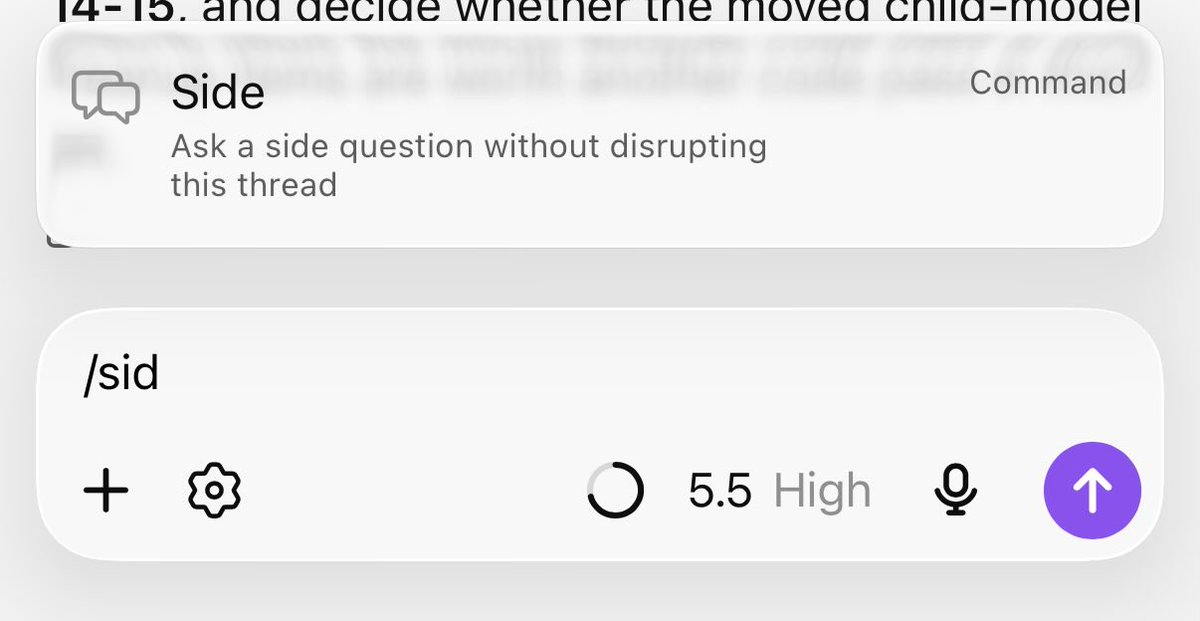
If you update to the latest ChatGPT iOS app version we have a few cool new things for Codex Mobile, including /side to ask some side questions in a temporary modal over the current context!
Thomas Ricouard tweet media
English
71
27
742
221.4K