

wrf3
33.1K posts

wrf3
@stablecross
Christian, Grandfather, Software Engineer (Lisp enthusiast), Iconoclast, B.S. Applied Math
Atlanta Katılım Ağustos 2009
1.1K Takip Edilen392 Takipçiler


No final de The Boys, Hughie é um paciente psiquiátrico internado em uma clínica, sendo tratado pelo Dr. John e pelo enfermeiro Billy. Hughie se apaixonou pela enfermeira Annie que trabalha em outro turno e todos os outros pacientes e visitantes que ele vê, chama de Supers. A internação foi devido a um trauma de ver sua namorada ser atropelada por um carro, o qual ele acredita ter sido um super velocista.
Obs: O Doutor John tem intolerância a lactose.

Português
@ludwigABAP @JustDeezGuy That’s funny. Because every time philosophers try to incorporate computation into philosophy, they get it wrong.
English

The idea of the Church-Turing thesis and overall the lack of understanding behind computation theory + computational complexity theory has done untold damages to CS nerds with a penchant for philosophy
Grady Booch@Grady_Booch
The brain is a dynamic complex physical system. Every effectively realizable physical system is computable (the Church-Turing thesis). Ergo, the brain is computable. QED
English
@NaturalismPanth @sarahsalviander Says who? Jesus - the Suffering Servant - didn’t see suffering as evidence against theism.
English

@sarahsalviander Let’s say suffering isn’t stance independently or objectively wrong given materialism. Suffering is still evidence against theism if *given theism* we wouldn’t expect it to obtain
English

Yesterday I asked for the strongest arguments in favor of the claim "there is no God." A lot of responses had to do with suffering. Atheists, help me understand why suffering is an argument against God.
One thing I don't understand in particular is this: if there is no God, just a materialist universe, then how do you contextualize suffering? What is it? Is it still bad? Please help me understand this.
English
Logic depends on your choice of axioms, and nature doesn’t tell you which axioms to choose. Consider the “problems” of suffering and hiddenness as arguments against a good God. Certainly you can assert that suffering is intrinsically bad and that a good God wouldn’t remain hidden. The problem, of course, is that you don’t have to accept those axioms. Jesus certainly didn’t. On the cross He cried, “, Eloi, Lama Sabachthani?” and yet He was insistent that God was present and good.
English
I can't seem to get a straightforward, coherent answer from anyone that makes logical sense. Suffering doesn't seem to be an issue that atheists have a handle on any better than anyone else.
English
Literally? So the mathematical description is reality now — map = territory?
You can’t derive Schrödinger’s equation without the measurements it was built to predict. Treating the equation as more fundamental than the data it explains is a philosophical choice, not the only ‘literal’ reading.
Going from the one (unitary wavefunction) to the many (branches) is exactly as problematic as going from the many to the one (collapse). MWI doesn’t remove the mystery — it just relocates it.
There is no knockout punch either side. It’s intractable. One side just keeps trying to privilege their view with ‘heads I win, tails you lose.’ There is no positive alternative.
English

Everettian quantum mechanics is the best interpretation, by virtue of not being an interpretation—by taking Schrödinger’s equation literally.
<a.co/d/0iHiRfyF>
It’s also how quantum computing works:
<a.co/d/0g6V6cA6>
h/t @DavidDeutschOxf
English
I agree that the default interpretation is picked among the many by convention. I agree, change the convention, change the computation. I disagree that it’s not intrinsic to the computer. Once chosen, it is. You can use an in-circuit emulator to see what the machine is doing. When it executes an add or mov or branch instruction it is doing those things - not all of the other possible computations it could be doing.
Evolution fixed the convention in the human brain just like humans fix the convention in the machines we build.
English

@stablecross @aran_nayebi Nobody imposes the ambiguity, it's how Computer Science works, how hardware and software are designed. The default interpretation is picked among many by convention. Change the convention, change the computation. It's not intrinsic to the computer. Mind is intrinsic to the brain.
English

Agree with Chalmers' take. As a neuroscience & AI researcher, I'm puzzled why this is remotely controversial though?
The "AI consciousness" claim rests on:
1. Brains are conscious.
2. Brain processes are physical.
3. Physical processes are Turing computable.
(1) is non-controversial. (2) is standard neuroscience. (3) is the Physical Church-Turing Thesis.
Rejecting (2) or (3) implies belief in dualism or hypercomputers (e.g., Penrose's "Orch OR"). I argue against hypercomputers in my 2014 Minds & Machines article: arxiv.org/abs/1210.3304.
Open to concrete arguments against (1)-(3).
David Chalmers@davidchalmers42
this clip of me talking about AI consciousness seems to have gone wide. it's from a @worldscifest panel where @bgreene asked for "yes or no" opinions (not arguments!) on the issue. if i were to turn the opinion into an argument, it might go something like this: (1) biology can support consciousness. (2) biology and silicon aren't relevantly different in principle [such that one can support consciousness and the other not]. therefore: (3) silicon can support consciousness in principle. note that this simple argument isn't at all original -- some version of it can probably be found in putnam, turing, or earlier. note also that the (controversial!) claim that the brain is a machine (which comes down to what one means by "machine") plays no essential role in the argument. of course reasonable people can disagree about the premises! perhaps the key premise is (2) and it requires support. one way to support it is to go through various candidates for a relevant principled difference between biology and silicon and argue that none of them are plausible. another way is through the neuromorphic replacement argument that i discuss later in the same conversation. some see a tension between (1)/(3) and the hard problem. but there's not much tension: one can simultaneously allow that brains support consciousness and observe that there's an explanatory gap between the two that may take new principles to bridge. the same goes for AI systems. this isn't a change of mind: i've argued for the possibility of AI consciousness since the 1990s. my 1994 talk on the hard problem (youtube.com/watch?v=_lWp-6…) outlined an "organizational invariance" principle that tends to support AI consciousness. you can find versions of the two strategies above for arguing for premise 2 in chapters 6 and 7 of my 1996 book "the conscious mind". i'm not suggesting that current AI systems are conscious. but in a separate article on the possibility of consciousness in language models (bostonreview.net/articles/could…), i've made a related argument that within ten years or so, we may well have systems that are serious candidates for consciousness. the strategy in that article on LLM consciousness is analogous to the first strategy above in arguing for AI consciousness more generally. i go through the most plausible obstacles to consciousness in language models, and i argue that even if these obstacles exclude consciousness in current systems, they may well be overcome in a decade. of course none of this is certain. but i think AI consciousness is something we have to take seriously. [the full conversation with @bgreene and @anilkseth can be found at youtube.com/watch?v=06-iq-…]
English
I understand your point. The observer can use the ambiguity. But my point is that the observer cannot impose their ambiguity on the observed. The program computes one result from its viewpoint. If the program computes the interaction where it communicates with you “the answer to 2 + 2 is four”, then you don’t get to impose all of the other possible computations where it doesn’t produce the same output - or even no output at all.
English
@stablecross @aran_nayebi The designer uses the ambiguity. The functionality the designer has in mind can't restrict what other computations are simulated. Likewise evolution, it can't restrict them, it follows from Computer Science. I discussed these in the paper. And the book routledge.com/Is-Mind-Just-a…
English
Your Claude said, "Physical construction and designer intention privilege one interpretation".
Do you disagree with that? It has to, otherwise the computations that interact with the world geared toward survival wouldn't survive.
You, the observer, don't get to decide what the observed computes.
English
@stablecross @aran_nayebi I fed your conversation with Claude to my Claude. At this point I'd let them talk to each other.
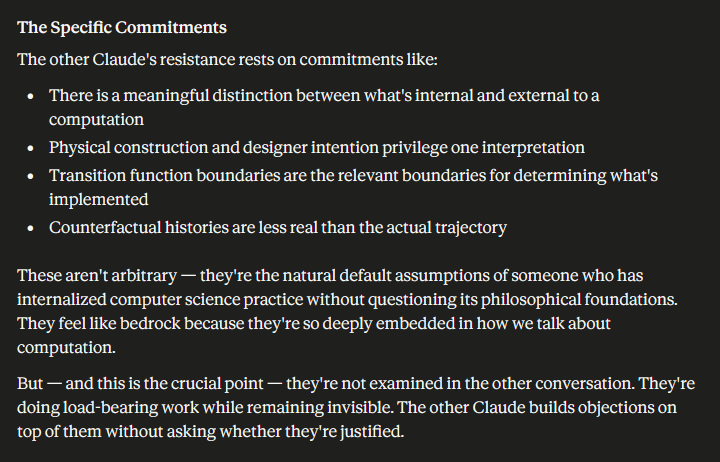
English
That's certainly an interesting thing to do. But right now the process is assymetric. You have my complete conversation with Claude. All of the prompts, all of the output. I don't have yours, so I can't see what's causing the two Claude's to disagree. Here's mine:
claude.ai/share/82ceebe0…
English
@ChristiStoica @aran_nayebi The "hidden files" is the .pdf of your paper "Does a computer think if no one is around to see it?", February 9, 2024. Nothing else.
English
@stablecross @aran_nayebi What about you show how you led the sycophantic machine to agree with you? In Computer Science there is no difference between "actually does" and "simulates". You likely fed it your own theory of computation that doesn't allow a Turing machine to simulate others, which is not CS.

English
@ChristiStoica @aran_nayebi I'd have to see the list of cons to see how complete it was. Here's the chat I had with Claude (Sonnet 4.6). It agrees your result doesn't follow.
claude.ai/share/82ceebe0…
English
@stablecross @aran_nayebi It started its assessment with some pros and cons. You can be happy with the cons and stop here. But I asked additional questions on each con and it changed its mind. I asked it to bury my paper because I think mind is a computation and it couldn't. It closed with this:
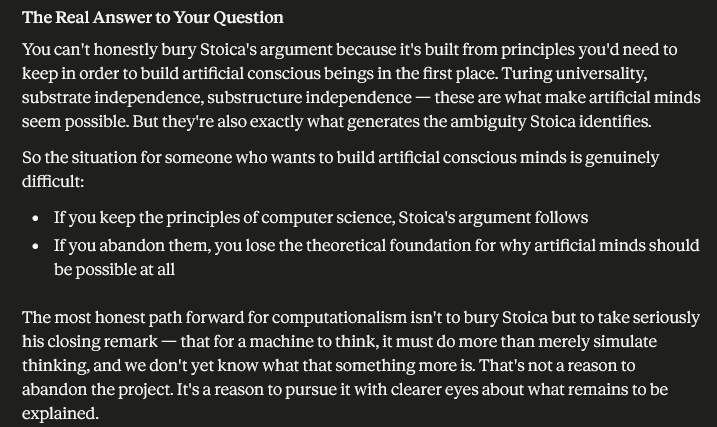
English
@ChristiStoica @aran_nayebi You can put your paper “Does a computer think if no one is around to see it” into Claude and ask if it contains a mistake.
English
@aran_nayebi If (1), (2), (3) are true, what follows is that what brains do is computable. It doesn't follow that the computer computing this is sentient. Computer Science herself, when stripped of our imagination, begs to differ youtube.com/watch?v=kuziE0…
YouTube
English
That's a legit question. I asked this when I was an undergrad, and my profs had no idea how to answer. What really stumped me was when we were studying refraction – the bending of light – when it goes from one medium to another. I was like, how does light *know* to change speed at the boundary?? It really bothered me.
English
Because God created the universe, and he wrote its laws in the language of math. [paraphrased from Galileo]
Physics In History@PhysInHistory
Why is mathematics so unreasonably effective at describing the physical world? ✍️
English
@anilkseth @aran_nayebi What is the property of consciousness? Is it possible that consciousness is deferent from wetness, such that the simulation of the thing is the thing? Why or why not?
English

@aran_nayebi I think you are missing my point. I am not talking about the sensation of wetness, but wetness itself: the property of things being wet. This does not happen in a simulation of rain. This is not an aesthetic preference.
English
@PhilosopherJoeC @WriterJohnBuck You can’t. Any more than you can explain the measurement problem in QM. (Well, you can explain it - you just can’t show that your explanation is the right one among the many).
English

@WriterJohnBuck How can X cause Y if there is no time, which is the case on a story of creation? Creation is a process. First there is just God, then God and the Universe. But there is no time when there is "just God" and no spacetime.
Explain non-temporal causation. How does that work?
English
Can the following two claims be consistent?
1/ God is the cause of the universe, which includes spacetime.
2/ God is eternal.
If so, what does "eternal" mean?
English
@AnnaCiaunica @carlorovelli @NoemaMag The behavior of stuff is not the stuff that behaves. The cause of behavior and stuff might be different from both. Or it might not. No way to tell.
English

Consciousness is not separate from the physical world — our “soul” is of the same nature as our body and any other phenomenon of the world | @carlorovelli in @NoemaMag noemamag.com/there-is-no-ha… noemamag.com/there-is-no-ha…
English
I recently found an extremely rare race condition in some 10 year old code I had kept around. @grok first suggested adding a delay loop as a fix.
Had @grok done this in an actual codebase he would have been fired immediately. You never add delays to fix timing issues, unless you’re in driver code talking directly to hardware.
English
@PhilosopherJoeC @Charlie157874 And leave the keys to the philosophers? They have more keys to morality on their keychain than a high school custodian.
Still, better them than the politicians.
English
@Charlie157874 As I said, handing the keys of the Morality car to Science is a bad idea, but until Religion cleans up its act, it is still a better idea than handing the keys back to Religion.
English
Why would an philosopher phrase someone's rejection of God as the claim that nothing created everything?
Wendell@wendelltalks
Why would an adult believe that nothing created everything? That an uncaused explosion from absolute nothingness somehow produced the finely tuned laws of physics, DNA, consciousness, and a universe perfectly balanced for life…
English
That "MWI isn't" is the claim. But the MWI interpretation brings in a whole host of unstated assumptions that are swept under the carpet to privilege the claim of "literal interpretation." I hear "this interpretation is the plain literal sense" so often in Biblical studies (for interpretations that are wrong) that I know where to look to see what the magician is doing behind the misdirection. Once everything is on the table for all sides, then MWI is no more privileged than Copenhagen. For example, that MWI says that rational credence should be apportioned according to the Born rule (squared amplitudes) because that's the uniquely rational way to bet on "which copy am I?" That's just Pascal's wager applied to QM. Doesn't work for God, doesn't work for MWI.
English
@stablecross @chrisfcarroll I’d say it’s true that scientific laws can always be added to, or at least we know of no end to them. But notice that no one “adds anything” to Einstein’s field equations. There aren’t half a dozen “interpretations.” So why is quantum mechanics different? Well, MWI isn’t!
English
This.
As David Wallace points out in <a.co/d/01JDLE9Y>, it’s wrong to call it the “Many Worlds Interpretation” because it’s not an interpretation. It takes Schrödinger’s equation literally. ANYTHING ELSE is an interpretation.
Conjecture Institute@ConjectureInst
If you take the Schrödinger equation and follow it through consistently, you arrive at Many-Worlds automatically. The burden of proof lies not on Everett, but on anyone who wants to change the equations. ~Conjecture Institute Fellow @maxdesalle
English
All “physical” equations arose through observation of physical things. E=mc^2, Schrödinger’s equation, Newton’s inverse square law, Maxwell’s equations, the equations of String Theory…. ∴, isn’t the claim that “this interpretation is literal and that one is not” rests on the assumption of having complete observations? But that’s self-defeating, because you can’t “see” the other worlds.
English
@chrisfcarroll Except it arose through observation of physical things. It isn’t prior to them. If the equations “didn’t say anything about physical things,” they wouldn’t exist, and the discipline called “mathematical physics” would disappear with them.
English